

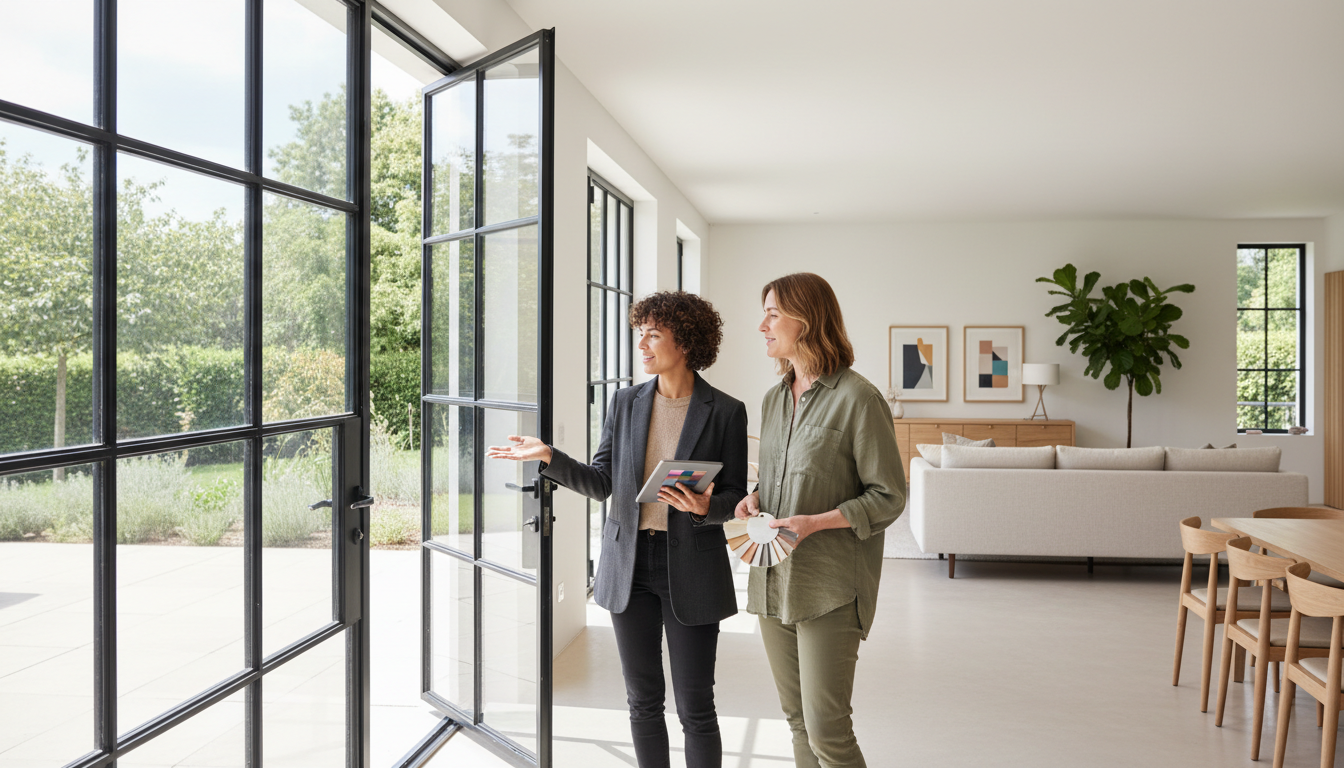
Metal-framed French doors are perfect for modern interiors. Light fixtures add shape and significance to spatial architecture. These windows are an excellent choice for open-plan designs because they feature thin aluminium or steel frames, large areas of glazing, and fine finishes.
The modern appeal of metal French doors
Metal-framed French doors do the job of French doors, but with a modern twist. It has a certain subtlety. The slender sightlines and crisp lines act as an excellent foil for pared-back palettes, minimal styling, and carefully curated decor.
The use of metal French doors addresses the desire for interiors that feel both open and intentional, giving rooms definition while preserving light and long views. In contemporary homes, these doors act almost like interior windows, extending natural light, emphasizing vertical proportions, and creating a sense of architectural rhythm from one space to the next.
Strength features shape a refined mood.
Metal frames bring structural integrity without visual heaviness. Their inherent strength allows for narrow profiles and large glass panels, creating a strong architectural outline that still feels airy and calm.
Well-designed steel or aluminum frames:
- Provide rigidity that resists warping and sagging over time, even in high-traffic zones
- Maintain tight, consistent sightlines that help the entire room feel more ordered and intentional
Dark, inky finishes, typically matte black or a deep bronze, add depth without overwhelming. The weight of these doors complements the mass at the room’s perimeter. As a result, any softer textiles, timber flooring, or stone surfaces take centre stage without visual pollution from the doors themselves.
Design elements for precise visual flow
It can benefit from clean circulation paths, unobstructed light paths, and discrete zoning. Metal-framed French doors do this, making visual connections between spaces that, although aesthetically connected, still need to remain separate in function, like living rooms and home offices, or kitchens and dining rooms.
The glazing acts as a bridge, allowing the eye to travel across a floor plan uninterrupted, while the grid or mullion pattern subtly organizes the view. When carefully aligned with architectural features—like ceiling beams, built-in shelving, or window mullions—these doors reinforce a strong design narrative that carries from room to room.
Finishes that frame, not dominate
The matte black and oil-rubbed bronze are still popular options as they frame the opening without drawing attention. Their surfaces have a quiet sheen and are grounded and still when combined with white, stone, or pale timber.
In softer palettes, warm metallics like endless champagne, aged brass tones, or charcoal-brown finishes can repeat in hardware, lighting, or window frames. Used this way, metal-framed French doors become part of a larger composition rather than a standalone statement.
Natural light and interior balance
Daylighting is central to contemporary design, affecting everything from energy use to mood and perceived room size. Metal-framed French doors, with their large glass surfaces and slender frames, are exceptionally effective at channeling this light.
Integrating natural daylighting strategies with interior French doors:
- Brings more light into the central areas of buildings or rooms without windows, reducing the need for daytime electric lighting.
- Reduces dark areas or gaps in open-plan or L-shaped layouts.
- It helps make transition spaces feel active throughout the day as light changes and reflections cross surfaces.
Key light-related benefits
- Creating three-dimensional spaces and layering through the use of natural light.
- By extending the breadth of current windows, we can reduce the amount of light in connected rooms.
- Help using daylight in interior areas without external glazing.
- Allow the warm light to disperse in the home through the glass.
Metal-framed French doors that align with exterior windows have a noticeable effect as light comes through multiple layers. Small homes feel as expansive as lofts thanks to this.
Material qualities that elevate character
Understanding the craftsmanship behind quality materials helps you choose doors that suit your home’s aesthetic and functional needs. Beyond their visual appeal, metal doors offer durability and performance benefits that justify their investment.
When you examine the flush frames, crisp corners, and precision engineering of high-quality steel or aluminum doors, you’re looking at materials engineered to withstand daily use while maintaining their refined appearance for years to come.
The lightweight yet rigid hardware and narrow sightlines aren’t just design details; they indicate superior construction that reduces drafts, improves security, and enhances your home’s energy efficiency. If you’re ready to upgrade your home with doors that combine exceptional material quality with modern style, learn more about their door services to explore options that elevate both the character and performance of your spaces.
Surface finishes and glass options
Matte or satin finishes are typically favored because they:
- Reduce glare, keeping the doors visually calm even in bright spaces
- Pair easily with both cool and warm color schemes
Glass choices add another layer of customization:
- Clear glass or low-iron glass lets more light through, enhancing the colors or objects.
- Reeded, fluted, or frosted glass adds textural privacy whilst still allowing light to flow from adjacent rooms.
With the right components, steel-framed French doors can go from mere partitions to permanent architectural features that add to the house’s language.
Placement choices for interior harmony
The doors and their placement influence the design of interiors. Well-placed furniture encourages flow, establishes zones, and increases ease of use in your everyday life. Metal French doors are ideal for areas that need some separation but still require visibility.
Living room to dining area
Glass panels placed between the living and dining areas promote conversation and visual connection, while also softening sound and containing cooking or entertainment noise. The frames provide a nice threshold that defines each zone while retaining an open atmosphere between areas, helping open-plan homes feel less sprawling and more purposeful.
Home office to entry or hallway
In a world where hybrid working is commonplace, metal-framed French doors can carve out a dedicated workspace without isolating it. Placed between a home office and an entryway or hall, they offer:
- Acoustic separation for focus
- Visual permeability, so the space still feels welcoming and integrated into the home
This balance of privacy and connection is particularly advantageous in a smaller house or apartment, where a completely enclosed, windowless office can feel oppressive.
Primary bedroom to balcony or terrace
When used between a primary bedroom and a balcony, terrace, or even an inter or sitting room, metal French doors frame views like artwork. They allow daylight and landscape to pour into the sleeping area while offering layered privacy through curtains, shades, or textured glass.
The result is a suite that feels resort-like: open, luxurious, and attuned to the changing light outside, yet still deeply personal.
Versatility across design styles
Although metal-framed French doors are closely associated with modern and industrial interiors, they adapt easily to a wide range of styles.
- In minimalist rooms, their shapes and transparency make them seem luxurious yet restrained and quiet.
- Gridded glazing can evoke traditional mullioned windows in transitional or Classic houses, while the metal frame adds a delicate modern touch.
- When paired with concrete, exposed brick, or repurposed timber, the black steel frames and hero muntins of industrial-inspired schemes visually augment the loft aesthetic.
Because they can be designed to suit different styles, they are popular for renovations, where the aim is typically to retain character.
Practical benefits: durability and maintenance
Besides looking good, metal-framed F ench doors work well and can last a long time. Steel and aluminum have dimensional stability that helps them withstand the opens and closes, as well as the temperature differences and use to which they are put.
Key practical advantages include:
- Frames that have been properly finished will distort, swell, and twist less than many timbers.
- Smooth metal and glass surfaces do not attract dust and are easy to clean; quality coatings for metal parts protect against corrosion and fading.
- You can adjust the design to use slim frames that can hold larger panels. Also, you can get various custom sizes. Thus, you can choose from multiple grid patterns to fit in with unique floor plans or architectural quirks.
When energy use is your top priority, look for a metal framework with high-performance insulated glazing to ensure comfort without excessive energy use.
Enhancing space perception and flow
One of the most compelling advantages of metal-framed French doors is their ability to transform a space’s feel without increasing its footprint. By preserving sightlines and borrowing light, they can:
- Make compact rooms feel larger and more connected
- Turn narrow hallways into luminous galleries
- Give long, linear layouts a sense of progression and layering
When used as internal room dividers, they allow homeowners to close off spaces for function—such as quiet work, dining, or guest use—while maintaining a cohesive overall visual field.
Ideal locations in a modern home
Some of the best uses for metal French doors in modern homes are:
- Between the kitchen and dining room to moderate noise and cooking aromas while preserving a visual connection
- Between the hallway and the living area to allow daylight into circulation spaces and create a framed “reveal” of the main gathering room
- Between the bedroom and the ensuite or dressing room, using frosted or reeded glass for discretion
- As internal partitions in open-plan lofts, subtly zoning living, work, and dining areas while keeping an airy, gallery-like feel
The doors in each instance serve to separate but also function as architectural features that ground the furniture and finishes surrounding them.
Comparison: metal-framed vs traditional French doors
| Feature | Metal-framed French doors | Traditional wood French doors |
|---|---|---|
| Frame profile | Slim sightlines, larger glass area for maximum light | Thicker profiles, slightly reduced glazing area |
| Aesthetic style | Modern, industrial, transitional, minimalist | Classic, cottage, traditional, rustic |
| Durability | Highly durable, resistant to warping and movement | More susceptible to moisture-related movement |
| Maintenance | Low maintenance, easy-to-clean surfaces | Requires more frequent refinishing in some environments |
| Design flexibility | Custom grids, finishes, and large panel sizes | Customizable but limited by timber stability |
| Daylighting performance | Excellent, ideal for deep light penetration | Good, but slightly more frame-to-glass ratio |
Creating a cohesive design story
When crafted well, metal-framed French doors are more than just a passageway. They combine architecture, lights, and life. By placing them along major sight lines, aligning their mullions with the windows’ grid, and echoing their finishes, hardware, and fittings, they feel like an integral part of the interior concept rather than an afterthought.
Homeowners and designers often love, trust, and expect a lot from metal French doors. Its textures, feelings, and lovely flavours will last he lifetime of the home. When utilized effectively, daylighting is one of your home’s central features. You will need to work out how to position and use things to tie it all together.
Frequent Answered Questions
1. Why are metal-framed French doors so popular in modern interior design?
Metal-framed French doors are slim and glassy. They have a very low-key architectural style that complements the new space perfectly. Windows greatly enhance a room’s beauty and let in more natural light. They will also visually connect rooms without actually increasing space.
2. How do metal French doors improve natural light and daylighting?
The greenhouses’ slim profiles and extensive glass surfaces ensure daylight penetrates deeply into the building’s floor plan, enhancing brightness in the central or windowless areas and reducing the need for artificial daylighting. Using transparent room dividers will eliminate dark corners and create soft light.
3. What design advantages do slim metal frames offer compared to traditional doors?
Slim metal frames provide strength without the thickness often required by timber, so the ratio of glass to frame is much higher. This will give better sightlines and a more open feel, while the stark confines offer more durability and stability for everyday use.
4. Which interior styles work best with metal-framed French doors?
French doors with metal frames are an excellent choice for modern, minimalist, and industrial interiors, and they also fit easily within transitional and updated classic schemes. The metal finish provides a contemporary yet subtle character that gives heritage homes a new lease of life, while the gridded glazing hints at classic mullions.
5. Are metal-framed French doors a good choice for small spaces?
Definitely, they are especially effective in smaller or narrow spaces, enabling one to open up a room without removing its separation. The use of transparent or lightly textured glass will help the compact rooms look more expansive and connected. Moreover, it will make the hallways, home office, and small living room bright and less confined.
6. Where are the best places to use metal French doors inside the home?
Popular interior locations include between the living and dining rooms, the kitchen and dining areas, the home office and hallway or entry, and the primary bedroom to the balcony, terrace, or sitting area. In each of these positions, the doors allow light and views to pass through while gently defining each zone.
7. What finishes and glass options work best for a modern look?
When it comes to framing openings, matte black and deep bronze finishes are timeless colors that will not dominate the scheme, especially alongside white walls, stone, or pale wood. When it comes to glass, choose clear or low-iron glass for maximum transparency, while frosted, reeded, or fluted glass will still let light through.
8. How do metal-framed French doors influence the mood of a room?
The solid formality of strong, linear frames, working in concert with large glass, produces a refined, closed mood. A dark frame provides depth and visual weight at the edges of a space; on the other hand, it lessens the impact of furniture, art, and natural textures.
9. Are metal-framed French doors durable and easy to maintain?
French doors made of high-quality steel or aluminum will not deform or move, even with regular, everyday use. The smooth surfaces, with a coating and a glass panel, are easy to clean and maintain. So, they’re an ideal long-term choice for a busy home.
10. Why choose metal French doors over traditional wood French doors?
Metal French doors are slimmer than traditional types and offer more glazing, creating a more modern style. They also provide excellent durability and require very little maintenance. Even though conventional wooden French doors look stunning, those with a metal frame usually offer better sightlines. Moreover, these doors provide enhanced structural stability in large building openings.
