

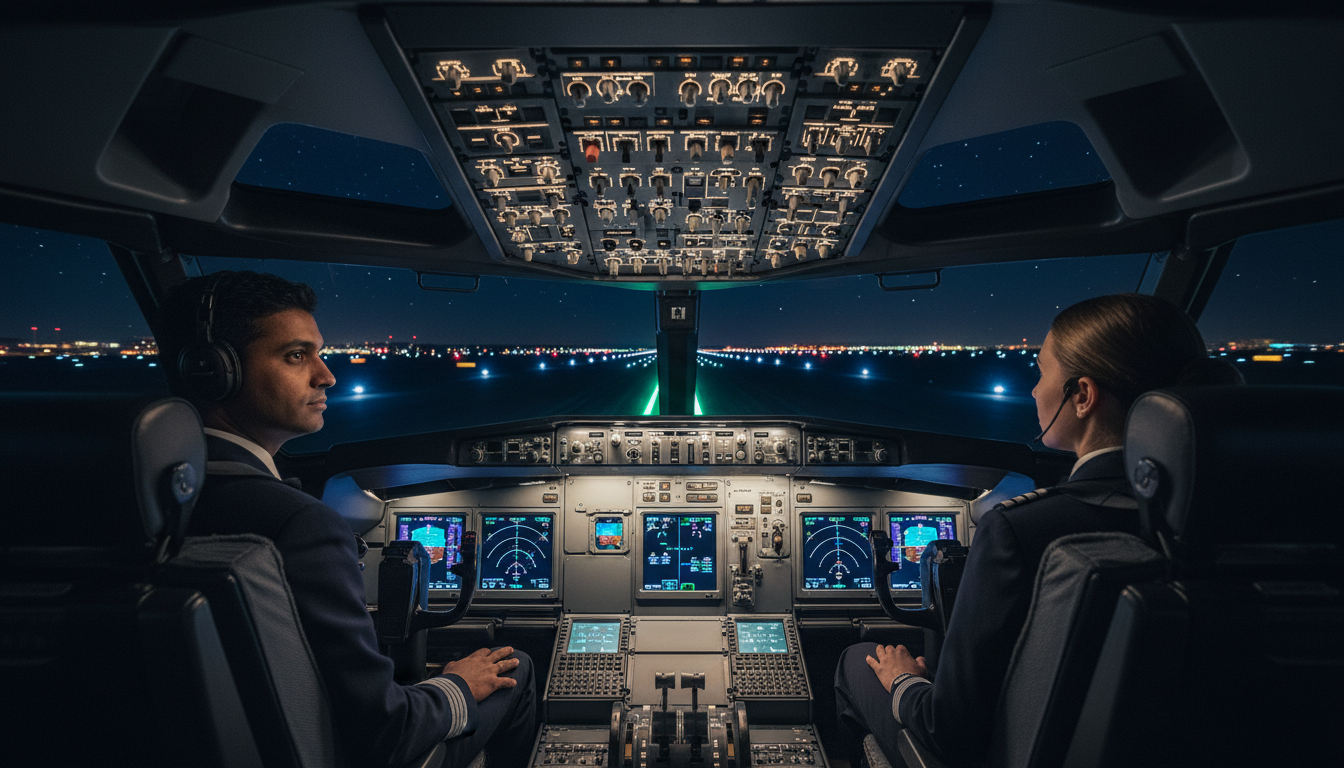
Clear night vision is a critical challenge for pilots: as they plunge into darkness, the familiar ground disappears. Even during the day, the pilots depend on visual references for landing and checking.
Thus, under these conditions, not only are the visual references missing or obscured, but even the landmarks are lost. The sky provides the pilot with far fewer references to help him understand his position and orientation, and even slight errors can snowball quickly.
Clarity of perception becomes a vital need in this darkness. It is the basis for a safe flight and an essential component of your aeromedical fitness. Clear-eyed pilots at night are confident and aware of their surroundings. In contrast, pilots with impaired night vision must rely heavily on instruments and automation, unaware of how miserable their eyes are.
The Science Behind Pilot Night Vision
Rods, cones, and the night blind spot
Night flying belongs more to the rods than to the cones. The cones at the center of the retina give sharp, color vision in bright light, but they fade as ambient light drops.
The rods, spread through the peripheral retina, become roughly 10,000 times more sensitive to light once fully dark-adapted, and they take over the job of detecting movement and contrast at night.
This creates an odd paradox in the cockpit: the sharpest part of the eye, the fovea, is actually a liability in low light. If an individual gazes directly at a dim object, it may vanish into a “night blind spot.” Consequently, the pilot needs to employ off-center viewing, typically 5-10 degrees off the target, to project it onto the rods rather than the cones.
Dark adaptation and how fragile it is
Dark adaptation is the process by which rods undergo a chemical reaction to restore their sensitivity after exposure to bright light. Practical flying experience indicates that near-maximal sensitivity is attained in about 30 minutes, preferably in dim light. However, this process can be partially reset with a flash of bright light.
The cockpit has numerous realities that hamper this change:
-
Bright ramp lights, landing lights, strobes, and tablet screens.
-
Glare from other traffic or airport lighting.
-
Cabin lighting is left higher than needed for comfort.
Night (rod) vision is easily washed out and then recovers slowly. A pilot taxiing out under floodlights may feel fine until rotating into a dark, rural departure and realizing the outside world is much less visible than expected.
Aeromedical Factors That Degrade Night Vision
Oxygen and the “silent” hit to vision.
The retina has one of the highest oxygen demands of any tissue in the human body, and it is unusually intolerant of hypoxia. Even altitudes that feel benign from a daytime “I feel fine” perspective can significantly reduce night visual acuity.
-
At night, supplemental oxygen is recommended in unpressurized aircraft at altitudes as low as 5,000 ft to maintain optimal retinal performance.
-
Without supplemental oxygen, visual acuity at night can drop by at least 35%, even at relatively modest altitudes.
For those pilots who wish to emphasize night safety and eye health, it is an easy habit that yields high dividends, as it changes their mindset from ‘night oxygen altitudes’ to ‘night oxygen altitude’.
Smoking, alcohol, and carbon monoxide
Several lifestyle and cockpit exposures quietly erode night vision:
-
When you smoke, carbon monoxide is released, which binds to hemoglobin, thus reducing the amount of oxygen delivered to the retinal tissue.
-
Alcohol makes it harder for the eyes to adjust to dim light. It also interferes with processing.
-
Both exhaust leaks and poor cabin sealing lead to higher carbon monoxide levels, which, in turn, degrade night vision well before symptoms appear.
From the perspective of aviation safety, these factors make a routine night flight more dangerous, as they interfere with the eye (the pilot’s primary sensory organ).
Visual scanning of the night sky
The methods of scanning during the day, the significant focus on and direct glances at targets, do not work well at night. The resolving power of rods is lower than that of cones, and their handling differs.
Typically, pilots will do effective night scanning:
-
Using off-center viewing: look 5-15 degrees to the side of the object to bring it onto the rods.
-
Holding each scan sector for about a second or more to give the rods time to register movement or dim lights.
-
When you’re in the dark, don’t focus on just one light, or you may enter a state called “empty-field myopia,” where your eye focuses at a short distance, and the image is fuzzy.
Such practices reduce the risk of missing other road users, illuminating the ground, or missing the light horizon.
Many pilots have found that proper equipment and training related to aviation night vision goggles transform their ability to operate safely after dark.
Protecting dark adaptation in the cockpit
When planning for nighttime flights, assume dark adaptation is a system that requires protection.
Pilots can:
-
Dim panel and instrument lighting to the lowest usable level.
-
Use red or subdued cockpit lighting where appropriate to reduce rod bleaching.
-
Shield tablet and phone screens with night modes, blue-light reduction, and lower brightness.
-
Plan taxi and departure routes with awareness of bright-light exposures such as ramp floodlights or reflective surfaces.
Even on the ground, balloon pilots have learned that a single burner blast at night can temporarily destroy night vision and situational awareness, sometimes for several minutes. Airplane pilots face the same physiology, only with different sources of light.
Sunglasses, Day Operations, and Night Vision
How daytime choices affect nighttime seeing
It may seem counterintuitive, but good sunglasses during bright daytime flying can actually protect night vision later in the same duty period. Sunglasses reduce retinal bleaching from intense sunlight and preserve the chemical precursors that rods need for dark adaptation when the sun goes down.
Not all sunglasses are equal in terms of aviation eye health:
-
Lenses must block ultraviolet light, particularly UV-B, to reduce long-term risks of cataracts and macular degeneration.
-
Cheap plastics and acrylics may transmit harmful UV while dimming visible light, giving a false sense of protection.
-
Wearing dark sunglasses (#4, which block 95% of light) can reduce visual acuity and hinder cockpit tasks.
A neutral/grey-green lens, either #2 or, more preferably, #3, offers most pilots the best compromise between glare reduction, UV protection, and visual function preservation.
Long-term eye health for frequent night flyers
The course of night flying through high-density or well-lit terminal operations takes pilots through recurrent sequences of glare and darkness. Aviation-grade vision demands safeguards for the retina and lens against UV and glare exposure after several flights.
Key strategies include:
-
Routine comprehensive eye exams with aviation-aware eye care professionals.
-
Notice the initial indications of cataracts or macular modifications, which could have a greater impact on contrast and night vision.
-
Aeromedical experts encourage a healthy diet for eye health, especially for pilots with long careers ahead.
Night Vision Goggles and Enhanced Vision Systems
What NVGs can and cannot do
Night vision goggles (NVGs) and other night vision devices (NVDs) provide some visual cues lost at night by amplifying available light during hours of darkness. These devices significantly enhance a pilot’s ability to see obstacles and cultural lighting in conditions that would otherwise appear nearly black.
However, NVGs are not a simple plug-and-play upgrade:
-
They decrease visibility and can cause tunnel vision.
-
Extended helmet use makes you more tired due to the extra weight & eyestrain.
-
They need special training; if misused, they can lead to overconfidence and misinterpretations of visual cues.
For civilian operators adopting NVGs, it is therefore essential to treat this as a separate skill set with training, SOPs, and regular checks.
NVGs in civilian and special operations
Although the military aviation environment developed and refined NVGs, their use in specific missions also includes selected civilian and public safety applications. At Present, several agencies and operators use night vision goggles (NVGs) to enhance safety at night. These include EMS from a helicopter, search-and-rescue, law-enforcement airframes, and some special-mission operators.
Even in these roles, the same physiology applies. Pilots require:
-
A solid experience in night operations and scanning.
-
NVGs have limited depth perception, which can cause light haloing.
-
The crew coordinated to execute the tasks and cross-check the instruments to prevent fixation.
Night Vision Goggles enhance the pilot’s eyesight, but do not eliminate the need for disciplined instrument flying and applicable aeromedical practices.
Human Factors, Illusions, and Night Operations
Visual illusions unique to the night
Many of the classic visual illusions in aviation are amplified after sunset.
Typical night illusions include:
-
Black-hole approaches: over dark, featureless terrain or water, where a well-lit runway floats in darkness and tempts the pilot into a dangerously low, shallow approach.
-
Autokinesis: a dim, stationary light appears to move when stared at, leading pilots to make control inputs toward an illusory “moving” target.
-
Ina “equate” assessment of ramp angle and distance on a slope, or otherwise illuminated ramp background lighting cues are absent or misleading.
We can combat such illusions by adhering to proper instrument use and employing stabilized approach criteria, particularly at night in IFR and marginal VFR conditions.
Fatigue and workload at night
While the plane is approved for 24-hour operations, the human body is programmed to sleep at night. To fly at night is to combine natural circadian low points, such as sleepiness and reduced sharpness, with increased visual demands.
Pilots and operators should perform the following to operate safely at night:
-
Treat late-night and early-morning departures as high-risk phases, regardless of experience level.
-
Be selective in your use of checklists and automation to reduce workload while retaining manual and basic instrument-flying skills.
-
Extra margins for fuel, weather, and alternates – because human and visual performance is not at daytime levels.
Utilizing night vision requires understanding the instrument technique, and the reverse is also true. The human eye can help the pilot to make better decisions and use the system correctly when it works best.
Training, Proficiency, and Best Practices
Making night vision part of every training plan
While many training programs view night currency as merely a box to check, True mastery of night flying demands more than the minimum number of takeoffs and landings. By applying lessons learned from army pilot training, flight school, and pilot safety, flight safety can be enhanced.
Effective elements include:
-
Talks in the classroom or briefing sessions regarding the rods, cones, dark adaptation, and night scanning techniques.
-
Night flight scenarios in which black holes approach, remote departures, and operations near high terrain are purposely explored.
-
Including policies on the use of supplemental oxygen at night for unpressurised aircraft.
Night IFR in marginal conditions should be viewed as an advanced skill, not a default operating mode, for instrument-rated pilots.
Personal minimums and decision-making
Every pilot should know their personal night minimums to reflect the aircraft’s experience and individual night vision performance. These may include:
-
Higher visibility and ceiling requirements at night than during the day.
-
Conservative crosswind and runway length standards for unfamiliar airports after dark.
-
Firm limits on how long to fly at night without a rest period, especially during circadian low periods.
Night vision for pilots is not just about what the eye can theoretically do; it is about building a system of decisions, procedures, and habits that keep the pilot well within the safe envelope.
