

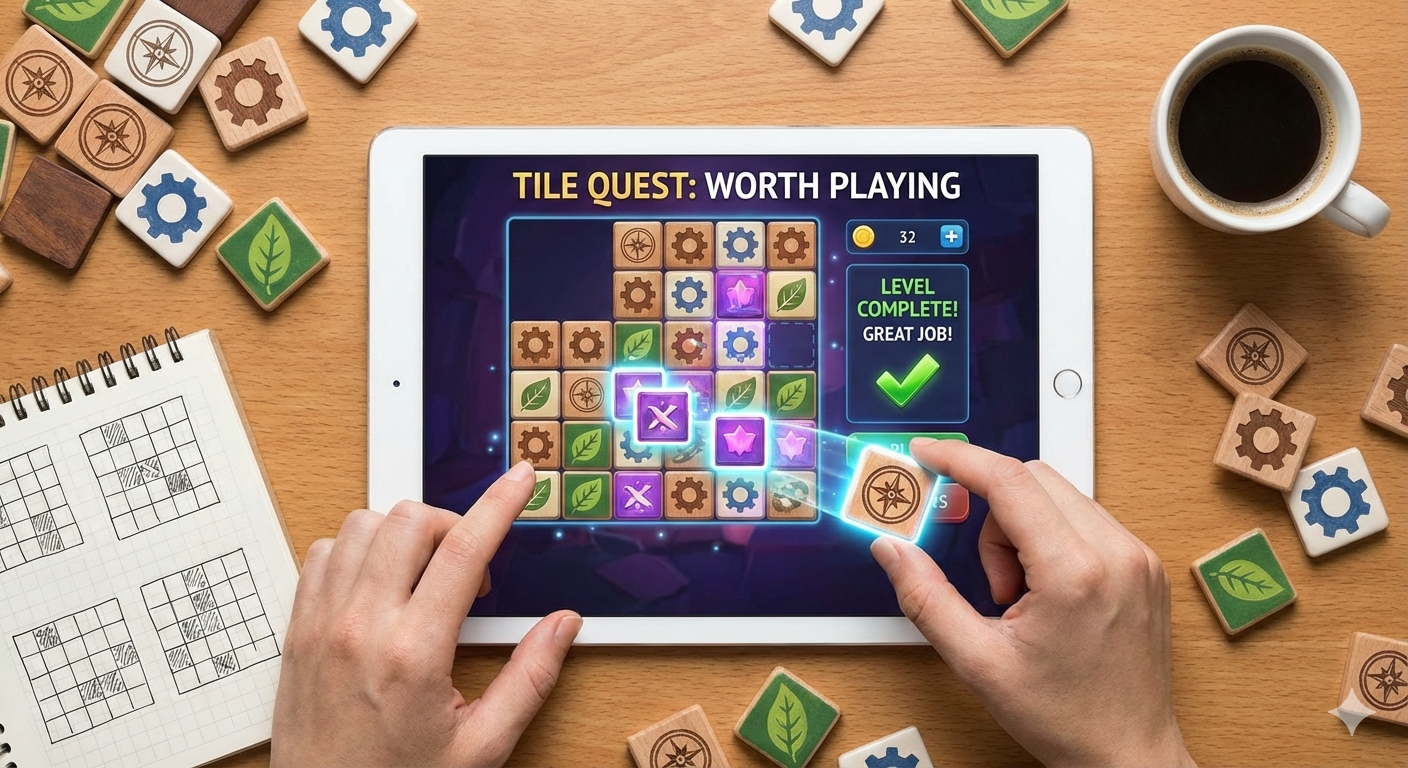
Structural integrity can help you pause at tile puzzles. A well-designed level of gameplay will almost always represent a mini-transaction with clear terms for the player and the designer. Essentially, these games feature clear mechanics, an easy-to-see gameboard, and an overall smooth rhythm of problems and solutions that always feel fair.
Tile puzzles and puzzles that feature pieces that fit together create games of spatial and logical reasoning with strong themes of progress. The most inventive will create multiple challenges through mechanical interactions. At their best, tiles and puzzles will restrict the number of possible moves. This lets the limited mechanics explode into a million more possibilities.
The Core Appeal of Tile Puzzle Games
This kind of game is a tile puzzle, in which, at the end, a player’s move must be to an unoccupied cell. How successful they are depends on every step seeming to be logically connected rather than driven by hidden randomness.
-
The player works within a small, fixed rule set.
-
Every action produces immediate, readable feedback.
-
The board always shows enough information to plan.
Mahjong is a perfect case. It presents removal, symmetry, and matching through a simple, visual approach that is easy to read but rich enough to promote long-term mastery. You look down at the thousands of tiles and learn which tile designs are impactful, how exposed tiles open up future moves/close future moves.
Games inspired by this format lean into:
-
Emphasis on a clear picture, rather than an illusion.
-
Use rules instead of surprises.
-
Design diversity instead of frequent mechanic turnover.
When there are structures in place with feedback that the players can control, it feels full without the properties getting misplaced or adding any unnecessary functions that distract the players. This is precisely what tile-puzzle game players return for. The right trouble is just enough, but not impossible. It must make you think.
Clear Rules and Defined mechanics
A good tile puzzle game starts with rules that are visible, stable, and fully legible from the very first level. Players should understand what is allowed, what is forbidden, and what counts as progress without having to guess.
Why Rule Clarity Matters
A successful tile-puzzle design usually revolves around a single core mechanic, extended and remixed over time rather than replaced every few stages. That core might be:
-
Matching symbols or colors.
-
Clearing layers or stacks.
-
Forming rows, paths, or specific shapes.
-
Manipulating gravity, adjacency, or direction.
What matters is that the game communicates how a tile moves or disappears, and why each change occurs. When players understand the cause-and-effect relationship of their moves, they start to:
-
Predict cascades and chain reactions.
-
Spot latent patterns before they appear.
-
Experiment with strategies instead of just reacting.
This allows long-term involvement. Even when there is randomness to the system, be it shuffled tiles or layouts never seen before, this new layer should always sit on a deterministic spine, never replace it.
Difficulty Without Confusion
Great tile puzzle difficulty curves feel like climbing a staircase, not hitting a wall. Designers achieve this by:
-
All levels will have the same rules.
-
Add complexity through level layouts and constraints.
-
Teach the same mechanic’s new nuances instead of introducing unnecessary systems.
As a result:
-
New players can use the same reasoning at level 1 and level 100.
-
Expert players see deeper patterns without needing another tutorial.
-
To fail is to realize we see nothing new; that our reference was wrong.
Players who enjoy challenging but fair games need puzzle games to remain. Meaning they don’t want, say, bad experiences. This refers to changing the objective in a game.
Visual Balance and Board Simplicity
If the rules represent the heart of a tile puzzler, the board is the face. Color contrast, clean spacing, and well-shaped tiles prevent strain and support fast decisions. The visual design controls how quickly players can perceive the situation, formulate a plan, and feel in control.
Readable Boards, Not Visual Noise
Strong layout design prioritizes:
-
The decorating symbols and tiles are easily distinguishable from the background.
-
Clean spacing that doesn’t blur the tiles together.
-
Easily identifiable, simple, and unique shapes that can be recognized at a glance.
Color must support meaning, but never be the only carrier of information, especially for colorblind players. Designers often combine:
-
Shape differences.
-
Iconography.
-
S btle outlines or patterns.
The players can tell which tile is which even if the colours are similar.
Animation must serve a purpose: smooth, fast, and tightly linked to the function of each movement. Everything on-screen should enhance clarity, not compete for attention. Every particle effect, bounce, or flash should clarify what just happened.
Visual Cues as Gameplay Tools
Players build mental maps of the board. Clever tile puzzle design reinforces those maps through:
-
Highlighting matched tiles before confirmation.
-
Flashing, pulsing, or subtly shaking actionable tiles.
-
Apparent effects when lines, groups, or layers are removed.
The board should never feel too dense or too empty:
-
A cramped grid overwhelms and hides essential details.
-
An overly sparse grid can make the game feel trivial or slow.
The sweet spot is a place on the screen that visually feels balanced, where all the cues push the player towards helpful action. This kind of balance is just the kind of thing that makes some tile-puzzle games have a “nice”, “clean” feel that’s relaxing for the player, while others think messy and tiring after a few rounds.
Stage Design That Supgame’sReplay
Once the game’s mechanics are set, it is the stage design that will serve as the main lever of freshness. The remixing of fixed-rule-set regulations that don’t have to be rewritten to make them interesting.
Variety Within a Stable System
Good tile puzzle stage design uses:
-
Unique board layouts.
-
Different tile distributions and quantities.
-
Changing turn limits or objectives.
-
Optional challenges layer on top of the same mechanics.
This approach lets a game:
-
Employ existing tools to formulate new challenges.
-
Appreciate players for mastering the main mechanic, not for remembering one-off rules.
-
Help with casual game and deep strategy explorations.
Mahjong demonstrates this beautifully. The rules of matching free tiles remain the same, but:
-
Tile stacks take new shapes.
-
Layering patterns shift.
-
Difficulty rises through clever arrangement, not rule complexity.
Modifying a tile in terms of how many of them there are, their position, or their role, is a sufficient alteration to instigate a change in the optimal plan. Replayable value is the same logic repeated again and again.
Designing for Long-Term Engagement
Replayable tile puzzles often lean on several design strategies:
-
Progressively increasing difficulty: The growth mainly teaches the fundamentals, whereas the latter stages stress-test them.
-
Optional objectives: higher score goal, stricter move limit, or optional objectives for experts.
-
Gameplay will alternate between tense, tight levels and more relaxed ones.
This pacing prevents fatigue and keeps even serious puzzle fans from burning out. Players feel challenged, but not harassed; tested, but not trapped.
Structure That Encourages Routine Play
Top tile puzzle games go beyond one more level.” They are addictive, and players fall into a pattern of engaging with the game. Players can safely play every day or every week using systems they trust.
Systems That Invite Daily Return
Games that present content in a more structured way can keep players engaged for longer than those that present content in a linear list. Common instances consist of:
-
Daily puzzles with fixed rules but changing layouts.
-
Limited-time challenges that reuse core mechanics in fresh scenarios.
-
Cycles (daily, weekly, monthly) that reset goals without rewriting the rulebook.
A good example of this format includes:
-
Daily puzzles with fixed rules but changing layouts.
-
Tiles are earned by completing short goals over time.
-
Patterns that reset weekly without changing tile rules.
-
Bonus stages are tied to consistent player actions.
A meta-structure offers the tile puzzler something more than a one-off distraction; it becomes your long-term friend. Players don’t only log in to beat a level, they log in to:
-
Maintain streaks.
-
Chase personal bests.
-
Clear a rotating checklist of goals.
Rewarding Short Sessions and Long Runs
The tile puzzle design respects your routine. Robust Games:
-
Make levels short enough for players to play quickly.
-
More complex modes or cumulative goals offer additional puzzles and extended play.
-
Do not use any paywalled mechanics that ruin the puzzle’s logic.
When the architecture allows for a five-minute break and a two-hour deep dive, the players can fit them into different parts of their lives. This is yet another unembellished reason that they keep coming back.
Why Serious Puzzle Fans Keep Returning to the Right Platforms
Puzzle enthusiasts, in particular tile-based logic games aficionados, seek out something more than merely a random grid to swipe across. They are drawn to platforms that prioritize puzzle design over filler.
What Makes a Platform “Puzzle-First”
A strong tile puzzle platform or site tends to offer:
-
A selection of games made with coherent, well-communicated mechanics.
-
Visual standards must be sensible so people can read the boards, and they have a good contrast and layout.
-
Difficulty increases gradually and follows a clear progression.
-
Scores, times, streaks, and challenge completions are all tracked.
The puzzle-first approach is especially beneficial for offerings like mahjong, ideal for gamers who enjoy matching and pattern recognition games.
-
Clean layouts that make stacked tiles easy to parse.
-
A variety of classic and inventive arrangements.
-
Gradual but meaningful difficulty ramps.
When a platform delivers all of that, serious fans start to treat it as their home base for tile puzzle games rather than hopping from one random app to another.
The Mindset of Serious Tile Puzzle Players
People who enjoy tile puzzle games usually have some priorities in common:
-
They want puzzles that reward learning, not mere repetition.
-
Playing with a purpose means having a goal, measurable growth, and visible results.
-
Consistent logic: No abrupt modifications to rules that nullify their earned knowledge.
A puzzle-first platform gives off an impression of being well-organized, with utility updates, designs, player features, etc. For anyone serious about tile games with high replay value, exploring platforms built around this philosophy is always worth the time.
