

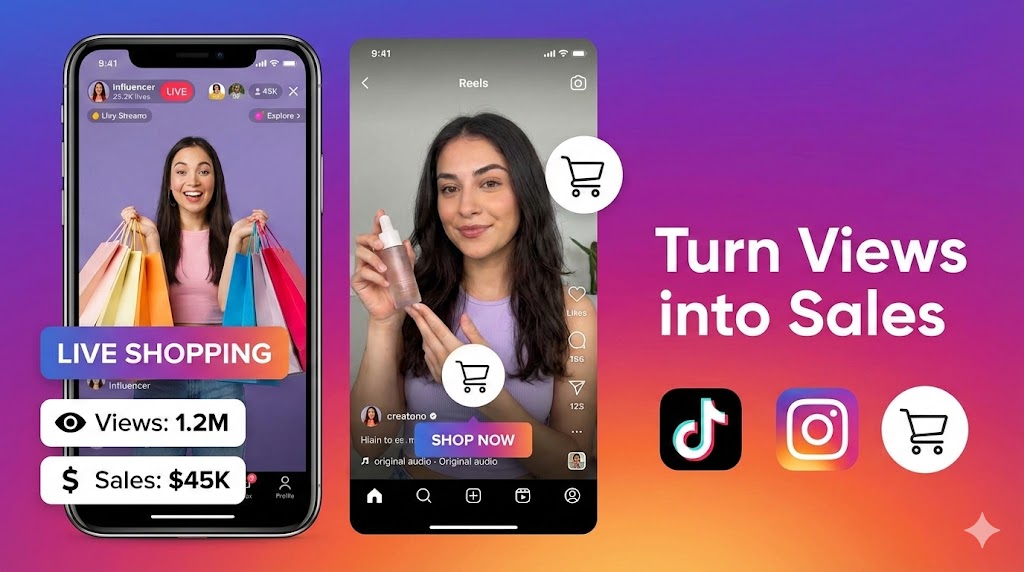
People are discovering products online through social commerce and creator-led shopping in a new way. These days, shoppers no longer hop from ecommerce website to ecommerce website; they traverse TikTok videos, thumb through Instagram Reels, and enjoy live shopping streams before proceeding straight to checkout, often on a one-and-done basis.
This article explains how you can convert TikTok, Instagram, and live shopping into sales, not just views. This analysis examines the emerging trends in sales and revenue for US social commerce. Further, it is converging around platforms and features designed to convert discovery into purchases, also, with forecasts signalling TikTok as a key driver.
The New Reality of Social Commerce
The Shift From Browsing to Buying In-Feed
Social commerce is simply e-commerce conducted on social media platforms. It’s when people find products, compare them, and buy them without leaving the app. Instagram and TikTok now feature native shopping, including shoppable posts, live shopping, and in-app checkout, which make every post shoppable.
As users generally consume content naturally, this shift is powerful for this reason. Shoppers can easily browse a creator’s video tutorial or try-on, tap a product tag or TikTok Shop link, and check out in a few taps. A modern social commerce strategy that harnesses the whole journey, from discovery to purchase, is a major factor in why creator-led shopping converts so well.
The State of US Social Commerce
Explosive Growth, Concentrated Power
US social commerce is no longer experimental; it is a fast-growing slice of retail ecommerce. Social commerce sales in the US are projected to surpass 100 billion dollars in 2026, growing at high double-digit rates year over year. While that still represents a single-digit share of total ecommerce, its growth trajectory makes it one of the most important channels for brands and creators to master now.
Even more important than the total size is where that money flows. Spending on social commerce in the US is highly concentrated among platforms that have built full-funnel shopping journeys: TikTok, Instagram, and Facebook account for the bulk, with YouTube and others taking a smaller share. These platforms have invested heavily in transaction technology, attention, native product catalogs, embedded checkout, and shoppable content.
TikTok Shop’s Rising Share
TikTok Shop’s US sales have grown by triple- and quadruple-digit year-on-year, hitting roughly 18.2% of total US social commerce in 2025. Forecasts suggest TikTok Shop’s share will climb to around 24% by 2027, with its social commerce sales projected to surpass 20 billion dollars in 2026 and more than 30 billion dollars by 2028.
These numbers matter for one reason: they show that TikTok is not just a discovery engine; it is a social commerce platform in its own right. For brands and creators, that means short-form video and live streams on TikTok are not just marketing; they are a direct revenue channel.
Why Creator-Led Shopping Converts
Creators as the New Storefronts
Creator-led social commerce sits at the intersection of influencer marketing and in-app shopping. Consumers see authentic use of various products by real people, such as macro influencers, micro-creators, and niche specialists.
This creator economy dynamic works because:
-
Audiences follow creators, not logos.
-
Creators understand their community’s language, pain points, and aspirations.
-
Product recommendations feel like conversations, not campaigns.
As a result, they travel a much shorter journey from interest to purchase. One effective video with a shoppable link or TikTok Shop card can compress awareness, consideration, and decision-making into a single moment.
Trust, Authenticity, and Social Proof
Trust is the most powerful tool of creator-led commerce. Today’s consumers view recommendations from creators as word of mouth, since they also notice the pros and cons, on-the-ground reality footage, and unfiltered results. Cosmetic, clothing, wellness, and home products, tutorial-style content, and ‘a day in the life’ vlogs demonstrate how it actually works, reducing the uncertainty that so often whittles away at conversion on standard product pages.
By integrating live shopping, viewers can seek answers in real time, request a closer look, and receive instant, on-the-spot responses.
This develops the trust factor. When launching new products or services, creator-led social commerce is an excellent option due to its strong honesty and interactions.
TikTok: The Engine of Creator-Led Social Commerce
TikTok has pushed social commerce marketing forward by building a complete in-app sales ecosystem. Key features include:
-
TikTok Shop: a native storefront where brands and creators list products and manage orders.
-
Shoppable in-feed videos: content that includes product anchors viewers can tap to buy.
-
The Showcase tab on creator profiles: a curated shelf of items the creator promotes.
-
Affiliate marketplace tools: systems that let creators earn commissions for driving sales.
This infrastructure allows creators to monetize their influence directly, while brands can run effective, targeted promotions. An in-app experience on TikTok increases conversions by 24% thanks to its frictionless design.
TikTok Live Shopping: Real-Time Sales
The QVC of Gen Z. That’s how TikTok Live shopping is often described: an interactive, character-driven experience rather than a scripted one. While viewers buy from the livestream, creators pin products from TikTok Shop, showcase them on camera, and answer comments with questions.
The simultaneous usage of several psychological drivers on TikTok facilitates the conversion of live shopping:
-
Real-time interaction and personalized responses.
-
Scarcity and urgency through time-limited discounts or bundles.
-
Herd behavior and social proof as viewers see concurrent comments and purchases.
When live streaming is consistently carried out on TikTok for categories such as beauty and fashion, accessories, and everyday gadgets, it captures a sizeable share of the overall social commerce sales funnel.
Instagram: From Visual Discovery to Checkout
Instagram remains a powerhouse for visual discovery, but it has also matured into a robust social commerce platform. Its key features include:
-
Instagram Shops: curated product collections on brand profiles.
-
Product tags in feed posts, Reels, and Stories, turning content into shoppable moments.
-
Live Shopping tools that allow hosts to feature products directly in the stream.
-
Checkout on Instagram is supported in regions, enabling in-app purchases.
These features allow brands and creators to build an end-to-end shopping journey where a Reel sparks interest, a product tag leads to a product detail page, and checkout happens without leaving the app.
Creator-Led Commerce on Instagram
Instagram is a great social media channel for brands in beauty, fashion, interiors, lifestyle, and wellness. Instagram creators frequently create social shopping ecosystems with:
-
Reels showcasing styling ideas or routines with product tags.
-
Stories featuring swipe-up or product link stickers.
-
Live sessions with live shopping enabled for real-time selling.
Because Instagram’s feed and Explore surfaces are visually driven, creator content has a long tail of discovery power. A single, high-performing Reel can keep driving traffic and sales to a product for weeks.
Live Shopping: Where Engagement Meets Conversion
What Makes Live Shopping Different
Live shopping blends entertainment, education, and ecommerce into a single, uninterrupted experience. Instead of watching a static ad or scrolling through a product page, shoppers watch a host use the product, answer troubleshooting questions, and drop exclusive offers in real time.
This format delivers:
-
Higher engagement (comments, likes, questions) compared with pre-recorded video.
-
A stronger sense of community, as viewers experience the event together.
-
A higher likelihood of impulse purchases driven by excitement and urgency.
Designing High-Converting Live Streams
Successful live shopping sessions on TikTok and Instagram share a similar structure.
Before the live:
-
Announce the event in advance with posts and Stories/Reels.
-
Tease exclusive deals, product drops, or limited stock.
During the live:
-
Introduce yourself and the session’s value quickly.
-
Demonstrate products clearly, using multiple angles and use cases.
-
Pin products and remind viewers how to buy in-stream.
-
Handle FAQs and objections as they appear in chat.
-
Use countdowns, bundles, and bonus gifts to drive urgency.
After the live:
-
Save the live replay for on-demand viewing.
-
Clip highlights into shorter TikToks or Reels with product tags.
-
Retarget viewers with follow-up content and limited-time offers.
This approach turns live shopping into a repeatable social commerce funnel rather than a one-off event.
Building a Creator-Led Social Commerce Strategy
Clarifying the Brand–Creator Partnership
For brands, creator-led shopping should be treated as a performance channel, not just a brand-awareness exercise. The division of roles often looks like this:
-
Brands: product quality, inventory, logistics, and pricing strategy.
-
Creators: storytelling, community building, content production, and live sales hosting.
Partnership models range from flat-fee deals with performance bonuses to pure affiliate or revenue-share agreements. The most effective social commerce campaigns often combine guaranteed compensation (to secure effort and quality) with upside tied to sales.
Choosing the Right Platforms and Formats
Not every product or creator belongs everywhere. A simple way to align content style to the platform is:
-
Short, viral demos and impulse buys → TikTok Shop.
-
Aesthetic, curated content and lifestyle storytelling → Instagram Shopping and Checkout.
-
Long-form education and in-depth reviews → YouTube Shopping or longer lives on TikTok.
Audience demographics matter too. If your core buyers are Gen Z or younger millennials, TikTok and Instagram Reels should dominate your social commerce marketing roadmap. For slightly older segments, Instagram feed content, Facebook, and YouTube can play a larger supporting role.
Turning Views into Sales: A Practical Playbook
Getting the Technical Foundations Right
Before chasing viral reach, make sure your social commerce strategy is backed by solid infrastructure.
For brands, that means:
-
Syncing accurate product catalogs to TikTok Shop and Meta Commerce Manager.
-
Using high-quality product images and clear, benefit-oriented descriptions.
-
Ensuring stock, pricing, and shipping settings are up to date.
-
Enabling native checkout where available to reduce drop-off.
For creators, it means:
-
Applying to TikTok Shop via Creator Center and connecting to relevant brands or affiliate programs.
-
Getting access to Instagram product tagging through approved Shops or brand partnerships.
-
Selecting products that genuinely match audience interests and values to protect trust.
Content Frameworks That Sell
To move from social media engagement to real revenue, structure your content around proven frameworks.
For short-form video (TikTok, Reels):
-
Problem → show a relatable pain point.
-
Solution → introduce the product naturally.
-
Proof → quick demo, before-and-after, or testimonial.
-
Offer → call to action with clear value (discount, bundle, or limited stock).
For live streams:
-
Hook → why viewers should stay (“I’m showing 5 under-$20 finds you’ll actually use”).
-
Demo → thorough walkthroughs of each product with use cases.
-
Interaction → live Q&A, polls, and on-the-spot recommendations.
-
Urgency → time-limited deals, freebies for first buyers, or exclusive bundles.
Balancing educational content with direct selling helps keep sessions enjoyable and prevents them from feeling like infomercials.
Measuring, Optimizing, and Scaling
Metrics That Actually Matter
If the goal is to turn TikTok and Instagram into sales channels, your reporting must go beyond views and likes. Key social commerce metrics include:
-
View-to-click rate on product tags or TikTok Shop cards.
-
Click-to-purchase conversion rate within the platform.
-
Live session conversion (revenue per viewer or per minute).
-
Average order value (AOV) from social buyers.
-
Repeat purchase rate and customer lifetime value coming from creator-led channels.
Tracking these KPIs helps brands and creators see which content formats, offers, and hosts deliver true business results.
Attribution and Creator Performance
Attribution for creator-led sales via affiliate links, promo codes, and in-built analytics dashboards is supported by most large platforms and third-party tools. Based on creators’ performance, brands can easily increase or decrease compensation and the depth of collaborations.
You can create a tiered system that rewards leading creators with time:
-
Higher commission rates or bonuses.
-
Exclusive product drops or early access.
-
Co-created products or capsule collections.
This transforms creator partnerships from one-off influencer posts into a sustained, scalable social commerce program.
Risks, Challenges, and How to Avoid Them
The Vanity Metrics Trap
One of the biggest risks in social commerce is obsessing over views or followers while neglecting conversion. Viral reach without shoppable infrastructure, product tags, TikTok Shop integration, or clear CTAs rarely translates into meaningful sales.
To avoid this, design every campaign with the end in mind: how will a viewer who likes this video buy the product in as few steps as possible?
Trust Erosion and Over-Commercialization
Another risk is overloading audiences with low-quality or irrelevant product promotions. When creators promote anything that pays, they burn through trust quickly—and trust is the engine of creator-led commerce.
Long-term success depends on:
-
Selective brand partnerships.
-
Clear disclosures of paid relationships.
-
Honest opinions, including what a product might not be ideal for.
Platform Dependence
Ultimately, there’s a risk with the platform. Reach and monetization can change overnight due to algorithmic changes, policies, and competitive shifts. It’s the right time to invest in your brand’s owned channels, including SMS and Email. In US social commerce strategies, TikTok and Instagram should be prioritized, but not relied on fully.
The Future of Social Commerce and Creator-Led Shopping
Social commerce will become even more predictive, personalized, and creator-led moving forward. AI will showcase products to users even before they search for them, AR will allow shoppers to “try on” products via their phone camera, and social feeds will combine entertainment and commerce so closely that the two will be almost indistinguishable.
Nonetheless, the essential reality will remain the same – the brands and creators that will win will be those that consider TikTok, Instagram, and live shopping engineered sales systems, not awareness tools. Connecting creators who are driven by trust, compelling content, and clear purchase paths, along with native shopping tools, will help you easily turn social views into actionable, scalable revenue in the year ahead.
