

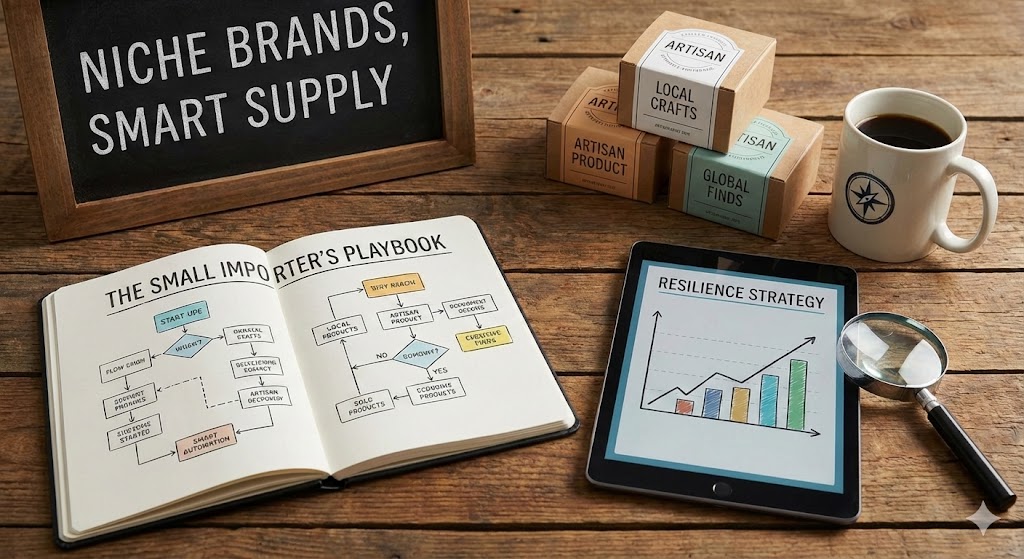
For a smaller importer or a niche brand, the supply chain is less of an abstract curve and more of a part of them. A container delay, factory closure, and tariff adjustment might erase all the profits painstakingly built over months of sourcing. Ultimately, a healthful brand faces grave threats. No longer a corporate “buzzword,” supply chain resiliency is a matter of survival for many smaller and midsize businesses.
The good news: you don’t need a footprint in every part of the globe or a large operations group to build a resilient import supply chain. With clear choices, uncomplicated tools, and a 30-day resilience sprint, small importers can prevent stockouts, stabilize margins, and protect their brand from shocks while staying lean.
What Supply Chain Resilience Really Means For Small Importers
At present, big consulting reports use complex language to define supply chain resilience. Nonetheless, small importers require a much more pragmatic definition.
In terms of small business groups, resilience means your supply chain must absorb shocks (delays, shortages, tariffs) while still keeping your products flowing to customers at a manageable cost and level of disruption. Niche brands and small importers are particularly exposed. The industry is significantly impacted by reliance on certain suppliers and routes; a single manufacturing plant or wharf disruption can quickly push a best seller to backorder, causing unplanned discounting due to late product.
Why Niche Brands Feel Supply Chain Shocks Harder
Niche ecommerce brands, specialty food businesses, boutique furniture importers, and similar companies often share three traits that increase supply chain risk:
-
Specialized products – Unique materials, custom molds, or small‑batch recipes that only a few factories can produce
-
Low volumes – Order sizes that put them at the back of the line when capacity is tight
-
High customer expectations – Loyal customers who expect consistent quality and availability
When a disruption hits, these brands cannot simply switch to a generic alternative without compromising their positioning. This makes supply chain risk management for small businesses a strategic priority, not an optional extra.
The New Risk Landscape For Small Importers And Niche Brands
The risk environment for global supply chains has changed significantly over the years. From small-business and executive surveys, a set of recurring risks has emerged that affects decisions on sourcing, inventory, and logistics.
The Top Risks Import‑Dependent Small Businesses Face
Recent reports and expert analyses point to a set of common supply chain risks in 2025 and beyond:
-
Policy changes to tariffs, whether by introduction or increase, add to the volatility in landed costs and margins for selected HS codes or countries.
-
A significant conflict, labor strike, or policy change slows or blocks key routes and major logistics hubs (e.g., ports, rail, or airports).
-
Extreme weather and climate disruption, such as floods, storms, and heat waves, affect manufacturing areas, ports, and agriculture.
-
Freight, customs, and logistics systems are increasingly digitising. Attacks or outages on them can slow movements.
-
An ESG and reputational risk, such as forced labor, environmental degradation, or any other compliance issue within the supply base, is likely to lead to bans or backlash.
When shocks occur, small importers often suffer as they lack bargaining power and buffers. At the small-business level, the need to develop a supply chain resilience strategy is becoming very urgent and impactful.
Balancing Cost And Resilience On A Small Budget
One of the biggest mindset shifts small businesses face is accepting that pure cost minimization can increase risk. Supply chains that receive relatively small recurring costs, such as expanded supplier options or a bit more buffer inventory, can achieve far lower risk of catastrophic disruption, according to the study on “Balancing Cost and Resilience”.
This means a lot for small importers and niche brands:
-
Spending a bit more on micro‑diversification of suppliers or regions
-
Holding limited safety stock on critical SKUs
-
Paying for better visibility and logistics support when it truly reduces risk
The goal is not to eliminate risk, but to reduce the chance that a single event can cripple your operations or cash flow.
Step 1 – Map Your Supply Chain And Find Single Points Of Failure
Resilience starts with clarity. Many founders know their factories and freight forwarders, but have never seen their entire supply chain on a single page. A simple supply chain map reveals where you are overexposed.
A Simple Supply Chain Map Any Small Importer Can Build
You do not need advanced software to map your supply chain. A spreadsheet or diagram is enough if it captures the essentials:
-
Tier 1 suppliers
-
Factories, co‑packers, converters, private label manufacturers, 3PLs
-
-
Tier 2 (where visible)
-
Key raw materials, packaging suppliers, and ingredient producers
-
-
Logistics network
-
Main ports of loading and discharge, carriers, consolidation points, and customs brokers
-
For each node, note the country, lead times, and rough order quantities. This kind of supply chain visibility for small businesses gives you a baseline for identifying fragile links.
Ranking SKUs And Chokepoints By Value At Risk
Once you have the structure, focus on products and links that matter most. A pragmatic approach is to:
-
Rank SKUs by:
-
Revenue contribution
-
Margin contribution
-
Strategic importance (brand anchor, hero product)
-
-
For top SKUs, ask:
-
Do they depend on a single factory?
-
Are they tied to one region or country?
-
Do they all flow through one port or lane?
-
According to the “value at risk” view, a single disruption could take out big monthly sales. These choke points are always the objective of resilience operations.
Step 2 – Micro‑Diversification: Adding Options Without Doubling Costs
Diversifying your supplier does not mean you must walk away from your best factory, either. Micro-diversification is beneficial for small importers, helping improve resilience without increasing the complexity of their operations.
Primary + Backup Instead Of Full Redundancy
Traditional risk management often focuses on redundant supply chains, but small businesses rarely have the volume to support redundancy across the board. Practical diversification looks more like:
-
Keeping a primary factory that handles 70–80% of volume
-
Developing a backup factory that can produce 20–30% of volume on short notice
-
Splitting sourcing between one offshore supplier and one nearer‑shore or domestic supplier for urgent runs
Increases backup capacity to affordable levels, enhancing a business’s supply chain flexibility without incurring high costs.
Mixing Local And Global For Niche Brands
A specialty food importer relies on a European co-packer for most of their production. To cope with seasonal demand fluctuations and transit delays, they additionally contract with a nearby regional co-packer.
-
The major manufacturing centre still handles most of the production for a boutique furniture importer, but a small local workshop has been developed for special runs and rush orders.
-
A food importer based in Europe uses a single co-packer for most of the product. The user, however, has a regional co-packer for peak harvest or freight issues.
Niche brands can transform their main products by combining local elements with global ones. The supply chain is affected by changes in freight and policy.
Step 3 – Rethink Inventory: Buffers, Safety Stock, And Lean Trade‑Offs
One key factor for a resilient supply chain is inventory. If inventory is too low, there is a risk of stockouts or lost sales. On the other hand, if there is too much, you tie up cash stock and risk obsolescence. Small importers should find equilibrium based on facts and appetite for risk.
Where Buffer Stock Makes Sense For Small Importers
You do not need extra stock on every item to build resilience. A more surgical approach focuses on:
-
Essential SKUs are responsible for a significant increase in revenue and traffic.
-
Products with high margins are prone to stockouts.
-
Products that have longer or more volatile lead times.
Modest safety stock levels can serve as a shock absorber against delays or demand spikes. Long-tail items can remain lean in the meantime to protect cash.
Practical Inventory Adjustments For Resilience
Small importers can adjust inventory policies without adopting complex systems. Tactics include:
-
To account for the expected delays, we are increasing our orders for hero SKUs slightly.
-
When freight conditions are unstable, split the order and ship it more frequently in smaller quantities.
-
A greater proximity of some inventory and/or 3PL warehouses to the key markets reduces response times.
Even basic demand planning for a small business, using historical sales data and simple reorder points, can significantly improve resilience and reduce the need for emergency shipments.
Step 4 – Strengthen Supplier Relationships As Your Hidden Insurance Policy
Small importers need to build the right relationships to build resilient supply chains. Tight capacity or supply chain disruptions force suppliers and logistics partners to decide whom to prioritize; strong relationships play an essential role in this.
Moving From Vendor To Partner.
A large number of small businesses view suppliers merely as vendors: negotiate prices, place purchase orders, and escalate only when things go wrong. An approach that builds resilience looks different:
-
Schedule regular calls or check‑ins to discuss:
-
Upcoming holidays or planned shutdowns
-
Changes in raw material prices or availability
-
Capacity constraints or new minimum order quantities
-
-
Share realistic forecasts and launch plans so factories can plan capacity.
This kind of transparency supports collaborative supply chain planning even at a small scale.
Becoming A Preferred Customer As A Small Buyer
Small importers often think that they are too small, but being a good customer can still earn priority treatment. Practical behaviors include:
-
Ordering regularly instead of erratically.
-
Pay up promptly and abide by the agreed terms.
-
Dealing with problems professionally and communicating the solution.
-
Whenever possible, share clear timelines rather than rushing at the last minute.
When disruptions occur, factories and forwarders are more likely to allocate their scarce capacity to predictable, easy-to-deal-with customers. brands’brands supply csecurerands’ this bond.
Step 5 – Use Data, Simple Tech, And AI To See Problems Earlier
You can improve your resilience by receiving early warnings. Global corporations may use advanced control towers; however, small importers can also achieve adequate visibility with simpler tools and basics.
Practical Visibility Tools For Small Importers
You may already have more data than you realize in your existing stack. Useful sources include:
-
A dashboard to track the delay and status of the consignment.
-
Portals to view stocks for logistics or market users.
-
Business management software that identifies sales patterns and lead cycle time.
Those small importers can avoid a crisis by regularly checking the data and getting the details. Supply chain visibility is integral to a small business.
Scenario Planning And AI‑Assisted Risk Monitoring
Complicated models are not a requirement for scenario planning to be beneficial. What happens if lead times double is a simple exercise? What if we impose a 10% tariff increase? Assist in putting your plans to the test.
Emerging tools also enable AI‑assisted supply chain planning at a small‑business scale by:
-
Forecasting demand based on historical sales and seasonal patterns
-
Flagging anomalies in supplier lead times or freight costs
-
Grouping SKUs by risk level allows you to prioritize diversification and buffering
With simple AI-enabled forecasting, companies can shift from firefighting to proactive risk management.
ESG, Reputation, And Regulatory Risk For Niche Importers
Before buffer, supply chain resilience meant being cost-focused. These days, any disruption or complete shutdown of supply chains is usually due to regulatory penalties and reputational damage.
Why ESG Now Matters In Supply Chain Resilience
Numerous major markets are increasingly adopting legislation on forced labour, the environment, and supply chain transparency. Niche brands and small businesses that rely on imports:
-
Certain regions or suppliers may suddenly become non‑compliant, requiring urgent shifts
-
Retail partners or marketplaces may demand evidence of due diligence
-
Consumers may boycott brands linked to unethical practices
Because ESG risk in supply chains is not only about values, it is a real operational risk that can affect access to markets and materials.
Lightweight ESG And Traceability Practices For Small Businesses
Small importers do not need enterprise‑scale programs to start managing ESG risk. Practical steps include:
-
Forward a basic questionnaire to major suppliers on labor, health, and environmental issues.
-
Requesting and storing qualifications within your particular sector, e.g., organic, Fair Trade, FSC, and ISO.
-
Maintaining attendance records for site visit audits and periodic reviews.
A collection of tools for smaller supply chains enhances traceability and compliance by tracking materials, documenting due diligence, and monitoring regulatory changes at affordable prices.
Collaborating With Other Small Businesses For Scale And Resilience
A small importer can’t build a citadel all by himself. Finding business resilience through working with peers, professional associations, and local networks may not be possible alone.
Sharing Risk, Capacity, And Information
Small‑business resilience guides increasingly highlight collaboration as a way to access scale advantages:
-
Shared warehousing or regional hubs enable brands to optimise inventory placement by having different niche brands co-locate their inventory in a single facility to access better services and pricing.
-
Small importers combine demand to negotiate lower MOQs and freight rates through group purchasing.
-
Sharing transport for a common destination through a common point.
Small brands can benefit from these models to improve supply chain flexibility and reduce logistics costs.
Practical Collaboration Models For Niche Importers
Examples of effective collaboration include:
-
Several specialty food importers share temperature‑controlled storage in a key region
-
A cluster of DTC brands using the same 3PL and forwarder to standardize processes and gain leverage
-
Local or industry associations facilitating introductions for shared container programs or co‑ops
Sharing information among shippers on issues such as port congestion, new customs rules, and suppliers’ reliability serves as an early warning system for the network. It helps to build SME communities’ supply chain resilience.
A 30‑Day Resilience Sprint For Small Importers And Niche Brands
Creating a fully resilient supply chain will take years, but stakeholders can make meaningful progress toward their goals in 30 days. Importers utilize resilience marches to rapidly and effectively translate ideas into action.
Week 1 – Map And Measure
-
Create a simple chart or table to map your supplier to the warehouse supply chain.
-
Take a look at your highest revenue and margin 10 SKUs and assess their dependency
-
Individual factories.
-
Solo nations.
-
Sole terminals or cargo passageways.
-
Be aware of current lead times, variations, and disruptions.
Week 2 – Diversify And Buffer Where It Counts
-
Identify potential alternative suppliers or regions for your riskiest SKUs.
-
Determine when reasonable safety stock or local manufacturing is justified, considering the risk and cash impact.
-
Contact a potential alternate supplier or co-packer to begin a dialogue.
Week 3 – Talk, Test, And Negotiate
-
Plan talks with existing suppliers on improving resilience.
-
Flexibility of contingency options and capacity.
-
Substitute substances or procedures
-
Prepared strategies to handle anticipated disruption scenarios.
-
Try out a small test run, such as a test order with an alternative supplier or a new freight route.
Week 4 – Document, Monitor, And Improve
-
Capture what you have learned in a simple supply chain resilience playbook documenting:
-
Critical SKUs and chokepoints
-
Backup options, contacts, and trigger rules
-
Inventory policies and communication protocols
-
-
Set up basic dashboards or reports to track:
-
Lead times and OTIF for inbound shipments
-
Percentage of spend covered by more than one source
-
Revenue at risk if a specific supplier fails
-
By the end of 30 days, you will not have eliminated risk, but you will have moved from vulnerability by default to managed risk with clear options and triggers.
Real‑World Case Snapshots Of Niche Brands Building Resilient Supply Chains
Techniques backed by relatable stories help build resilience. Effective supply chains often use short case studies to show how principles work in practice.
Case 1 – Boutique Furniture Importer Adds Local Backup
-
A small furniture importer had no fallback offshore factory for parts. There was a sudden backlog at ports and regional disruptions. As a result, lead times doubled.
-
They charted their network of suppliers, identified the most profitable goods, and teamed up with a small home-country shop to handle 20–30% of the volume for those goods.
-
Expedited orders and additional customer requirements could be catered to locally. Meanwhile, the main factory continued processing regular volumes for VIP customers. The supply chain optimised distribution to provide better service to people in need.
Case 2 – Specialty Food Brand Nearshores Part Of Its Production
-
A specialty foods company has experienced delays due to port congestion and a shortage of cold storage containers.
-
They found a near-market co-packer while still using the original supplier in Europe for most of the volume for cost and speed.
-
Key markets’ lead times have been shortened, while the brand has enjoyed greater flexibility to adjust to seasonal demand spikes and transport disruptions.
Case 3 – DTC Niche Brand Uses Data And Scenario Planning
-
A lifestyle brand engaged in direct-to-consumer sales was importing custom-made products when freight costs rose sharply and lead times became uncertain.
-
They maintained service levels above 95 percent while keeping inventories stable and preventing backorders by strategically analyzing available stock and customer demand.
-
The result of this analysis is: fewer stockouts on hero products; greater margin stability; and more confidence in planning in volatile times.
-
The supply chain resilience case studies highlight how even small-scale importers can do a lot with simple tools and realistic options.
Conclusion
It’s time for small importers and niche brands to become stronger than ever before. It should not be a ‘when we have more time’ project. It is necessary to perform a single-point-of-failure analysis of the supply chain. The use of micro-diversification, buffer inventory, and stronger supplier relationships can change a fragile, single-threaded operation into a flexible network with real options when shocks happen.
This month, identify the right partners and collaborate with them. Approach your logistics plan appropriately to avoid late shipments, tariff hikes, factory issues, other complications, and damage to the reputation of your pricey item.
You can now focus on the map, target sourcing, backup suppliers, and the most realistic stocking changes, with an easy entry-level ESG and collaboration. You don’t need to have a dedicated team or enterprise tools to start with.
Innovative businesses assess risk and minimise exposure. Over time, these habits compound to create a more robust business that customers, partners, and investors can count on.
