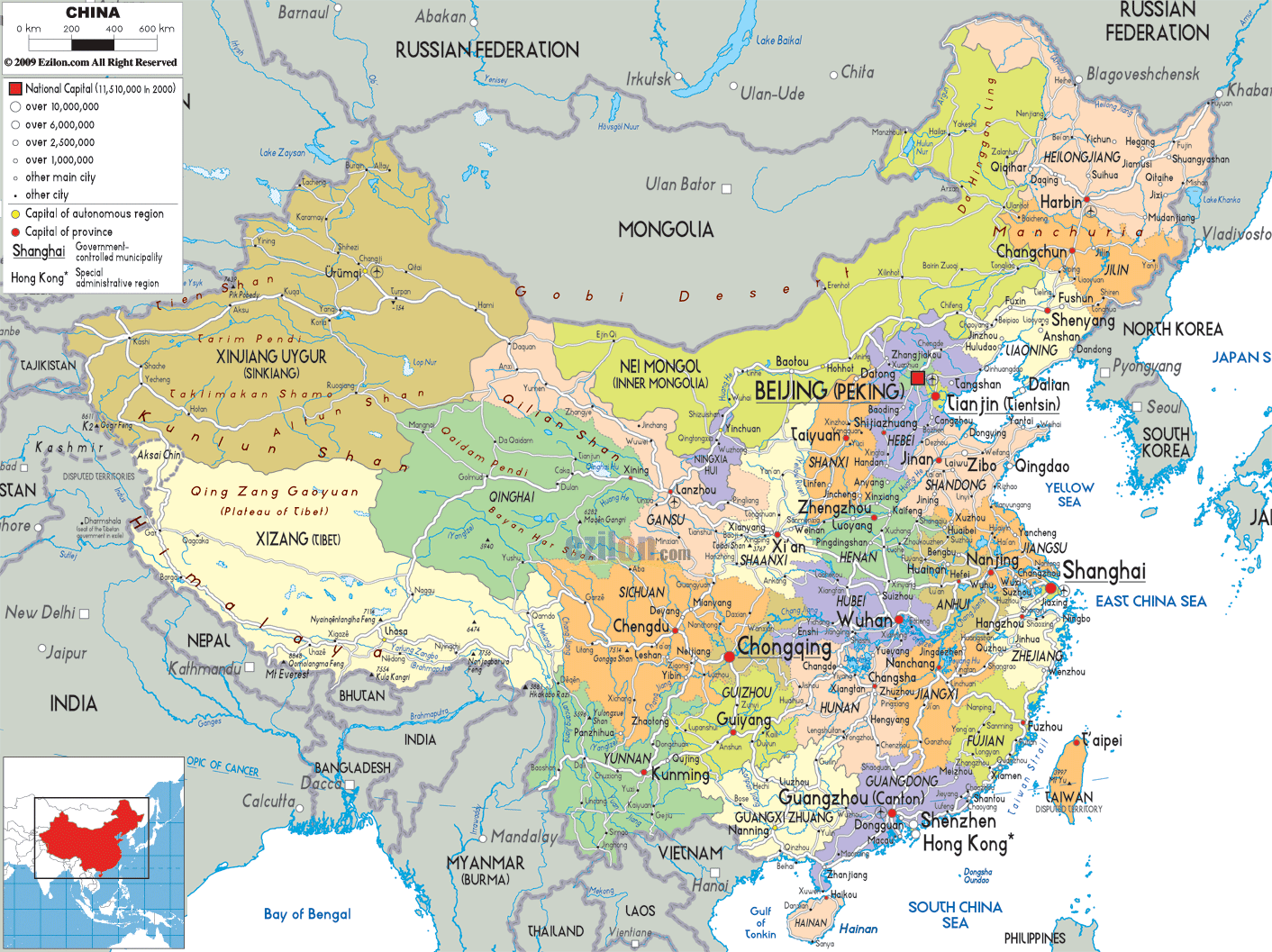
Description: Detailed large political map of China showing names of capital city, towns, states, provinces and boundaries with neighbouring countries.
This map of China with cities, provinces, and towns is already large enough to read directly on your desktop. To see a full-screen zoom view on a phone or tablet, tap the map image (or tap the Zoom Map label above the image). Scan by shading provinces in various colored blocks, with China's cities and towns in bold.

Detailed map of China with cities, towns, provinces, villages and surrounding countries. China shares borders with Mongolia, Russia, India, Pakistan, Vietnam, and North Korea, among other neighboring countries.
The map of China with regions at the top level shows the country's provincial-level divisions, i.e., 22 provinces, 5 autonomous regions, 4 centrally administered municipalities, and 2 special administrative regions. Regions like Hebei, Henan, Sichuan, Guangdong, and Shandong are accompanied by autonomous regions with special color patches filling the map. They are Xinjiang Uygur, Tibet (Xizang), Inner Mongolia (Nei Mongol), Ningxia Hui, and Guangxi Zhuang.
The map shows four municipalities: Beijing, Shanghai, Tianjin, and Chongqing. They are separate units, a step up from a city, despite being city-based. There is also the label of the special administrative regions. These regions are Hong Kong and Macau, which lie near the south coast.
Each colored area is covered with an intricate network of dots and labels. They show the provincial capitals and other cities. Larger dots denote larger cities. Cities appear on the map as dots, and primary roads are shown as thin lines connecting them. You can see how people travel between the provinces and along the huge east – west and north – south corridors across China.
The map also delineates the borders of neighboring nations, such as Russia, Mongolia, Kazakhstan, India, and Vietnam, as well as nearby seas, so users can see at a glance how China fits into the larger picture of East and Central Asia and the nations in proximity.
On the China map with cities, Beijing is marked at the northeast end of the country as the national capital with a symbol and name that are immediately eye-catching. Shijiazhuang is the provincial capital of Hebei. Other large centers include Tangshan, Baoding, and Cangzhou.
They are all part of a ring of industrial and residential cities that you see when you fly into Beijing. Located just to the southeast is Tianjin, one of the four municipalities shown with its own capital icon, which links to Beijing, the twin city link on this Chinese cities map.
Towards the south on the eastern coast, Shanghai – another municipality a little further down the Yangtze delta – has the most daring badge of all. It is choked with traffic and close to cities such as Hangzhou, Suzhou, and Nanjing.
The interior of Chongqing is depicted as a vast municipality situated along the upper Yangtze corridor, with its name and symbol scaled to match those of China's other major urban agglomerations. Chongqing and Guangzhou, southern metropolises, are among the four megacities that, together with Beijing and Shanghai, dominate the city layer map of China and make the urban hierarchy easy to understand.
Starting to read the map of China with towns and villages from the far west, the eyes fall on a large autonomous region called Xinjiang Uyghur, shaded in a broad color that covers much of northwestern China. Xinjiang has dots and labels for cities, such as Urumqi, Kashi (Kashgar), Hotan, and Korla, showing how administrative centers are scattered across a vast area.
This area is along the borders with Kazakhstan, Kyrgyzstan, Tajikistan, Afghanistan, and Pakistan. Highways from these settlements lead toward central China and outward to crossings over frontiers, making the map of Chinese cities a key travel planner for movement in and out of this border region.
Directly south of Xinjiang lies the expansive region of Tibet (Xizang), whose color band extends along China's southwestern edge. The map clearly depicts the administrative center of Lhasa, and other towns such as Shigatse and Nyingchi, strung out across the remote plateau that borders Nepal, Bhutan, and India.
In the northeast, the province of Qinghai features its capital, Xining, and towns such as Golmud, which sit on major road routes linking eastern China to the far west. This section of the map of China with regions shows geography students how large territorial units depend on a relatively small number of cities to manage transport and governance across large distances.
China Map. Area North. A long band of the Inner Mongolia (Nei Mongol) Autonomous Region, bordering Mongolia and the Russian Federation, is shown on the China map. Capitals and important urban centers, such as Hohhot, Baotou, Chifeng, and Hailar, are situated along rail and road corridors, demonstrating how towns line up along the steppe border.
Because the area is long and narrow, seeing the names and dots spaced out across the northern edge helps readers understand the distribution of administrative functions along the horizontal dimension of China's northern frontier.
The China map with towns also shows the cities of the adjoining provinces of Heilongjiang, Jilin, and Liaoning farther to the north. These include major cities such as Harbin, Changchun, and Shenyang. All of these are located near Russia and North Korea and have a dense network of roads and rail links to the rest of the northeast. A cluster of provinces in the northeast, showing how China's industrial heartlands and border cities connect with neighboring states, will be useful to travelers and students of regional trade and demographics.
On the Chinese cities' map, you will see a province and a major port forming a chain as you proceed downwards from the coastline on the northeastern side. Beginning in Liaoning and the port city of Dalian, the map then goes south through Hebei, Shandong, Jiangsu, and Zhejiang.
Each province is labeled along with its capital and major cities. Shijiazhuang (Hebei), Jinan (Shandong), Nanjing (Jiangsu), and Hangzhou (Zhejiang) are shown in bold. At the same time, other notable cities, like Qingdao, Yantai, Suzhou, Wuxi, and Ningbo, are plotted as smaller dots along the coast and in inland corridors.
The road lines and narrow spacing of names on this detailed map show high urbanization in eastern China; the logistics, manufacturing, and porting activities connect the interior to the seas. Anyone who searches for "map of China with cities and regions" can find this stretch of coast to get exactly what they want.
That would be a clear idea of the provinces, along with a sense of how multiple large cities sit next to one another along the Bohai Gulf, the Yellow Sea, and the East China Sea. The map identifies neighboring countries across the sea, like South Korea and Japan, making it easier for users to plan a trade route or a trip to multiple countries.
The map of China shows that in the middle of the country are several populous provinces, each with a capital that is also the largest city in China. Henan's capital, Zhengzhou, is flagged as a major traffic hub, while the nearby large cities, Luoyang and Nanyang, appear as faint dots.
The province of Hubei, which lies to the south of Henan, is marked by its capital, Wuhan, a major Chinese metropolis and a prominent node on the national road and rail grid, as depicted on the map.
In the west of the map lies Xi'an, the capital of the Shaanxi Subregion. Baoji and the towns are connected to Xi'an by road and have clear signs. To the south is Hunan, with Changsha as its capital.
Other cities shown include Zhuzhou, Shaoyang, and more. They also have road lines connected to Changsha. The clear label shows the capital city of the Hunan Subregion. For locals or geography students, the China map with regions highlights the link between large interior provinces and the coastal belt via corridors through central cities.
When you turn your gaze southwards, however, the map of China with towns and villages shows that the provinces of Guangdong and Fujian, along with the autonomous region of Guangxi Zhuang, are densely populated. Guangzhou is the capital city of Guangdong and is located in the heart of the Pearl River Delta.
It is bordered by some of the region's largest cities, including Shenzhen, Dongguan, Foshan, and Zhuhai. They all form one of the largest urban areas in the world. The map shows Hong Kong and Macau as special administrative regions next to this cluster, allowing one to see how these territories relate to Mainland cities in Guangdong.
Fujian province is famous for Fuzhou, its capital, and Xiamen, a major port. An excellent network of light roads links other coastal towns. Guangxi, to the southwest, the capital Nanning and cities like Beihai and Guilin demonstrate how the southern provinces of China border Vietnam and the Gulf of Tonkin. Anyone using the map of China with cities will see this area clearly labeled as the main entry points into Southeast Asia, as well as major coastal tourism and trading hubs.
The southwest interior provinces of China, as shown on a region map, include several large cities with a complex administrative setup. Sichuan is represented by its capital, Chengdu, a megacity whose printed name dominates, and other important cities such as Mianyang and Leshan. Yunnan lies to the south of Sichuan, with its capital at Kunming and border towns towards Myanmar, Laos, and Vietnam, all clearly mapped.
Guizhou is the name of the province whose capital is Guiyang, whose towns are Zunyi and Anshun. The roads link Chengdu, Chongqing, and the southern provinces. When users review the China map cities layer, they can see that this southwestern conglomeration reveals a web of provincial capitals and secondary cities that connect inland basins and plateaus with coastal and inland neighbors.
A block of three provinces is in the northeast. They are Heilongjiang, Jilin, and Liaoning. They are positioned between Inner Mongolia and the border with Russia and North Korea. China cities and regions map: major cities or state capitals include Harbin (Heilongjiang), Changchun (Jilin), and Shenyang (Liaoning).
These cities are clearly marked with the capital symbol and bigger fonts. Smaller dots cluster along transport routes to the coast, indicating other significant cities, namely Daqing, Jilin City, Anshan, and Dalian.
Road and rail lines on this detailed map connect these northeastern cities to Beijing and Tianjin, as well as to cross-border points with Russia and North Korea. The area portrayed on the map shows the traditional manufacturing and resource-extraction core.
For geography students, it shows how China's administrative provinces align with a sensitive geopolitical fault line. For residents and industrial planners, it marks an important area.
If you look down and slightly to the inside, you will notice China's cities and provinces clump right around the lower Yangtze basin. The provinces of Jiangsu, with capital Nanjing, and Zhejiang, with capital Hangzhou, are located right beside Anhui, with capital Hefei, which in turn has cities like Suzhou, Wuxi, Wenzhou, and Ma'anshan. The mapping of the two cities reveals that the expressways and railways move across provincial borders seamlessly. This affords the one country's most integrated urban regions.
Many users searching for a map of China with cities and towns may be looking for this region because of its commercial importance in SEO and usability. By labeling provincial capitals, framing provincial borders, and plotting intermediate cities on the map, users get a complete view of the structure of the lower Yangtze urban corridor without further zooming in.
Back to the North China Plain, the map of China shows Hebei and Shandong provinces, most important around Beijing and Tianjin. The two bold icons represent Shijiazhuang, the capital of Hebei, and Jinan, the capital of Shandong.
The other centers are Qingdao, Yantai, Weifang, Baoding, and Handan. These cities are connected by a network of roads that runs from the coast to the interior, highlighting the relationship between the ports and the manufacturing cities across the provinces.
The Map of China with Towns and Villages also includes smaller county-level cities and towns. This gives a good idea of the settlement pattern in one of the world's most densely populated plains. This will help itineraries for travelers to connect one coastal tourist city, Qingdao, with another inland cultural destination using the road line on the map.
Hunan and Jiangxi are located in central southern China, while the province of Hainan is an island off the southern coast of China. Located on the banks of the Xiang River, Changsha is the capital of Hunan province. Other cities include Zhuzhou, Hengyang, and Shaoyang. Nanchang, the capital of Jiangxi, and cities such as Ganzhou and Jiujiang, which appear on road lines to the north to the Yangtze corridor and south to Guangdong.
The island province of Hainan is shown offshore in the South China Sea, with its capital, Haikou, in the north and the city of Sanya in the south, on the Hainan province map. For those who read the map, Hainan appears to be separate from China but is still labeled as part of China. Also, since Hainan cities appear on the map, it would cover all searches of "map of China with towns and villages".
An advantage of this map of China with cities and regions is that it clearly shows all international borders. The map shows that the country shares borders with Russia, Mongolia, North Korea, Vietnam, Laos, Myanmar, India, Bhutan, Nepal, Pakistan, Afghanistan, Tajikistan, Kyrgyzstan, and Kazakhstan.
The clear nomenclature along the edge helps you identify each neighboring country. With clear labeling, you should be able to use this map to understand China's geopolitical landscape and plan overland travel or trade routes.
In the bottom corner, a smaller box indicates China's location in Asia so international readers can see where the country is in relation to the whole. Those searching for a map of China with cities can refer to the inset before looking at the map containing specific provinces and cities.
The map doesn't detail highway categories and classifications; however, the light lines connecting the cities show the flow of traffic. A long east-west corridor links the cities of Xinjiang through to Gansu, Shaanxi, and Henan.
The north-south axes connect Beijing and Harbin, Shanghai-Gzhu, and Chengdu-Kunming. The inferred roadways show residents and truck planners the highways used for truck travel, and travelers the distance they can cover by road, along with coastal ports or capitals in the hinterland.
Since the article text has these route-based relationships, it very much matches search queries like 'map of China with cities and towns' and 'map of China cities routes', which generally come from people looking to move, not just memorize the names of its provinces.
The political map of China, showing towns, uses a graduated system of symbols in the legend to depict their hierarchy. The biggest symbols are the largest cities (Chongqing, Shanghai, Beijing, and Chengdu) with metro populations exceeding 20 million, according to recent estimates. Larger icons or dots represent major cities such as Guangzhou, Shenzhen, Tianjin, and Wuhan, while smaller dots represent hundreds of prefectures and counties across the country.
For geography students, this offers an instantly visual lesson on how a national urban system is arranged. Residents can see at a glance which nearby city serves as their primary regional center. Travelers can benefit from a China map with cities, as it helps them find the major transport hubs. These cities have major airports and high-speed rail connections. Thus, it is easier to travel.
This Map of China with Cities and Towns is useful for all users as it displays a combination of provinces, autonomous regions, municipalities, special administrative regions, cities, towns, borders, and roads, for accurate identification of provinces or cities as well as provincial capital, and linking up how nearby cities are connected to the national corridor. Travelers from Shanghai and Guangzhou can trace Chengdu, Xi'an, and Urumqi, which have overnight halts at intermediary cities or transit points.
The China map with regions offers almost a complete syllabus in one graphic for geography students. Further, it shows the cities in order of their importance and how their borders relate. Since the map centers on political and human geography, ruling out physical relief, it can be used to teach almost everything connected with population, power, and regional development without visual clutter.
China is located in East Asia between Central Asia, Russia, Southeast Asia, and the Pacific coast.
China borders Russia, Mongolia, North Korea, Vietnam, Laos, Myanmar, India, Bhutan, Nepal, Pakistan, Afghanistan, Tajikistan, Kyrgyzstan, and Kazakhstan.
The map shows provinces, autonomous regions, municipalities, and special administrative regions across China.
Beijing is the national capital shown on the northeastern side of China.
Major cities include Beijing, Shanghai, Guangzhou, Shenzhen, Chongqing, Chengdu, Wuhan, Tianjin, Xi'an, and Harbin.
Shanghai is located on the eastern coast near the Yangtze River Delta.
Beijing is China's political capital and a major administrative and transportation center.
The map shows Beijing, Shanghai, Tianjin, and Chongqing as centrally administered municipalities.
The autonomous regions shown include Xinjiang, Tibet, Inner Mongolia, Ningxia, and Guangxi.
Xinjiang is located in northwestern China bordering Kazakhstan, Kyrgyzstan, Tajikistan, Afghanistan, and Pakistan.
Xinjiang cities shown include Urumqi, Kashgar, Korla, and Hotan.
Tibet is located in southwestern China bordering Nepal, Bhutan, and India.
Tibetan cities shown include Lhasa, Shigatse, and Nyingchi.
Inner Mongolia stretches across northern China along the border with Mongolia and Russia.
Major Inner Mongolia cities include Hohhot, Baotou, Chifeng, and Hailar.
Northeast China cities shown include Harbin, Changchun, Shenyang, Dalian, and Jilin City.
Guangzhou is located in Guangdong Province in southern China.
Cities include Guangzhou, Shenzhen, Dongguan, Foshan, Zhuhai, Hong Kong, and Macau.
Hong Kong is located on the southern coast of China beside Guangdong Province.
Central China cities shown include Wuhan, Zhengzhou, Changsha, and Xi'an.
Chengdu is located in Sichuan Province in southwestern China.
Southwest China cities shown include Chengdu, Kunming, Guiyang, Chongqing, and Nanning.
Hainan is an island province located in the South China Sea south of mainland China.
The map shows Haikou and Sanya on Hainan Island.
The map shows the Bohai Gulf, Yellow Sea, East China Sea, South China Sea, and Gulf of Tonkin.
Major corridors connect Xinjiang through Gansu, Shaanxi, Henan, and eastern coastal provinces.
Yes, the map clearly displays provincial and administrative boundaries across China.
Yes, the map is useful for studying provinces, cities, borders, and regional geography.
Yes, travelers can use the map to understand cities, transport routes, border crossings, and regional corridors.
No. Printing or copying maps from this site is not permitted.

Physical Map of China
Physical map and map image of China.

Road Map of China
Road map and map image of China.

Regional Directory of United States of America
Information and guide about United States of America and websites with American topics.

Regional Directory of Europe
Information and guide about Europe and websites with European topics.

Regional Directory of Australia
Information and guide about Australia and websites with Australian topics.