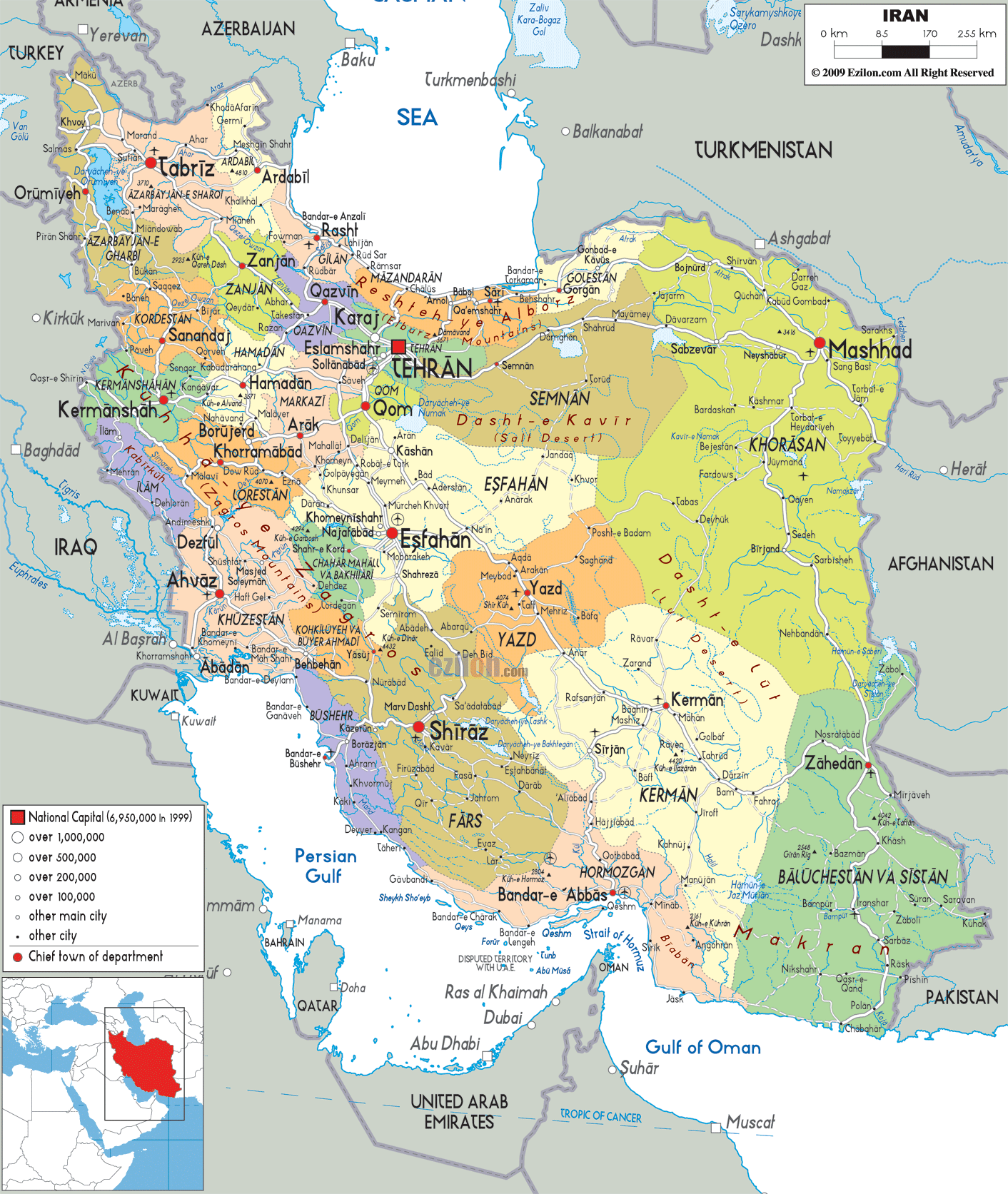
Description: Detailed large political map of Iran showing names of capital city, towns, states, provinces and boundaries with neighbouring countries.
This map of Iran with cities, provinces, and towns is already large enough to read directly on your desktop. To see a full-screen zoom view on a phone or tablet, tap the map image (or tap the Zoom Map label above the image). Scan by shading provinces in various colored blocks, with Iran's cities and towns in bold.

Detailed map of Iran with cities, towns, provinces, villages and surrounding countries. Iran shares borders with Iraq, Turkmenistan, Afghanistan, and Pakistan, as well as Turkey, Azerbaijan, and Armenia to the northwest. This best map of Iran is carefully structured to guide the reader from region to region, helping you understand not only where cities are located but also how provinces, landscapes, and neighboring countries connect.
Iran is divided into 31 provinces, each with its own capital and administrative structure. As is clear from the map, using colour separations, provinces such as Tehran, Isfahan, Fars, Khorasan, and Kerman are marked. Cities are not randomly spread around a map, as you will see when you study the map. They are distributed according to natural patterns, influenced by geographic features such as mountain ranges, water sources, and trade routes.
The map is said to be a road-light network, meaning it shows links between important cities without confusing the reader. This lets you see the spatial relationships while still getting an idea of how the flow moves through the country.
Iran sits at the crossroads of West Asia, Central Asia, and South Asia, making it one of the most strategically positioned countries in the world. As you observe the map, you can see how Iran connects multiple regions through its borders and coastlines.
To the west, Iran borders Iraq and Turkey, as shown on the map to the left.
To the northwest, you will find Armenia and Azerbaijan, while the Caspian Sea stretches across the northern edge.
To the northeast, Turkmenistan appears, followed by Afghanistan and Pakistan to the east.
To the south, the country opens into the Persian Gulf and the Gulf of Oman, both clearly labeled on the map.
This positioning has shaped Iran's role as a historical trade hub, connecting ancient routes between Asia, Europe, and the Middle East.
At the top of the map, the Caspian Sea coastline forms a narrow but extremely fertile strip of land. This area is seen as greener than the rest of the country, which adds to its visual appeal. There are provinces like Gilan, Mazandaran, and Golestan.
In this coastal zone, cities include Rasht, Sari, and Gorgan. The tension between alpine and marine formations has created a corridor over which cities have developed. Agriculture and urbanisation flourish in the zone.
Unlike the dry interior regions, this northern area benefits from higher rainfall and a milder climate, making it one of the most densely populated and productive parts of Iran.
Moving slightly south from the Caspian region, your attention is drawn to Tehran, the capital city. On the map, Tehran is prominently marked as the national capital, positioned near the center of the northern half of the country.
Tehran lies at the base of the Alborz mountain range, which is why many of the surrounding areas appear elevated or mountainous. As Iran's largest city, Tehran serves as the country's political, economic, and transportation hub.
The urban corridor around Tehran, including Karaj, Qazvin, and Qom, is important. The map highlights how these cities are linked together by major routes that connect them nationally.
As you move toward the northwest on the map, you encounter Tabriz, one of Iran's most important historical cities. Due to Tabriz's proximity to the borders of Turkey and Azerbaijan, it has become a significant hub.
The surrounding provinces, including East Azerbaijan and West Azerbaijan, are characterized by mountainous terrain. This region has long been a crossroads of civilizations, and the map reflects this by showing multiple connections leading toward neighboring countries.
Further south along Iran's western border, we see provinces such as Kurdistan and Kermanshah. Towns such as Sanandaj and Kermanshah appear on this route.
The Zagros Mountains run diagonally across western Iran, shaping this region. The mountain ranges determine settlement; cities are situated in valleys. Kermanshah, especially, is an important city because of its proximity to Iraq and its role as a center for trade and agriculture.
In the southwestern part of the map, you will notice Khuzestan Province, which stands out due to its proximity to the Persian Gulf and Iraq. The major city here is Ahvaz, located along the Karun River, one of Iran's most important waterways.
This region is flatter compared to the mountainous west and is known for its oil resources and industrial importance. Cities like Abadan and Khorramshahr are also visible near the Gulf, emphasizing the region's economic role.
As your eyes move toward the center of the map, you reach Isfahan, one of Iran's most famous cities. Located at a major crossroads, Isfahan historically connected north-south and east-west trade routes.
On the map, Isfahan appears centrally positioned, surrounded by other important regions. This reflects its historical importance as a cultural and architectural center.
Just south of Tehran, the map highlights Qom, a major religious city. Its location between Tehran and central Iran makes it a key spiritual and administrative center.
One of the most striking features on the map is the presence of vast desert areas, including:
Dasht-e Kavir (Great Salt Desert)
Dasht-e Lut (Lut Desert)
These regions are clearly labeled and occupy a large portion of central Iran. They explain why cities are often located around the edges rather than in the center of the country.
In the northeastern section of the map, the large Khorasan region dominates. The major city here is Mashhad, one of Iran's most important religious and cultural centers.
Mashhad is positioned near the border with Turkmenistan, making it a key connection point between Iran and Central Asia.
Further southeast, the map shows Sistan and Baluchestan Province, one of the largest and least densely populated regions. Zahedan is the main city in the area, located along the Pakistan-Afghanistan border.
The region is less urbanized and more open, owing to its deserts and low population density.
Moving southward, the map highlights Fars Province, home to the city of Shiraz. Shiraz is located in a fertile area near the Zagros Mountains and is known for its cultural heritage and historical significance.
At the southern edge of the map, the coastline becomes more prominent. The city of Bandar Abbas is clearly visible along the Strait of Hormuz, one of the world's most important shipping routes.
This area connects Iran to global maritime trade, and the map underscores this by highlighting its coastal position along the Persian Gulf and the Gulf of Oman.
The map divides Iran into 31 provinces, each clearly labeled and color-coded. This makes it easy to visually follow the country from region to region while understanding how each province contributes to the national structure.
These provinces form a continuous green belt along the Caspian Sea. Cities like Rasht, Sari, and Gorgan are located near water sources, which explains their dense populations and agricultural importance.
This area is the administrative and cultural center of Iran. Tehran is the capital of Iran, while Qom is a religious centre and Isfahan is a cultural centre.
These provinces are mountainous and located near Iraq. Cities are located along the valleys and easy access routes.
These regions are vast and less populated. Cities like Mashhad, Yazd, and Kerman act as key anchors within large geographic spaces.
The provinces open the route for Iranian products to the world through the Persian Gulf. The cities of Shiraz and Bandar Abbas are considered to be the heart of this.
To fully understand this detailed map of Iran, follow this simple flow:
Start at the north (Caspian Sea)
Move to Tehran and the central provinces
Expand toward the west and east borders
Finish at the southern coastline
This approach mirrors the country's geographic and economic structure.
Iran is located in West Asia between the Middle East, Central Asia, and South Asia.
Iran borders Iraq, Turkey, Armenia, Azerbaijan, Turkmenistan, Afghanistan, and Pakistan.
Tehran is the capital city of Iran and is located in the north-central part of the country.
Tehran is located south of the Caspian Sea near the Alborz mountain region.
Major cities include Tehran, Mashhad, Isfahan, Shiraz, Tabriz, Ahvaz, Bandar Abbas, Yazd, and Kermanshah.
The map shows all 31 provinces of Iran including Tehran, Fars, Isfahan, Kerman, East Azerbaijan, and Khorasan regions.
Tabriz is located in northwestern Iran near the borders of Turkey and Azerbaijan.
Western provinces bordering Iraq include Kurdistan, Kermanshah, Ilam, and Khuzestan.
Mashhad is located in northeastern Iran near the border with Turkmenistan.
Mashhad is one of Iran's most important religious and cultural cities.
Isfahan is located in central Iran and serves as a historic cultural center.
Major Gulf cities include Bandar Abbas, Bushehr, Abadan, and Khorramshahr.
Shiraz is located in southern Iran within Fars Province.
The Strait of Hormuz is a strategic waterway near Bandar Abbas connecting the Persian Gulf to the Gulf of Oman.
The map shows Dasht-e Kavir and Dasht-e Lut in central Iran.
Ahvaz is located in southwestern Iran in Khuzestan Province.
Eastern provinces near Afghanistan include South Khorasan and Sistan and Baluchestan.
Zahedan is located in southeastern Iran near Pakistan and Afghanistan.
Important Caspian coastal cities include Rasht, Sari, and Gorgan.
Major northern provinces include Gilan, Mazandaran, and Golestan.
The map highlights the Alborz Mountains in the north and the Zagros Mountains in western Iran.
Major western cities include Kermanshah, Sanandaj, Ahvaz, and Ilam.
Qom is located south of Tehran in central Iran.
Qom is one of Iran's most important religious cities.
Major coastal provinces include Hormozgan, Bushehr, and Khuzestan.
The map shows the Caspian Sea, Persian Gulf, and Gulf of Oman.
Yes, the map is useful for studying provinces, cities, borders, and regional geography.
Yes, travelers can use the map to understand major cities, routes, and regional orientation.
Yes, the map clearly displays Iran's provincial boundaries and administrative divisions.
No. Printing or copying maps from this site is not permitted.

Physical Map of Iran
Physical map and map image of Iran.

Road Map of Iran
Road map and map image of Iran.

Regional Directory of United States of America
Information and guide about United States of America and websites with American topics.

Regional Directory of Europe
Information and guide about Europe and websites with European topics.

Regional Directory of Australia
Information and guide about Australia and websites with Australian topics.