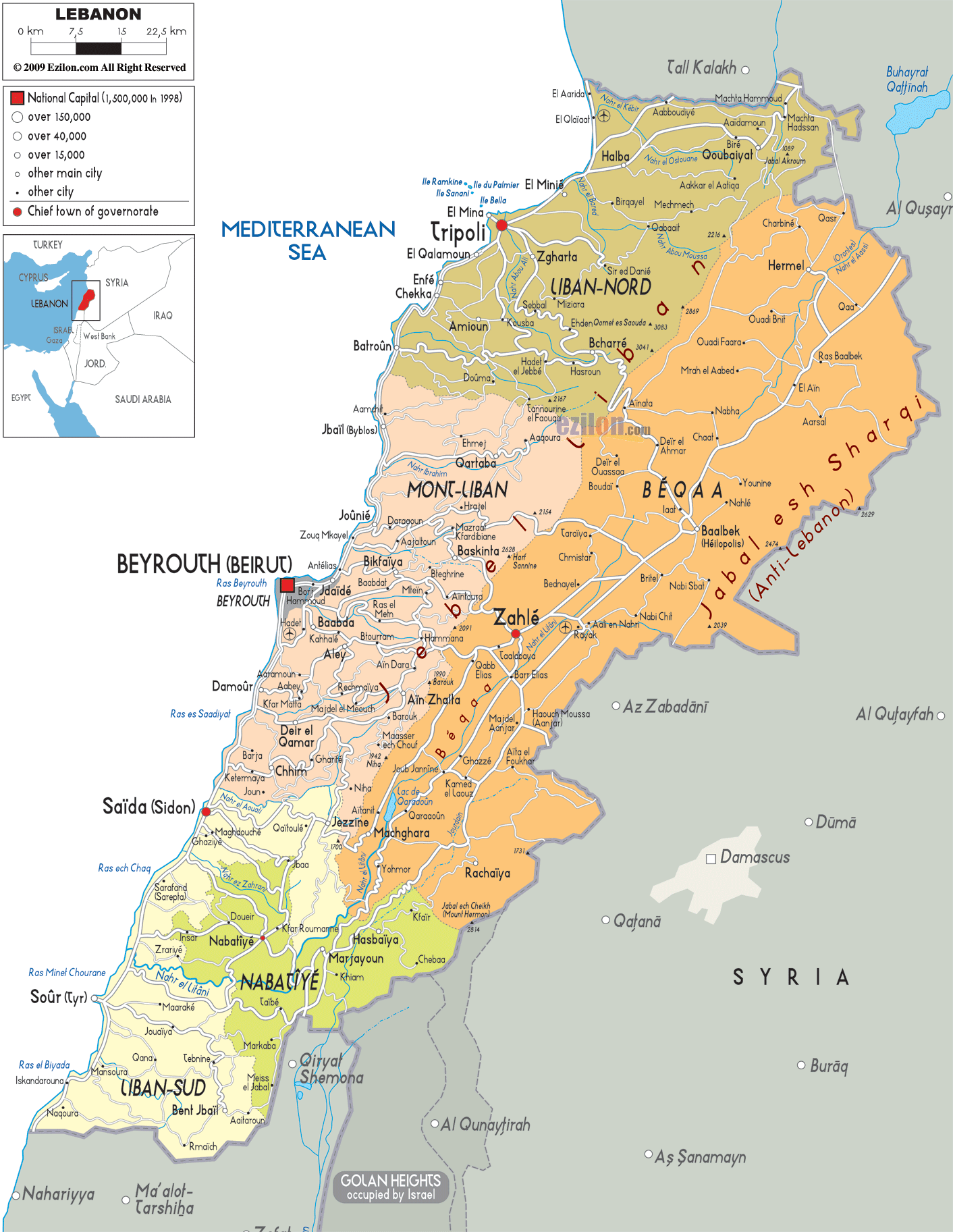
Description: Detailed large political map of Lebanon showing names of capital city, towns, states, provinces and boundaries with neighbouring countries.
This map of Lebanon with cities, governorates, and towns is already large enough to read directly on your desktop. To see a full-screen zoom view on a phone or tablet, tap the map image (or tap the Zoom Map label above the image). Scan by shading governorates in various colored blocks, with Lebanon's cities and towns in bold.

Detailed map of Lebanon with cities, towns, governorates, villages and surrounding countries. Lebanon shares borders with Syria and Israel. Participating in the map with cities shows that Lebanon's main cities are Beirut (Beyrouth), Tripoli, Sidon (Saida), Tyre (Sour), Zahle, and Baalbek, all clearly situated on the coast and in inland valleys. Simultaneously, the map indicates the North Lebanon (Liban-Nord), Mount Lebanon (Mont-Liban), Bekaa Valley, Nabatieh, and South Lebanon (Liban-Sud) administrative regions. Each region is color-coded, allowing readers to quickly identify how urban density, terrain, and land use vary across the country.
The road network in Lebanon, while presented in a road-light format, is still highly informative. A map showing the main cities of the country connected by routes along the coast, through passes in the mountains, and into the Bekaa Valley. This is a useful map for travelers (to plan routes), students studying the geography of the Middle East, or anyone interested in how Lebanon's landscape shapes movement and settlement.
As shown on the map, Lebanon is located on the eastern coast of the Mediterranean Sea and has a long, narrow coastline, which influences much of its development. The coastline is a characteristic, not an imitation, or something like that. It supports important cities and activities.
The northern and eastern borders of Syria are defined by mountain ranges that separate it from Lebanon. The map clearly marks these highlands, which clearly distinguish the interior of Lebanon from the surrounding lands.
Lebanon borders Israel to the SouthSouth. This boundary runs through South Lebanon, near regions such as Tyre and Nabatieh, which are located close to the border.
This geographic positioning makes Lebanon a country where coastal access, mountainous terrain, and inland valleys all interact within a very compact space. The map reflects this complexity by clearly showing how cities, regions, and natural features are tightly interwoven.
At the top of the map, Tripoli appears as the primary urban center in northern Lebanon. Positioned directly on the Mediterranean coast, Tripoli serves as both a port city and a regional hub for commerce and population.
The map shows how Tripoli connects to nearby areas such as El Mina, forming a coastal urban cluster. Roads run into the mountains from the town, indicating that it has been a link between the sea and the interior highlands.
Inland, the map shows the Akkar region extending into and bordering Syria. This is an underpopulated area with long distances between towns and large expanses of land. The map of northern Lebanon shows how conditions become rougher farther from the coast.
High-altitude inland mountain towns are Zgharta and Bcharre. Roads running through these areas show the impact of geography on the route taken. Roadways run alongside valleys and slopes rather than taking a direct approach.
As you move south along the coast, the map reveals a continuous chain of cities including Byblos (Jbail), Jounieh, and surrounding towns. These cities form a dense urban corridor that leads directly into Beirut.
This map of Lebanon's coastal cities clearly shows how development is concentrated along the coast. Due to the population density and economic activity, cities are closely spaced, and road networks are highly connected.
Beirut, that region's capital, is located in the center. Beirut is centrally located on the map, showing its distinctive position along its coast. Surrounding areas such as Baabda and Hadath extend the urban landscape inland, forming a large metropolitan region.
Beirut acts as the main hub from which roads extend in all directions, linking it to northern cities like Tripoli, southern cities like Sidon, and inland regions such as Zahle.
Moving east across the mountain range, the map opens into the Bekaa Valley, a wide and fertile region that contrasts sharply with the coastal and mountainous areas.
At the center of this valley lies Zahle, a major inland city that serves as a hub for agriculture and trade. The map clearly shows the valley running north to South, with roads following its length, connecting various towns.
Further north, Baalbek is another important city in the Bekaa region. Located near the Syrian border, Baalbek sits in a flat landscape surrounded by mountains.
The Lebanon Valley map features emphasize how this region serves as both an agricultural center and a transportation corridor.
The map of Lebanon, with cities and regions, shows how the country has been divided into distinct areas. Further, these areas or regions owe their dominance or flavour to several different factors.
Due to Lebanon's small size, regions are closer together and more unified as a country than in larger nations, where regions are farther apart.
The map allows readers to understand how coastal cities, mountain settlements, and inland valleys interact within a tightly linked network. This combination of diversity and proximity is one of Lebanon's defining features.
The map depicts North Lebanon as a coastal urban region complemented by the mountain hinterland. The coastal city of Tripoli is Libya's chief town, its roads branch both out to sea and even into the interior.
The northern cities map of Lebanon shows the larger towns and cities, as well as the smaller villages and hamlets that connect to Tripoli. It provides an essential part of a localised network through which trade and everyday life can occur. In areas such as Zgharta and Bcharre, in mountainous regions, habitation is determined by altitude.
The map shows how routes are accommodated to fit under the mountains as the roads curve through low-lying areas. The network is quite functional but closely tied to an overall landscape.
Mount Lebanon is the most densely interconnected region on the map. It surrounds Beirut and extends both along the coast and into the mountains.
The Lebanon urban density map features are most visible here, with cities and towns closely spaced and connected by a dense network of roads. Coastal cities such as Jounieh and Byblos form part of a continuous urban strip that merges into Beirut.
At the same time, inland mountain areas host sm ller communities connected by roads that follow natural terrain. This combination of coastal density and mountainous settlement creates a dynamic and diverse region.
Beirut's central position in Mount Lebanon makes it the focal point of the entire country, with all major routes leading to or from it.
The Bekaa Valley is one of the most important regions on the map, both geographically and economically. It stretches from north to South between the Mount Lebanon range and the Anti-Lebanon mountains, forming a natural corridor.
Cities such as Zahle and Baalbek are positioned along this valley, with roads running parallel to its length. The Lebanon Bekaa Valley map shows how this region supports agriculture due to its flat terrain and fertile soil.
At the same time, the valley serves as a transportation route connecting northern and southern Lebanon. This dual role makes it a critical part of the country's infrastructure.
South of the Bekaa Valley, the Naatih region is an inland area. The map shows Nabatieh, Hasbaya, and other towns. The roads link them to the coastal cities and inland areas.
This area connects the Bek valley with the South, enabling people to move between the South and other parts of the country.
The map shows how Lebanon's roads stretch across the diverse landscape, providing access even in remote areas of the country.
A combination of coastal cities and border regions characterizes South Lebanon. The map shows Sidon (Saida) and Tyre (Sour) as the main coastal cities, both connected by a continuous coastal road network.
These cities are regional hubs, facilitating trade, transport, and a population along the Mediterranean.
The inland areas go south towards the border, and the land becomes more varied. The map shows the interlinking of coastal cities with inland towns through roads in the region, creating balance.
To fully understand this detailed ebanon map with cities, follow a logical visual path:
Begin at Tripoli in the north
Move south along the Mediterranean coastline to Beirut
Explore inland through the Mount Lebanon mountains
Cross into the Bekaa Valley and follow its length
Move south into Nabatieh and South Lebanon
Return to the coast at Sidon and Tyre
This approach allows readers to experience the full geographic diversity shown on the map.
This is the best map of Lebanon, with cities and the road network, because it combines clarity with depth. It provides enough detail to understand geography, while remaining simple enough for easy interpretation.
It is especially useful for:
Travelers planning routes across Lebanon
Stu ents studying regional geography
Researchers analyzing urban and rural patterns
Residents seeking to understand connections between regions
The map displays regions, cities, coastline, mountains, and road connections.
Beirut is located along the Mediterranean coast.
Tripoli is located in northern Lebanon.
Sidon lies south of Beirut on the coast.
Tyre is in southern Lebanon along the Mediterranean.
Syria and Israel.
A fertile valley in eastern Lebanon.
In the Bekaa Valley.
In northeastern Lebanon.
Mount Lebanon and Anti-Lebanon ranges.
North of Beirut.
Along the coast north of Beirut.
In southern inland Lebanon.
Near the northern border.
No. Printing or copying maps is not permitted.

Physical Map of Lebanon
Physical map and map image of Lebanon.

Road Map of Lebanon
Road map and map image of Lebanon.

Regional Directory of United States of America
Information and guide about United States of America and websites with American topics.

Regional Directory of Europe
Information and guide about Europe and websites with European topics.

Regional Directory of Australia
Information and guide about Australia and websites with Australian topics.