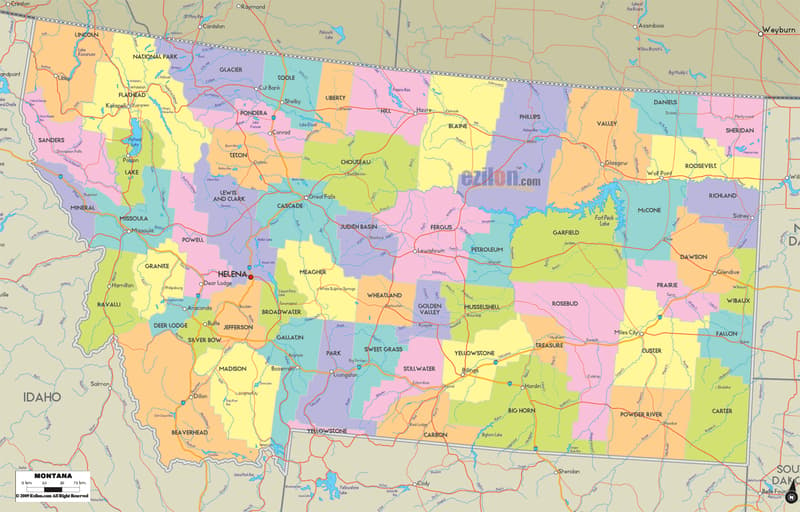
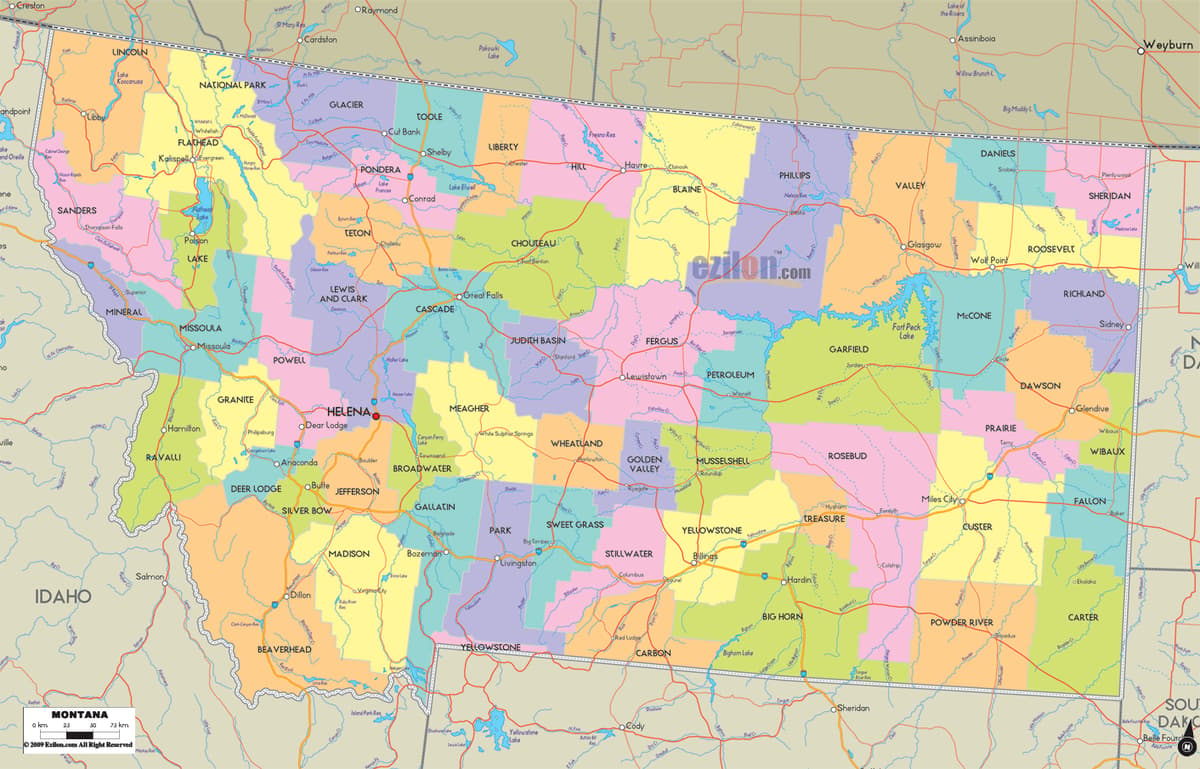
Description: Detailed large map of Montana State, USA showing cities, towns, county formations, roads highway, US highways and State routes.
Montana's Rocky Mountain west gives way to the Great Plains across the rest of the state, bordered by Idaho along the jagged western edge, Wyoming across the south including the Yellowstone gateway counties, North Dakota and a short reach of South Dakota along the east, and the Canadian provinces of British Columbia, Alberta, and Saskatchewan along the 49th parallel to the north. All 56 counties are shown, and the Missouri, Yellowstone, Clark Fork, and Milk rivers act as the main orientation lines running through the interior. Light corridor cues for I-90, I-94, and I-15 help place the state's biggest anchors the cartography marks clearly: Billings in Yellowstone County, Missoula in Missoula County, Great Falls in Cascade County, and Bozeman in Gallatin County.
Lincoln County - seat: Libby. Tucked into the state's far northwest corner, Libby sits along the Kootenai River with Eureka near the Canadian line and Troy toward Idaho; Lake Koocanusa's long reservoir arm gives this corner an easy blue anchor. South of Lincoln, Sanders County - seat: Thompson Falls, reads as a long strip along the Clark Fork valley between the Bitterroot and Cabinet ranges, with Plains nearby. Mineral County - seat: Superior, sits farther down the same river, with St. Regis and Alberton as smaller labels near the Idaho line. Missoula County - seat: Missoula, marks the spot where the Clark Fork meets the Bitterroot and Blackfoot rivers, with Lolo and Bonner as nearby suburbs. South along the Bitterroot Valley, Ravalli County - seat: Hamilton, strings together Stevensville, Victor, Corvallis, and Darby beneath the mountains. Back north, Lake County - seat: Polson, fronts the south shore of Flathead Lake with Ronan and St. Ignatius inland, while Flathead County - seat: Kalispell, anchors the lake's north end with Whitefish and Columbia Falls tied to Glacier National Park. East of the Divide, Glacier County - seat: Cut Bank, carries Browning and the Blackfeet Nation along the park's eastern boundary.
Along U.S. 2 and the Canadian line, Toole County - seat: Shelby, sits near the border ports of entry, with Sunburst just north. Liberty County - seat: Chester, centers on wheat country above the Milk River valley. Hill County - seat: Havre, is the strongest High Line label, with Box Elder and Rudyard along the corridor and the Bear Paw Mountains as a faint backdrop. Blaine County - seat: Chinook, lines up with Harlem and the Fort Belknap area along the Milk River. Phillips County - seat: Malta, covers Dodson and Saco on the river plain, with the Missouri Breaks reaching south. Valley County - seat: Glasgow, anchors the Fort Peck Lake reach, with Nashua and Fort Peck itself on the reservoir's shoreline. Daniels County - seat: Scobey, forms a compact block on the border with prairie texture throughout, and Sheridan County - seat: Plentywood, anchors the far northeast corner near Medicine Lake. South of those, Roosevelt County - seat: Wolf Point, straddles the Missouri River lowlands, with Poplar to the east, and Richland County - seat: Sidney, meets the North Dakota line along the Yellowstone River, with Fairview nearby.
South of the border tier, Pondera County - seat: Conrad, and neighboring Teton County - seat: Choteau, sit right under the Rocky Mountain Front, with Valier, Fairfield, and Dutton along the plains' edge. Cascade County - seat: Great Falls, centers on the Missouri River's chain of falls and dams, with Belt and Cascade nearby. Chouteau County - seat: Fort Benton, sits on a deep Missouri River bend, with Big Sandy to the north. Farther east, Judith Basin County - seat: Stanford, lies between the Little Belt and Judith ranges with Hobson and Geyser nearby, and Fergus County - seat: Lewistown, is a bold mid-state label ringed by the Judith Mountains, with Moore, Denton, and Winifred in the wheat country around it. South of Fergus, Petroleum County - seat: Winnett, is Montana's least populous county, and Garfield County - seat: Jordan, anchors a vast, sparsely labeled stretch between the Fort Peck waters and the Musselshell plains.
Lewis and Clark County - seat: Helena, holds the state capital, with Montana City, East Helena, and Lincoln framing the valley and Canyon Ferry Reservoir to the east. Jefferson County - seat: Boulder, sits between Butte and Helena, with Whitehall in the Jefferson River valley, and Broadwater County - seat: Townsend, sits at the head of Canyon Ferry Reservoir. Gallatin County - seat: Bozeman, carries Belgrade and Manhattan nearby, with the Gallatin, Madison, and Jefferson rivers meeting near Three Forks to form the Missouri, and the county's south edge reaches toward the West Yellowstone gateway. Park County - seat: Livingston, sits on the Yellowstone River with Gardiner at the north entrance to Yellowstone National Park. Madison County - seat: Virginia City, is the historic gold-rush seat, with modern population centers Ennis and Twin Bridges in the Madison and Beaverhead valleys, while Beaverhead County - seat: Dillon, forms Montana's broad southwest corner along the Idaho line, with Lima and Wisdom in the Big Hole basin. Silver Bow County - seat: Butte, is a consolidated city-county built on a mining legacy, and Deer Lodge County - seat: Anaconda, carries the Pintler range and Georgetown Lake nearby. Powell County - seat: Deer Lodge, is easy to mix up with Deer Lodge County next door, framed by the Clark Fork and Blackfoot river basins, and Granite County - seat: Philipsburg, anchors the Pintler foothills with Drummond along the Clark Fork corridor.
Meagher County - seat: White Sulphur Springs, sits between the Little Belt and Castle ranges along the Smith River drainage. Wheatland County - seat: Harlowton, carries Judith Gap as a second label, and Golden Valley County - seat: Ryegate, is a small rectangle with the Musselshell River running east through it. Musselshell County - seat: Roundup, stands on a big bend of the same river, bridging toward the Yellowstone valley. Yellowstone County - seat: Billings, carries the map's largest city label, with Laurel and Lockwood framing the metro and the Yellowstone River arcing east through the county. Stillwater County - seat: Columbus, lines up Absarokee, Nye, and Park City along the Stillwater and Yellowstone tributaries, and Carbon County - seat: Red Lodge, sits under the Beartooth Front with Joliet and Fromberg along the Clarks Fork valley, touching Wyoming at the high peaks. Sweet Grass County - seat: Big Timber, sits on the Yellowstone and the Boulder River fork, closing out this corridor with an easy-to-read square shape.
Big Horn County - seat: Hardin, sits central with Crow Agency close by and Lodge Grass toward Wyoming, with the Bighorn River and canyon as strong cues. Treasure County - seat: Hysham, is a narrow county between the Yellowstone and Rosebud, and Rosebud County - seat: Forsyth, sits on the Yellowstone with Colstrip inland, stretching deep into rolling plains toward Custer and Powder River. Custer County - seat: Miles City, carries a large label on the Yellowstone where the Tongue and Powder rivers meet the valley. Powder River County - seat: Broadus, runs along the Powder River with a long south boundary touching Wyoming, and Carter County - seat: Ekalaka, lies in the far southeast corner with badlands texture, the only county touching South Dakota.
Fallon County - seat: Baker, sits near Baker Lake with Plevna to the west, and Wibaux County - seat: Wibaux, rests on a small creek valley right at the North Dakota line. Dawson County - seat: Glendive, carries a strong label on the Yellowstone, with Richey to the northwest toward the Missouri uplands. Prairie County - seat: Terry, sits on bluffs above the Yellowstone amid badland breaks, and McCone County - seat: Circle, sits centered amid rolling prairie between the Yellowstone and Missouri, closing the loop back toward Fort Peck Lake.
Because every county block is colored and every county seat is printed in a consistent symbol, the eye can answer everyday questions quickly: Which county is Billings in? Yellowstone. Where does Missoula sit? Missoula County, at the confluence of the Clark Fork, Bitterroot, and Blackfoot rivers. Which seat serves the Glacier gateway? Kalispell in Flathead, with Cut Bank in Glacier on the park's east side. What is the seat in the far southeast corner? Ekalaka in Carter. Where is Red Lodge relative to Billings? Southwest across Stillwater and Carbon along the Beartooth Front. That is the power of this detailed map for both residents and visitors: counties first, with just enough network to anchor direction.
Four rivers do most of the orientation work on this page. The Missouri River loops from Three Forks through Great Falls and Fort Benton, then east across the Hi-Line counties to Fort Peck Lake. The Yellowstone River runs from the Park County gateway through Billings, Miles City, and Glendive toward North Dakota. The Clark Fork drains the northwest from Missoula toward Idaho. The Milk River threads the High Line counties from Havre to Glasgow. Keep these four in mind and any county on the map is easy to place.
The road layer is intentionally minimal. I-90 runs from the Idaho line near Lookout Pass through Missoula, Butte, Bozeman, and Billings. I-94 continues east from Billings through Miles City, Glendive, and Wibaux to North Dakota. I-15 runs north-south from the Idaho line near Lima through Butte, Helena, and Great Falls to the Canadian border at Sweetgrass. None of these are meant for turn-by-turn navigation, only as county-placement cues.
Every one of Montana's 56 counties and its seat, in alphabetical order: Beaverhead County (Dillon), Big Horn County (Hardin), Blaine County (Chinook), Broadwater County (Townsend), Carbon County (Red Lodge), Carter County (Ekalaka), Cascade County (Great Falls), Chouteau County (Fort Benton), Custer County (Miles City), Daniels County (Scobey), Dawson County (Glendive), Deer Lodge County (Anaconda), Fallon County (Baker), Fergus County (Lewistown), Flathead County (Kalispell), Gallatin County (Bozeman), Garfield County (Jordan), Glacier County (Cut Bank), Golden Valley County (Ryegate), Granite County (Philipsburg), Hill County (Havre), Jefferson County (Boulder), Judith Basin County (Stanford), Lake County (Polson), Lewis and Clark County (Helena), Liberty County (Chester), Lincoln County (Libby), Madison County (Virginia City), McCone County (Circle), Meagher County (White Sulphur Springs), Mineral County (Superior), Missoula County (Missoula), Musselshell County (Roundup), Park County (Livingston), Petroleum County (Winnett), Phillips County (Malta), Pondera County (Conrad), Powder River County (Broadus), Powell County (Deer Lodge), Prairie County (Terry), Ravalli County (Hamilton), Richland County (Sidney), Roosevelt County (Wolf Point), Rosebud County (Forsyth), Sanders County (Thompson Falls), Sheridan County (Plentywood), Silver Bow County (Butte), Stillwater County (Columbus), Sweet Grass County (Big Timber), Teton County (Choteau), Toole County (Shelby), Treasure County (Hysham), Valley County (Glasgow), Wheatland County (Harlowton), Wibaux County (Wibaux), and Yellowstone County (Billings).
Montana borders Idaho along the mountainous west, Wyoming to the south, North Dakota to the east, a short stretch of South Dakota at the southeast corner, and Canada, three provinces: British Columbia, Alberta, and Saskatchewan, along the northern line. The state holds 56 counties across roughly 147,000 square miles, making it the fourth-largest state by area despite ranking among the least densely populated. Beaverhead County is the largest by land area at about 5,543 square miles, while Silver Bow County is the smallest at about 718 square miles. Yellowstone County, home to Billings, is the most populous county at roughly 172,692 residents, while Petroleum County is the least populous at roughly 548 residents. Beaverhead, Chouteau, Custer, Deer Lodge, Gallatin, Jefferson, Lewis and Clark, Madison, and Missoula counties share the title of oldest, all created February 2, 1865, by the first Montana Territorial legislature. Montana covers about 147,000 square miles in total, with roughly 145,550 square miles of land. The capital, Helena, sits in Lewis and Clark County at the foot of the Rockies, and the state's major population centers run from Billings and Great Falls through Missoula and Bozeman to Helena and Butte. Landscape-wise, the state splits roughly in half: the Rocky Mountains and forested valleys fill the west, while rolling plains, badlands, and river breaks spread across the east.
Montana's ten largest cities by current population are Billings (about 117,116, Yellowstone County), Missoula (about 73,489, Missoula County), Great Falls (about 60,442, Cascade County), Bozeman (about 53,293, Gallatin County), Butte (about 34,494, Silver Bow County), Helena (about 32,091, Lewis and Clark County), Kalispell (about 24,558, Flathead County), Belgrade (about 10,460, Gallatin County), Anaconda (about 9,421, Deer Lodge County), and Havre (about 9,362, Hill County). Billings anchors the state's largest metro with healthcare, energy, and agricultural trade tied to its rail yards and refineries. Missoula centers a timber-turned-university economy around the University of Montana, while Bozeman has grown fast around Montana State University, photonics and optics firms, and a booming outdoor-recreation and tech sector some call Montana's answer to Silicon Valley. Great Falls hosts Malmstrom Air Force Base alongside its agricultural trade base on the Missouri River. Butte still carries its mining legacy from the Anaconda Copper era, and Helena blends state government work with the historic Last Chance Gulch mining district downtown. Agriculture remains the backbone statewide: wheat and cattle dominate the plains, while the eastern counties around Richland, Roosevelt, and Sheridan sit on the western edge of the Bakken oil and gas play. Tourism keeps growing too, with Glacier and Yellowstone National Park gateway towns pulling visitors through Flathead, Glacier, Gallatin, and Park counties every summer.
Montana's cultural identity runs deep with Native American heritage. Seven reservations cover parts of the state: the Blackfeet Nation in Glacier County, the Flathead Reservation shared by Lake and Sanders counties, Fort Belknap in Blaine and Phillips counties, Fort Peck in Roosevelt and Daniels counties, the Crow Reservation in Big Horn County, the Northern Cheyenne Reservation in Rosebud and Big Horn counties, and Rocky Boy's Reservation in Hill and Chouteau counties. The Old West and ranching legacy shows up everywhere, from the historic cattle trails through Fergus and Petroleum counties to the cowboy art of Charlie Russell, whose namesake museum sits in Great Falls, Cascade County. Virginia City in Madison County, a preserved gold-rush town and one of Montana's first territorial capitals, still draws history buffs. Butte's Silver Bow County carries a rich mining and labor history tied to the Anaconda Copper Mining Company. Glacier National Park in Flathead and Glacier counties and the Montana portion of Yellowstone National Park in Gallatin and Park counties anchor the state's tourism identity, drawing millions of visitors each year. Higher education spreads across the map too: the University of Montana in Missoula, Montana State University in Bozeman, Montana Technological University in Butte, Carroll College in Helena, and the University of Montana Western in Dillon.
On this map, Granite Peak (Beartooth Range, near the Wyoming line) and the Missouri, Yellowstone, and Clark Fork rivers double as landmarks for finding counties quickly. For elevation, terrain, watersheds, and land-cover detail, see our Physical Map of Montana.
Montana has a semi-arid continental climate on the plains with cold, snowy winters and warm summers, while the mountainous west sees heavier snowfall and milder, wetter conditions influenced by Pacific air. For a full seasonal and biome breakdown, see our Physical Map of Montana.
North-south travel runs mainly on I-15 (from the Idaho line near Lima north through Butte, Helena, and Great Falls to the Canadian border at Sweetgrass). East-west travel runs on I-90 (from the Idaho line near Lookout Pass through Missoula, Butte, Bozeman, and Billings) and I-94 (continuing east from Billings through Miles City, Glendive, and Wibaux to the North Dakota line). Keep in mind that ZIP codes do not follow county lines in Montana, so a single ZIP code can span two counties. Always confirm the county name directly from the map or index rather than assuming it from a ZIP prefix.
Use this as a quick index. Every line lists the county with its county seat (and a familiar city when the map labels one). Short cues mention river, border, or gentle corridor context only.
Lincoln – Libby; Kootenai River corner near Canada and Idaho.
Sanders – Thompson Falls; Clark Fork valley strip.
Mineral – Superior; Clark Fork near the Idaho line.
Missoula – Missoula; confluence of the Clark Fork, Bitterroot, and Blackfoot.
Ravalli – Hamilton; Bitterroot Valley string of towns.
Lake – Polson; south shore of Flathead Lake.
Flathead – Kalispell; north end of Flathead Lake, Glacier gateway.
Glacier – Cut Bank; east boundary of Glacier National Park.
Toole – Shelby; border ports of entry.
Liberty – Chester; Milk River valley wheat country.
Hill – Havre; central High Line hub.
Blaine – Chinook; Fort Belknap area.
Phillips – Malta; Missouri Breaks to the south.
Valley – Glasgow; Fort Peck Lake shoreline.
Daniels – Scobey; compact block on the border.
Sheridan – Plentywood; far northeast corner near Medicine Lake.
Roosevelt – Wolf Point; Missouri River lowlands.
Richland – Sidney; North Dakota line on the Yellowstone.
Pondera – Conrad; irrigated plains under the Front.
Teton – Choteau; Rocky Mountain Front landmark.
Cascade – Great Falls; Missouri River falls and dams.
Chouteau – Fort Benton; deep Missouri River bend.
Judith Basin – Stanford; between the Little Belt and Judith ranges.
Fergus – Lewistown; ringed by the Judith Mountains.
Petroleum – Winnett; Montana's least populous county.
Garfield – Jordan; Fort Peck to Musselshell breaks country.
Lewis and Clark – Helena; state capital on the Missouri.
Jefferson – Boulder; Jefferson River valley.
Broadwater – Townsend; head of Canyon Ferry Reservoir.
Gallatin – Bozeman; Missouri headwaters at Three Forks.
Park – Livingston; Yellowstone gateway at Gardiner.
Madison – Virginia City; historic gold-rush seat.
Beaverhead – Dillon; Montana's largest county by area.
Silver Bow – Butte; consolidated mining city-county.
Deer Lodge – Anaconda; Pintler range and Georgetown Lake.
Powell – Deer Lodge; Clark Fork and Blackfoot basins.
Granite – Philipsburg; Pintler foothills.
Meagher – White Sulphur Springs; Smith River drainage.
Wheatland – Harlowton; Judith Gap wind corridor.
Golden Valley – Ryegate; Musselshell River crossing.
Musselshell – Roundup; big river bend toward Yellowstone County.
Yellowstone – Billings; Montana's most populous county.
Stillwater – Columbus; Stillwater and Yellowstone tributaries.
Carbon – Red Lodge; Beartooth Front, touches Wyoming.
Sweet Grass – Big Timber; Yellowstone and Boulder River fork.
Big Horn – Hardin; Bighorn River and Crow Agency.
Treasure – Hysham; narrow county on the Yellowstone.
Rosebud – Forsyth; Yellowstone River with Colstrip inland.
Custer – Miles City; Tongue and Powder river confluence area.
Powder River – Broadus; long Wyoming border to the south.
Carter – Ekalaka; far southeast corner, touches South Dakota.
Fallon – Baker; near the North Dakota line.
Wibaux – Wibaux; smallest footprint on the state line.
Dawson – Glendive; strong Yellowstone River label.
Prairie – Terry; bluffs above the Yellowstone.
McCone – Circle; rolling prairie toward Fort Peck Lake.
This directory aligns with what you see on the page: every county, its seat, and a one-line locator that keeps the focus on counties rather than driving steps.
Fifty-six, each shaded and labeled with its county seat.
Helena, in Lewis and Clark County.
Yellowstone County.
Missoula County.
Cascade County.
Gallatin County.
Silver Bow County, a consolidated city-county.
Lewis and Clark County.
Flathead County.
Hill County.
Deer Lodge County, a consolidated city-county.
Park County.
Custer County.
Richland County.
Dawson County.
Roosevelt County.
Beaverhead County.
Fergus County.
Carbon County.
Along the Continental Divide in the northwest, touching Flathead and Glacier counties.
Gallatin and Park counties, with West Yellowstone and Gardiner as gateways.
From north to south: Lincoln, Sanders, Mineral, Missoula, Ravalli, and Beaverhead.
From west to east: Beaverhead, Madison, Gallatin, Park, Sweet Grass, Carbon, Big Horn, Powder River, and Carter.
From north to south: Sheridan, Roosevelt, Richland, Wibaux, and Fallon.
Carter County, in the far southeast corner.
From west to east: Lincoln, Flathead, Glacier, Toole, Liberty, Hill, Blaine, Phillips, Valley, Daniels, and Sheridan.
British Columbia, Alberta, and Saskatchewan.
Light references to I-90, I-94, and I-15 place the state's biggest cities without cluttering the county-first design.
No. Printing or copying maps from this site is not permitted.
Beaverhead County, at about 5,543 square miles.
Silver Bow County, at about 718 square miles.
Yellowstone County, home to Billings, with roughly 172,692 residents.
Petroleum County, with roughly 548 residents.
Billings, in Yellowstone County, with about 117,116 residents.
Beaverhead, Chouteau, Custer, Deer Lodge, Gallatin, Jefferson, Lewis and Clark, Madison, and Missoula counties share the title, all created February 2, 1865, by the first Montana Territorial legislature.
No. ZIP codes cross county lines, so use the county boundaries and seats shown here instead.

Physical Map of Montana
Physical map and map image of Montana.

Regional Directory of Canada
Information and guide about Canada and website listing.

Regional Directory of United States of America
Information and guide about United States of America and websites with American topics.

Regional Directory of Europe
Information and guide about Europe and websites with European topics.

Regional Directory of Australia
Information and guide about Australia and websites with Australian topics.