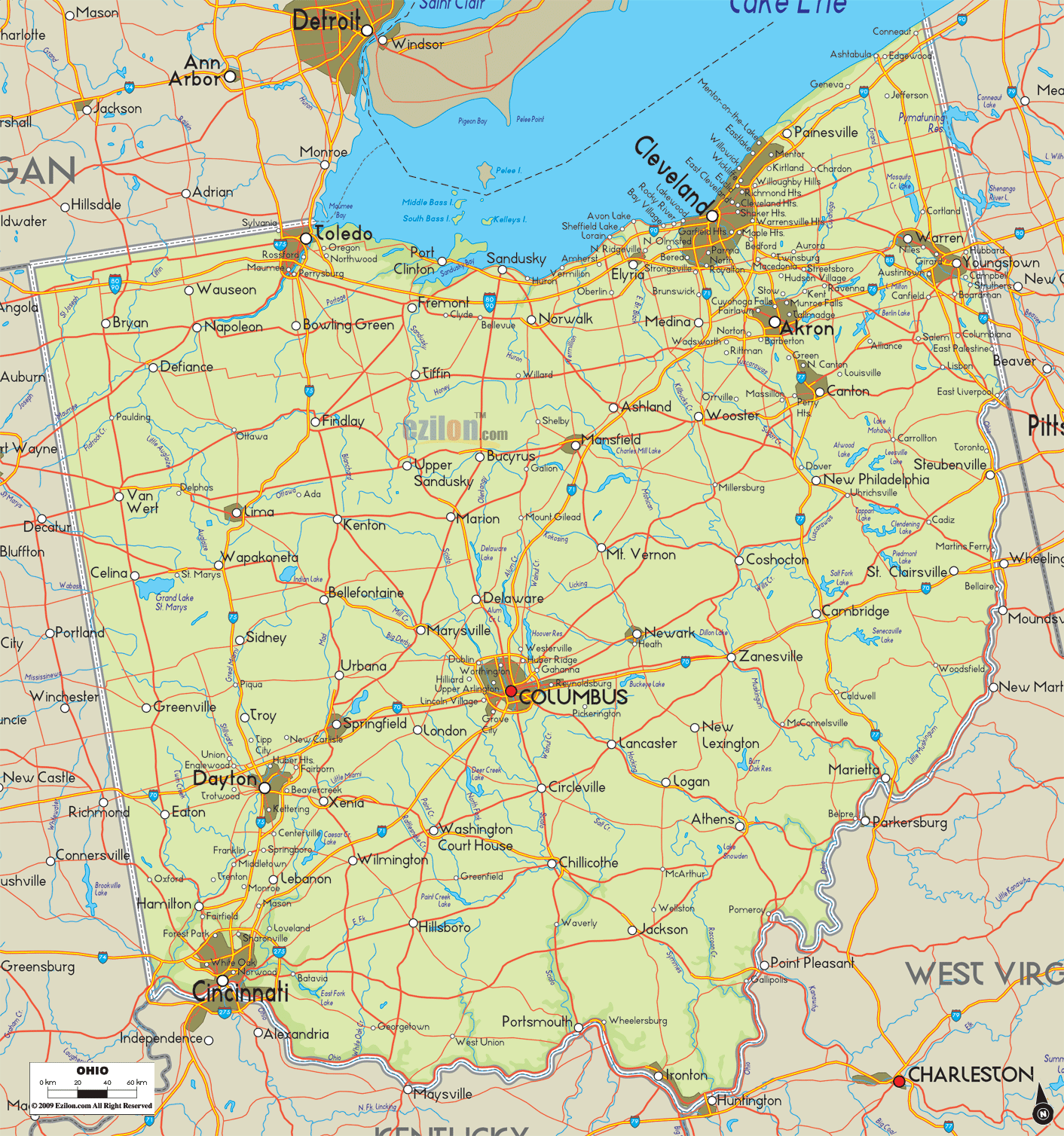
Description: The Physical map of Ohio State, USA showing major geographical features such as rivers, lakes, topography and land formations.

Detailed Physical map of Ohio with elevations and other topographic features such as mountains, rivers and lakes. For county boundaries, cities, and roads, see our County and Road Map of Ohio. Ohio borders Michigan, Indiana, Kentucky, West Virginia and Pennsylvania. The geographical map of Ohio looks busy with cities and roads. Yet still, though there are blue rivers and shade relief on this map, as well as a bright strip for Lake Erie along the northern border, every road and settlement in the state is shaped by landforms. This map can help residents, visitors, and geography students trace how the Lake Erie shore, the Central Till Plains, and the Appalachian Plateau fit together.
Ohio appears as a roughly rectangular area framed by Michigan to the northwest, Indiana to the west, Kentucky and West Virginia along the Ohio River to the south, and Pennsylvania to the east. The top of the map shows the blue water of Lake Erie with port cities such as Toledo, Sandusky, and Cleveland marked as bright circles. Columbus, Cincinnati, Dayton, Akron, and Canton are the inland cities shown on the map. A network of highways and rivers weaves through pale green plains and light shaded hills between them, evidence of how gentle terrain can support dense transport networks.
Following the top of the physical map, the Lake Erie shoreline stands out as the most prominent natural boundary. The coast forms a slightly curved line from Toledo in the west through Port Clinton, Sandusky, and Lorain to Cleveland, Ashtabula, and the Pennsylvania state line. The water is rendered in bright blue, while narrow lowlands just inland are shown with soft shading, indicating a gentle coastal plain.
This region is essential for shipping and recreation. Maumee Bay, around Toledo, and the islands off Sandusky connect ports, fishing grounds, ferries, and beaches. On the map of Ohio, the main highways and rail lines run close to the shore, showing that transportation follows the easiest terrain. Students can see that the Lake Erie coast acts as a natural corridor linking Michigan, Ohio, Pennsylvania, and New York.
West of Toledo, the map shows the Maumee River flowing from Indiana into Lake Erie. This river drains a broad area of northwestern Ohio that was once covered by the waters of glacial Lake Maumee. The land here is very flat and fertile, which the map suggests with minimal relief shading and a dense grid of small towns such as Napoleon, Defiance, Bryan, and Wauseon. For travelers, this detailed map makes it easy to understand why straight rural roads and farm fields dominate the northwest.
At the center of the physical map, the city of Columbus stands out with a large label and a cluster of roads radiating outward. Surrounding Columbus, the colored shading remains light and even, reflecting the glaciated till plains that cover most of central Ohio. Ice sheets from the last glaciation left behind a smooth mantle of sediments that support agriculture and make road building simple.
This map shows many small towns in this plain, including Delaware, Marysville, London, Circleville, Lancaster, Newark, and so on. The Scioto, Olentangy, and Licking river valleys tend to be shallow, but the relief is generally gentle. Geography students can use this part of the map to discuss how glaciation smooths landscapes and produces rich soils that attract population and trade routes.
The Scioto River is a significant physical feature running from the Appalachian foothills through Columbus to the Ohio River. On the map, it can be followed from Portsmouth in the south through Chillicothe, Circleville, and Columbus, then northward toward Marion and Upper Sandusky via its tributaries. The river flows in a broad blue band with several narrow blue threads. The roads and towns are gathered in the valley of the river.
Their alignment indicates the early trade and canals, and later highways, followed river corridors. Planning to drive? The map shows that the Scioto Valley makes for a beautiful drive, linking historic towns, state parks, and farmland, with only gradual elevation changes.
Turning to the western side of the physical map of Ohio, you find the Miami Valley, where the Great Miami River flows from near the northern border past Piqua, Troy, Dayton, and Hamilton toward Cincinnati. Branches such as the Stillwater River and the Mad River are also marked, joining the main channel around Dayton.
The valleys are older than the ice cover but may be less actively eroded. Cities and transport lines are in flat areas near rivers and in suburbs, while farms and woodland are on slightly higher ground. Looking at the detailed map, we can see that the Dayton area developed where multiple river valleys joined to supply water, power, and easy travel.
The map shows a large curve of the Ohio River by Cincinnati in the lower left corner. Here, the river serves as both a physical and political boundary between Ohio and Kentucky. The map of Cincinnati suggests a rather dense city. There are many roads and bridges linking Cincinnati to Covington and Newport across the river. The surrounding area has much more relief, with low hills here.
This terrain explains why older neighborhoods occupy benches above the river while steep, wooded slopes remain less developed. Travelers can use the map to see that routes entering Cincinnati often follow the river valley or cross at narrow points, illustrating how the valley constrains road design.
The Appalachian Plateau occupies most of southeastern Ohio; therefore, the shading on this map is particularly more complex, but it narrows the state significantly. The streets wind their way, and the river valleys are tight in Athens, Logan, Nelsonville, New Lexing, Cambridge, Marrietta, and St. Clairs… This pattern shows hills and streams, unlike the vast, flat landscape on the road to Columbus.
Rivers like the Hocking, Muskingum, and Little Muskingum are visible as twisting blue lines that join the Ohio River. The relief shading around them suggests narrow ridges and valleys, typical of a dissected plateau. This part of the geographical map of Ohio helps students understand why towns here are smaller, roads are more curving, and forests remain more extensive than in the central plains.
The Ohio River, an essential river in the USA, runs along the southern edge of Kentucky from east to west. The river runs from Cincinnati eastward past Portsmouth, separating Ohio from Kentucky and West Virginia. In many places, the physical map shows steep valley walls, especially in the southeast corner, where the hill region meets the river.
For travelers, this detailed map suggests scenic drives along the river, riverfront parks, and historic river towns that grew with the steamboat trade. It also illustrates why some highways stay close to the river while others climb to the plateau before continuing inland.
In the northeast corner of the map, the Cleveland-Akron corridor stands out as one of the densest urban regions in Ohio. Cleveland sits on the Lake Erie shore with the Cuyahoga River bending through its industrial flats before reaching the lake. Farther south, Akron, Canton, and Massillon occupy the uplands along the upper Cuyahoga and Tuscarawas Rivers.
The Ohio physical map shows that the region lies where glacial plains end and the Appalachian Plateau begins. Therefore, it has gentle slopes and small valleys. The well-known Cuyahoga Valley, between Cleveland and Akron, is a narrow river corridor of the same name that has been partly protected as a national park. From a student's perspective, its presence on the map helps geography students relate industrial development, canal routes, and protected natural areas to a single valley system.
East of Akron and Canton, one finds Youngstown, Steubenville, and East Liverpool, which are aligned with the Penn and West Virginia borders and divides. The Appalachian form that appears in southeastern Ohio is less able to cushion against shading. The Mahoning River valley, the Beaver River valley, and the Tuscarawas River valley are included.
This pattern on the geographical map of Ohio reminds readers that eastern Ohio shares many features with western Pennsylvania and northern West Virginia: hills, coal-bearing strata, and river valleys that supported steel and mining industries.
Geography teachers can use this high terrain map to explain a range of physical processes. Glaciation appears in the smooth plains of the northwest and center, while river erosion dominates the Appalachian Plateau. By doing this, students can trace the main drainage divides from Lake Erie to the Ohio River basin and back up the rivers feeding the first set, and observe how those waters eventually make their way to the ocean via the St. Lawrence and Mississippi systems.
Because the map labels many towns and highways, it also supports lessons linking physical and human geography. For example, students may want to inquire about why large cities cluster along rivers and coasts. Or, why not hilly areas where interstate highways cross the central plains?
For travelers, this detailed map serves as a planning tool for road trips, cycling routes, and outdoor adventures. People interested in boating can follow the inlets of Lake Erie, the Ohio River, and inland reservoirs. Hikers and campers can locate state parks and forests in the Appalachian hills around Athens, Logan, and Marietta. Visitors who want a mixed bag of city fun and nature-related activities can pair urban centers like Columbus, Cleveland, or Cincinnati with day trips into valleys and parks at arm's length, riffing on the rivers and relief features.
This Ohio physical map is intended for online viewing as part of a curated collection. It should not be printed, copied, downloaded, or redistributed. Users can study and enjoy the map directly on the website while respecting these rules, which protect the cartographic work and data.
It shows Lake Erie shoreline, major rivers, glaciated plains, Appalachian hills, and the locations of cities, towns, and highways across the state.
You can follow highways along river valleys, link major cities like Cincinnati, Columbus, and Cleveland, and choose scenic routes through hills or across open plains.
The map highlights the Ohio, Scioto, Great Miami, Maumee, Muskingum, Cuyahoga, and Hocking Rivers as key waterways that organize the landscape.
Yes, gentle shading marks glaciated lowlands while more textured shading in the southeast and east reveals the Appalachian Plateau hills.
No, the Ohio map is only for viewing on the site and printing, copying, downloading, or redistributing it is not allowed.
The map labels many small towns and uses clear symbols, so it is reliable for regional orientation, though detailed street navigation still requires a local map or GPS.
Ohio has Lake Erie coastal lowlands in the north, glaciated till plains through the center and west, and Appalachian Plateau hills in the southeast and east.
Rivers like the Ohio, Scioto, Great Miami, and Cuyahoga offered transport, water power, and trade routes, so cities grew where navigation and crossings were easiest.
Central and western Ohio around Columbus, Dayton, and Lima are known for broad, gently rolling farmland on glacial till plains.
The hilliest terrain lies in southeastern and eastern counties around Athens, Logan, Marietta, and St. Clairsville on the Appalachian Plateau.
It shows a continuous coast with ports like Toledo, Sandusky, Lorain, Cleveland, and Ashtabula along with bays and offshore islands.
Students can trace river systems, mark drainage divides, identify physical regions, and connect cities to nearby landforms directly on the map.
Cincinnati is located at the confluence of the Great Miami valley system and the Ohio River, making it a major transportation hub.
Columbus lies in the middle of the glaciated plains, where roads and rail lines from every direction meet on relatively level ground.
The Cuyahoga Valley lies between Cleveland and Akron, following the bend of the Cuyahoga River and containing a national park and canal corridor.
Eastern counties along the Ohio River and near Youngstown, Steubenville, and East Liverpool have strong historic links to coal mining and steel production.
Hiking, camping, rock climbing, hunting, and exploring state parks and forests are common in the Hocking Hills and other plateau areas.
Northern Ohio near Lake Erie often has cooler summers and lake effect snow, while southern Ohio along the Ohio River tends to be slightly warmer with longer growing seasons.
Lake Erie supports shipping, fishing, recreation, and tourism while also influencing local climate and providing habitat for many bird and fish species.
Glaciated plains and gentle terrain allow roads and rail lines to follow nearly straight routes without large mountain barriers.
The Appalachian Plateau in the southeast and east has more continuous forest cover, especially where slopes are steep and soils are thin.
The river is shown as a continuous blue boundary along the south and southeast edges, with towns like Cincinnati, Portsmouth, and Marietta marking key crossings.
Most inland lakes are reservoirs created by dams on rivers, but they still appear on the map as important recreation and water storage areas.
Western Ohio supports corn, soybeans, wheat, and livestock on fertile glacial soils, leading to a landscape of fields, barns, and small market towns.
Urban regions appear as dense clusters of roads and place names, while rural areas show wider spacing between towns and more open space between highways.
The valley still carries barge traffic, rail lines, and major highways that link the Midwest with the South and Appalachian regions.
You could base yourself in Columbus, Cleveland, Cincinnati, or Akron and use the short distances on the map to reach nearby rivers, parks, and forests for day trips.
Northern rivers like the Maumee, Sandusky, and Cuyahoga flow to Lake Erie, while central and southern rivers such as the Scioto, Great Miami, and Muskingum drain into the Ohio River.
Ohio can face river flooding, severe thunderstorms, winter storms, and occasional tornadoes, but it lacks major earthquakes or active volcanoes.
They should expect frequent towns and services on main routes, but still carry water, check weather forecasts, and plan fuel stops, especially when crossing hilly plateau areas in the southeast.

Counties and Road Map of Ohio
Counties and Road map and map image of Ohio.

Regional Directory of Canada
Information and guide about Canada and website listing.

Regional Directory of United States of America
Information and guide about United States of America and websites with American topics.

Regional Directory of Europe
Information and guide about Europe and websites with European topics.

Regional Directory of Australia
Information and guide about Australia and websites with Australian topics.