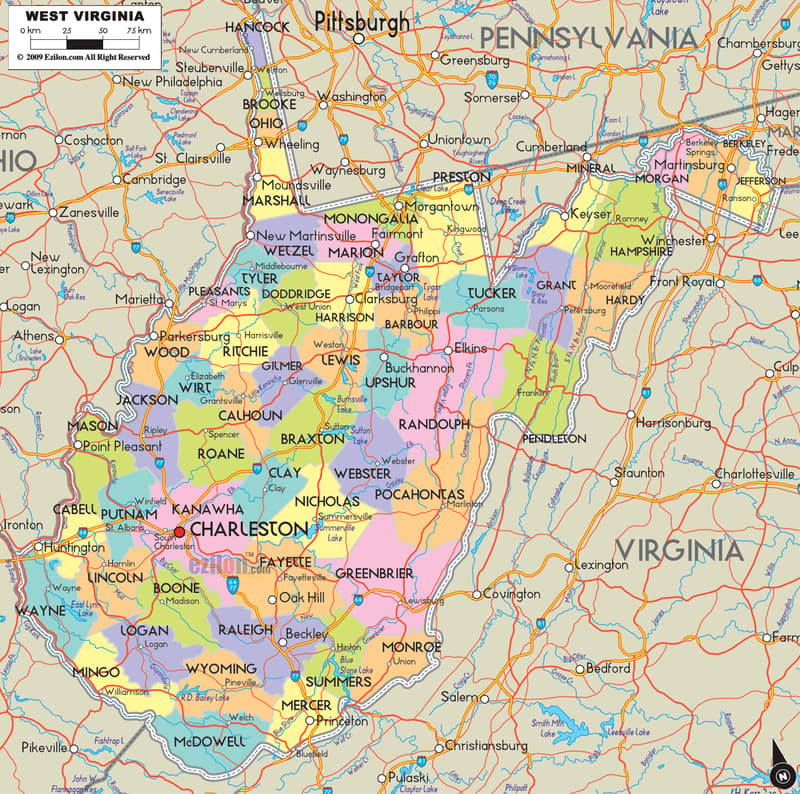
Description: Detailed large map of West Virginia State, USA showing cities, towns, county formations, roads highway, US highways and State routes.
Map of West Virginia (USA). West Virginia map with cities, counties, and towns. Use this detailed map to understand West Virginia's full county grid, every administrative capital (county seat), the major cities and towns, bordering states and waters, and a few highway cues for orientation only. It is the best map style for residents, travelers, and geography students who want clarity without road clutter. West Virginia's shape stands out among the states, two panhandles reaching off a mountainous core in opposite directions, and the map's 55 counties are exactly what makes sense of that shape. The Northern Panhandle threads Hancock, Brooke, Ohio, and Marshall counties along the Ohio River between Ohio and Pennsylvania, while the Eastern Panhandle reaches toward Maryland and Virginia through Morgan, Berkeley, and Jefferson counties along the Potomac. In between, the state's anchor cities line up along a handful of interstates: Charleston in Kanawha County, Huntington in Cabell County, Morgantown in Monongalia County, Parkersburg in Wood County, and Wheeling in Ohio County.
Borders and waters at a glance: Ohio runs the entire western edge along the Ohio River, from Hancock County down to Wayne County. Pennsylvania borders the north through the Northern Panhandle plus Monongalia and Preston counties. Maryland runs along the Potomac past the Eastern Panhandle counties and on through Mineral and Hampshire counties. Virginia forms the long eastern and southern line from Jefferson County down through the Alleghenies to Mingo County, and Kentucky closes the southwest corner along the Tug Fork through McDowell, Mingo, and Wayne counties. Five rivers do most of the orientation work on this map: the Ohio, Kanawha, Monongahela, Potomac, and New. Light corridor cues for I-79, I-64, I-77, I-68, and I-81 help place the state's cities without cluttering the county grid.
West Virginia's shape on the map comes from two panhandles pointing in opposite directions. The Northern Panhandle narrows to a thin finger between Ohio and Pennsylvania through Hancock, Brooke, Ohio, and Marshall counties along the Ohio River, while the Eastern Panhandle reaches toward Maryland and Virginia through Morgan, Berkeley, and Jefferson counties along the Potomac. Ohio runs the entire western edge along the Ohio River from Hancock County down to Wayne County. Pennsylvania borders the north through the Northern Panhandle plus Monongalia and Preston counties. Maryland runs along the Potomac past the Eastern Panhandle counties and on through Mineral and Hampshire counties. Virginia forms the long eastern and southern line from Jefferson County down through the Alleghenies to Mingo County, and Kentucky closes the southwest corner along the Tug Fork through McDowell, Mingo, and Wayne counties. All 55 counties are shown, and the Ohio, Kanawha, Monongahela, Potomac, and New rivers act as the main orientation lines running through the state. Light corridor cues for I-79, I-64, I-77, I-68, and I-81 help place the state's anchor cities: Charleston in Kanawha County, Huntington in Cabell County, Morgantown in Monongalia County, Parkersburg in Wood County, and Wheeling in Ohio County.
The slender finger between Ohio and Pennsylvania stacks four counties along the Ohio River. Hancock County (seat: New Cumberland) tops the state and is West Virginia's smallest county by land area, with Weirton's steel mills close to the Pennsylvania line and river bridges leading over to Steubenville, Ohio. Brooke County (seat: Wellsburg) continues the ribbon of river towns just south of Hancock. Ohio County (seat: Wheeling) centers on Wheeling, the old National Road hub, with the county wrapped around the river's broad bend. Marshall County (seat: Moundsville) faces Bellaire, Ohio across the water and widens toward rugged interior hills to the east.
The thumb beyond the Potomac curves into the I-81 corridor, and it feels closer to the Washington, D.C. suburbs than the rest of the state. Morgan County (seat: Berkeley Springs) holds the historic spa town tucked into the angle between the Cacapon and Potomac rivers. Berkeley County (seat: Martinsburg) is the corridor's hub and one of the state's fastest-growing counties, with I-81 running straight through Martinsburg toward Hagerstown, Maryland. Jefferson County (seat: Charles Town) reaches the meeting point of the Potomac and Shenandoah rivers, and Harpers Ferry sits right where West Virginia, Maryland, and Virginia come together.
From the Monongahela River down through the Tygart and West Fork valleys, seven counties form a tight energy and university belt. Monongalia County (seat: Morgantown) anchors West Virginia University right on the Pennsylvania line, where I-79 and I-68 meet. Marion County (seat: Fairmont) sits just south along the Monongahela, with Fairmont built around paired river crossings. Harrison County (seat: Clarksburg) stretches along US-50, with Bridgeport and the North Central WV Airport close by. Taylor County (seat: Grafton) is known for Tygart Lake and a deep railroad history. Barbour County (seat: Philippi) sits on the Tygart Valley River, home to one of the country's few remaining covered bridges still carrying daily traffic. Upshur County (seat: Buckhannon) is a crossroads town on US-33 surrounded by valley farms. Lewis County (seat: Weston) sits near Stonewall Jackson Lake, close to the I-79 corridor.
The shaded county tiles step like shingles over the Allegheny Front in the state's high country. Preston County (seat: Kingwood) frames the Cheat River canyons near the Pennsylvania line, just off I-68. Tucker County (seat: Parsons) is smaller, sitting where the Shavers Fork meets the Black Fork. Randolph County (seat: Elkins), one of the biggest tiles on the map, marks where US-33 meets the upper Tygart Valley River and serves as the cultural gateway to the Monongahela National Forest. Pocahontas County (seat: Marlinton) spreads across high mountain balds with the Greenbrier River tracing through it. Webster County (seat: Webster Springs) sits west of Pocahontas along rougher valley roads. Pendleton County (seat: Franklin) runs along the Virginia line with Spruce Knob, the state's highest point, tucked inside its borders. Grant County (seat: Petersburg) and Hardy County (seat: Moorefield) flank the South Branch Potomac through fertile river bottoms. Mineral County (seat: Keyser) and Hampshire County (seat: Romney) continue the Potomac arc toward Maryland.
South of the Northern Panhandle, the Ohio Valley opens into rolling river-bottom towns. Wetzel County (seat: New Martinsville) and Tyler County (seat: Middlebourne) sit along river flats with hills backing up behind them. Pleasants County (seat: St. Marys) is one of the smaller counties on the map by population. Wood County (seat: Parkersburg) is the busiest stretch of this reach, with Parkersburg sitting where the Little Kanawha River meets the Ohio, directly across from Marietta, Ohio.
Inland from the river, six counties climb into oil and gas country. Wirt County (seat: Elizabeth) is a compact tile squeezed between Wood and Calhoun counties. Ritchie County (seat: Harrisville) and Doddridge County (seat: West Union) climb toward US-50 through quiet uplands. Gilmer County (seat: Glenville) and Calhoun County (seat: Grantsville) sit deeper in the hills near the Little Kanawha River. Roane County (seat: Spencer) rounds out the cluster, a wooded interior county east of the river valley.
Jackson County (seat: Ripley) sits on I-77 between Parkersburg and Charleston. Mason County (seat: Point Pleasant) fronts the Ohio at the mouth of the Kanawha River, where the two rivers meet across from Gallipolis, Ohio.
The map centers on Kanawha County (seat: Charleston), where the Kanawha River bends beneath the state capitol dome and I-64 crosses I-77 near downtown. Putnam County (seat: Winfield) sits just downstream, a fast-growing bedroom county between Charleston and Huntington. Boone County (seat: Madison) runs south along US-119 into coal country. Clay County (seat: Clay) holds wooded interior ridges east of the Kanawha. Braxton County (seat: Sutton) sits on I-79 with Sutton Lake nearby and Flatwoods marked at the interstate junction. Nicholas County (seat: Summersville) is known for Summersville Lake, with US-19 crossing the county on its way toward the New River Gorge.
Cabell County (seat: Huntington) anchors the Tri-State metro where West Virginia, Ohio, and Kentucky meet, with I-64 running straight through downtown Huntington to the Ohio River bridges. Wayne County (seat: Wayne) sits just south, edging both the Ohio River and the Kentucky line. Lincoln County (seat: Hamlin) bridges the Guyandotte River headwaters between Cabell and Boone counties.
Logan County (seat: Logan) runs north toward Kanawha along the Guyandotte River. Mingo County (seat: Williamson), the newest county in the state, hugs the Tug Fork right at the Kentucky line. Wyoming County (seat: Pineville) and McDowell County (seat: Welch) sit deep in the coalfields along narrow valleys carved by the Guyandotte and Tug Fork.
Fayette County (seat: Fayetteville) holds the New River Gorge Bridge, with Oak Hill nearby and US-19 crossing the gorge on its way south. Raleigh County (seat: Beckley) anchors the Turnpike highlands just south, where I-64 meets I-77.
Summers County (seat: Hinton) marks the confluence of the Greenbrier and New rivers, with Bluestone Lake just upstream. Greenbrier County (seat: Lewisburg) sits along I-64 with White Sulphur Springs toward the Virginia line. Monroe County (seat: Union) occupies the southeastern corner, with karst plateaus and sinkholes across its farmland. Mercer County (seat: Princeton) closes out the region next to Bluefield on the Virginia line, where I-77 dips south through East River Mountain.
Because every county block is colored and every seat is printed in a consistent symbol, the eye can answer everyday questions fast. Which county is Beckley in? Raleigh. Where does Martinsburg sit? Berkeley, along I-81 near the Maryland line. Which seat serves the New River Gorge? Fayetteville in Fayette County. What is the seat in the state's far southern tip? Welch in McDowell. Where is Wheeling relative to Charleston? North through the Northern Panhandle, well up I-79 and I-70. That is the value of this detailed map for residents and visitors alike: counties first, with just enough road network to anchor direction.
Five rivers do most of the orientation work on this page. The Ohio River traces the entire western border from Hancock County to Wayne County. The Kanawha River runs through the capital, bending beneath Charleston before joining the Ohio at Point Pleasant. The Monongahela River flows north through Marion and Monongalia counties toward Pittsburgh. The Potomac River and its South Branch trace the Eastern Panhandle and the Potomac Highlands, forming the Maryland line. The New River cuts the dramatic gorge through Fayette and Summers counties on its way to becoming the Kanawha. Keep these five in mind and any county on the map is easy to place.
The road layer is intentionally minimal. I-79 runs Charleston to Clarksburg to Fairmont to Morgantown and on to the Pennsylvania line. I-64 runs Huntington to Charleston to Beckley to Lewisburg and on to Virginia. I-77 runs Parkersburg to Ripley to Charleston, joins I-64 through the Beckley corridor, then continues south to Princeton and the Virginia line. I-68 connects Morgantown east to Maryland. I-81 threads the Eastern Panhandle through Martinsburg toward Hagerstown, Maryland. None of these are meant for turn-by-turn navigation, only as county-placement cues.
Every one of West Virginia's 55 counties and its seat, in alphabetical order: Barbour County (Philippi), Berkeley County (Martinsburg), Boone County (Madison), Braxton County (Sutton), Brooke County (Wellsburg), Cabell County (Huntington), Calhoun County (Grantsville), Clay County (Clay), Doddridge County (West Union), Fayette County (Fayetteville), Gilmer County (Glenville), Grant County (Petersburg), Greenbrier County (Lewisburg), Hampshire County (Romney), Hancock County (New Cumberland), Hardy County (Moorefield), Harrison County (Clarksburg), Jackson County (Ripley), Jefferson County (Charles Town), Kanawha County (Charleston), Lewis County (Weston), Lincoln County (Hamlin), Logan County (Logan), Marion County (Fairmont), Marshall County (Moundsville), Mason County (Point Pleasant), McDowell County (Welch), Mercer County (Princeton), Mineral County (Keyser), Mingo County (Williamson), Monongalia County (Morgantown), Monroe County (Union), Morgan County (Berkeley Springs), Nicholas County (Summersville), Ohio County (Wheeling), Pendleton County (Franklin), Pleasants County (St. Marys), Pocahontas County (Marlinton), Preston County (Kingwood), Putnam County (Winfield), Raleigh County (Beckley), Randolph County (Elkins), Ritchie County (Harrisville), Roane County (Spencer), Summers County (Hinton), Taylor County (Grafton), Tucker County (Parsons), Tyler County (Middlebourne), Upshur County (Buckhannon), Wayne County (Wayne), Webster County (Webster Springs), Wetzel County (New Martinsville), Wirt County (Elizabeth), Wood County (Parkersburg), and Wyoming County (Pineville).
West Virginia borders Pennsylvania to the north, Maryland to the northeast, Virginia to the east and south, Kentucky to the southwest, and Ohio along the entire western edge via the Ohio River. The state holds 55 counties. Randolph County is the largest by land area at about 1,040 square miles, while Hancock County is the smallest at about 83 square miles. Kanawha County is the most populous at roughly 172,381 residents, and Wirt County is the least populous at roughly 4,879 residents. Hampshire County, established in 1754, is the oldest county, and Mingo County, established in 1895, is the newest. West Virginia covers about 24,230 square miles in total, with about 24,038 square miles of land. The capital, Charleston, sits in Kanawha County along the Kanawha River, and the state's major population centers run from Wheeling and Weirton in the Northern Panhandle, through Morgantown, Clarksburg, and Fairmont in the north-central belt, down to Charleston and Huntington in the Kanawha and Tri-State corridors, and out to Martinsburg in the Eastern Panhandle. Landscape-wise, the state sits almost entirely within the Allegheny and Appalachian Plateau, rising into the Potomac Highlands and the Alleghenies in the east, with the Ohio River tracing a long curving boundary along the entire west side.
West Virginia's ten largest cities by current population are Charleston (about 47,918, Kanawha County), Huntington (about 46,189, Cabell County), Morgantown (about 30,273, Monongalia County), Parkersburg (about 29,461, Wood County), Wheeling (about 26,670, Ohio County), Martinsburg (about 18,805, Berkeley County), Weirton (about 18,785, Hancock County), Fairmont (about 18,303, Marion County), Beckley (about 16,977, Raleigh County), and Clarksburg (about 15,829, Harrison County). Charleston anchors state government along with a growing health care and finance sector, while Huntington's Marshall University and the Tri-State's rail and river shipping keep Cabell County busy. Morgantown's West Virginia University drives the north-central belt's economy alongside a growing energy-research and biotech corridor. Coal and natural gas still matter most in the southern coalfields, spanning Boone, Logan, Mingo, Wyoming, McDowell, and Raleigh counties, alongside a growing natural gas and pipeline industry tied to Marcellus and Utica shale drilling across the north-central and Northern Panhandle counties. The chemical industry built up around the Kanawha Valley in Kanawha and Putnam counties, once nicknamed Chemical Valley, still anchors manufacturing there today. Steel and glassmaking shaped the Northern Panhandle around Weirton and Wheeling for generations. Agriculture runs smaller-scale here than in flatter states, concentrated in the Eastern Panhandle's orchards and the poultry farms of the eastern hill counties. With the Ohio River forming the entire western border, river barge traffic through Huntington and Parkersburg still moves coal, chemicals, and grain even though the state has no coastline.
West Virginia's identity is tied closely to its mountains, coal camps, and rivers. The state's labor history runs deep in the southern coalfields, where Logan, Mingo, and Boone counties saw the Battle of Blair Mountain and decades of mine-worker organizing that shaped American labor law. Bluegrass, old-time, and gospel music trace back to the hollows of the Potomac Highlands and the Greenbrier Valley, celebrated each year at festivals in Randolph and Pocahontas counties. The New River Gorge in Fayette County, now a national park, anchors the state's whitewater rafting and rock climbing scene, while Harpers Ferry in Jefferson County marks a pivotal site from John Brown's raid and the Civil War. Higher education spreads across the map too, with West Virginia University in Morgantown (Monongalia County), Marshall University in Huntington (Cabell County), and smaller colleges in Elkins, Buckhannon, and Shepherdstown rounding out the state's academic centers. The Greenbrier resort in White Sulphur Springs, Greenbrier County, has hosted presidents and foreign dignitaries for more than two centuries.
On this map, Spruce Knob (Allegheny Mountains, Pendleton County) and the Ohio, Kanawha, and Potomac rivers double as landmarks for finding counties quickly. For elevation, terrain, watersheds, and land-cover detail, see our Physical Map of West Virginia.
West Virginia has a humid continental to humid subtropical climate, with colder winters and shorter summers in the higher Potomac Highlands than in the lower river valleys. For a full seasonal and biome breakdown, see our Physical Map of West Virginia.
North-south travel runs mainly on I-77, which becomes the West Virginia Turnpike between Charleston and Princeton, and on I-79, which threads Charleston through Clarksburg to Morgantown and the Pennsylvania line. East-west travel splits into two corridors: I-64 crosses the south from Huntington through Charleston and Beckley to the Virginia line, while I-68 connects Morgantown to Maryland and I-81 runs the length of the Eastern Panhandle through Martinsburg. Keep in mind that ZIP codes do not follow county lines in West Virginia, so a single ZIP code can span two counties, and the mountainous terrain means travel times between towns are often longer than straight-line distance would suggest. Always confirm the county name directly from the map or index rather than assuming it from a ZIP prefix or driving time.
Use this as a quick index. Every line lists the county with its county seat and a short river, border, or corridor cue, grouped by the same natural regions used above.
Berkeley – Martinsburg; I-81 corridor hub.
Jefferson – Charles Town; Potomac and Shenandoah confluence, Harpers Ferry.
Morgan – Berkeley Springs; Cacapon-Potomac angle.
Hancock – New Cumberland; smallest county by area.
Brooke – Wellsburg; Ohio River ribbon town.
Ohio – Wheeling; National Road hub.
Marshall – Moundsville; opposite Bellaire, Ohio.
Monongalia – Morgantown; WVU and the I-79/I-68 junction.
Marion – Fairmont; Monongahela River crossings.
Harrison – Clarksburg; US-50 corridor.
Taylor – Grafton; Tygart Lake.
Barbour – Philippi; Tygart Valley River covered bridge.
Upshur – Buckhannon; US-33 crossroads.
Lewis – Weston; Stonewall Jackson Lake.
Preston – Kingwood; Cheat River canyons.
Tucker – Parsons; Shavers Fork and Black Fork confluence.
Randolph – Elkins; largest county by area.
Pocahontas – Marlinton; Greenbrier River headwaters.
Webster – Webster Springs; rough interior valleys.
Pendleton – Franklin; Spruce Knob, the state's high point.
Grant – Petersburg; South Branch Potomac bottoms.
Hardy – Moorefield; South Branch Potomac bottoms.
Mineral – Keyser; Potomac arc toward Maryland.
Hampshire – Romney; oldest county in the state.
Kanawha – Charleston; state capital, most populous county.
Putnam – Winfield; Charleston-Huntington bedroom county.
Boone – Madison; US-119 coal corridor.
Clay – Clay; wooded interior ridges.
Braxton – Sutton; Sutton Lake off I-79.
Nicholas – Summersville; Summersville Lake.
Wetzel – New Martinsville; Ohio River flats.
Tyler – Middlebourne; Ohio River flats.
Pleasants – St. Marys; smaller by population.
Wood – Parkersburg; Little Kanawha and Ohio confluence.
Wirt – Elizabeth; least populous county.
Ritchie – Harrisville; US-50 uplands.
Doddridge – West Union; US-50 uplands.
Gilmer – Glenville; Little Kanawha hill country.
Calhoun – Grantsville; Little Kanawha hill country.
Roane – Spencer; wooded interior county.
Jackson – Ripley; I-77 between Parkersburg and Charleston.
Mason – Point Pleasant; Kanawha-Ohio confluence.
Cabell – Huntington; Tri-State metro anchor.
Wayne – Wayne; Ohio River and Kentucky line.
Lincoln – Hamlin; Guyandotte River headwaters.
Logan – Logan; Guyandotte River valley.
Mingo – Williamson; newest county, Tug Fork.
Wyoming – Pineville; deep coalfields.
McDowell – Welch; deep coalfields, Tug Fork.
Fayette – Fayetteville; New River Gorge Bridge.
Raleigh – Beckley; I-64/I-77 junction.
Summers – Hinton; Greenbrier and New River confluence.
Greenbrier – Lewisburg; I-64, White Sulphur Springs.
Monroe – Union; karst plateau farmland.
Mercer – Princeton; Bluefield and the Virginia line.
This directory aligns with what you see on the page: every county, its seat, and a one-line locator that keeps the focus on counties rather than driving steps.
West Virginia has 55 counties, all labeled and color-shaded on the map.
Charleston, in Kanawha County, along the Kanawha River.
Charleston is in Kanawha County; Huntington is in Cabell County.
Hancock, Brooke, Ohio, and Marshall counties, along the Ohio River.
Morgan, Berkeley, and Jefferson counties, along the Potomac River.
Morgantown is in Monongalia County, near the Pennsylvania line.
Martinsburg, along I-81 in the Eastern Panhandle.
Jefferson, Hardy, Pendleton, Pocahontas, Greenbrier, Monroe, Summers, Mercer, McDowell, Wyoming, and Mingo.
Hancock, Brooke, Ohio, Marshall, Wetzel, Tyler, Pleasants, Wood, Jackson, Mason, Cabell, and Wayne, along the Ohio River.
Hancock, Brooke, Ohio, and Marshall in the Northern Panhandle, plus Monongalia and Preston.
Morgan, Berkeley, Jefferson, Mineral, and Hampshire, along the Potomac River.
McDowell, Mingo, and Wayne, along the Tug Fork and Big Sandy.
In Fayette County, near Fayetteville, along US-19.
Cabell County (Huntington), plus Wayne and Lincoln counties.
Ohio County.
Parkersburg.
Raleigh County, at the I-64/I-77 junction.
Lewisburg.
Randolph, Pocahontas, Webster, Tucker, and Pendleton counties.
Randolph County.
Seat of Berkeley County, along I-81.
Jackson, Mason, Cabell, and Wayne counties.
Princeton, with Bluefield nearby on the Virginia line.
Seat of Morgan County, in the Eastern Panhandle.
Mason County, at the Kanawha-Ohio confluence.
Marion County, on the Monongahela River.
Preston County.
I-64, I-77, I-79, I-68, I-81, US-50, US-19, and US-33.
Nicholas County.
Hardy County.
Romney, along the South Branch Potomac.
McDowell County, in the southern coalfields.
Harrison County, on US-50.
Greenbrier County.
Summers County, at Hinton.
No. Printing or copying our maps from the site is not permitted.
Randolph County, at about 1,040 square miles.
Hancock County, at about 83 square miles.
Kanawha County, with roughly 172,381 residents.
Wirt County, with roughly 4,879 residents.
Charleston, in Kanawha County, with about 47,918 residents.
Hampshire County, established in 1754.
No. ZIP codes cross county lines, so use the county boundaries and seats shown here instead.

Physical Map of West Virginia
Physical map and map image of West Virginia.

Regional Directory of Canada
Information and guide about Canada and website listing.

Regional Directory of United States of America
Information and guide about United States of America and websites with American topics.

Regional Directory of Europe
Information and guide about Europe and websites with European topics.

Regional Directory of Australia
Information and guide about Australia and websites with Australian topics.