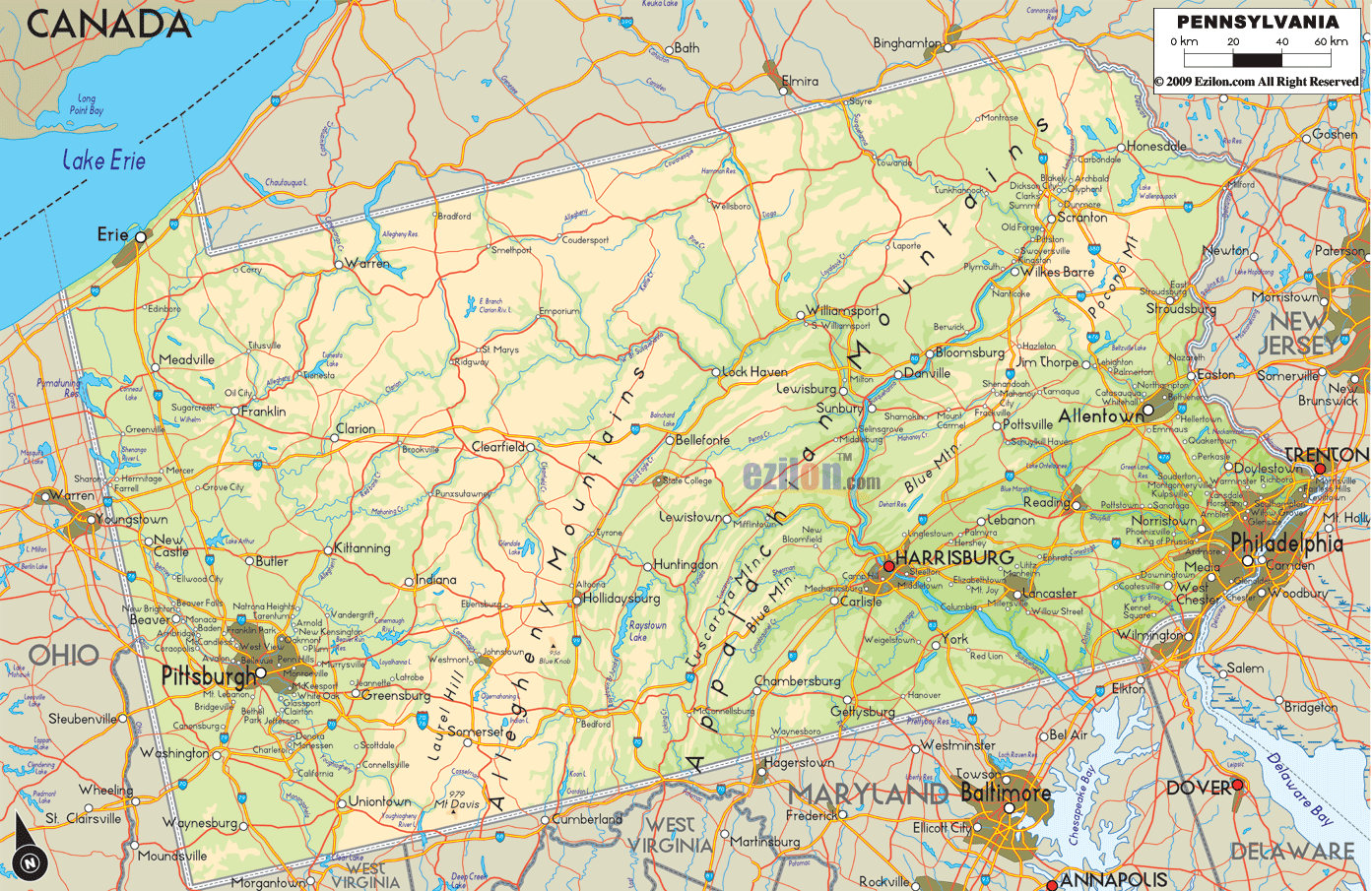
Description: The Physical map of Pennsylvania State, USA showing major geographical features such as rivers, lakes, mountains, topography and land formations.

Detailed Physical map of Pennsylvania with elevations and other topographic features such as mountains, rivers and lakes. Pennsylvania borders New York, New Jersey, Delaware, Maryland, West Virginia and Ohio. From Lake Erie in the northwest to the Delaware River along the eastern border, the detailed map shows how landforms influence every major city and travel corridor. For county boundaries, cities, and roads, see our County and Road Map of Pennsylvania.
Pennsylvania sits between Ohio, West Virginia, Maryland, Delaware, New Jersey, New York, and the Canadian border at Lake Erie. On our map, you can trace these borders and immediately notice how the state stretches east to west, which explains the wide variety of landscapes from the industrial valleys in the west to the densely settled corridor around Philadelphia in the east.
In the far northwest corner of the geographical map of Pennsylvania, Lake Erie forms a short but essential shoreline. The city of Erie anchors this coastal strip. The shading here is lighter and smoother than the interior mountain zones, showing that the Erie Lowland is relatively flat. Vineyards and orchards benefit from the moderating effect of the lake, a fact that geography students can connect directly to the narrow band of level land on the map.
Roads from Erie run south toward Meadville, Franklin, and Warren, quickly leaving the lowland and entering hillier country. This visible shift from the lake plain to the uplands makes the northwest a valuable example of how a large water body shapes local relief and climate.
Most of western and north central Pennsylvania lies on the Allegheny Plateau. On the physical map of Pennsylvania, this region appears as a mass of green and tan with closely spaced contour shading. Towns such as Meadville, Clarion, Franklin, Warren, Clearfield, Dubois, Indiana, and Kittanning dot the plateau.
Although called a plateau, this surface is deeply incised by rivers such as the Allegheny River, the Clarion River, and French Creek. Their valleys carve winding lines across the map. For travelers, this pattern explains why road distances can be longer than they appear, with highways weaving around ridges and following river bottoms rather than running straight.
In the southwest corner, the map highlights Pittsburgh, where the Allegheny River and Monongahela River join to form the Ohio River, surrounding towns such as New Castle, Beaver, Butler, Greensburg, Washington and Uniontown fill the industrial and suburban belt around the city.
Because the plateau has been dissected into many hills, bridges, and river crossings stand out on the geography map of Pennsylvania. Students can use our detailed map to see precisely why Pittsburgh grew at a river confluence: it occupies the central transportation node where several valleys meet.
Moving east, the relief pattern changes dramatically into long, narrow ridges aligned southwest to northeast. Names such as Allegheny Mountain, Tussey Mountain, Jacks Mountain, Blue Mountain and the broad term Appalachian Mountains are written along these ridges on the map. Between them lie parallel valleys that contain towns like Huntingdon, Lewistown, Chambersburg, Carlisle, and Lebanon.
This part of the physical map of Pennsylvania is textbook Ridge-and-Valley Province terrain. Compressed rock folds have been eroded into alternating high- and low-relief belts. Highways and rail lines choose valley floors or water gaps where rivers cut through ridges, which is easy to see when you follow transport routes between Harrisburg, Altoona, Lewistown, and Scranton.
Near the center of the map, the state capital, Harrisburg, sits on the east bank of the Susquehanna River. The broad Susquehanna Valley opens here, providing a natural corridor between northeastern and southeastern Pennsylvania. Places such as Carlisle, York, Lancaster, and Lebanon show how settlements cluster in the more generous lowlands near the river.
Students using the geographical map of Pennsylvania can observe how Harrisburg’s location relates to river crossings, nearby valleys, and the approach routes from both Pittsburgh and Philadelphia. The map makes clear that the capital lies in a central pass between mountain belts.
The Susquehanna River dominates central Pennsylvania. It flows from New York past Sayre and Towanda, receives the West Branch Susquehanna near Sunbury, then continues south through Harrisburg toward the Chesapeake Bay. On the map, the West Branch can be traced past Lock Haven, Williamsport, Lewisburg, and Clearfield.
Because the Susquehanna cuts diagonally across ridges, it creates several water gaps that carry both the river and roads. Geography students can use our detailed map to study how the river system shapes settlement patterns, floodplains, and transportation.
Along the eastern border, the Delaware River separates Pennsylvania from New Jersey. The river runs past Easton, Trenton, Philadelphia, and down toward Wilmington and Delaware Bay. Major tributaries such as the Lehigh River and Schuylkill River join the Delaware within Pennsylvania and are clearly marked on the physical map.
Historic coal and steel towns, including Allentown, Bethlehem, Easton, Reading, Pottsville, and Norristown, cluster along these rivers. Their presence on the map reflects the long link between water transport, coal fields, and industrial development.
In southwestern Pennsylvania, the Monongahela River flows north from West Virginia, while the Youghiogheny River rises in the Laurel Highlands and curves toward Pittsburgh. Both join the Allegheny at the city to form the Ohio River. The map’s vivid river network lets travelers plan scenic routes through valleys such as the one near Ohiopyle and Connellsville, where deep gorges cut through the plateau.
The northeastern part of the Pennsylvania map shows upland terrain associated with the Pocono Mountains and a glaciated plateau. Towns like Scranton, Wilkes-Barre, Hazleton, Carbondale, and Tunkhannock appear in valleys carved by ice and water. Lakes and reservoirs dot the region, visible as small blue patches across the highlands.
The Pocono region slopes gently toward the Delaware River, which forms the eastern boundary. For travelers and tourism planners, the map highlights how close major cities are to ski areas, lakes and forested hills.
North of the Poconos, the map shows links toward Binghamton, Elmira, and Bath in New York. To the southeast, it connects valleys toward Trenton, Newark, and New York City. Highways and rail corridors follow river lowlands, making the northeastern corner of Pennsylvania part of the larger Mid-Atlantic urban belt.
In the southeastern corner, shading becomes gentler as the land descends into the Piedmont and Atlantic Coastal Plain. Here lie Philadelphia, Chester, Norristown, King of Prussia, Reading, Lancaster, and York. The physical map of Pennsylvania shows fewer steep ridges in this zone, replaced by rolling hills and broad river terraces.
The Schuylkill and Delaware Rivers meet at Philadelphia, creating a wide estuarine setting. The nearby state borders of New Jersey and Delaware make this region a central gateway. Roads and rail lines radiate outward from the city, and students can study the pattern directly on the map to understand why Philadelphia developed as a port and manufacturing center.
From Philadelphia westward across the Lincoln Highway and other corridors, towns such as Downingtown, Coatesville, Lancaster, and Gettysburg mark historic routes. The geographical map of Pennsylvania hints at famous battlefields and colonial routes by showing how valleys and passes allowed armies and settlers to move through otherwise rough terrain.
Teachers can use this physical map of Pennsylvania to explain how the Appalachian Mountains, Allegheny Plateau, Erie Lowland, and Piedmont divide the state into clear geographic regions. Students can trace the rivers, compare relief across the stat,e and link major cities to the landforms that support them.
Because the map combines shaded relief, hydrography, and settlements, it serves as both a terrain reference and a practical overview of human geography. For projects, students can add overlays that mark coal fields, transportation routes, or demographic patterns while still relying on the base map for orientation.
Travelers and outdoor enthusiasts can use our detailed map as a planning guide before switching to a navigation app or paper road atlas. Hikers can identify ridge crests in the Laurel Highlands or Blue Mountain, paddlers can follow the Susquehanna or Delaware, and history fans can map out loops between Pittsburgh, Harrisburg, Philadelphia, Gettysburg, and Erie.
The map clarifies how long drives cross multiple physiographic regions, so visitors understand why a trip from Pittsburgh to Philadelphia includes steep hills, broad valleys, and flatter coastal plains.
This Pennsylvania physical map is part of a curated online collection. It is provided for viewing and educational reference only. Users should not print, copy, download, scrape, or redistribute the map in any format. Respecting this rule protects the cartographic work and helps keep high-quality maps available on the site.
It highlights the Allegheny Plateau, Appalachian ridges, river valleys, lowlands around Philadelphia and the locations of major cities such as Pittsburgh, Harrisburg and Philadelphia.
You can follow highways between Pittsburgh, Harrisburg and Philadelphia, pick the best river valleys to drive through and note where mountain ridges make travel slower.
The Susquehanna River and its West Branch, the Delaware River, the Monongahela, Allegheny, Ohio, Schuylkill and Lehigh Rivers are all clearly labeled.
Yes, it marks the Appalachian Mountains, Allegheny Plateau, Pocono highlands, Blue Mountain and other ridges using shaded relief.
No, the map is for on screen viewing only, and printing, copying, downloading or redistributing the image is not allowed.
The detailed map labels many county seats and small towns, which makes it useful for regional orientation even if you still use a street map for exact addresses.
Harrisburg sits in the Susquehanna River valley where mountain ridges open into a wider lowland, giving good access to both eastern and western parts of the state.
Pittsburgh lies in deeply cut valleys where the Allegheny and Monongahela meet to form the Ohio River, and steep hills rise above the rivers on all sides.
It cuts across ridges, forms a major central valley, supports towns like Sunbury, Williamsport and Harrisburg, and drains a large part of the state toward Chesapeake Bay.
The Poconos offer forested hills, lakes and ski areas in northeastern Pennsylvania, close to New York and New Jersey, and the upland terrain is easy to see on the map.
Historic coal fields and steel towns cluster in river valleys near Scranton, Wilkes-Barre, Allentown, Bethlehem, Pittsburgh and the Monongahela and Schuylkill corridors.
You can see that western Pennsylvania is mostly plateau and river gorges around Pittsburgh, while the east combines ridge and valley country with lower coastal plain near Philadelphia.
The northwest corner borders Lake Erie, with the city of Erie and a narrow strip of lowland running along the shore.
Pittsburgh sits near Ohio and West Virginia, Erie is close to Ohio and New York, and Philadelphia lies right on the Delaware River across from New Jersey and Delaware.
Rivers like the Susquehanna, Delaware and Schuylkill carve gaps through ridges, so roads and railways use those same corridors instead of climbing steep mountains.
Ski areas are common in the Pocono Mountains, along the Allegheny highlands and in parts of the Laurel Highlands where the elevation is higher and snowfall is greater.
Flatter farmland appears in the Erie Lowland near Lake Erie, parts of the Susquehanna and Juniata valleys and the rolling Piedmont near Lancaster and York.
The plateau appears as irregular hills with branching valleys, while the Ridge and Valley region shows long parallel ridges and straight valleys lined up in bands.
Erie, Pittsburgh, Altoona, State College, Harrisburg, Reading and Philadelphia lie along the broader set of east west routes that cross the state.
Students can outline the Erie Lowland, Allegheny Plateau, Ridge and Valley, Piedmont and Atlantic Coastal Plain, and then connect each province to climate, land use and settlement.
Areas near the Allegheny National Forest, Poconos, Laurel Highlands, Pine Creek Gorge, Susquehanna River islands and Delaware Water Gap stand out for hiking, boating and camping.
The tidal reach runs well past Philadelphia up the Delaware River, and the estuarine section appears as a broad waterway on the map.
It combines a river port at the meeting of the Delaware and Schuylkill, flat coastal plain land for urban growth and direct links to New Jersey, Delaware and the Atlantic seaboard.
Towns such as Altoona, Johnstown, Chambersburg, Carlisle, Hazleton and Scranton provide access to nearby ridges, state forests and scenic gaps.
Maps show where high ridges, plateaus and exposed passes are located so drivers can anticipate snowier stretches, plan alternate routes and allow more time through mountain areas.
The Laurel Highlands lie southeast of Pittsburgh, around Johnstown and Somerset, and on the map they appear as a belt of higher ridges and valleys along the western edge of the Appalachians.
You can follow the main east west highway cutting through mountain ridges south of State College and Harrisburg, passing near towns such as Breezewood, Bedford and Somerset.
Large forested areas on the Allegheny Plateau and in north central counties indicate habitats for black bear, white-tailed deer and other wildlife that depend on continuous woodland.
The map is licensed only for viewing within the website, which means users may study it online but may not print it, save it, copy it to other sites or redistribute it in any form.
An updated online map can show current highways, towns and protected lands more clearly, while also offering sharper relief and river details for accurate geography study.

Counties and Road Map of Pennsylvania
Counties and Road map and map image of Pennsylvania.

Regional Directory of Canada
Information and guide about Canada and website listing.

Regional Directory of United States of America
Information and guide about United States of America and websites with American topics.

Regional Directory of Europe
Information and guide about Europe and websites with European topics.

Regional Directory of Australia
Information and guide about Australia and websites with Australian topics.