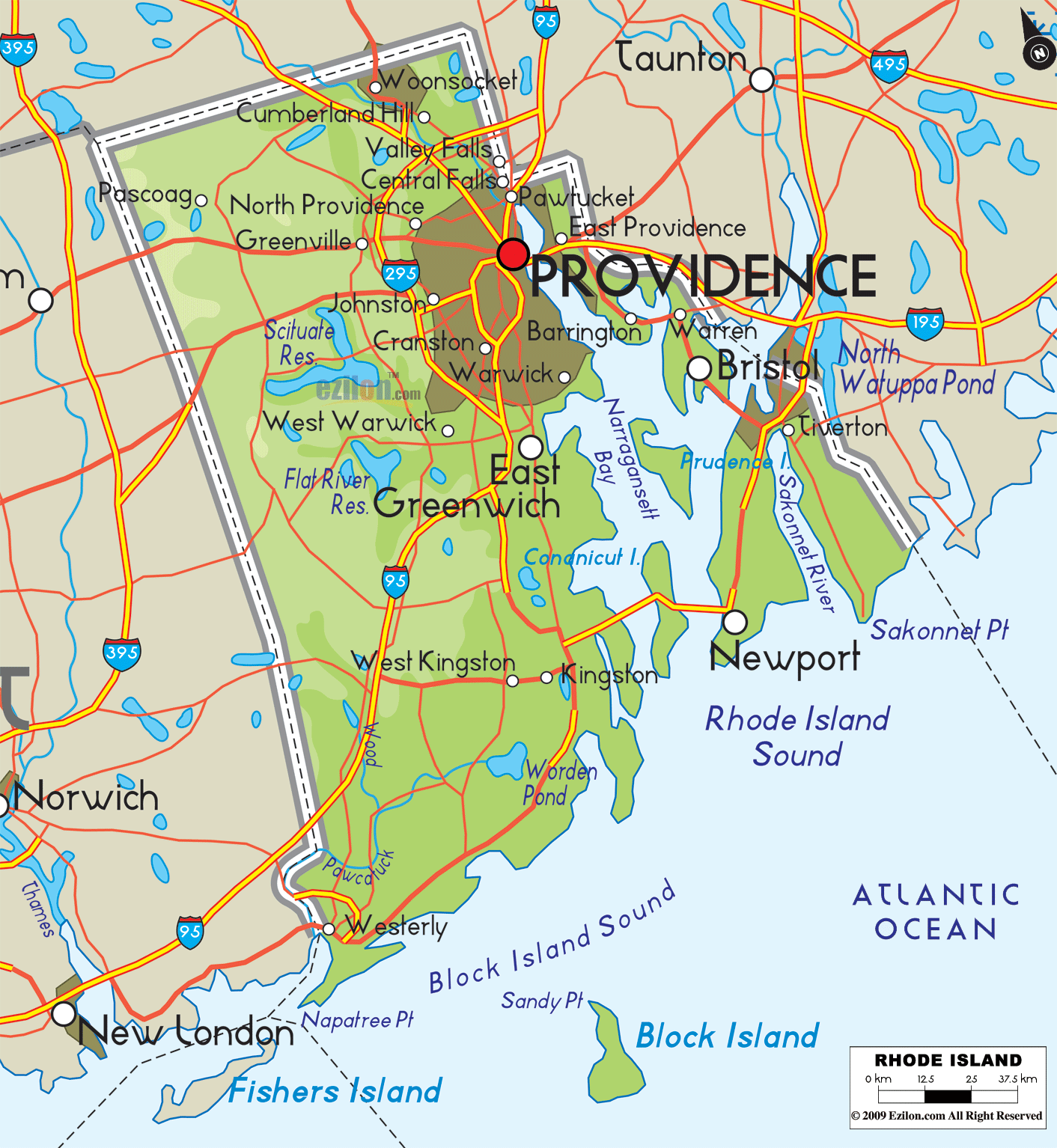
Description: The large detailed Physical map of Rhode Island State, USA showing major geographical features such as islands, rivers, lakes, topography and land formations.

Detailed Physical map of Rhode Island with elevations and other topographic features such as mountains, rivers and lakes. Rhode Island borders Connecticut and Massachusetts. Even though Rhode Island covers a small land area, the map shows a complex shoreline, deep bays, coastal ponds and a dense cluster of cities around Providence and Narragansett Bay. This detailed map helps residents, travelers, and geography students understand how water and land interact in the Ocean State. For county boundaries, cities, and roads, see our County and Road Map of Rhode Island.
Rhode Island sits between Connecticut to the west and Massachusetts to the north and east, with Rhode Island Sound and the Atlantic Ocean forming the southern boundary. Our map outlines these borders clearly. Interstate 95 runs from southwest to northeast, entering from New London and Connecticut, passing near Westerly, West Kingston, East Greenwich, and downtown Providence before continuing toward Taunton and the Boston area. This main corridor links inland uplands and coastal lowlands, so following it on the map quickly reveals the shape of the state.
At the centre of Rhode Island's map is Narragansett Bay. It is a huge drowned river valley that extends deep into the state from the Rhode Island Sound. The bay separates the mainland from several islands, including Conanicut and Aquidneck Islands, the latter of which has the city of Newport at its southern end. Deep indentations, such as Warwick Neck, Bristol Neck, and other smaller peninsulas, make the coastline highly irregular.
On the map, Narragansett Bay appears as a branching blue shape with towns like Warwick, East Greenwich, Barrington, Warren, Bristol, and Tiverton around its shores. The bay explains why many towns face the water, what this means for the boat traffic and maritime history that define Rhode Island. The bay provides students with evidence of sheltered harbors, shipping routes, and bridge locations.
South of the mainland, the map labels Rhode Island Sound, Block Island Sound, and Block Island itself. The waters that surround Block Island include Block Island Sound and offshore points like Sandy Point and nearby islets. At Westerly in the southwest, the coastline finally meets these open sounds and gives way to sandy beaches and a barrier spit. Following the shoreline from Westerly eastward across Point Judith, Narragansett, Saunderstown, and on toward Newport shows how the coastal lowland wraps around the mouths of Narragansett Bay.
Because the state is coastal, sea level, storms, and tides shape much of the terrain. The map's combination of blue water, green lowlands, and darker uplands makes that relationship visually clear.
Providence, the capital and largest city of Rhode Island, lies at the north end of Narragansett Bay. The rivers of the north-western and western regions reach tidal water here. The north-western and western rivers reach tidal waters at this location. Nearby places such as Cranston, Warwick, Pawtucket, East Providence, North Providence, Johnston, and Central Falls cluster tightly around Providence, forming a continuous urban and suburban belt.
Interstate highways 95 and 195 cross here, along with smaller routes that radiate toward Woonsocket, Bristol, and Newport. On the physical map of Rhode Island, this region is mostly lowland, indicated by lighter shading with only gentle hills, which explains why early industry and modern transportation concentrated here. The bay provides navigation, while smoother terrain makes it easier to build mills, railroads, and neighborhoods.
A part of the map shows that, west and southwest of Providence, there are scattered blue patches in Rhode Island. These patches or the blue colour represent ponds and reservoirs. Scituate Reservoir, Flat River Reservoir, and Worden Pond are larger water bodies, and there are numerous blue patches around them that represent smaller bodies of water, such as ponds. Stored surface water in our state is a precious drinking supply and is also essential for recreation.
Locations along the Pawcatuck River near Westerly and the Blackstone River valley north of Providence are not as evident on a small state map but are still visible as winding blue lines with towns spaced along them. Students analyzing these rivers can show how small watersheds still structure settlement and transport.
Along the western side near the Connecticut border, the map shading becomes darker green, indicating slightly higher, more rugged terrain. Towns such as Westerly, West Greenwich, Exeter, and Coventry sit in this zone. Although Rhode Island does not have high mountains, the western uplands feature rolling hills and forests, in contrast to the flatter coastal plain along Narragansett Bay.
This subtle relief is essential for understanding land use. Uplands are better suited to forests and low-density settlement, while the lowlands around East Greenwich, Warwick, and Providence support denser residential and industrial development. By comparing color tones and contour hints on the physical map of Rhode Island, geography students can interpret these patterns.
Interstate 95 runs across the western portion of the state, almost parallel to the coast. It enters the state from Connecticut at Pawcatuck and New London and runs by Westerly, Hopkinton, Richmond, West Greenwich, and into the Providence area. This way minimizes going over broken ground and uses natural low passes between ridges. Lesser highways link small places and beach towns.
For travelers, following I-95 on the map shows the easiest way to move between New York, Connecticut, Rhode Island, and Massachusetts, while also pointing to exits to beaches, towns, and historic sites.
On the detailed map, Newport appears at the southern end of Aquidneck Island. The island's shape, surrounded by Narragansett Bay on the west and Rhode Island Sound on the south and east, is precise. Bridges connect Newport to Jamestown on Conanicut Island and to the mainland around Portsmouth and Tiverton.
The low bluffs, beaches, and coves around Newport explain why it developed as a significant port and later as a resort and sailing center. Geography students can see how the island sits near the mouth of Narragansett Bay, making it naturally suited for naval facilities and maritime commerce.
Along the mainland coast south of Kingston and West Kingston, the map indicates several coastal ponds and inlets, including Worden Pond and nearby lagoons that connect to Rhode Island Sound. The shoreline includes Narragansett, South Kingstown, and Westerly. Ponds form between sandbars and barrier beaches that separate them from the open ocean, while this area is highly tourism-oriented and vulnerable to storms and sea-level rise.
Following the coastline on a map of Rhode Island helps trip planners pick beach routes while also noting which parts of the shoreline are low and vulnerable, an essential lesson for understanding coastal management.
Using a physical map of Rhode Island, the small state with a diverse range of uplands in the northwest and tidewater bays in the southeast, might help teachers discuss landforms in class. Pupils may contrast Narragansett Bay in Rhode Island with other New England estuaries, follow I-95 through different types of landscapes, and state that urban areas cluster in broad, flat coastal lowlands.
Because Rhode Island shares borders with Connecticut and Massachusetts and faces the Atlantic Ocean, the map also helps students place the state within the larger New England region and see how it connects to metropolitan Boston and coastal southern New England.
Travelers often underestimate how much there is to see in Rhode Island. By looking at our detailed map, they can quickly see that driving from Providence to Newport, from Westerly to East Greenwich, or from inland ponds to coastal beaches involves different terrain and road networks, even when distances are short.
Using the map of Rhode Island, visitors can design loops that connect Providence, East Greenwich, coastal parks, Newport, and back through inland towns, with each segment following bays, rivers, or ridges that are easy to recognize on the map.
This Rhode Island physical map is provided for viewing and educational reference on the website only. Users can access the document online and zoom in on the state of their choice to examine the coastline and compare it with other states, etc. Nevertheless, the map image must not be printed, downloaded, copied, or redistributed. Following this rule protects cartographic work and ensures that high-quality maps remain accessible for all.
It highlights Narragansett Bay, Rhode Island Sound, coastal lowlands, inland ponds and the clustered cities of Providence, Warwick, East Greenwich and Newport.
You can follow Interstate 95 and smaller coastal roads, use the map to spot beach towns like Westerly and Narragansett, and see where bridges link to Newport and the islands.
Narragansett Bay, Rhode Island Sound and Block Island Sound all appear, showing how deeply the ocean cuts into the small state.
Yes, darker shading marks slightly higher ground near the Connecticut border, while lighter colors show the flatter coastal plain along Narragansett Bay and Rhode Island Sound.
No, the map is only for viewing on the site and should not be printed, downloaded, copied or reused elsewhere.
The detailed map labels towns like Westerly, Kingston, East Greenwich, Bristol and Tiverton, giving enough information to understand their positions along the shore.
Providence lies at the head of Narragansett Bay in the north central part of the state, where rivers from the northwest reach tidal water and highways converge.
Newport sits on the southern end of Aquidneck Island, facing both Narragansett Bay and Rhode Island Sound, which makes it a natural harbor and sailing center.
The state touches Connecticut to the west and Massachusetts to the north and east, and it lies between New York City and Boston along the New England coast.
Interstate 95 enters from Connecticut near Westerly, runs past West Greenwich and East Greenwich and then passes through Providence before continuing into Massachusetts.
Features such as Scituate Reservoir, Flat River Reservoir and Worden Pond appear as blue patches on the map, mainly in the western and southern parts of the state.
The Pawcatuck River forms part of the border with Connecticut near Westerly, and its valley provides a route for roads and small communities.
Coastal towns like Westerly, Narragansett, South Kingstown and Newport are popular because they border Rhode Island Sound, Block Island Sound and several coastal ponds.
Most of the state is gently rolling coastal lowland, but the western edge has more rugged, wooded hills that rise higher than areas along Narragansett Bay.
Maps show low lying coastal zones, barrier beaches and inlets so you can identify areas that are more exposed to storm surge and high waves from the Atlantic.
Rhode Island has a humid continental climate with strong maritime influence, so Narragansett Bay and Rhode Island Sound moderate winter cold and summer heat near the coast.
Providence houses several campuses, Kingston in South County is home to the University of Rhode Island, and Bristol and Newport also host well known institutions.
It is roughly forty five minutes by road; the map shows routes crossing bridges over Narragansett Bay to reach Aquidneck Island and then south into Newport.
Historic textile mills, shipbuilding, trade and later service and education industries grew along the bay because of sheltered harbors and easy water transport.
Maps display road and rail lines linking Providence to Boston, Hartford, New York and other regional centers, along with the coastline that continues into Massachusetts and Connecticut.
Block Island lies south of the mainland in Block Island Sound, roughly between the Rhode Island and Long Island coasts, and is clearly shown offshore on the map.
They provide settings for boating, fishing, bird watching and beach recreation, and the map helps users locate access points and nearby communities.
By comparing city locations with bays, rivers and transportation lines, a student can see that most population clusters near Providence, Warwick, East Greenwich and the Narragansett Bay shoreline.
Travelers may view and plan with the map online, but they must not print, download, copy or redistribute the image, since it is protected cartographic content.
The western and southwestern counties around Exeter, Richmond, Hopkinton and West Greenwich show more green upland shading, indicating forests and scattered rural settlements.
It displays ports at Providence and Newport, ferry connections, bridge crossings and the way highways follow the shores of Narragansett Bay and Rhode Island Sound.
The map makes this nickname clear by showing how much of the state’s boundary touches bays, sounds and the open Atlantic, with long stretches of shoreline compared to its land area.
By studying elevation patterns and coastal inlets, planners can identify low lying neighborhoods and infrastructure that may need protection or adaptation in future decades.
Newport, Providence, Bristol, East Greenwich and Westerly all appear, each with long histories tied to colonial trade, shipbuilding, industry or resort development.
It combines current roads, towns and protected areas with accurate terrain and coastline detail, making it easier to understand geography, plan trips and support classroom learning.

Counties and Road Map of Rhode Island
Counties and Road map and map image of Rhode Island.

Regional Directory of Canada
Information and guide about Canada and website listing.

Regional Directory of United States of America
Information and guide about United States of America and websites with American topics.

Regional Directory of Europe
Information and guide about Europe and websites with European topics.

Regional Directory of Australia
Information and guide about Australia and websites with Australian topics.