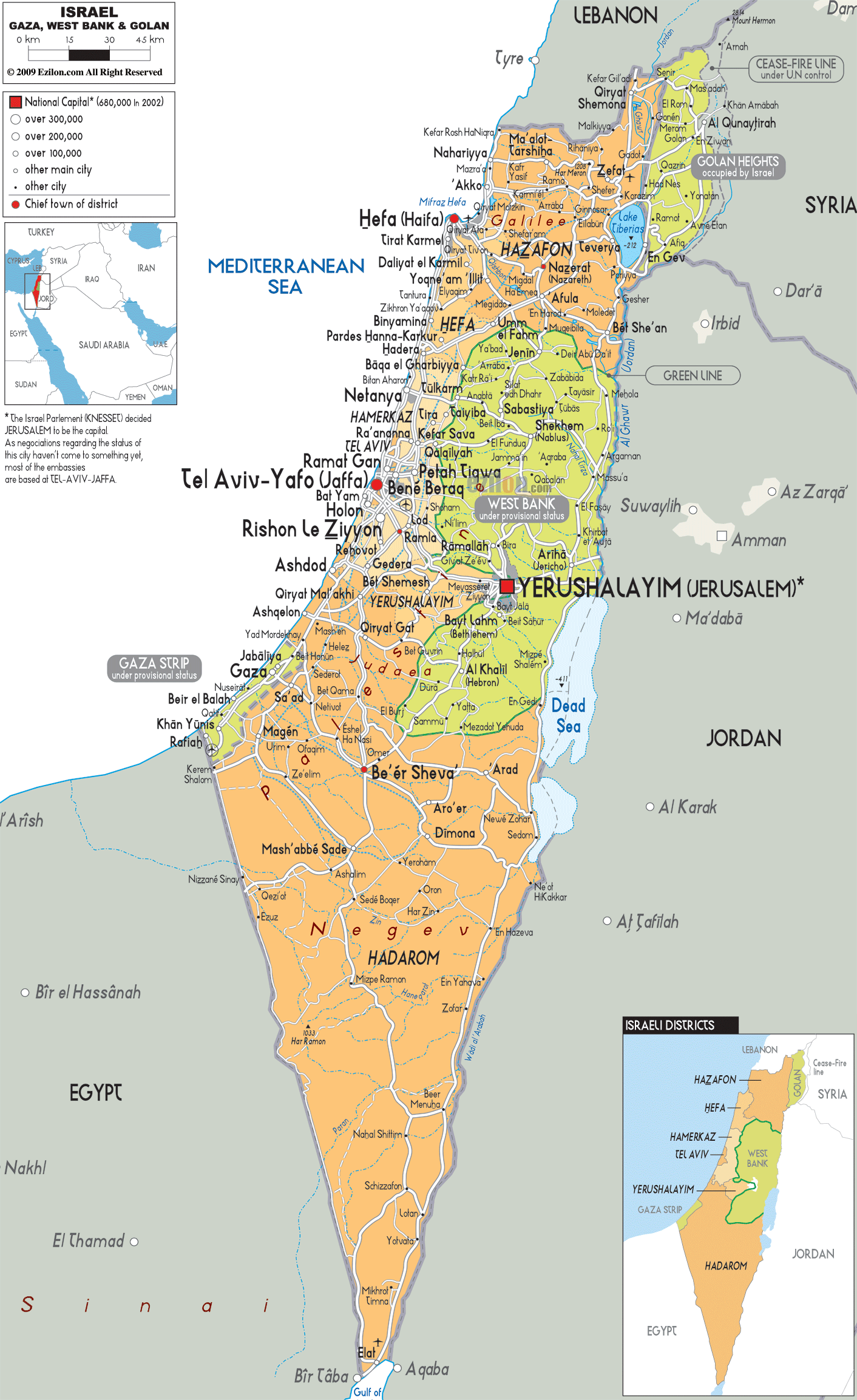
Description: Detailed large political map of Israel showing names of capital city, towns, states, provinces and boundaries with neighbouring countries.
This map of Israel with cities, districts, and towns is already large enough to read directly on your desktop. To see a full-screen zoom view on a phone or tablet, tap the map image (or tap the Zoom Map label above the image). Scan by shading districts in various colored blocks, with Israel's cities and towns in bold.

Detailed map of Israel with cities, towns, districts, villages and surrounding countries. Israel shares borders with Lebanon, Syria, and Jordan. Despite its relatively small size, the map reveals a dense arrangement of cities, districts, transportation routes, and natural features that together form a highly structured national layout.
The map of Israel above clearly shows the major cities, including Tel Aviv, Jerusalem, Haifa, Be'er Sheva, Nazareth, and Eilat. It also defines the country's administrative divisions, which include Hazafon (Northern District), Hefa (Haifa District), Hamerkaz (Central District), Tel Aviv District, Yerushalayim (Jerusalem District), and Hadarom (Southern District). The areas are colour-coded to help the reader distinguish the geography and administration.
The road-light network shown on the map helps the reader to understand the connectivity. Although it doesn't show every road, it clearly shows the main corridors connecting cities so that you can see movement along the coast, in the inland areas, and in the desert.
The map shows Israel located at an intersection between continents. The Mediterranean Sea lies to the west. There is a long coastline here, with several cities. North of Israel lies Lebanon, while the Golan Heights and Syria lie to its northeast. To the east, the map shows the Jordan River Valley and Jordan, while the West Bank is prominently labeled in the central-east region. To the southwest, the map transitions toward Egypt and the Sinai Peninsula.
This strategic position makes Israel a bridge between Asia, Africa, and Europe, which is reflected in the concentration of cities along key geographic corridors. The map also highlights sensitive geopolitical zones, such as the Gaza Strip and the West Bank, providing users with a complete understanding of the regional layout.
Situated at the northern apex of the map is the Northern District (Hazafon), which is aided by its varied terrain. The cities of Nazareth, Safed, Tiberias, and Acre (Akko) are marked on the map with their names and positions relative to the natural features.
The map shows prominent Lake Tiberias (the Sea of Galilee) among other features. The freshwater lake is a central reference point for northern Israel, adjacent to urban settlements and agricultural land. The water makes this region more fertile than other places in the country. As a result, settlement density is high.
Cities are placed on hills and valleys, not on plains, as this map shows. This results in roads that are smoothly integrated into the landscape, with curves and swerves designed to fit in naturally. This facilitates the formation of routes and paths between heights and subsequent valleys.
Going a little further south around the Mediterranean Sea, we can find the map of the Haifa District (Hefa). The city is marked on the map of Israel as one of its main coastal cities.
This city is located on the coast, making it a port city. It also has an industrial area for the same reason. Moreover, the map shows strong road connections linking this city to the northern cities and the central area. So, Haifa Map will provide you with an idea of the location. In proximity are cities that integrate with the continuous urban areas along the coast.
In this region, it becomes clearer that we are entering a transition from the hilly north to the flatter coastal region. It helps us understand the influence of geography on urban growth.
As your attention shifts toward the center of the map, the density of cities increases significantly. This region, which includes Tel Aviv-Yafo and the Central District (Hamerkaz), represents the most urbanized and economically active area in Israel.
The map shows a continuous stretch of cities along the Mediterranean coast, including:
Tel Aviv-Yafo
Rishon LeZion
Holon
Bat Yam
Netanya
Herzliya
These cities are closely spaced, forming a metropolitan belt where urban boundaries often overlap. The road network here is more concentrated, reflecting high levels of movement, commuting, and economic activity.
This area serves as Israel's financial and technological hub, and its central location on the map reinforces its importance.
The location map shows Jerusalem (Yerushalayim) inland of the coastal plain. It is an elevated city of historical significance. Jerusalem is located in the country's highlands, clearly indicated and linked by main roads.
Jerusalem is portrayed as an essential link between the different parts of the country. Among them are Tel Aviv, Hebron, Bethlehem, and Ramallah. The national capital is both a cultural and an administrative centre.
The surrounding terrain is generally rougher than that of the coastal plain, which influences road construction and the distribution of cities.
As you continue moving south on the map, the landscape changes dramatically. The Southern District (Hadarom) occupies a large portion of the country and is dominated by the Negev Desert.
The map clearly shows how cities become more spaced out in this region. The main urban center here is Be'er Sheva, which appears as a key hub connecting northern and southern Israel.
In contrast to the central region, which is densely populated, the Negev has open land, long roads, and limited urban development. The map shows a clear visual contrast.
At the southernmost tip of the map, Eilat appears as a small yet significant city on the Gulf of Aqaba. This position gives Israel access to the Red Sea, making Eilat an important gateway for tourism and trade.
The map shows a long road connecting Eilat to the rest of the country, underscoring its isolation and strategic importance.
The map of Israel, with major cities, organizes the country into districts that reflect both geography and governance. Each district has distinct characteristics that are clearly visible on the map.
The Northern District is one of the most geographically diverse areas on the map. The cities of Nazareth, Safed, and Tiberias are located near water and high terrain.
The map demonstrates how settlements are built in harmony with nature, as is the case with the lake and the valley.
The presence of Lake Tiberias makes this area more fertile than the surrounding desert, enabling agriculture and urban life.
The map position of Haifa highlights it as an important coastal and industrial sector. The city lies in the north and the center, and it is a transportation hub in Israel.
Coastal cities nearby influence the economies and populations of the coastal chain.
The Central District is the most densely populated area on the map. Cities are closely spaced, and the road network is highly developed.
This region includes major urban centers that support business, transportation, and residential life. The map shows that this area is the core of Israel's population.
Tel Aviv is clearly Israel's economic powerhouse. Its coastal location and dense urban surroundings make it one of the most important cities on the map.
The map shows strong connectivity between Tel Aviv and surrounding cities, reinforcing its central role.
Jerusalem stands out not only for its location but also for its elevation and surrounding terrain. The map shows how it connects to both coastal and inland regions.
This makes it a central point for travel, governance, and cultural significance.
The Southern District is located at the bottom half of the map. It is clear that the Negev Desert, as evidenced by the cities of Be'er Sheva and Eilat.
The map depicts the distances between distant road connections. Even though there are no people present in this area, it is still effective.
The map also provides context by showing surrounding areas:
West Bank (east)
Gaza Strip (west)
Jordan (east)
Egypt (southwest)
Lebanon and Syria (north)
This helps users understand Israel's geographic and political environment.
To fully understand this detailed map of Israel, follow this sequence:
Begin in the north (Hazafon)
Move along the coastal cities (Haifa to Tel Aviv)
Shift inland to Jerusalem
Continue south to Be'er Sheva
End at Eilat and the Red Sea
This map of Israel with cities and road network is highly useful for:
Travelers planning routes
Students studying geography
Researchers analyzing urban patterns
Residents' understanding of regional connections
The map shows districts, major cities, borders, seas, and a simplified road network for orientation.
Jerusalem is located in central Israel within the inland highlands.
Jerusalem.
Tel Aviv is located on the Mediterranean coast in central Israel.
Northern, Haifa, Central, Tel Aviv, Jerusalem, and Southern districts.
Haifa is located in northern Israel along the Mediterranean coast.
Nazareth is in the Northern District near the Galilee region.
Lake Tiberias, also called the Sea of Galilee.
The Mediterranean Sea borders Israel to the west.
Along the eastern border between Israel and Jordan.
Beersheba, officially Be'er-Sheva is located In southern Israel within the Negev region.
A large desert covering southern Israel.
At the southern tip of Israel along the Red Sea.
Lebanon, Syria, Jordan, and Egypt.
A region east of central Israel shown clearly on the map.
Along the southwestern Mediterranean coast.
Tel Aviv, Netanya, and surrounding cities.
South of Tel Aviv along the coast.
Further south near Gaza.
Major routes connecting cities and districts.
The central coastal region around Tel Aviv.
The Negev Desert in southern Israel.
To understand routes, cities, and distances.
Yes, it shows cities, regions, and geography clearly.
East of Tel Aviv in central Israel.
North of Tel Aviv along the coast.
In the southern West Bank.
North of Jerusalem.
Its mix of coastline, mountains, valleys, and desert.
No. Printing or copying maps from this site is not permitted.

Physical Map of Israel
Physical map and map image of Israel.

Road Map of Israel
Road map and map image of Israel.

Regional Directory of United States of America
Information and guide about United States of America and websites with American topics.

Regional Directory of Europe
Information and guide about Europe and websites with European topics.

Regional Directory of Australia
Information and guide about Australia and websites with Australian topics.