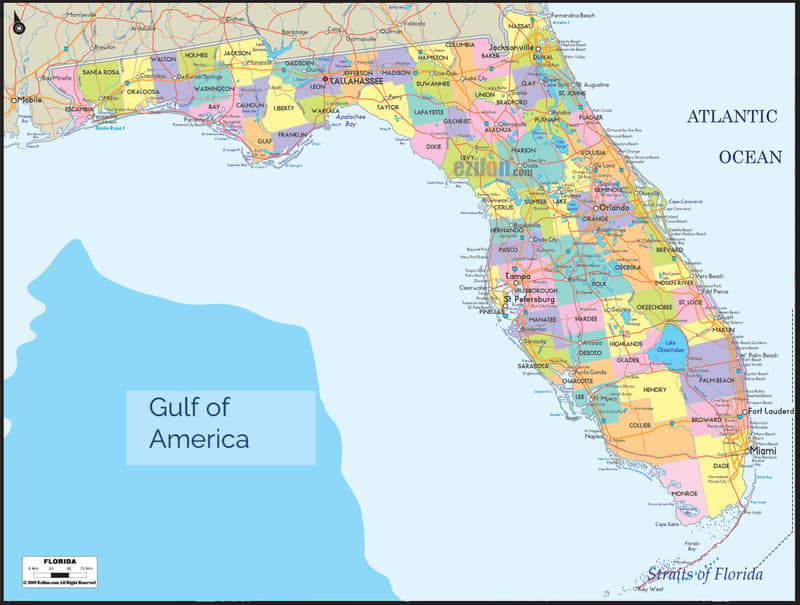
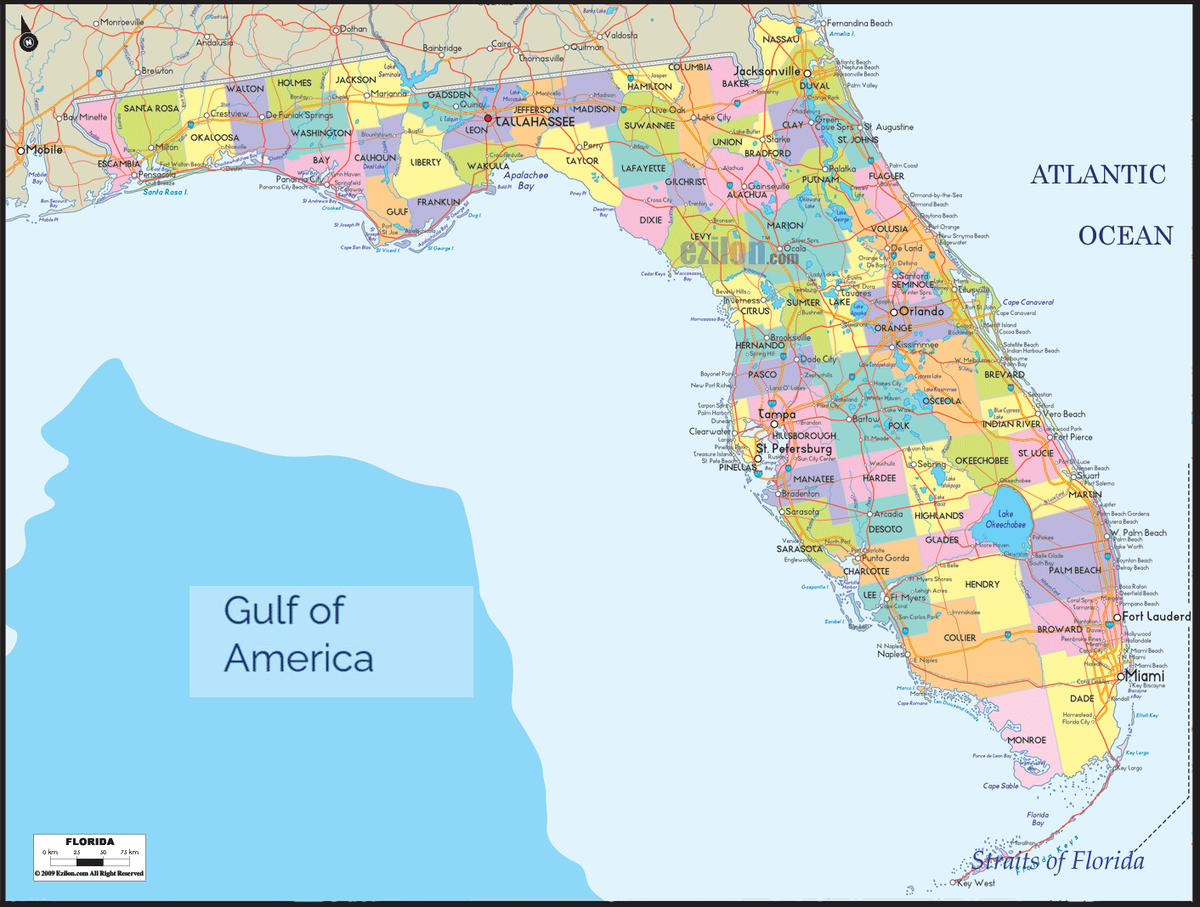
Description: Detailed large map of Florida State USA showing cities, towns, county formations, roads highway, US highways and State routes.
 Map of Florida (USA). Florida map with cities, counties, and towns. Use this detailed map to understand Florida’s full county grid, every administrative capital (county seat), the major cities and towns, bordering states and waters, and a few highway cues for orientation only. It is the best map style for residents, travelers, and geography students who want clarity without road clutter. The map is built county-first, so each of the 67 counties is shaded and labeled with its seat before anything else. Whether you’re scanning for a major population center or looking up a small county seat, the same map answers both just as well.
Florida’s north is Georgia, and in the northwest, it is Alabama in the Panhandle. The west and south coasts of Florida border the Gulf of Mexico. The Atlantic Ocean runs the entire east side of Florida. The two oceans meet at the Straits of Florida, which is beyond the Keys. Florida’s map with counties and cities keeps those borders and waters visible at every zoom level; this way, you can always orient yourself without having to guess which coast you are looking at.
The outlines of the counties on this Florida transit map are lightly shaded in. I-10 runs across the state’s Panhandle; I-75 runs the Gulf side from the Georgia line down through Naples and across to Miami; I-95 runs the Atlantic coast; I-4 connects Tampa, Orlando, and Daytona Beach; and Florida’s Turnpike runs from Wildwood across to Miami through the interior. These lines aren’t used for measurement but help quickly place a county. The writing stays on counties, seats, and actual cities/towns people search for this content.
A quick summary of Florida’s major cities and counties map. Tallahassee, which is in Leon County in the Panhandle, is the state capital, though not the city. With about 2,034 square miles of land, Palm Beach County is the largest of Florida’s 67 counties. Union County, at about 240 square miles, is the smallest. Miami-Dade County has more than 2.8 million residents, making it the most populous county, while Liberty County has fewer than 8,500 residents, making it the least populous county.
The oldest counties are Escambia County and St. Johns County. Florida’s original two counties were created on July 21, 1821. Florida covers approximately 65,758 square miles in total. In Jacksonville, Miami, Tampa, Orlando, St. Petersburg, Port St. Lucie, Cape Coral, Hialeah, Tallahassee, and Fort Lauderdale, the population is very large.
Florida’s topography ranges from the Panhandle, including the Big Bend marshes to the north, to the central swath of lakes and groves, and straight to the Everglades and Keys in the deep south.
Alachua–Gainesville; Baker–Macclenny; Bay–Panama City; Bradford–Starke; Brevard–Titusville; Broward–Fort Lauderdale; Calhoun–Blountstown; Charlotte–Punta Gorda; Citrus–Inverness; Clay–Green Cove Springs; Collier–Naples; Columbia–Lake City; DeSoto–Arcadia; Dixie–Cross City; Duval–Jacksonville; Escambia–Pensacola; Flagler–Bunnell; Franklin–Apalachicola; Gadsden–Quincy; Gilchrist–Trenton; Glades–Moore Haven; Gulf–Port St. Joe; Hamilton–Jasper; Hardee–Wauchula; Hendry–LaBelle; Hernando–Brooksville; Highlands–Sebring; Hillsborough–Tampa; Holmes–Bonifay; Indian River–Vero Beach; Jackson–Marianna; Jefferson–Monticello; Lafayette–Mayo; Lake–Tavares; Lee–Fort Myers; Leon–Tallahassee; Levy–Bronson; Liberty–Bristol; Madison–Madison; Manatee–Bradenton; Marion–Ocala; Martin–Stuart; Miami-Dade–Miami; Monroe–Key West; Nassau–Fernandina Beach; Okaloosa–Crestview; Okeechobee–Okeechobee; Orange–Orlando; Osceola–Kissimmee; Palm Beach–West Palm Beach; Pasco–Dade City; Pinellas–Clearwater; Polk–Bartow; Putnam–Palatka; St. Johns–St. Augustine; St. Lucie–Fort Pierce; Santa Rosa–Milton; Sarasota–Sarasota; Seminole–Sanford; Sumter–Bushnell; Suwannee–Live Oak; Taylor–Perry; Union–Lake Butler; Volusia–DeLand; Wakulla–Crawfordville; Walton–DeFuniak Springs; Washington–Chipley.
The state’s most western gateway county and one of two oldest, Escambia County is located at Pensacola and Century, near the Alabama line, with Perdido - farthest down the coast. Home to the beach towns of Gulf Breeze and Navarre along its island-strewn shore across Pensacola Bay, while inland deep in the Blackwater River country around Milton and Pace.
Crestview is located in the untamed northern tier of Okaloosa County, and Fort Walton Beach and Destin are strung along Choctawhatchee Bay. Walton County’s southern border features picturesque beach towns. Its seat, DeFuniak Springs, surrounds the lake of the same name, and Freeport stands at the bay’s northern end. The coast of Bay County is dominated by Panama City, but the barrier island is labeled Panama City Beach, whereas the cluster of towns around St. Andrew Bay is easy to pick out.
Moving to the interior of the state, Washington County is a rural county located in Chipley, while Vernon and Wausau are located north of Bay County. Holmes County is located right at the Alabama border at Bonifay, while Esto and Ponce de Leon anchor the waters of Holmes Creek. The only county in Florida that touches Alabama and Georgia, Jackson County’s corners are Graceville and Sneads, and Chattahoochee - just over the line in Gadsden County - helps orient Jackson against Lake Seminole. Seated at Marianna, in Jackson County.
Calhoun County is a small interior county on the Apalachicola River, with its seat at Blountstown and Altha on its north edge. The coastal seat of Gulf County, the city of Port St. Joe, is located south of Wewahitchka at a point where the Cape San Blas coastline curves into the Gulf. The county seat of Franklin County is the city of Apalachicola. Carrabelle and St. George Island are Coastal communities in Franklin County at the point where the Panhandle meets the Big Bend. Liberty County, the least populous county in Florida, is heavily forested, lying along the Apalachicola River, and seated in Bristol.
Gadsden County has its seat in Quincy and lies around the capital, with Havana on the Georgia line and Lake Seminole forming the west boundary of the capital area. Leon County, the state’s capital located in Tallahassee, dominates this labeled set here, along with Miccosukee, Woodville, and Lake Jackson for context, along Leon’s northern border with Georgia. To the south of the capital, Wakulla County -with its seat at Crawfordville, St. Marks, and the coastal marshes leading towards the Gulf forms a green wedge between Leon and the Big Bend shore. Jefferson County is a county seated at Monticello. It is east of Tallahassee. This county, with Lloyd marked, has a long, sandy coast that leads into Taylor County.
The Big Bend begins in Taylor County, a coastal seat that is one of the few to be surrounded by timberland and marsh, with Steinhatchee at the mouth of the river to the south. Madison County, which borders Georgia, is seated in Madison itself, which runs across this stretch of the north Florida farm belt, and in Greenville and Lee. Hamilton County, seated at Jasper, rounds out the Suwannee River corridor and the Georgia line with White Springs and Jennings.
Suwannee County has Live Oak as its seat, with Branford at the confluence of the Suwannee and Santa Fe rivers, where the county touches Lafayette and Columbia. Lafayette County itself is a small riverside county with a seat at Mayo and Day and river springs. Dixie County, seat at Cross City, makes the Gulf edge of the Big Bend with Suwannee and Horseshoe Beach, and Levy County, seat at Bronson, exhibits Cedar Key offshore and Chiefland inland, the start of the Nature Coast north of Tampa Bay. The final area in the region is Gilchrist County, a small county in west Alachua which is seated at Trenton and bounded by Bell and the Santa Fe River springs.
Situated inland, the county of Alachua is home to Gainesville, the principal university city. It borders Alachua, Newberry, High Springs, and Hawthorne. Lake City is the county seat of Columbia County, located at the intersection in north Florida of 301, 441, and Interstate 10. Fort White is a tiny town located to the south near the Suwannee. Union County is small and central-north Florida’s smallest county by land area, bordered by Bradford and Alachua and seated at Lake Butler.
Baker County is located at the Georgia line west of Jacksonville, and its county seat is at Macclenny. Glen St. Mary nearby. Meanwhile, the county of Bradford, whose seat is in Starke, is a north-central county with Hampton and Lawtey located between Gainesville and Jacksonville. Clay County, with Green Cove Springs as its seat, completes the southwest suburban curve of Jacksonville with Orange Park, Middleburg, and Keystone Heights.
The county of Nassau is situated on the Atlantic at Fernandina Beach and reaches the Georgia line. This county contains Callahan and Hilliard, as well as the resorts of Amelia Island. Duval County, a consolidated city-county seated at Jacksonville, dominates the lower St. Johns River. Arlington, Jacksonville Beach, Atlantic Beach, and Neptune Beach are labeled.
Florida’s most populous city is Jacksonville. St. Johns County stretches from Jacksonville to St. Augustine along the historic coast and marks Ponte Vedra Beach, Hastings, and Crescent Beach; with its emergence, St. Johns and Escambia became Florida’s two oldest counties. Putnam County’s seat is at Palatka, where the St. Johns River widens. Interlachen, Crescent City, and Welaka are marked.
Flagler County is situated at Bunnell and runs along the Atlantic south of St. Augustine with Palm Coast and Flagler Beach. Also, Volusia County is centered on DeLand and extends along the coast and into St. Johns backcountry, including Daytona Beach, Ormond Beach, Port Orange, New Smyrna Beach, and Deltona, where I-4 reaches the coast.
Marion County, which is located in Ocala, is separated from the other central ridge by horse-farm highlands which are dotted with Dunnellon, Belleview, and Reddick. Citrus County, seated at Inverness, marks the spring coast at the Gulf’s eastern bend with Crystal River and Homosassa. Sumter County, seated in Bushnell, links the ridge between the Gulf Coast and Lake County, with The Villages and Wildwood occupying its north end. Lake County, with Tavares as seat, lies along Dora and Harris chain of lakes with Leesburg, Eustis, Mount Dora and Clermont. Situated to the north of Orlando, Seminole County, seated at Sanford, contains Altamonte Springs, Longwood, Oviedo, and Winter Springs.
Along with Orange County itself, dominated by Orlando, the bright center of the peninsula is Winter Park, Apopka, Maitland, Ocoee, and Lake Buena Vista. Osceola County, which has its seat at Kissimmee, occupies the east-central swamps with St. Cloud and the Kissimmee Chain of Lakes working their way down to Okeechobee. Polk County, with a seat at Bartow, gathers Lakeland, Winter Haven, Haines City, Auburndale, and Lake Wales around the lakes of the central ridge.
Further to the west is Hernando County, whose seat is Brooksville; it lies inland on the ridge, with Spring Hill, which marks the Gulf side along the Nature Coast. Just to the north of Tampa Pasco County, whose seat is Dade City, stretches along the Gulf-to-central-ridge transition, with New Port Richey, Zephyrhills, and Wesley Chapel.
Two counties encircle Tampa Bay itself. Hillsborough County, which is home to Tampa, is the core of the west-central metro, with Brandon, Plant City, Temple Terrace, and Ruskin appearing around the bay, while Pinellas County, which is home to Clearwater, fills the peninsula directly across the bay from Tampa with St. Petersburg, Largo, Dunedin, and the barrier island beaches.
Manatee County heads down the Gulf Coast with its southern mouth at the entrance to Tampa Bay at Bradenton, with Palmetto and Anna Maria Island and Lakewood Ranch marked. Sarasota County is carved into a portion of the Gulf Coast near the Myakka with Venice, North Port, and Siesta Key. DeSoto County is a small inland county of ranchland and the Peace River between Sarasota and Highlands, centered at Arcadia, while Charlotte County, centered at Punta Gorda, focuses on Charlotte Harbor - the large estuary that shapes this mid-Gulf stretch, with Port Charlotte on its shore. Lee County is in Fort Myers and maps the Caloosahatchee-to-Gulf delta, including Cape Coral, Fort Myers Beach, Sanibel, and Bonita Springs. In the far southwest corner is Collier County, home to Naples. Moreover, it puts city and wilderness together with Marco Island, Immokalee, and the Big Cypress interior.
On the south rim of Lake Okeechobee is Hendry County, whose seat is LaBelle. At Clewiston, Hendry County meets sugar and lake towns. Glades County is a slender county on the western shore, with its seat in Moore Haven. The Caloosahatchee heads west to Fort Myers. Highlands County, the site of Sebring, lies south of Polk. It sits on the lake chain formed by the central ridge. Avon Park and Lake Placid are marked. Hardee County, the site of Wauchula, refers to a compact agricultural county. Polk and DeSoto sit on either side of it. Okeechobee County is the county of the city of Okeechobee on the north edge of the lake where canal lines fan towards the coast and interior.
On the Atlantic side, the Space Coast starts in Brevard County, in Titusville. Moreover, the Kennedy Space Center and the Cape Canaveral complex are located in Titusville. Moreover, Cocoa, Cocoa Beach, Melbourne, and Palm Bay are clearly marked along long barrier islands. The Treasure Coast heads south: Indian River County, with its seat at Vero Beach, contains labor and grove lands to the lagoon and Sebastian and Fellsmere to the west; St. Lucie County, with its seat at Fort Pierce, contains Port St. Lucie just inland of the lagoon, one of the state’s fastest growing cities; and Martin County, with its seat at Stuart, frames the north end of the Palm Beaches, which contain Jensen Beach, Hobe Sound, and the St. Lucie Inlet.
The southeast metro runs through Palm Beach County, seated at West Palm Beach and Florida’s largest county by land area, with Boca Raton, Delray Beach, Boynton Beach, Palm Beach Gardens, and Jupiter along the coast and Belle Glade and Pahokee inland on the lake’s edge. Broward County, seated at Fort Lauderdale, spreads Hollywood, Pompano Beach, Coral Springs, Miramar, Pembroke Pines, and Deerfield Beach across the coastal shelf and the Everglades fringe. Miami-Dade County, seated at Miami and Florida’s most populous county, clusters Miami Beach, Hialeah, Doral, Coral Gables, Homestead, and Key Biscayne between Biscayne Bay and the eastern Everglades.
The county of Monroe is home to Key West and is located between Key Largo and Marathon, and then Key West and on the mainland within the Everglades. It is represented on the map as a string into the Straits of Florida.
This page relies heavily on two coastlines and one wetland for orientation work. The entirety of the west and south side, from the bays of the Panhandle to Tampa Bay, Charlotte Harbor, and the mangrove edge near Naples. The entire east coast from Fernandina Beach to Miami Beach is flanked by the Atlantic Ocean.
South of Lake Okeechobee, the Everglades spreads over Miami-Dade, Broward, Collier and Monroe counties, between them, a slow-moving sheet of water channeled by Florida’s canal and levee system towards Florida Bay. The water narrative extends from Monroe County and the Keys to the very tip of Florida, culminating in Key West. If you remember the Gulf, the Atlantic, Lake Okeechobee, and the Everglades, any county on this map is easy to place.
Florida comprises 67 counties, and the cities and towns within those counties need to be properly identified by residents, movers, and tourists. A map cluttered with roads tends to conceal what lies beneath highway shields. This Florida map with cities and towns is unusual because most maps highlight municipalities, but this one does not. Every county is in a shaded block. Every seat is printed in bold.
The interstate lines are light, making it clear this is the right stretch of state. This approach addresses the questions people have already asked, namely which county a given city is in, what the seat is, and which state or ocean lies on the other side of the line. Using a dedicated driving app for turn-by-turn guidance is still the best way. A map of Florida counties like this one speeds things up and gets the point across more clearly.
This map uses the Panhandle uplands, the central ridge and lake district, and the Everglades to quickly locate counties. Using the rivers, it shows the St. Johns, Suwannee, and Apalachicola rivers as lines. View our Physical Map of Florida for details on elevation, terrain, and land cover.
Florida has a humid subtropical climate in the north and central regions and a tropical climate in the far south, with a wet season running from late spring through early fall. For a full seasonal and biome breakdown, see our Physical Map of Florida.
Sitting on the St. Johns River, Jacksonville is the largest city in Florida and is located in Northeast Florida. Miami is located in Miami-Dade County. It is a gateway to Latin America for international trade, finance, and tourism. Port Miami and Port Everglades (Broward County) are among the world’s busiest cruise ports. The economy of the Gulf Coast’s port and healthcare is driven by Tampa and St. Petersburg.
Orange County was built on tourism, including Disney World and Universal Orlando, as well as a growing simulation and modeling technology corridor in Orlando. Brevard County’s Space Coast is at the heart of aerospace. This aerospace cluster includes the Kennedy Space Center and a collection of private launch companies. Farming remains robust in the central ridge counties around Polk and Highlands, in the Everglades Agricultural Area near Hendry and Palm Beach County, and in interior citrus groves. Florida’s no-state-income-tax system continues to draw new business and residents from up to other states.
Florida’s culture is a captivating mix of Spanish colonial and Seminole heritage, Cuban and Caribbean influences, and a beach-and-space-age modern image. St. Augustine, which is located in St. Johns County, is the oldest continuously occupied city of European origin in the US. The southeastern metro’s character is shaped by the Art Deco Historic District in Miami Beach, as well as Cuban influences in Little Havana and elsewhere.
The Space Coast in Brevard County, which is home to NASA, connects Daytona Beach in Volusia County with stock car racing and the Daytona 500. Every March, spring training baseball fills stadiums throughout Central and Southwest Florida. College campuses also fill out the map, starting with the University of Florida in Gainesville (Alachua County), Florida State University in Tallahassee (Leon County), and the University of Miami in Coral Gables (Miami-Dade County).
Traveling north to south along the Atlantic side is handled by I-95, while on the Gulf side it’s I-75. I-75 runs from the Georgia border south through Naples and across to Miami. East-west travel through the Panhandle is on I-10, while travel through the middle of the peninsula is on I-4, which connects Tampa, Orlando, and Daytona Beach.
The Turnpike in Florida creates a diagonal shortcut from Wildwood to Miami while US-1 remains the sole road link through the Keys. Remember that Florida ZIP codes are not designed to adhere to county lines. For example, a single ZIP code may cover two counties. Be certain to verify the county name on the map or index rather than relying on a ZIP prefix.
Florida has 67 counties, and the map shows every one shaded with its county seat labeled.
Tallahassee, in Leon County, in the western Panhandle.
Duval County, Florida's largest city by population.
Miami-Dade County, Florida's most populous county.
Hillsborough County, on Tampa Bay.
Orange County, in central Florida.
Pinellas County, across the bay from Tampa.
Jackson, Gadsden, Leon, Jefferson, Madison, Hamilton, Columbia, Baker, and Nassau counties border Georgia along the northern line.
Escambia, Santa Rosa, Okaloosa, Walton, Holmes, and Jackson counties border Alabama across the western Panhandle.
I-10, I-75, I-95, I-4, and Florida's Turnpike, shown only as light reference lines.
County seat of Escambia County, in the far western Panhandle.
County seat of Monroe County, at the southern end of the Florida Keys.
County seat of Collier County, on the Gulf coast in southwest Florida.
County seat of Broward County, on the southeast Atlantic coast.
County seat of Palm Beach County, Florida's largest county by land area.
County seat of Sarasota County, on the Gulf coast south of Tampa Bay.
County seat of Alachua County, in north-central Florida.
In Volusia County, seat DeLand, on the Atlantic coast.
In Brevard County, seat Titusville, on Florida's Space Coast.
Spanning parts of Miami-Dade, Broward, Collier, and Monroe counties in the far south.
No. Printing or copying maps from this site is not permitted.
Palm Beach County, at about 2,034 square miles.
Union County, at about 240 square miles.
Miami-Dade County, with more than 2.8 million residents.
Liberty County, with fewer than 8,500 residents.
Jacksonville, in Duval County, with close to a million residents.
Escambia and St. Johns counties, both established July 21, 1821, Florida's first two counties.
No. ZIP codes cross county lines, so use the county boundaries and seats shown here instead.
The St. Johns, Suwannee, Caloosahatchee, and Apalachicola rivers serve as light reference lines.
The Gulf of Mexico on the west and south, and the Atlantic Ocean on the east, meeting at the Straits of Florida near the Keys.

Physical Map of Florida
Physical map and map image of Florida.

Regional Directory of Canada
Information and guide about Canada and website listing.

Regional Directory of United States of America
Information and guide about United States of America and websites with American topics.

Regional Directory of Europe
Information and guide about Europe and websites with European topics.

Regional Directory of Australia
Information and guide about Australia and websites with Australian topics.