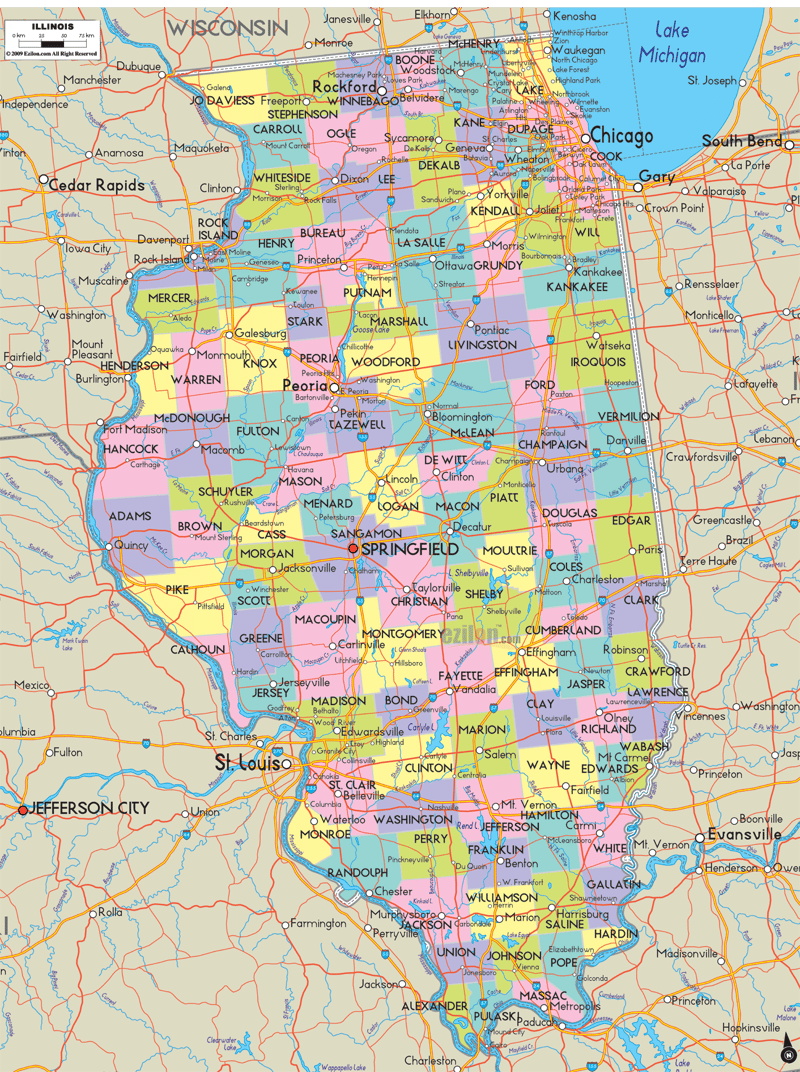
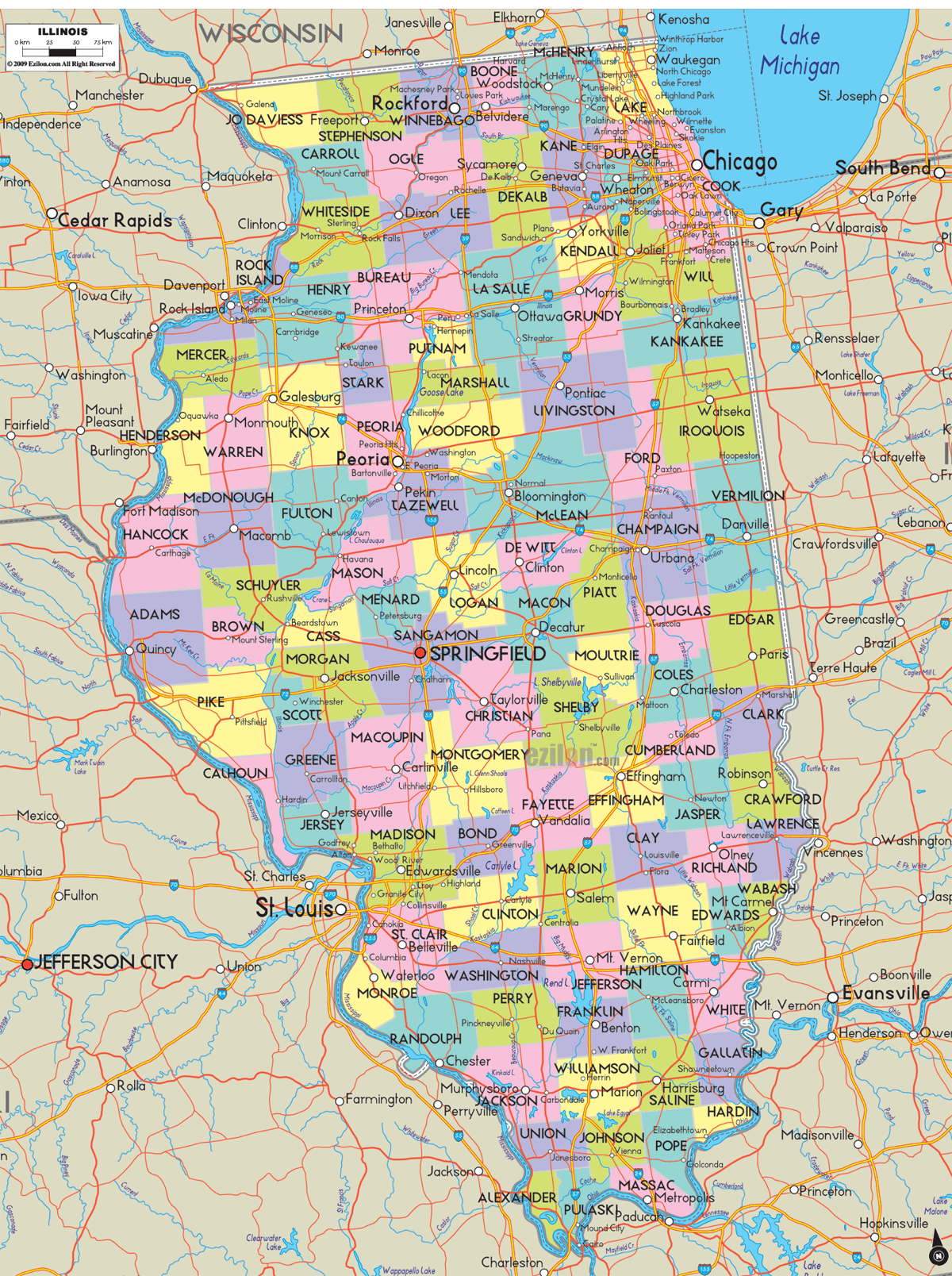
Description: Detailed large map of Illinois State, USA showing cities, towns, county formations, roads highway, US highways and State routes.
Illinois runs north from Wisconsin down to Kentucky across the Ohio River, with Indiana along the east side and Missouri and Iowa across the Mississippi River to the west, plus a short stretch of Lake Michigan shoreline in the northeast corner. All 102 counties are shaded here as color blocks, each carrying its county seat in bold, and every large city's label sits directly on top of the county that contains it, so a city's home county is easy to spot at a glance. The Mississippi, Illinois, and Ohio rivers act as the main orientation lines running through and around the state, while I-55, I-57, I-90/I-94, I-80, and I-64 are kept light so the county grid, not the road network, stays the star of the page.
 Map of Illinois (USA). Illinois map with cities, counties, and towns. Use this detailed map to understand Illinois's full county grid, every administrative capital (county seat), the major cities and towns, bordering states and waters, and a few highway cues for orientation only. This map style is the best for locals, tourists, and geography students who need facts without roads.
Here, all 102 counties appear with their own shaded block, with the seat in bold type on top, so that a border and its county seat are never more than a glance apart. Since every large city's label sits right over the county that contains it, you can find almost any city’s home county in a matter of seconds.
Borders and waters at a glance: Illinois extends from the shoreline of Lake Michigan in Chicago in the Northeast, west along the Mississippi River past the Iowa and Missouri lines, south to Kentucky across the Ohio River, and east to Indiana, with Wisconsin forming the entire northern edge. Whatever route you take on the map, a neighboring state is never more than a shaded block away from your destination.
Road-light orientation: This map of cities and towns in Illinois is deliberately less busy so the roads layer isn’t too heavy. The I-90 and I-94, in the Northeast, arch along Lake Michigan through Chicago. The I-88 and I-80 run westwardly toward the Mississippi across the Northern counties. The I-55 connects Chicago, Bloomington, Springfield, and St. Louis down the Central spine. The I-39 runs north to south through Rockford, LaSalle, and Bloomington. The I-57 tracks Kankakee-Champaign-Effingham-Mt. Vernon and enters Southern Illinois. The I-72 passes through Quincy, Springfield, and Champaign. The I-70 travels through St. Louis, Effingham, and Terre Haute. And the I-64 spans St. Louis-Mt. Vernon-Evansville in the Deep South. Use these as guides to follow the county grid, not as a replacement for an app to drive.
This map of Illinois cities and counties makes it easy to see where the state’s landmarks are located relative to their neighbors and rivers. Illinois borders Wisconsin to the north, Indiana to the east, Kentucky to the south across the Ohio River, and Missouri and Iowa to the west across the Mississippi River, with Lake Michigan forming the short northeast edge. The state contains 102 counties. McLean County (Bloomington-Normal) is the largest county in land area (approximately 1,186 square miles), while Putnam County (located along the Illinois River) is the smallest county (approximately 172 square miles). Cook County, home to Chicago and the second most populous county in the United States, is the most populous county. The least-populated county is Hardin County, in the far southeast. St. Clair County is the oldest, having been created in 1790 (before Illinois became a state in 1818) in the Northwest Territory.
The state is about 57,914 square miles in total and about 55,519 square miles of land. Springfield, the capital of the state of Illinois, is located in Sangamon County – not Chicago. This surprises many first-time visitors to the city. Chicago is Illinois’ biggest city. The ten largest cities in Illinois by current population are Chicago, Aurora, Naperville, Joliet, Rockford, Elgin, Springfield, Peoria, Champaign, and Waukegan. With a landscape that is quite varied, the state has the coastal plain of Lake Michigan and the dense suburbia of Chicagoland in the northeast, going through broad prairie till plains in the center, through the Bluff country of the Mississippi and Illinois Rivers, and further into rougher, hillier Shawnee Hills near the Ohio River in the far south.
Adams–Quincy; Alexander–Cairo; Bond–Greenville; Boone–Belvidere; Brown–Mount Sterling; Bureau–Princeton; Calhoun–Hardin; Carroll–Mount Carroll; Cass–Virginia; Champaign–Urbana; Christian–Taylorville; Clark–Marshall; Clay–Louisville; Clinton–Carlyle; Coles–Charleston; Cook–Chicago; Crawford–Robinson; Cumberland–Toledo; DeKalb–Sycamore; De Witt–Clinton; Douglas–Tuscola; DuPage–Wheaton; Edgar–Paris; Edwards–Albion; Effingham–Effingham; Fayette–Vandalia; Ford–Paxton; Franklin–Benton; Fulton–Lewistown; Gallatin–Shawneetown; Greene–Carrollton; Grundy–Morris; Hamilton–McLeansboro; Hancock–Carthage; Hardin–Elizabethtown; Henderson–Oquawka; Henry–Cambridge; Iroquois–Watseka; Jackson–Murphysboro; Jasper–Newton; Jefferson–Mount Vernon; Jersey–Jerseyville; Jo Daviess–Galena; Johnson–Vienna; Kane–Geneva; Kankakee–Kankakee; Kendall–Yorkville; Knox–Galesburg; Lake–Waukegan; LaSalle–Ottawa; Lawrence–Lawrenceville; Lee–Dixon; Livingston–Pontiac; Logan–Lincoln; Macon–Decatur; Macoupin–Carlinville; Madison–Edwardsville; Marion–Salem; Marshall–Lacon; Mason–Havana; Massac–Metropolis; McDonough–Macomb; McHenry–Woodstock; McLean–Bloomington; Menard–Petersburg; Mercer–Aledo; Monroe–Waterloo; Montgomery–Hillsboro; Morgan–Jacksonville; Moultrie–Sullivan; Ogle–Oregon; Peoria–Peoria; Perry–Pinckneyville; Piatt–Monticello; Pike–Pittsfield; Pope–Golconda; Pulaski–Mound City; Putnam–Hennepin; Randolph–Chester; Richland–Olney; Rock Island–Rock Island; Saline–Harrisburg; Sangamon–Springfield; Schuyler–Rushville; Scott–Winchester; Shelby–Shelbyville; Stark–Toulon; Stephenson–Freeport; St. Clair–Belleville; Tazewell–Pekin; Union–Jonesboro; Vermilion–Danville; Wabash–Mount Carmel; Warren–Monmouth; Washington–Nashville; Wayne–Fairfield; White–Carmi; Whiteside–Morrison; Will–Joliet; Williamson–Marion; Winnebago–Rockford; Woodford–Eureka.
Start off at the place where the map is most congested: the Northeast corner, right on Lake Michigan, anchored by the country’s third-largest city.
The bulk of the coastline around this area is taken up by Cook County (which has Chicago as its seat), and Chicago is clearly labeled. Neighborhoods like Evanston, Skokie, Oak Park, Cicero, Harvey, Calumet City, and Des Plaines are on the map, but Chicago is the seat; there’s no doubt about it. If you follow the county line northwest, you reach Lake County; if you go southwest, you reach Will and DuPage.
Lake County (seat: Waukegan) follows the Lake Michigan shoreline north to the Wisconsin line, and you can pick out Libertyville, Gurnee, and Highland Park along the way.
West of the city, DuPage County (seat: Wheaton) packs Naperville, Downers Grove, Lombard, and Elmhurst into a tight cluster of labels.
Southwest of Chicago, Will County (seat: Joliet) shows Joliet in bold, with Bolingbrook, Plainfield, New Lenox, and Romeoville strung out along the I-55 and I-80 corridors.
Kane County (seat: Geneva) straddles the Fox River, with Aurora and Elgin on either bank and Batavia and St. Charles rounding out what locals call the tri-cities.
Up in the Northern suburbs, McHenry County (seat: Woodstock) turns exurban fast, with Crystal Lake and McHenry labeled close to the Wisconsin border.
Kendall County (seat: Yorkville) is one of the fastest-growing counties in the state, wedged between Aurora, Plano, and Oswego.
Follow the map southwest of Will, and you reach Grundy County (seat: Morris), a compact county sitting right on the Illinois River.
Southeast of Chicago, Kankakee County (seat: Kankakee) marks Kankakee and Bradley on the Kankakee River.
Taken together, these collar counties make up the Chicago metropolitan area, each one shaded clearly enough that you can match any suburb to its county without ever opening a highway atlas.
Moving west out of Chicagoland, the map's Northern tier is a lattice of counties that either touch Wisconsin or follow the Rock River.
Winnebago County (seat: Rockford) is the hub of this whole northern stretch, and Rockford's neighbors, Loves Park and Machesney Park, are labeled right beside it.
Just east of Rockford along I-90 sits Boone County (seat: Belvidere).
Ogle County (seat: Oregon) is home to Oregon and Rochelle, right where the Rock River crosses the I-88 corridor.
DeKalb County (seat: Sycamore) sits on the Kishwaukee River, with the city right beside its seat, and the county reaches east toward Kane.
Lee County (seat: Dixon) is where Lincoln got his early start in Illinois politics; Dixon sits on the Rock River, with Amboy just down the road.
Whiteside County (seat: Morrison) straddles the Rock River at Sterling-Rock Falls, close to I-88.
Carroll County (seat: Mount Carroll) is quiet, rural river-bluff country directly across from Clinton, Iowa.
Stephenson County (seat: Freeport) prints “Freeport” large on the map, with Freeport sitting on the Pecatonica River.
In the far Northwest corner, Jo Daviess County (seat: Galena) is Illinois's hill country, right at the Mississippi, with Galena and Elizabeth both marked.
Follow the Mississippi south, and the map picks up the Illinois side of the Quad Cities, then the farm counties running south from there.
Rock Island County (seat: Rock Island) pairs Moline and East Moline with its seat, directly across the river from Davenport and Bettendorf, Iowa.
Henry County (seat: Cambridge) sits a bit inland, where Geneseo and Kewanee are the larger towns on the map.
South of Rock Island, Mercer County (seat: Aledo) follows the river through its bends.
Henderson County (seat: Oquawka) is narrow and river-bound, with its seat sitting right on the bank.
Warren County (seat: Monmouth) prints Monmouth in bold, between Galesburg and the river.
Knox County (seat: Galesburg) is anchored by a key rail city; Galesburg appears large right where US-34 meets I-74.
The Illinois River is the central thread running through this part of the map.
LaSalle County (seat: Ottawa) clusters Ottawa and LaSalle-Peru right where I-80 begins its run west, with Streator showing up to the south.
West of LaSalle, Bureau County (seat: Princeton) marks Spring Valley and Princeton along I-80.
Putnam County (seat: Hennepin) is Illinois's smallest county by land area, bordered directly by the river.
Between LaSalle and Peoria counties, Marshall County (seat: Lacon) sits right on the water.
Stark County (seat: Toulon) is a compact square west of Marshall and north of Peoria.
Peoria County (seat: Peoria) puts a bold, urban label right on the river's big bend.
Directly across from Peoria, Tazewell County (seat: Pekin) shows East Peoria and Morton along I-74 and I-155.
North of Bloomington, Woodford County (seat: Eureka) places Germantown Hills, Metamora, and El Paso on the map.
This stretch of the Central counties is a good one for anyone trying to memorize county seats.
McLean County (seat: Bloomington) is Illinois's largest county by land area, with Bloomington-Normal at its center and Le Roy, Lexington, and Heyworth labeled around it.
Livingston County (seat: Pontiac) sits right on I-55, between Dwight and Fairbury.
West of Champaign, De Witt County (seat: Clinton) shows Clinton Lake as a blue patch on the map.
Logan County (seat: Lincoln) sits directly on the I-55 corridor.
North of Champaign, Ford County (seat: Paxton) shows Gibson City on the map.
Piatt County (seat: Monticello) sits between Champaign and Decatur.
Macon County (seat: Decatur) is easy to spot on the map, between the Sangamon River lakes and the city itself.
Sangamon County (seat: Springfield) is home to the state capital, with Chatham, Auburn, and Rochester surrounding it.
North of Springfield, Menard County (seat: Petersburg) is a compact county with Athens labeled on it.
Mason County (seat: Havana) sits along the Illinois River, west of both Logan and Tazewell.
The same pattern carries on west to the Mississippi and its bluffs.
Fulton County (seat: Lewistown) shows Canton in a large label, and the county spans what's known as Spoon River Country.
Schuyler County (seat: Rushville) lies between Fulton and Brown.
Brown County (seat: Mount Sterling) is small, but its square is still easy to pick out.
Adams County (seat: Quincy) dominates the Mississippi bend here in the far West.
Hancock County (seat: Carthage) labels both Carthage and Nauvoo along the river.
McDonough County (seat: Macomb) centers on Macomb, home to Western Illinois University, with Bushnell shown nearby.
Heading south toward St. Louis, the counties on the map begin to narrow along rivers and rail lines.
Greene County (seat: Carrollton) sits between the Illinois and Mississippi rivers.
North of Alton, Jersey County (seat: Jerseyville) shows the river confluence right on the map.
Calhoun County (seat: Hardin) forms a unique peninsula squeezed between the Mississippi and Illinois rivers.
North of Calhoun, Pike County (seat: Pittsfield) is large and rural.
East of Pike, Scott County (seat: Winchester) and Morgan County (seat: Jacksonville) sit side by side.
Cass County (seat: Virginia) joins Menard and Mason around the bend of the river.
The East-Central quadrant of the map is dense, packed with well-labeled cities and college towns.
Champaign County (seat: Urbana) shows Champaign-Urbana as twin labels along I-74 and I-72, with Rantoul and Mahomet marked nearby.
Right on the Indiana line, Vermilion County (seat: Danville) marks Hoopeston and Georgetown.
South of Kankakee, Iroquois County (seat: Watseka) dots US-24 with towns like Gilman and Onarga.
East of Coles, Edgar County (seat: Paris) sits right on the state line.
Coles County (seat: Charleston) includes both its seat and Mattoon, the larger of the two cities.
Between Champaign and Coles, Douglas County (seat: Tuscola) is noted for Arcola’s Amish heritage.
Moultrie County (seat: Sullivan) and Shelby County (seat: Shelbyville) both sit in the Kaskaskia River lake region.
The county seat of Cumberland is Toledo, located between Shelby and Jasper on I-70.
Clark County (seat: Marshall) borders Indiana directly opposite Terre Haute.
Jasper County, with Newton as its seat, and Richland County (Olney as its seat) continue the Embarras River valley southward.
Lawrence County (seat: Lawrenceville) and Crawford County (seat: Robinson) follow the Wabash River south from there.
Effingham County (seat: Effingham) prints a bold label right at the junction of I-57 and I-70, with Teutopolis just nearby.
Fayette County (seat: Vandalia) is home to a former state capital on the Kaskaskia River, clearly labeled along I-70.
West of Fayette sit Bond County (seat: Greenville) and Clinton County (seat: Carlyle), the latter home to Carlyle Lake.
North of Jefferson, Marion County (seat: Salem) shares Centralia with multiple counties.
Wayne County (seat: Fairfield) lies just south of Clay County (seat: Louisville).
Edwards County (seat: Albion) and Wabash County (seat: Mount Carmel) both hug the Wabash River in the far Southeast.
The map marks the Illinois counties that form Greater St. Louis, known locally as Metro-East.
Madison County (seat: Edwardsville). Urban centers, Alton, Granite City, and Collinsville are labeled.
St. Clair County (seat: Belleville). East St. Louis, O'Fallon, and Fairview Heights appear along the I-64/I-255 belt.
Monroe County (seat: Waterloo). South of St. Clair along the river.
Jersey and Calhoun counties (with seats in Jerseyville and Hardin) already complete the confluence region to the north.
Macoupin County (seat: Carlinville) and Montgomery County (seat: Hillsboro) stretch north and east of Metro-East.
Christian County (seat: Taylorville) sits east of Sangamon, rounding out this cluster.
Southern Illinois shows a tapestry of small counties that students often study by river and ridge.
Jefferson County (seat: Mount Vernon). A key junction where I-57 and I-64 cross.
Franklin County (seat: Benton) and Williamson County (seat: Marion) anchor the Herrin-Marion coal basin; Carterville and Johnston City are labeled.
Jackson County (seat: Murphysboro). Carbondale is a large university city just east of the seat.
Perry County (seat: Pinckneyville) and Randolph County (seat: Chester) run along the Kaskaskia and Mississippi.
Washington County (seat: Nashville), north of Randolph along I-64.
Hamilton County (seat: McLeansboro), White County (seat: Carmi), and Gallatin County (seat: Shawneetown) trace the lower Wabash and Ohio rivers.
Saline County (seat: Harrisburg) borders the Shawnee National Forest.
Hardin County (seat: Elizabethtown) is Illinois's least populous county, buffeted by the Ohio River's bluffs.
Pope County (seat: Golconda), Massac County (seat: Metropolis), Pulaski County (seat: Mound City), and Alexander County (seat: Cairo) complete the far-southern tip where the Ohio meets the Mississippi.
Union County (seat: Jonesboro) and Johnson County (seat: Vienna) sit west and north of Massac, respectively, extending into Williamson and Pulaski counties.
Four rivers and one Great Lake do most of the orientation work on this page. The Mississippi River forms the entire western border, past Rock Island, Quincy, and Alton. The Illinois River cuts through the center, linking Ottawa, Peoria, and Havana before joining the Mississippi at Grafton. The Ohio River traces the southern border past Metropolis and Cairo. The Wabash River forms a long stretch of Indiana’s eastern border. Lake Michigan anchors the northeast corner of Chicago. Keep these five in mind, and any county on the map is easy to place.
The layer of road is purposely thin. The I-90/I-94 curves along Lake Michigan through Chicago. The main north-south spines of the interstate system are I-55 and I-57, which run from Chicago down to the central counties of St. Louis, as well as down to the Missouri border. Interstate 80 and Interstate 88 intersect the Northern counties, Interstate 74 and Interstate 72 navigate the middle of the state, and Interstate 64 and Interstate 70 take care of the far south near the Ohio River. None of these are for turn-by-turn navigation; they are just for placement in the county.
The residents of the county can confirm the jurisdiction and services since taxes, courts, and elections operate on county lines, not ZIP codes. Tourists can link visits county by county: the town of Galena in Jo Daviess, Starved Rock, near LaSalle, Springfield in Sangamon, Cahokia Mounds in St. Clair, and Shawnee views in Pope and Hardin. Geography students may use the sequence Rock to Illinois to Kaskaskia to Wabash to Ohio to Mississippi to memorize Illinois’s 102 counties by river, using the county seats as anchors. The map of Illinois counties owes its value to these three audiences: the county grid stays the organizing idea, with just enough road and river reference to keep everyone centered.
On this map, the Illinois River valley and the Shawnee Hills in the far south serve as landmarks for quickly finding counties. For elevation, terrain, watersheds, and land-cover detail, see our Physical Map of Illinois.
Illinois has a humid continental climate statewide, with cold, snowy winters in the north and milder, more humid winters in the far south near the Shawnee Hills. For a full seasonal and biome breakdown, see our Physical Map of Illinois.
The economy of Illinois is largely driven by Chicago and Cook County, where a financial and futures trading sector has taken shape around the CME Group and the Chicago Board Options Exchange, alongside O’Hare International, one of the busiest airports globally. This influence stretches to the collar counties as well: Boeing maintained its old Chicago headquarters, Caterpillar made its home in Peoria County, and Deere & Company anchors Rock Island County’s Quad Cities economy.
In Downstate, most of the map is still colored agriculture. After all, Illinois ranks in the top two or three states in the country for corn and soybeans. And these crops are found in the central and western counties, from McLean to Adams. The 10 largest cities in Illinois by population are Chicago, Aurora, Naperville, Joliet, Rockford, Elgin, Springfield, Peoria, Champaign, and Waukegan. Besides the Chicago area, most of that growth clusters around Rockford in the north and the Champaign-Urbana university corridor in the east-central counties.
The blues and jazz clubs, deep-dish pizza, and riverfront architecture in Cook County are aspects of an identity distinct from the general impression of Illinois, and Springfield in Sangamon County carries the Lincoln legacy of Illinois, home to his house, tomb, and presidential library. Galena in Jo Daviess County holds the 19th-century downtown district that is best preserved in the entire Midwest owing to its lead mining and steamboat days.
Beyond Chicago, higher education plays a significant role in the economy of the region, largely due to the local economics of campus towns like the University of Illinois at Champaign County, Northwestern at Cook County, and both Illinois State and Illinois Wesleyan at McLean County, as well as the state’s reputation for academic excellence. Situated in Hancock County along the banks of the Mississippi, Nauvoo occupies a unique place in American religious history as an early headquarters of the Latter-day Saint movement before its westward movement.
Most of the traffic in Illinois, particularly in the central and southern regions of the state, is carried on I-55 and I-57 from Chicago south to St. Louis and the Missouri border. I-80 crosses the northern counties, while I-64 handles the far south near the Ohio River, and I-90/I-94 runs through Chicago. Be aware: county lines and ZIP codes don’t always align with the map. A ZIP lookup shouldn’t offer jurisdiction, taxes, and court decisions. A ZIP code may include areas from both counties highlighted on this map. Look at these 5 examples to understand better!
Illinois has 102 counties and the map shades every one with its county seat labeled.
Springfield, the state capital, sits in Sangamon County in central Illinois.
Chicago sits on Lake Michigan in Cook County, with Chicago itself serving as the county seat.
Aurora spans Kane, DuPage, Will, and Kendall counties; Naperville sits mainly in DuPage County.
Will County, seat Joliet, sits southwest of Chicago along I-55 and I-80.
In Winnebago County, in northern Illinois along the Rock River.
Elgin sits in Kane and Cook counties; Waukegan is the seat of Lake County on the Lake Michigan shore.
Urbana is the seat of Champaign County beside Champaign; Bloomington is the seat of McLean County with Normal next door.
DuPage (Wheaton), Lake (Waukegan), Will (Joliet), Kane (Geneva), and McHenry (Woodstock).
Madison (Edwardsville) and St. Clair (Belleville) anchor Metro-East along the Mississippi River.
Rock Island County (seat Rock Island) and neighboring Henry County sit along the Mississippi opposite Iowa.
Jo Daviess, Stephenson, Winnebago, Boone, McHenry, and Lake counties.
Cook, Kankakee, Iroquois, Vermilion, Edgar, Clark, Crawford, Lawrence, and Wabash counties.
Alexander, Pulaski, Massac, Pope, Hardin, and Gallatin counties.
Alexander, Jackson, Randolph, Monroe, St. Clair, Madison, Jersey, Calhoun, Pike, and Adams counties.
Hancock, Henderson, Mercer, Rock Island, Whiteside, Carroll, and Jo Daviess counties.
I-55, I-57, I-90/I-94, I-80, and I-64 appear only as light reference lines.
In Peoria County, on the Illinois River in the center of the state.
Springfield in Sangamon County, home to Lincoln's house, tomb, and presidential library.
In Jo Daviess County, in the hill country of the far northwest corner.
In Hancock County, along the Mississippi River.
In Alexander County, at the far southern tip where the Ohio meets the Mississippi.
In Massac County, on the Ohio River across from Kentucky.
Near Ottawa, the seat of LaSalle County, along the Illinois River.
In St. Clair County, near Collinsville in the Metro-East area.
McLean County, home to Bloomington-Normal, is the largest by land area.
Putnam County, along the Illinois River, is the smallest by land area.
Cook County, home to Chicago, is the most populous county in Illinois and the second-most populous county in the United States.
Hardin County, in the far southeast, has the fewest residents of Illinois's 102 counties.
St. Clair County, established in 1790 under the Northwest Territory.
Chicago, in Cook County, with roughly 2.7 million residents, is Illinois's largest city and the third-largest city in the United States.
No. ZIP codes cross county lines, so use the county boundaries and seats shown here instead.
No. Printing or copying maps from this site is not permitted.

Physical Map of Illinois
Physical map and map image of Illinois.

Regional Directory of Canada
Information and guide about Canada and website listing.

Regional Directory of United States of America
Information and guide about United States of America and websites with American topics.

Regional Directory of Europe
Information and guide about Europe and websites with European topics.

Regional Directory of Australia
Information and guide about Australia and websites with Australian topics.