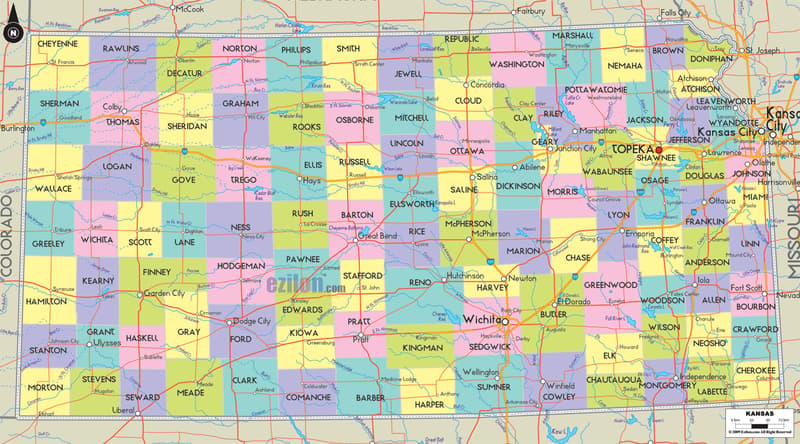
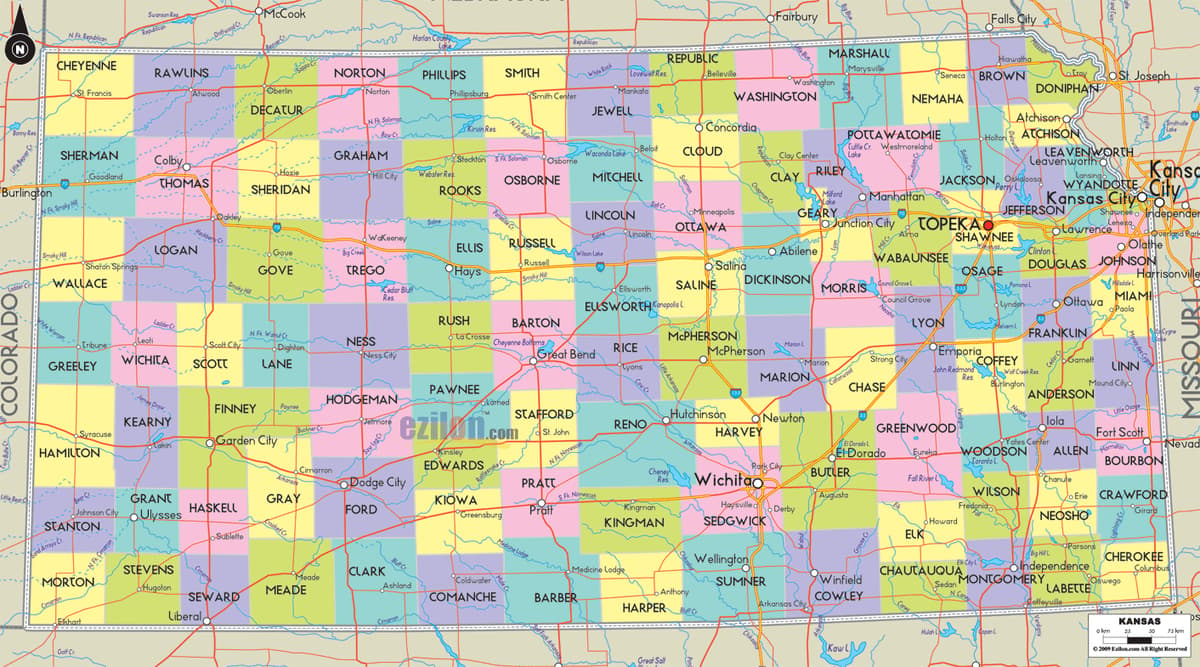
Description: Detailed large map of Kansas State USA showing cities, towns, county formations, roads highway, US highways and State routes.
 Map of Kansas (USA). Kansas map with cities, counties, and towns. Use this detailed map to understand Kansas's full county grid, every administrative capital (county seat), the major cities and towns, bordering states and waters, and a few highway cues for orientation only. It is the best map style for residents, travelers, and geography students who want clarity without road clutter. Kansas packs all 105 counties, more than all but a handful of states, into one wide rectangle of a map, so color coding does more of the work here than a maze of route numbers ever could. Each county sits in its own shaded block with the seat printed in bold right on top, and the thin road lines underneath are only there to help you keep your bearings, not to replace a real atlas. Whether you're tracing county lines, looking for a specific city, or just want to see how the whole state fits together, the color blocks make it easy to find what you need in a few seconds.
Borders and waters at a glance: Colorado sits to the west, Nebraska runs the entire top edge to the north, Missouri closes off the east, and Oklahoma forms the southern line. Picture the state itself as one wide rectangle built from 105 counties, nearly all of them square or near-square cells in the old Kansas township grid, which is exactly why the map reads so easily at a glance. The land changes too as you move west to east: the far western edge is the High Plains, the middle third drops into the Smoky Hills and the Arkansas River lowlands, and the eastern third holds the Flint Hills, the glaciated northeast, and the Osage Cuestas. A handful of river names on the map, Arkansas, Smoky Hill, Kansas, Republican, Big Blue, Neosho, Verdigris, do a lot of the work explaining how the state actually settled, without turning the graphic into a tangle of blue lines. Whether you're studying it for school or just planning where to go next, the same colored county grid makes it easy to place any city, county, or river at a glance.
Road-light orientation: All 105 counties show up as color blocks here, stitched together by I-70 running east to west, and I-35 with I-135 handling the north-south routes through the center, while I-235 loops around Wichita for local reference only. The Kansas (Kaw) and Arkansas rivers are the two main lines to lean on for orientation, and the Missouri River traces part of the northeast border past Doniphan, Atchison, and Leavenworth counties. The capital, Topeka, sits in Shawnee County, and it isn't the state's largest city, that title belongs to Wichita, over in Sedgwick County.
Start at the Colorado line, in the far northwest corner, where Cheyenne County keeps its seat at St. Francis, a small junction town. Follow the Nebraska border east from there and the seats come quickly: Rawlins has Atwood, Decatur has Oberlin, Norton keeps its own name as the seat, Phillips has Phillipsburg, Smith has Smith Center, Jewell has Mankato, Republic has Belleville, Washington keeps its own name too, Marshall has Marysville, Nemaha has Seneca, and Brown has Hiawatha. The chain ends at Doniphan County and its seat Troy, right where the line meets the Missouri River. Look at the map and you will see a thin ribbon marked US-36 running the length of this northern tier, mostly there to help you keep the order of these counties straight, not to suggest a driving route.
Drop one row south of that chain and you are back at the Colorado border, this time in west-central Kansas. Sherman County is anchored by Goodland; next door, Wallace County lists Sharon Springs and Greeley County lists Tribune. Moving east, Thomas County has Colby, Logan County has Oakley, and Gove County labels both Gove City and Quinter. Trego County follows with WaKeeney, then Ellis County with the regional hub Hays, Russell County with Russell, and Ellsworth County with Ellsworth. Central Kansas picks up with Saline County and Salina, Dickinson County and Abilene, Geary County and Junction City, and Riley County and Manhattan. Keep going east and you reach Pottawatomie County with Westmoreland, Wabaunsee County with Alma, and Shawnee County, home to the state capital, Topeka. Douglas County and Lawrence come next, and the row finishes at the Missouri line with two metro counties: Wyandotte, showing Kansas City, KS and Bonner Springs, and Leavenworth County, showing Leavenworth and Tonganoxie. A thin red I-70 line runs the length of this belt on the map, there purely to orient your eye, though it's worth noticing how many county seats and college towns sit right along it.
The southwest corner opens with Morton County and its seat, Elkhart, then rolls east through Stanton County and Johnson City, Stevens County and Hugoton, Seward County and Liberal, Meade County and Meade, Clark County and Ashland, Comanche County and Coldwater, Barber County and Medicine Lodge, and Harper County and Anthony. The word Oklahoma printed along a thin red border line makes this whole stretch easy to track on the map. Slide east along that same southern tier and the seats keep coming: Sumner County has Wellington; Cowley County has Winfield and Arkansas City; Chautauqua County has Sedan; Montgomery County has Independence and Coffeyville; Labette County has Oswego and neighboring Parsons; and Cherokee County, in the far southeast corner, has Columbus and Baxter Springs right along the Missouri line. Two more seats finish off that corner: Pittsburg, labeled in Crawford County, and Fort Scott, labeled in Bourbon County.
The central run of Kansas, west to east, reads like a checkerboard of farm towns and courthouse squares. Starting again near the Colorado line, Hamilton County lists Syracuse, Kearny County lists Lakin, and Wichita County lists Leoti, not to be confused with the city of Wichita far to the southeast. Finney County lists the regional center Garden City, Gray County lists Cimarron, and Ford County carries an unmistakable label in Dodge City. Continuing east, Hodgeman County has Jetmore, Edwards County has Kinsley, Pawnee County has Larned, and Stafford County has St. John. Barton County shows Great Bend, Rice County shows both Lyons and Sterling, McPherson County shows McPherson, Reno County shows Hutchinson, and Harvey County shows Newton. Butler County shows El Dorado and Augusta, and then the state's largest city appears in bold: Wichita, in Sedgwick County, with Derby and Haysville close by. South of that cluster sit Kingman County with Kingman, Pratt County with Pratt, and Kiowa County with Greensburg, while Edwards and Stafford hold their spots from earlier, Harper ties back to Anthony, and Sumner ties back to Wellington right at the Oklahoma line. The light road links act like thin bookmarks here, letting you keep your place without ever overshadowing the county labels themselves.
East-central Kansas is where the green swath of the Flint Hills takes over, threaded through by several rivers. The seats are easy to spot once you know where to look: Chase County has Cottonwood Falls, Morris County has Council Grove, and Lyon County has Emporia, where the map marks a turnpike symbol for orientation only. Greenwood County has Eureka, Elk County has Howard, Wilson County has Fredonia, and Woodson County has Yates Center. Allen County has Iola, Anderson County has Garnett, and Franklin County has Ottawa. Osage County has Lyndon, with Osage City nearby, and Coffey County has Burlington, close to John Redmond Lake. Linn County has Mound City, and Miami County has Paola and Louisburg. Johnson County, at the edge of this belt, has Olathe together with the suburban cities Overland Park, Shawnee, and Lenexa, all shown clustered in the metro area. To the north, the Kansas River valley carries Pottawatomie, Riley, Geary, Wabaunsee, Shawnee, and Douglas counties already covered above, then adds Jefferson County with Oskaloosa, Jackson County with Holton, and Atchison County with Atchison, sitting north of the river.
The map makes the Missouri line unmistakable in the northeast, with the multi-county Kansas City metro sitting right along it. Wyandotte County holds Kansas City, KS, Bonner Springs, and Edwardsville; Johnson County holds Olathe, Overland Park, Shawnee, and Lenexa; Leavenworth County holds Leavenworth and Tonganoxie; and Douglas County holds Lawrence. Further north, Atchison County holds Atchison, and Doniphan County holds Troy and Wathena, both overlooking the Missouri River. Brown County holds Hiawatha, and to the west, Jefferson and Jackson counties provide the next steps back toward Topeka. The roads through here are mostly beltways and river bridges, but the map keeps them thin on purpose so the county labels stay the main event.
A county map answers different questions than a driving map does. Residents want to know which county a town falls under for property, schools, and courts. Visitors just need a statewide sense of where places sit relative to borders and rivers. Students and teachers trace historical settlement along a grid of seats and courthouses. This map meets all three needs by listing every county name and seat distinctly, treating larger cities as context rather than the main event, and leaning on just enough road network to tie the story together. Look at the map and you can jump from Hutchinson to Lyons to Great Bend without ever reading an exit number. You can see that Emporia is the heart of Lyon County, that Topeka sits in Shawnee County on the Kansas River, that Garden City sits in Finney County near the Colorado panhandle, and that Pittsburg sits in Crawford County near Missouri, all in a few seconds of scanning.
Three rivers carry almost all of the orientation weight on this map. The Kansas River, also called the Kaw, crosses the northeast from Junction City through Topeka and Lawrence before meeting the Missouri at Kansas City. The Arkansas River bends through the center of the state past Great Bend, Hutchinson, and Wichita on its way south toward Oklahoma. The Missouri River traces part of the northeast border past Doniphan, Atchison, and Leavenworth counties. Keep those three rivers in mind, along with the Smoky Hill, Republican, and Neosho rivers as secondary cues, and almost any county on this map becomes easy to place.
The road layer stays intentionally minimal here. I-70 is the spine, running the full width of the state from Kansas City through Topeka, Salina, and Hays to the Colorado line. I-35 and the Kansas Turnpike link Wichita up through Emporia to Topeka and Kansas City, while I-135 connects Wichita to Salina and I-235 loops around western Wichita. None of these lines are meant for turn-by-turn navigation, they are county-placement cues, nothing more.
Allen–Iola; Anderson–Garnett; Atchison–Atchison; Barber–Medicine Lodge; Barton–Great Bend; Bourbon–Fort Scott; Brown–Hiawatha; Butler–El Dorado; Chase–Cottonwood Falls; Chautauqua–Sedan; Cherokee–Columbus; Cheyenne–St. Francis; Clark–Ashland; Clay–Clay Center; Cloud–Concordia; Coffey–Burlington; Comanche–Coldwater; Cowley–Winfield; Crawford–Girard; Decatur–Oberlin; Dickinson–Abilene; Doniphan–Troy; Douglas–Lawrence; Edwards–Kinsley; Elk–Howard; Ellis–Hays; Ellsworth–Ellsworth; Finney–Garden City; Ford–Dodge City; Franklin–Ottawa; Geary–Junction City; Gove–Gove City; Graham–Hill City; Grant–Ulysses; Gray–Cimarron; Greeley–Tribune; Greenwood–Eureka; Hamilton–Syracuse; Harper–Anthony; Harvey–Newton; Haskell–Sublette; Hodgeman–Jetmore; Jackson–Holton; Jefferson–Oskaloosa; Jewell–Mankato; Johnson–Olathe; Kearny–Lakin; Kingman–Kingman; Kiowa–Greensburg; Labette–Oswego; Lane–Dighton; Leavenworth–Leavenworth; Lincoln–Lincoln; Linn–Mound City; Logan–Oakley; Lyon–Emporia; Marion–Marion; Marshall–Marysville; McPherson–McPherson; Meade–Meade; Miami–Paola; Mitchell–Beloit; Montgomery–Independence; Morris–Council Grove; Morton–Elkhart; Nemaha–Seneca; Neosho–Erie; Ness–Ness City; Norton–Norton; Osage–Lyndon; Osborne–Osborne; Ottawa–Minneapolis; Pawnee–Larned; Phillips–Phillipsburg; Pottawatomie–Westmoreland; Pratt–Pratt; Rawlins–Atwood; Reno–Hutchinson; Republic–Belleville; Rice–Lyons; Riley–Manhattan; Rooks–Stockton; Rush–La Crosse; Russell–Russell; Saline–Salina; Scott–Scott City; Sedgwick–Wichita; Seward–Liberal; Shawnee–Topeka; Sheridan–Hoxie; Sherman–Goodland; Smith–Smith Center; Stafford–St. John; Stanton–Johnson City; Stevens–Hugoton; Sumner–Wellington; Thomas–Colby; Trego–WaKeeney; Wabaunsee–Alma; Wallace–Sharon Springs; Washington–Washington; Wichita–Leoti; Wilson–Fredonia; Woodson–Yates Center; Wyandotte–Kansas City.
This Kansas map with counties and cities shows a state bordered by Nebraska to the north, Missouri to the east, Oklahoma to the south, and Colorado to the west. The state holds 105 counties. Butler County is the largest by land area at about 1,428 square miles, while Wyandotte County is the smallest at about 151 square miles. Johnson County is the most populous, home to Overland Park and Olathe, and Greeley County is the least populous of Kansas's 105 counties. Thirty of Kansas's counties trace to 1855, when the territorial legislature created the original 36 counties, making them tied as the state's oldest, among them Douglas, Johnson, Leavenworth, and Shawnee. Kansas covers approximately 82,278 square miles in total, with about 81,759 square miles of land. The capital, Topeka, sits in Shawnee County, a smaller city than the state's largest, Wichita, in Sedgwick County. The state's major metros run from the Kansas City area in the northeast through Topeka, Lawrence, and Manhattan, down to Wichita in the south-central plains. Landscape-wise, the state moves from the rolling Flint Hills and glaciated northeast in the east, across the Smoky Hills and Arkansas River lowlands in the center, to the High Plains in the far west.
Look at Wichita and Sedgwick County and you are looking at Kansas's aviation industry: Textron Aviation, Spirit AeroSystems, and a cluster of general-aviation manufacturers have earned the city its nickname, the "Air Capital of the World." Johnson County, on the Kansas side of the Kansas City metro, runs on corporate offices and logistics tied to the shared economy across the Missouri line, and that strength alone has made it the state's most populous county. Topeka and Shawnee County anchor state government and insurance, while Manhattan, in Riley County, mixes Kansas State University with the military presence of Fort Riley next door. Step outside the metros and agriculture takes over most of the map: Kansas leads the nation in wheat production and ranks high in cattle and sorghum too, with grain elevators and feedlots dotting the central and western counties. By population, the ten largest cities on the map are Wichita, Overland Park, Kansas City, Olathe, Topeka, Lawrence, Shawnee, Lenexa, Manhattan, and Salina, and four of those, Overland Park, Olathe, Shawnee, and Lenexa, all sit on the Johnson County side of the Kansas City metro.
Dodge City, in Ford County, built a lasting identity around its cattle-drive and Wild West years, and it still leans on that Boot Hill history to draw visitors today. Lawrence, home to the University of Kansas in Douglas County, and Manhattan, home to Kansas State University in Riley County, are the state's two big public research campuses, and the rivalry between the two runs deep in Kansas culture. Look toward the center of the state and the Flint Hills, spanning Chase, Morris, Wabaunsee, Lyon, Geary, and Riley counties, hold one of the last large stretches of unplowed tallgrass prairie left in North America, drawing a steady stream of ranchers, researchers, and photographers every fall when the controlled burns light up the hills. Nicodemus, in Graham County, is the oldest, and only remaining, Black settlement west of the Mississippi founded during Reconstruction, and it is preserved today as a National Historic Site. Kansas's part in "Bleeding Kansas" and the run-up to the Civil War is still visible on the map in Douglas County, where Lawrence was burned during Quantrill's Raid in 1863.
On this map, the High Plains to the west, the Flint Hills in the east-central counties, and the Smoky Hills through the center double as quick landmarks for finding a county, with the Arkansas, Kansas, and Smoky Hill rivers acting as your navigation lines. For elevation, terrain, and land-cover detail, see our Physical Map of Kansas.
Kansas runs a humid continental climate in the east that gradually turns semi-arid out in the High Plains to the west, with hot summers, cold winters, and a spring season known for frequent severe weather. See our Physical Map of Kansas for the full seasonal and biome breakdown.
Running east to west, I-70 is the spine of the state, crossing the full width from Kansas City through Topeka, Salina, and Hays to the Colorado line. North to south, I-35 and the Kansas Turnpike link Wichita up through Emporia to Topeka and Kansas City, while I-135 connects Wichita to Salina and I-235 loops around western Wichita. One thing worth knowing about the map itself: county lines and ZIP code boundaries don't always line up. A single ZIP code can straddle two counties, so lean on the shaded county blocks here for jurisdiction, taxes, and courts, not a ZIP lookup.
Use this as a supplementary index. Each line lists the county, its county seat (and one or two cities shown on the map when relevant), plus a short orientation note with river or border context only when it helps.
Cheyenne – St. Francis, far northwest on the Nebraska and Colorado corner. Rawlins – Atwood; north tier west. Decatur – Oberlin, north of the Prairie Dog Creek valley. Sherman – Goodland; western tier with a rail crossing. Wallace – Sharon Springs; south of the north line, open range. Greeley – Tribune; Kansas's least populous county, at the Colorado line. Thomas – Colby, regional service center in the west. Logan – Oakley; prairie county below Thomas. Gove – Gove City and Quinter; Smoky Hill uplands. Trego – WaKeeney; squarely on the central west grid. Graham – Hill City; mixed cropland and grassland. Sheridan – Hoxie; north-central western row. Rooks – Stockton, Plainville; on the north slope of the Smoky Hills. Phillips – Phillipsburg; north tier center. Norton – Norton; north tier west of center. Smith – Smith Center; near the geographic center of the continental U.S. marker. Jewell – Mankato; north tier east-central. Republic – Belleville, along the US-81 orientation line. Washington – Washington; north tier above the Big Blue basin.
Ellis – Hays, a major university and medical center, is the county seat, clearly labeled. Russell – Russell; seat near the Smoky Hill River. Osborne – Osborne; west of Beloit. Mitchell – Beloit; Solomon River valley. Lincoln – Lincoln; often shown as Lincoln Center in records. Cloud – Concordia; north of Salina on the US-81 axis. Ottawa – Minneapolis; a small seat between Concordia and Salina. Clay – Clay Center; it sits west of the Big Blue system. Riley – Manhattan; college town north of I-70. Pottawatomie – Westmoreland, across the river from Manhattan. Geary – Junction City; between Milford Lake and the Kansas River. Wabaunsee – Alma; Flint Hills foothills. Dickinson – Abilene; Eisenhower's boyhood hometown, clear label. Saline – Salina; the dominant service center of the middle. McPherson – McPherson; central manufacturing town. Rice – Lyons and Sterling; a pair of towns shown on the map. Ellsworth – Ellsworth and Kanopolis; on the Smoky Hill. Barton – Great Bend; named for the bend in the Arkansas River. Rush – La Crosse; southwest of Hays. Pawnee – Larned; seat on a straight grid road. Ness – Ness City; central west row. Lane – Dighton; small seat along K-96 orientation line. Scott – Scott City; west-central pivot irrigation region. Finney – Garden City, a significant western hub shown prominently. Kearny – Lakin; Arkansas River corridor. Wichita – Leoti; site of Kansas's bloodiest county-seat fight in 1887, not to be confused with the city of Wichita far to the southeast. Hamilton – Syracuse, at the Colorado border.
Edwards – Kinsley; midpoint between Dodge City and Great Bend. Kiowa – Greensburg; rebuilt seat noted on the map. Pratt – Pratt; county services for south-central. Stafford – St. John, a farming county between Great Bend and Pratt. Reno – Hutchinson; salt mines and fairgrounds city labeled clearly. Harvey – Newton and Hesston, just north of Sedgwick County. Marion – Marion and Hillsboro; map labels both. Butler – El Dorado and Augusta; Flint Hills edge with refinery city, and Kansas's largest county by land area. Kingman – Kingman, west of Wichita. Sedgwick – Wichita (with Derby and Haysville); the largest Kansas city cluster. Sumner – Wellington; stretches to the Oklahoma line. Cowley – Winfield and Arkansas City; the Arkansas River bend to Oklahoma. Harper – Anthony and Harper; south-central ranch country. Barber – Medicine Lodge; Gypsum Hills setting. Comanche – Coldwater; quiet courthouse square. Clark – Ashland; seat near the Cimarron corridor. Meade – Meade and Fowler, west of the Pratt County belt. Seward – Liberal; large seat near the state's southern panhandle. Haskell – Sublette; small seat on the western grid. Grant – Ulysses; center of irrigated agriculture. Stevens – Hugoton; natural gas region seat. Stanton – Johnson City, next to the Colorado line. Morton – Elkhart; tri-state corner seat.
Chase – Cottonwood Falls; seat tucked amid the tallgrass. Morris – Council Grove; historic trail town. Lyon – Emporia; labeled where the turnpike meets US-50 for context. Osage – Lyndon with nearby Osage City; lake district labels appear. Coffey – Burlington; John Redmond Lake is nearby on the map. Greenwood – Eureka, on the rolling prairie. Elk – Howard; quiet hill country seat. Chautauqua – Sedan, near the Oklahoma border. Wilson – Fredonia; Verdigris Valley. Woodson – Yates Center; seat on the prairie square. Allen – Iola, with Humboldt often noted nearby in regional contexts. Neosho – Erie with Chanute labeled; both appear on the map. Labette – Oswego and Parsons; a rail and college town pair. Montgomery – Independence and Coffeyville; twin anchors near US-75. Anderson – Garnett, between Ottawa and Iola. Franklin – Ottawa; on the I-35 corridor for reference only. Miami – Paola and Louisburg; feeds the Kansas City suburbs. Linn – Mound City; Osage Cuestas edge. Douglas – Lawrence, university seat on the Kansas River. Shawnee – Topeka; state capital and county seat together. Jefferson – Oskaloosa; between the river and Perry Lake. Jackson – Holton, north of Topeka. Atchison – Atchison; Missouri River bluffs. Leavenworth – Leavenworth and Tonganoxie; military and historic district. Wyandotte – Kansas City, Bonner Springs, Edwardsville; urban cluster, and Kansas's smallest county by land area. Johnson – Olathe with Overland Park, Shawnee, Lenexa; suburban arc, and Kansas's most populous county.
Bourbon – Fort Scott; seat on the US-69 orientation line to Missouri. Crawford – Girard with Pittsburg, coal, and college area. Cherokee – Columbus with Baxter Springs; tri-state crossroads. Allen, Neosho, Labette, Montgomery, Wilson, and Woodson were covered above as the Verdigris and Neosho river set; the map presents them as a clear stair-step pattern toward the Missouri and Oklahoma lines.
This directory covers every county and the primary place labels readers see on the map. Short notes reference rivers, borders, and minimal route clues only so the county names and seats stay front and center.
Kansas has 105 counties and the map shows every one, each labeled with its county seat.
Topeka is in Shawnee County on I-70 and I-470, where the Kansas Turnpike (I-335) meets the loop.
Johnson and Wyandotte, with Leavenworth and Miami often included, linked by I-435, I-70, I-35, I-635 and US-69.
In Sedgwick County at the junction of I-35 with I-135 and US-54 or US-400.
In Douglas County on the I-70 Kansas Turnpike and US-59 along the Kansas River.
Manhattan is in Riley County; use K-177 from I-70 at Junction City, or US-24 and K-18 into the city.
In Lyon County where I-35 meets I-335 on the Kansas Turnpike, with US-50 crossing town.
Garden City is in Finney County and Dodge City in Ford County, both on US-50 or US-400 and near US-83.
From west to east: Cheyenne, Rawlins, Decatur, Norton, Phillips, Smith, Jewell, Republic, Washington, Marshall, Nemaha, Brown and Doniphan.
From north to south: Doniphan, Atchison, Leavenworth, Wyandotte, Johnson, Miami, Linn, Bourbon, Crawford and Cherokee.
From west to east: Morton, Stevens, Seward, Meade, Clark, Comanche, Barber, Harper, Sumner, Cowley, Chautauqua, Montgomery, Labette and Cherokee.
From north to south: Cheyenne, Wallace, Greeley, Hamilton, Stanton and Morton.
In east central Kansas across Chase, Morris, Wabaunsee, Lyon, Geary and Riley counties, with scenic K-177 between Emporia and Manhattan.
In Leavenworth County on the Missouri River; US-73 or K-7 connects it to the Kansas City belt.
In Atchison County on the Missouri River north of Leavenworth, reached by US-59 and US-73.
Pittsburg is in Crawford County on US-69 and US-160 near the Missouri line.
In Barton County where US-56 and K-96 meet US-281 on the Arkansas River bend.
In Saline County at the junction of I-135 and I-70, a central Kansas hub.
In Reno County, home to the Kansas State Fairgrounds and the Kansas Cosmosphere.
In Ellis County on I-70, home to Fort Hays State University.
Sedgwick with Butler, Harvey and Sumner commonly included; some maps also note Reno and Cowley.
The Kansas (Kaw), Arkansas and Missouri rivers, with the Smoky Hill, Republican and Neosho as secondary orientation lines.
I-70 runs east to west, I-35 and I-135 run north to south through Wichita and the Kansas Turnpike, and I-235 loops around Wichita.
Butler County is the largest Kansas county by land area, at about 1,428 square miles.
Wyandotte County is the smallest Kansas county by land area, at about 151 square miles.
Johnson County has the largest population of any Kansas county, home to Overland Park and Olathe.
Greeley County has the smallest population of Kansas's 105 counties, at roughly 1,150 residents.
Thirty Kansas counties trace to 1855, when the territorial legislature created the original 36 counties, including Douglas, Johnson, Leavenworth and Shawnee.
Wichita is Kansas's largest city by population, followed by Overland Park, Kansas City and Olathe; the state capital Topeka ranks fifth.
This map focuses on counties, cities and towns rather than ZIP code boundaries; county lines and ZIP code boundaries do not always match exactly.
No. Printing or copying our maps from the site is not permitted.

Physical Map of Kansas
Physical map and map image of Kansas.

Regional Directory of Canada
Information and guide about Canada and website listing.

Regional Directory of United States of America
Information and guide about United States of America and websites with American topics.

Regional Directory of Europe
Information and guide about Europe and websites with European topics.

Regional Directory of Australia
Information and guide about Australia and websites with Australian topics.