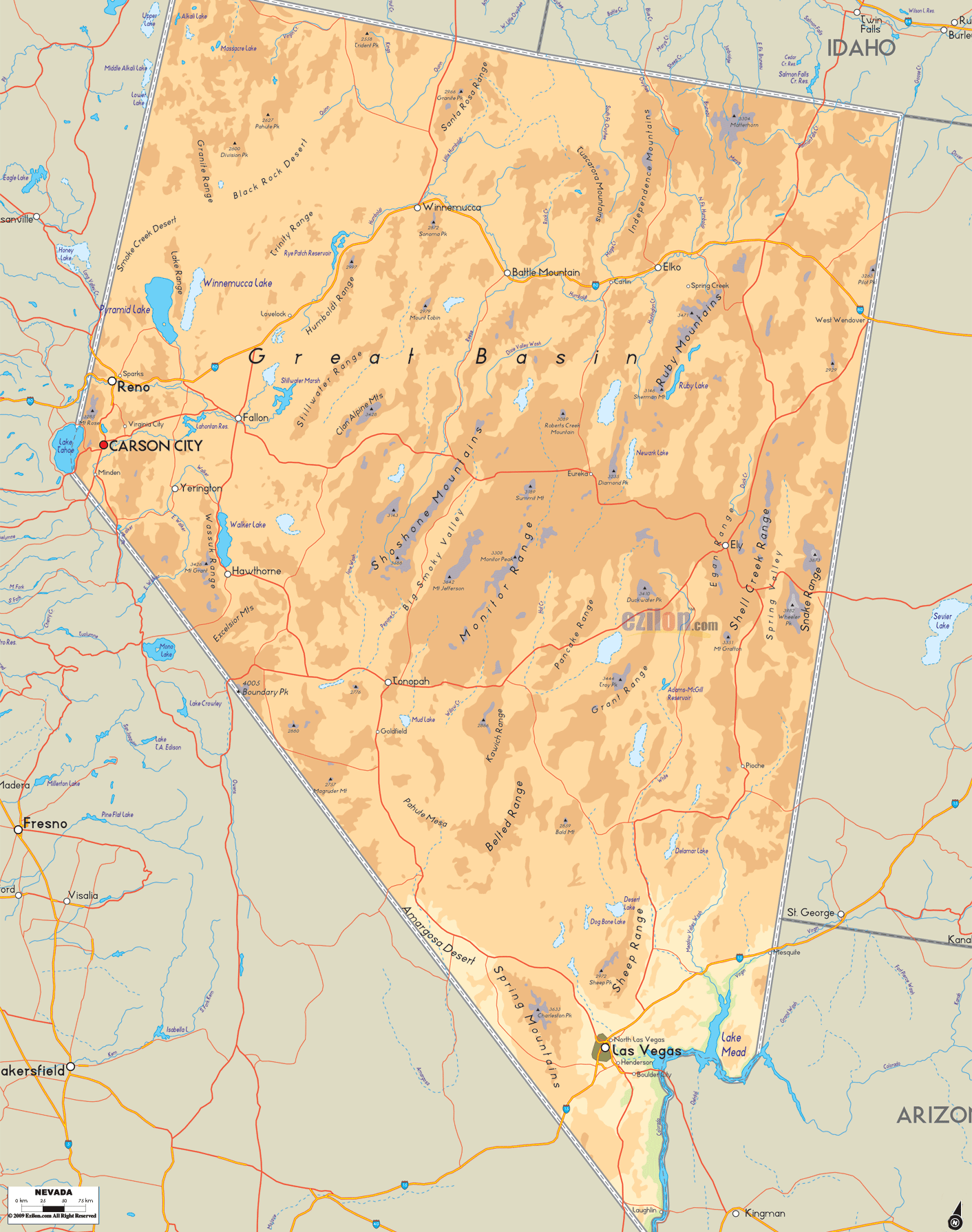
Description: The Physical map of Nevada State, USA showing major geographical features such as rivers, lakes, topography and land formations.

Detailed Physical map of Nevada with elevations and other topographic features such as mountains, rivers and lakes. For county boundaries, cities, and roads, see our County and Road Map of Nevada. Nevada borders Oregon, Idaho, Utah, Arizona and California. It gives travelers, students, and residents a complete visual sense of elevation changes, water features, land formations, and the spatial spread of Nevada's natural terrain. In this guide, we will walk through the map as if we are exploring each central geographic region.
Nevada sits in the heart of the American West, bordered by California, Oregon, Idaho, Utah, and Arizona. What makes the state truly unique is its Basin and Range Province, a vast region of alternating mountain ranges and dry valleys.
The physical map of Nevada clearly shows this pattern. Broad basins appear as light-colored, shaped areas; numerous mountain chains extend across the country, and shaded ridges appear from the Sierra Nevada on the western edge to the Ruby Mountains in the northeast. These two extremes of environmental geographic identity, tempered by human habitation, bestow on the state rugged beauty, spaciousness, and dramatic contrasts in high and low ground.
Nevada is known as the most mountainous state in the contiguous United States, and its geography helps demonstrate why. More than 300 individual mountain ranges stretch across the state, each separated by long, dry basins. This pattern results from tectonic processes that pulled the crust apart, creating fault-block mountains that rise steeply above the surrounding desert floors.
On the physical map, you can see how the valleys, such as the Great Basin, Smoke Creek Desert, Black Rock Desert, Sylvania Valley, and Las Vegas Valley, spread across the state. Many of these basins contain dry lakebeds, salt flats, or playas. The map marks examples such as Winnemucca Lake, Pyramid Lake, Walker Lake, Summit Lake, Ruby Lake, Carson Sink, and Goshute Valley. These water features vary dramatically depending on elevation and precipitation, giving Nevada a mosaic of desert wetlands, mountain lakes, and arid plains.
Steep mountain ranges flank each basin. The physical map of Nevada shows notable features such as the Sierra Nevada, Toiyabe Range, Toquima Range, Ruby Mountains, Snake Range, Monitor Range, Egan Range, Spring Mountains, and Sheeprock Range. Because the map uses precise terrain shading, the viewer can see how these chains rise sharply from the valley floor. The mountains impact the weather, life forms, and humans in Nevada.
Northern Nevada is defined by high-elevation desert, volcanic plateaus, and striking dry lakebeds. On the map of Nevada, one of the most visible features is the Black Rock Desert, an expansive playa famous for its pale, flat surface and for hosting the annual Burning Man event. This area lies in the Great Basin, a region with no outlet to the sea.
Other essential features in northern Nevada include:
These large basins create vast open spaces with minimal vegetation and broad horizons. The geographical map of Nevada clearly shows its boundaries, illustrating that it is an enclosed basin surrounded by rugged ranges. The terrain here is shaped by ancient lakes that evaporated long ago, leaving behind salt flats and dry sediments.
Pyramid Lake is one of Nevada's most iconic lakes and is among the most significant remaining remnants of prehistoric Lake Lahontan. The map shows Pyramid Lake's triangular shape and its location along the highway corridors linking Reno to the northern deserts. Its waters are fed by the Truckee River, which flows from Lake Tahoe across the Sierra Nevada foothills.
The Humboldt River, which runs west across nearly the middle of the state, is Northern Nevada's central river system. The river drains a large area and eventually vanishes in the Humboldt Sink. The map shows Battle Mountain, Elko, Carlin, and Lovelock along the Humboldt River corridor. Because explorers and settlers have crossed Nevada, this river has acted as a significant route.
Central Nevada has some of the most dramatic features shown on the physical map. The region is dominated by long mountain ranges separated by sparsely populated basins. Here, peaks often rise above 11,000 feet, giving the state a surprisingly alpine character despite its desert reputation.
One of the most prominent ranges in central Nevada is the Toiyabe Range, visible on the map stretching north–south near Austin. Featuring Arc Dome, one of Nevada's highest peaks, this range forms a dramatic wall above the Big Smoky Valley.
To the east of Toiyabe lies the Toquima Range, followed by the Monitor Range. These central ranges run nearly parallel to one another and are clearly shown on the map by strong elevation shading. They help define Nevada's interior geography while hosting remote wildlife habitats and high-elevation forests.
The map's southeastern portion shows the Snake Range, home to Wheeler Peak, one of Nevada's tallest mountains. This area is part of Great Basin National Park, known for its rugged peaks, limestone caves, bristlecone pines, and dramatic night skies. The Snake Range's physical form highlights how sharply it rises above the surrounding basin.
Western Nevada's terrain is heavily shaped by the Sierra Nevada, which borders California. Moist air is forced upward by this mountain chain, which causes the area to receive more rainfall and have larger lakes, rivers, and forests.
Although not fully shown on the map, the edges of Lake Tahoe and the Carson Range influence the geography around Reno and Carson City. The map shows how valleys such as Washoe Valley and Carson Valley sit between the Sierra Nevada uplift and the interior desert basins.
The geographical map of Nevada clearly marks Reno, Sparks, and Carson City, areas where rivers, mountains, and transportation routes converge. The Truckee River flows through Reno from Lake Tahoe, providing an important water source in this semi-arid region.
Moving southeast toward Hawthorne, the map shows the elongated Walker Lake, one of Nevada's major natural lakes. The surrounding desert terrain and mountains, such as the Wassuk Range, create substantial elevation contrasts that are visible on the map.
Southern Nevada has a distinctly different environment from the north. This region lies within the Mojave Desert, characterized by warmer temperatures, dramatic rock formations, and unique desert vegetation.
The Las Vegas Valley, located between the Spring Mountains (to the west) and the Sheeprock Range (to the east), is home to Las Vegas, North Las Vegas, and Henderson, Nevada. The shaded relief on the elevation map shows Mount Charleston, the highest point in southern Nevada, rising above the valley floor.
To the east, the map includes Lake Mead, formed by the Hoover Dam on the Colorado River. This water system supplies much of the region's water and forms a central recreational area. The physical map shows how the Colorado River marks the southeastern boundary between Nevada and Arizona.
South of Las Vegas, the terrain transitions to wide-open desert basins, including Ivanpah, Eldorado, and Mesquite Valleys. The map's shading helps viewers understand how these shallow basins sit between desert mountain ranges.
Although Nevada is the driest state in the country, the map reveals a surprising number of lakes and wetlands. Most are remnants of ancient lakes that once covered large areas during the Ice Age.
Pyramid Lake - fed by the Truckee River.
Walker Lake - a large desert lake framed by mountains.
Lake Mead - Nevada's largest reservoir.
Summit Lake - a high-elevation lake in northern Nevada.
Ruby Lake - wetland area fed by mountain snowmelt.
Humboldt River - the longest river entirely within Nevada.
Truckee River - connects Lake Tahoe to Pyramid Lake.
Carson River - flows into the Carson Sink.
Walker River - primary source for Walker Lake.
Colorado River - forms Nevada's eastern boundary.
The map shows clearly how these rivers flow through valleys carved between mountain systems.
This Nevada map is handy for understanding:
Elevation changes.
Desert basin distribution.
Location of major cities relative to land formations.
How roads follow valleys between mountain ranges.
Where rivers and lakes break up the desert landscape.
How the Sierra Nevada and Mojave Desert influence the climate.
Students can utilize the map to examine plate tectonics, geology, and desert systems. People can use it to find beautiful routes, mountain passes, or parks. People become more familiar with the land around their cities.
The physical map of Nevada highlights mountains, basins, valleys, rivers, dry lakes, deserts, and elevation patterns across the state so you can understand the overall terrain at a glance.
Nevada lies where the Earth's crust stretched and fractured, which created alternating mountain ranges and wide desert basins. The map shows this Basin and Range pattern very clearly.
The map shows the Sierra Nevada, Ruby Mountains, Spring Mountains, Snake Range, Toiyabe Range, Toquima Range, and several other Basin and Range mountain chains across Nevada.
Wheeler Peak in the Snake Range is one of the highest points in Nevada and appears on the map as a tall, rugged summit rising above the surrounding Great Basin landscape.
The Great Basin covers most of Nevada, especially the northern and central interior, where enclosed desert basins and dry valleys dominate the physical map.
Pyramid Lake, Walker Lake, Lake Mead, Ruby Lake, and Summit Lake are clearly marked on the map as important water bodies in an otherwise dry region.
The Humboldt River, Truckee River, Carson River, Walker River, and the Colorado River are all highlighted as key river systems that shape Nevada's geography and hydrology.
Northern Nevada is defined by high desert plateaus, large playas like the Black Rock Desert, volcanic fields, and a pattern of long mountain ranges separated by broad basins.
Central Nevada is shaped by long north south mountain chains, high valleys, desert basins, and several peaks that rise above 11,000 feet, creating very rugged landforms on the map.
Southern Nevada lies in the Mojave Desert, so it has warmer temperatures, bold rock formations, the Las Vegas Valley, and the nearby Colorado River corridor, which look different from the cooler central basins.
The Black Rock Desert dominates the north, the Great Basin Desert extends across the central interior, and the Mojave Desert covers the far south around Las Vegas on the map.
The map uses shaded relief and color contrast to show sharp changes between low lying valleys and steep mountain slopes, making elevation changes easy to spot.
Las Vegas Valley, Carson Valley, Big Smoky Valley, Washoe Valley, and Goshute Valley all stand out as distinct basins framed by mountains on the Nevada physical map.
By showing higher, cooler mountain areas near the Sierra Nevada and lower, drier basins inland, the map hints at different climate zones across Nevada's geography.
Nevada is divided into the northern Great Basin region, central Basin and Range interior, Sierra Nevada foothill zone in the west, and the Mojave Desert region in the south as shown on the map.
Plateaus, calderas, and lava fields in northern Nevada are shown through elevation shading, reflecting the state's complex volcanic and tectonic history in the physical landscape.
Wheeler Peak, Mount Charleston, Pyramid Lake, the Ruby Mountains, the Black Rock Desert, and Lake Mead stand out as major natural landmarks on the Nevada physical map.
Near Lake Tahoe, the map shows the Carson Range, Tahoe adjacent valleys, and the western edge of Nevada where Sierra Nevada snowfall influences rivers and local hydrology.
The map highlights only a few river systems, several closed basin lakes, and many dry lakebeds, which together show how limited surface water is across Nevada's deserts and basins.
Areas near the Sierra Nevada, including regions around Reno, Carson City, and the Lake Tahoe edge, receive more moisture than the interior basins, which appears in the pattern of rivers and lakes.
The Las Vegas Valley is surrounded by the Spring Mountains, Mojave Desert slopes, and the broader Colorado River system to the southeast on the Nevada physical map.
Travelers can use the map to find elevation changes, scenic valleys, mountain passes, lake districts, and remote desert regions so they can choose routes and destinations that match their interests and skill level.
The map shows deserts, alpine zones, wetlands, and forested peaks, which correspond to different wildlife habitats and help explain where various plant and animal communities live in Nevada.
Many Nevada lakes sit in closed basins without outlets to the ocean, so water mostly evaporates or seeps into the ground, which is why these lakes are endorheic on the map.
The Ruby Mountains rise in northeastern Nevada, where they form a steep, rugged range above the surrounding high desert basins, clearly marked on the physical map.
Lake Mead is shown as a large reservoir along the Colorado River on Nevada's southeastern boundary, surrounded by steep desert terrain and canyon walls.
Tectonic stretching and faulting created repeated uplift along roughly parallel faults, producing multiple separate mountain ranges divided by down dropped basins across Nevada.
The Snake Range, Ruby Mountains, Toiyabe Range, Spring Mountains, and the edges of the Sierra Nevada all appear especially rugged and steep on the Nevada physical map.
Students and teachers can use the map to study landforms, elevation, climate patterns, tectonics, the Basin and Range structure, and how geography influences where people live in Nevada.
No. The Nevada physical map on this site is provided for on screen viewing only. Printing, copying, or redistributing the map in any form is not allowed.

Political Map of Nevada
Political map and map image of Nevada.

Regional Directory of Canada
Information and guide about Canada and website listing.

Regional Directory of United States of America
Information and guide about United States of America and websites with American topics.

Regional Directory of Europe
Information and guide about Europe and websites with European topics.

Regional Directory of Australia
Information and guide about Australia and websites with Australian topics.