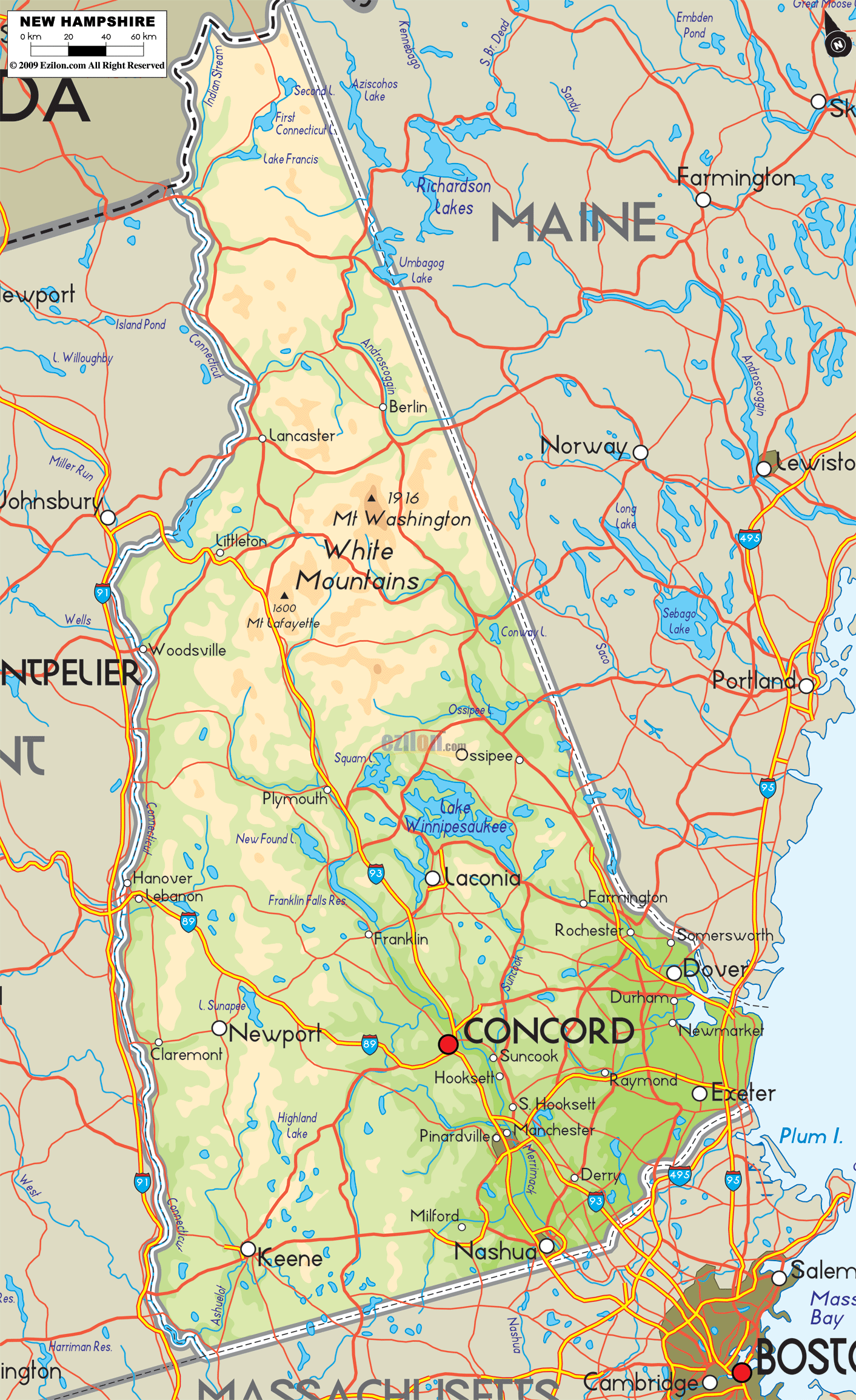
Description: The Large Detailed Physical map of New Hampshire State, USA showing major geographical features such as rivers, lakes, topography and land formations.

Detailed Physical map of New Hampshire with elevations and other topographic features such as mountains, rivers and lakes. For county boundaries, cities, and roads, see our County and Road Map of New Hampshire. New Hampshire borders Maine, Massachusetts and Vermont. When you look at this geographical map of New Hampshire, you immediately see how elevation changes define the land, from the towering summit of Mount Washington to glacial lakes like Winnipesaukee and smaller kettle lakes sprinkled throughout the state.
Because this is a large-format map, it helps the user understand the geography of New Hampshire, including the lakes and rivers, as well as the relief features of the area, which shape travel, recreation, and settlement. If you live in or are visiting northern New England, or are a student of the area, being able to read a physical map is a valuable skill.
New Hampshire is positioned among Vermont, Maine, Massachusetts, and Canada. But what sets it apart is the way the mountains, river valleys, and lakes interact. The best map representation uses shading to represent the state's terrain, allowing the viewer to see ridges, uplands, and lowlands.
The map shows the darker-shaded areas of the White Mountains, with many high elevations, such as the Presidential Range. Mount Washington is labelled 1916 meters. The regions in lighter green are places like the Merrimack Valley, the Connecticut River Valley, and the coastal plain near Portsmouth, which are low. Elevation changes affect the weather around them, road travel, ecosystems, and people's overall experience of the landscape.
The physical map of New Hampshire highlights how the state is split into three major geographic zones: the mountainous north, the lake-dotted central region, and the rolling hills and river valleys of the south. Each area has distinct landforms and features.
In the northern region, the map shows the Canadian border, Lake Francis, the north Connecticut River, and forested uplands. The rural towns of Pittsburg, Colebrook, and Lancaster lie just below the high country. The map area has many lakes and ponds. It also has many long rivers that are fed by snowmelt. Here, elevation is the maximum, which is why this area experiences the coldest weather, the thickest snowpack, and the longest winters.
The White Mountains, the state's most recognizable feature, are located slightly to the southeast. The map prominently shows Mount Washington, the highest peak in the northeastern United States. The peaks surrounding this mountain, such as Mount Lafayette in the Franconia Range, are also marked.
The way these mountains are shaded on the map makes them stand out. It makes it easy to trace mountain ridges, valleys, and pretty notches. The Ammonoosuc and Saco Rivers originate here and flow out into other parts of the state. The map shows the locations of Lincoln, Conway, Berlin, Littleton, and other towns in relation to the mountains.
Water is undoubtedly one of the most distinctive characteristics on the geographical map of New Hampshire. The hundreds of lakes, reservoirs, and ponds, all of glacial origin, are shown on the map. The largest body of water is Lake Winnipesaukee, located near Laconia and extending toward Wolfeboro, Meredith, and Alton Bay. Smaller ponds surround the lakes.
The map also draws attention to:
Squam Lake near Holderness is known for its calm waters and mountain views.
Newfound Lake, west of Plymouth, is another deep glacial lake.
Lake Sunapee near Newport, which feeds into the Sugar River.
Ossipee Lake, north of Lake Winnipesaukee, connects to the Ossipee River.
The Connecticut River forms the western boundary of the state with Vermont.
The Merrimack River flows through Concord, Manchester, and Nashua.
The Pemigewasset River, originating in the White Mountains and flowing south to join the Merrimack.
The Saco River flows east toward Maine.
Because rivers and lakes are essential to both human settlement and ecosystems, the map's depiction of water systems helps viewers understand how watersheds shape geography and population centers.
The map clearly shows the central part of the state, also known as the Lakes Region, which contains a cluster of lakes and forested low mountains. You will find two of New Hampshire's most beautiful lakes in this area: Squam Lake and Lake Wentworth. You can't quote any phrase or term within the paper more than once.
Plymouth, positioned at the northern edge of the Lakes Region, sits where the Pemigewasset River flows into flatter terrain. The map also shows Franklin, where the Pemigewasset and Winnipesaukee Rivers meet to form the Merrimack River. This convergence is a key hydrological feature that the map makes easy to visualize.
Southern New Hampshire has more people, and the physical map of New Hampshire shows cities in relation to landforms. Concord, prominently marked, is situated on low-lying land along the Merrimack River. The state's largest city, Manchester, is located just south of Concord along the Merrimack. Nashua, next to Massachusetts, is where flat land stops, and hilly wetlands start.
This map shows main roads that follow valleys rather than pass over mountains, e.g., the interstate that runs through Concord, Manchester, and Nashua. Milford, Exeter, Portsmouth, and Dover are lower-elevation places showing settlement regions along rivers and coastal inlets.
Along the eastern border, the state meets Maine, and the map displays numerous lakes and rivers stretching across the boundary. Towns such as Conway, Ossipee, Rochester, and Farmington lie in valleys formed by the Saco and Ossipee Rivers. The southeastern section shows a transition from forested uplands to low coastal plains.
New Hampshire's coastline is short but significant. Portsmouth and surrounding towns are positioned near tidal estuaries that feed into the Atlantic. Although the map focuses more on internal geography, it hints at New Hampshire's coastal access, which influences the climate and commerce.
It's a landform map of New Hampshire showing landforms, rivers, and elevated areas. Students of geography can refer to the map for important glacial lakes, river valleys, and mountains. Tourists can use it to find scenic roads and hiking routes, and to calculate travel time based on terrain. People learn how towns are located around rivers, lake systems, and mountain corridors.
The map is handy for understanding:
Mountain clusters and elevation changes.
River networks and lake distributions.
Valley systems and flatlands.
Town placements relative to terrain.
How transportation routes follow natural corridors.
Understanding the physical geography helps people better appreciate how the natural landscape shapes daily life in New Hampshire.
It shows New Hampshire's mountains, lakes, rivers, valleys, and natural landforms, with shaded relief that makes elevation changes and terrain patterns easy to see.
Elevation is shown with shaded relief and color tones, so higher mountains appear darker and more textured while lower valleys and river plains look lighter and smoother.
Mount Washington appears in the northern central part of the map in the White Mountains, clearly labeled as the highest peak in the state.
The map highlights the White Mountains, including the Presidential Range and Franconia Range, along with smaller highland areas and foothills in central New Hampshire.
The White Mountains region appears as a darker, heavily shaded area with tightly packed contours, indicating steep slopes, high peaks, and deep valleys.
The map shows Lake Winnipesaukee, Squam Lake, Newfound Lake, Lake Sunapee, Ossipee Lake, and many smaller glacial lakes across the state.
Lake Winnipesaukee appears in central New Hampshire, near Laconia and Meredith, as a large, irregularly shaped body of water with many bays and islands.
Major rivers such as the Connecticut River, Merrimack River, Pemigewasset River, Androscoggin River, Saco River, and Exeter River are clearly labeled on the map.
By tracing how rivers flow from the White Mountains and uplands into larger valleys and lakes, you can see the main watersheds and drainage patterns across the state.
The Connecticut River Valley runs along the entire western border of New Hampshire with Vermont, appearing as a long north to south valley with river towns and lowlands.
The Merrimack River is shown flowing south from the confluence of the Pemigewasset and Winnipesaukee Rivers through Concord, Manchester, and Nashua toward Massachusetts.
The Lakes Region appears in central New Hampshire as a cluster of mid sized and small lakes surrounded by gentle hills and lower mountain foothills.
The Seacoast area is shown in the far southeast corner of the state near Portsmouth, where lower elevation land meets tidal rivers and a short Atlantic coastline.
Northern New Hampshire appears more mountainous and forested, while southern New Hampshire shows broader valleys, rolling hills, larger cities, and more developed river corridors.
Yes, the distribution of lakes, rounded hills, and smoothed valleys on the map reflects glacial activity that carved basins and shaped New Hampshire's terrain.
Travelers can use the map to find scenic mountain routes, lake districts, river valleys, and lower elevation corridors that are easier for driving, hiking, camping, and sightseeing.
By comparing higher elevations in the White Mountains with lower valleys and coastal plains, the map helps you understand why some regions are colder, snowier, or milder.
Concord, Manchester, Nashua, Portsmouth, Laconia, Keene, Berlin, and Littleton appear in relation to rivers, valleys, and mountain foothills on the map.
The Maine border forms the eastern edge of New Hampshire and is marked alongside many lakes and rivers that cross between the two states.
The Canadian border appears at the top of the map, where northern forests, lakes, and rivers stretch across into Quebec, with towns like Pittsburg and Colebrook nearby.
Students can study mountains, glacial lakes, river valleys, plateaus, rolling hills, and coastal lowlands all from one detailed map of New Hampshire.
Yes, the map highlights mountain ranges, ridgelines, notches, and trailhead towns, which are useful for planning hikes in areas like the White Mountains and Lakes Region.
You can see highways and main roads drawn along river valleys and through mountain passes, which follow the easiest routes through New Hampshire's rugged terrain.
Heavily shaded highlands and remote uplands on the map show where forests and natural landscapes dominate, especially in the north and in the White Mountains.
Residents can use the map to understand how their town fits into the broader geography, including local rivers, nearby mountains, lakes, and elevation patterns that affect weather and travel.
Geography students can use the map to practice reading relief shading, tracing river systems, identifying watersheds, and comparing physical regions across the state.
Yes, the map makes it clear that most cities such as Concord, Manchester, and Nashua lie in lower river valleys and flatter regions rather than on steep mountain slopes.
The map is ideal for school projects, because it visually explains New Hampshire's mountains, lakes, rivers, and valleys in a clear and easy to understand way.
Yes, it is very helpful for route planning, since the map shows not only towns but also the terrain, so you can see where roads pass through hills, valleys, and lake districts.
No. The New Hampshire physical map on this website is provided for on screen viewing only, and printing, copying, or redistributing the map is not allowed.

Counties and Road Map of New Hampshire
Counties and Road map and map image of New Hampshire.

Regional Directory of Canada
Information and guide about Canada and website listing.

Regional Directory of United States of America
Information and guide about United States of America and websites with American topics.

Regional Directory of Europe
Information and guide about Europe and websites with European topics.

Regional Directory of Australia
Information and guide about Australia and websites with Australian topics.