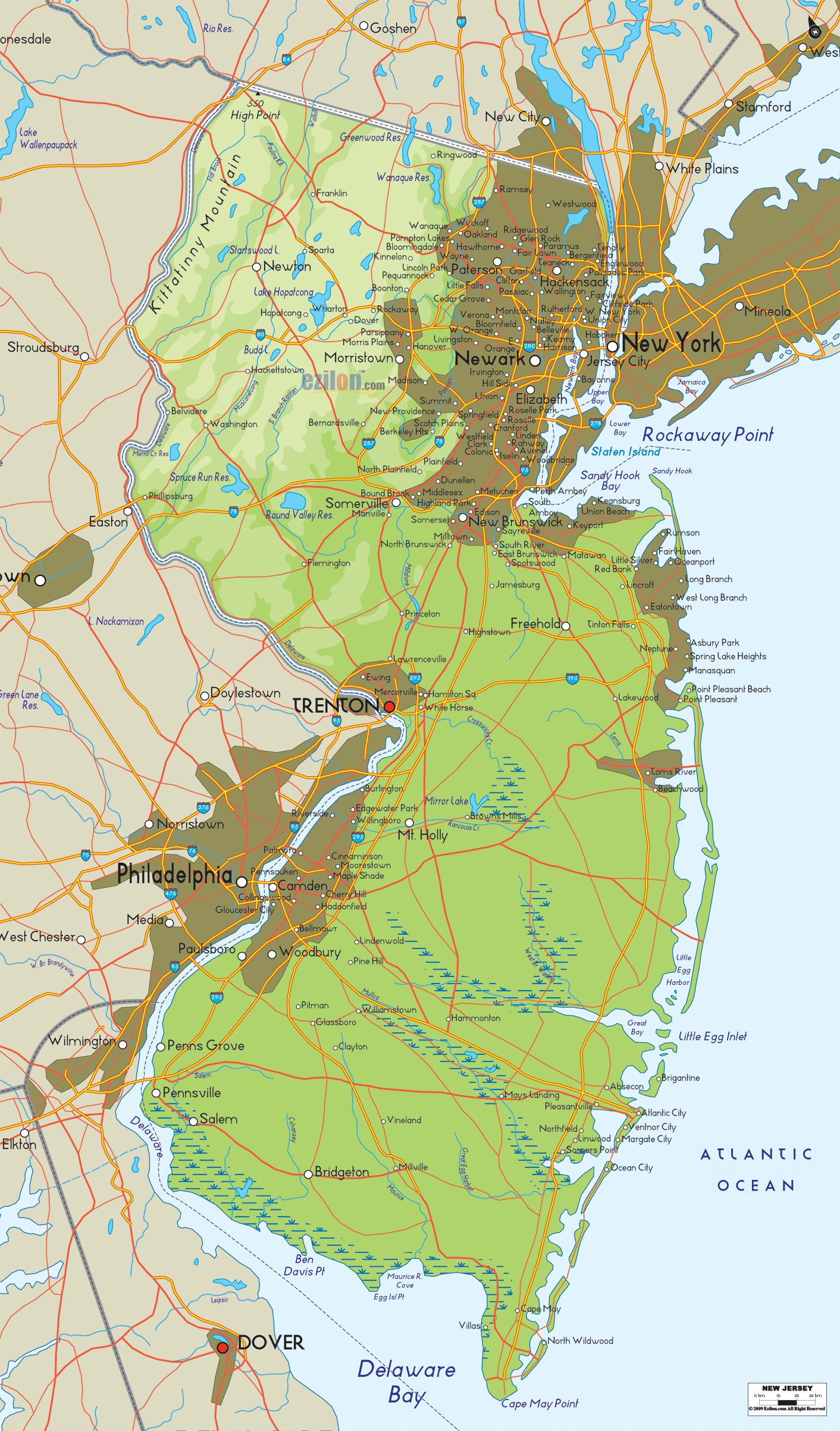
Description: The Physical map of New Jersey State, USA showing major geographical features such as rivers, lakes, topography and land formations.
Detailed Physical map of New Jersey with elevations and other topographic features such as mountains, rivers and lakes. For county boundaries, cities, and roads, see our County and Road Map of New Jersey. New Jersey borders New York, Pennsylvania and Delaware. When you study this geographical map of New Jersey, you are not just looking at highways and town names.
You are seeing how the Delaware River, the Atlantic coast, barrier islands, low marshlands, the Inner Coastal Plain, the Pine Barrens, the rolling Piedmont, and the Kittatinny Mountain ridge all connect. This detailed map shows how water, landforms, and cities interact, making it useful for residents, travelers, and geography students who want a clear picture of New Jersey's natural setting.
From top to bottom, New Jersey stretches from the Delaware Water Gap in the northwest to Cape May at the southern tip, where the Atlantic Ocean meets Delaware Bay. The map shows this as a long, slightly curved shape pressed between Pennsylvania, New York, and the sea.
The western edge follows the Delaware River, which forms a bold boundary line lined with towns such as Phillipsburg, Trenton, Burlington, Camden, Pennsville, and Salem. The eastern edge is entirely coastal, facing the Atlantic Ocean with a chain of barrier islands and resort towns including Long Branch, Asbury Park, Seaside Heights, Atlantic City, Ocean City, Wildwood, and Cape May.
In the northwest corner of our map, you see the Highlands region and the Kittatinny Mountain ridge. Newton, High Point, and the Delaware Water Gap stand out here. The shading on the physical map shows this area as higher ground, with narrow valleys and a more rugged terrain than the rest of the state. High Point, near the New York border, is the state's highest elevation and appears on the map as part of a narrow, north–south mountain line.
Lakes and reservoirs are common in this upland zone. Lake Hopatcong, Spruce Run Reservoir, Round Valley Reservoir, and Greenwood Lake are clearly marked. These water bodies show how glacial activity carved basins that later filled with water. For residents and visitors, this region is known for state parks, hiking, and scenic drives, all of which can be planned and understood using this physical map.
Moving southeast, the terrain lowers into the Piedmont and urban corridor that runs from the New York metropolitan area through Newark and Jersey City down to Trenton and Camden. On the map, this appears as a darkly shaded band filled with city names and a dense network of roads and rail lines. The Passaic, Hackensack, and Raritan Rivers cut through this zone, flowing east toward Newark Bay, Raritan Bay, and the Atlantic Ocean.
Newark, Jersey City, Paterson, Elizabeth, New Brunswick, and Trenton are all placed along these river valleys and bays. The physical map makes it clear that cities cluster where rivers meet tidal waters, giving access to ports and flat land for transport routes. Geography students can see how the Piedmont's gentle slopes and broad lowlands helped support early industry and modern urban growth.
South of the Raritan Valley, the relief shading lightens as you enter the Inner Coastal Plain, a broad lowland stretching across central New Jersey. Towns such as Freehold, Somerville, Flemington, and Hightstown lie in this region. The map shows a mix of farmland, low ridges, and small streams feeding into the Raritan, Delaware, and coastal bays.
This part of the physical map shows why New Jersey has a long farming history despite its urban reputation. The soft undulations and the land surface are suitable for growing a variety of crops, and the presence of rivers and a road network provides easy access to nearby cities. This detailed map indicates that water can shape landscapes even in farming and suburban areas. Look at the marvellous small lakes, ponds, and marshes!
The New Jersey Pinelands or Pine Barrens take up much of southern and central South Jersey. The map shows a large, light-green area with a few large cities, many streams, small lakes, and wildlife areas. Areas like Hammonton, Vineland, and Browns Mills are examples of settlement in the forested plain.
The slow-moving tea-colored rivers, Mullica, Great Egg Harbor, and Maurice Rivers that meander toward the sea, and Delaware Bay are shown by the blue lines. The Pinelands have sandy and porous soil. So, surface water collects in wetlands and cedar swamps rather than in large, deep lakes. The physical map helps travelers spot wildlife refuges, state forests, and canoe routes that are hidden within this otherwise flat region.
Along the western edge, the map shows the Delaware River broadening as it moves south from Trenton toward Philadelphia and Camden, before spreading into Delaware Bay near Salem and Pennsville. The river is drawn as a firm, curving boundary with many bridges and crossings. Towns such as Phillipsburg, Trenton, Burlington, Camden, Penns Grove, Salem, and Bridgeton hug its banks, and the shading around them indicates low-lying floodplains.
The Delaware Bay coastline appears as indented marshlands with names like Fortescue, Money Island, and Maurice River Cove. Marsh symbols and low relief shading reveal that this is a landscape of tidal flats, mud banks, and wildlife habitat. For geography students, this part of the map illustrates how estuaries and bays form where rivers meet the sea and how human communities adapt to low-lying ground vulnerable to flooding and storms.
The eastern part of New Jersey is almost entirely coastal. The Atlantic Ocean is separated from the mainland by a thin strip of barrier islands and peninsulas. On these islands are resorts like Sandy Hook, Long Branch, Asbury Park, Seaside Heights, Atlantic City, Ocean City, Wildwood, and Cape May. The map clearly marks each town, inlet, and bay, including Barnegat Bay, Great Bay, Great Egg Harbor Bay, and Hereford Inlet.
The color contrast between the ocean, bays, and land makes it easy to see how narrow these barrier islands are. Inlets and channels cut through them at points such as Manasquan Inlet, Barnegat Inlet, and Little Egg Inlet, which are essential for boating and coastal navigation. Travelers can use this detailed map to understand which towns are on the mainland, which sit on islands, and how bridges link them.
The physical map also shows how New Jersey is tied into the larger metropolitan framework. In the northeast, New York City sits just across the Hudson River and Upper New York Bay from Jersey City, Hoboken, and Newark.
The shading highlights the built-up nature of this zone, but you can still see the underlying bays, rivers, and low ridges that shape it. To the southwest, across the Delaware River from Camden and Gloucester County, is Philadelphia. You can see on the map that major highways and rail systems follow river valleys and low-lying corridors.
This reference map will help citizens understand commuting routes, ports, industrial areas, and more. For students, it shows how physical geography guided the development of major urban centers and transport hubs.
Because this physical map of New Jersey combines natural features and cities into a single view, it serves as both a learning tool and a travel guide. Geography students can practice locating landform regions: the Appalachian Valley and Ridge in the northwest, the Highlands and Piedmont near the urban core, the Inner Coastal Plain in the centre, the Outer Coastal Plain and Pinelands in the south, and the Atlantic coastal zone along the east. They can trace major rivers such as the Delaware, Raritan, Passaic, Hackensack, and Maurice Rivers, then connect them to bays and estuaries.
Travelers can use the map to find scenic drives along the Delaware River, plan day trips from New York or Philadelphia to the beaches, or explore less-known areas in the Pinelands and Delaware Bay marshes. The shading shows where roads follow high ridges and where they travel down the river valleys and along flat sections of the coast. Giving users a glance at conditions in the inland hills and on the shore can help manage expectations.
For residents, the map offers a broader context for familiar places. Towns like Morristown, Freehold, Vineland, and Toms River are shown in relation to rivers, wetlands, and coasts, which can deepen understanding of flood risks, ecosystems, and regional identity.
Finally, the map is offered for on-screen viewing. It is important to note that printing, copying, or redistributing this New Jersey physical map is not allowed. Users should explore the map digitally, zooming in on their device rather than downloading or reproducing it.
It shows New Jersey's rivers, coasts, wetlands, cities, and landforms, including the Delaware River, Atlantic shoreline, Pinelands, and northern Highlands.
Elevation is shown with gentle relief shading, so higher ridges in the northwest look darker while low coastal plains and marshlands appear lighter and flatter.
They are located in the northwest corner of the state near Newton and High Point, shown as a narrow band of higher ground along the Pennsylvania border.
Lake Hopatcong, Greenwood Lake, Spruce Run Reservoir, and Round Valley Reservoir are among the most visible inland water bodies on the map.
The Delaware River forms the entire western border, shown as a wide curving river lined with towns such as Phillipsburg, Trenton, Camden, Pennsville, and Salem.
Trenton appears near the center of the western border, on the Delaware River between the northern Highlands and the lowlands of the Inner Coastal Plain.
New York City lies just east of northeastern New Jersey across the Hudson and Upper New York Bay, while Philadelphia lies west of Camden across the Delaware River.
The Pinelands occupy a broad area of southern and central South Jersey, shown as lightly shaded forested land with many small streams and lakes.
The Passaic, Hackensack, Raritan, and Delaware Rivers are all highlighted as major river systems shaping the valleys and cities of northern and central New Jersey.
The coastal plain appears as a wide, flat green area stretching from the Raritan River southward to Cape May, with low relief and many wetlands and streams.
Atlantic City appears on a narrow barrier island along the southern Atlantic coast, facing the ocean and separated from the mainland by bays and marshes.
The map shows Raritan Bay, Barnegat Bay, Great Bay, Great Egg Harbor Bay, and numerous inlets such as Barnegat Inlet and Little Egg Inlet.
Travelers can use the map to see which beach towns are on barrier islands, where bridges cross bays, and how far coastal resorts are from inland cities.
It shows a low, marshy shoreline with towns such as Salem, Pennsville, Fortescue, and Cape May Point, highlighting tidal flats and wildlife habitat.
Newark, Jersey City, Paterson, Elizabeth, New Brunswick, Trenton, Camden, and the Philadelphia–Camden area stand out as large urban clusters along rivers and bays.
The map makes it clear that most major cities grew along rivers, estuaries, and transport corridors where terrain is flatter and access to ports is better.
Yes, primary highways are drawn as red or orange lines that follow valleys, coastlines, and low passes, helping users connect cities and regions.
Farming areas are concentrated in the central Inner Coastal Plain and parts of South Jersey, shown as broad lowlands between cities and forests.
The boundary is drawn along the Hudson River, New York Bay, and a short land section in the north, with cities like Jersey City and Newark facing New York City.
Cape May sits at the southern tip of the state where the Atlantic Ocean meets Delaware Bay, shown as a narrow peninsula with beaches and resorts.
Students can identify the Valley and Ridge, Highlands, Piedmont, Inner Coastal Plain, Outer Coastal Plain, Pinelands, and Atlantic coastal barrier island systems.
Yes, the map’s low relief shading and placement of marsh symbols, rivers, and bays show where floodplains and wetlands are most widespread.
They can trace river systems, mark landform regions, compare urban and rural zones, and explain how New Jersey’s location between two major cities shaped its development.
It is helpful for finding higher ground in the northwest, major reservoirs, state forests in the Highlands and Pinelands, and coastal areas for boating and bird watching.
Rivers such as the Raritan, Passaic, and Delaware are shown flowing into estuaries, bays, and the ocean, illustrating how inland waters connect to coastal systems.
Yes, because it overlays roads on natural features, users can study how highways follow river valleys, skirt wetlands, and cross bridges over bays and inlets.
The northwest corner is clearly higher, while most of the center and south are low, flat plains, which explains climate and land use differences across the state.
It is well suited for school, research, and teaching because it combines landforms, water features, and populated places in a single clear view.
Yes, it gives a strong overview of main routes, regional distances, and how terrain and coasts might affect driving choices alongside more detailed navigation tools.
No. The New Jersey physical map is provided for on screen viewing only, and printing, copying, or redistributing the map in any form is not allowed.

Counties and Road Map of New Jersey
Counties and Road map and map image of New Jersy.

Regional Directory of Canada
Information and guide about Canada and website listing.

Regional Directory of United States of America
Information and guide about United States of America and websites with American topics.

Regional Directory of Europe
Information and guide about Europe and websites with European topics.

Regional Directory of Australia
Information and guide about Australia and websites with Australian topics.