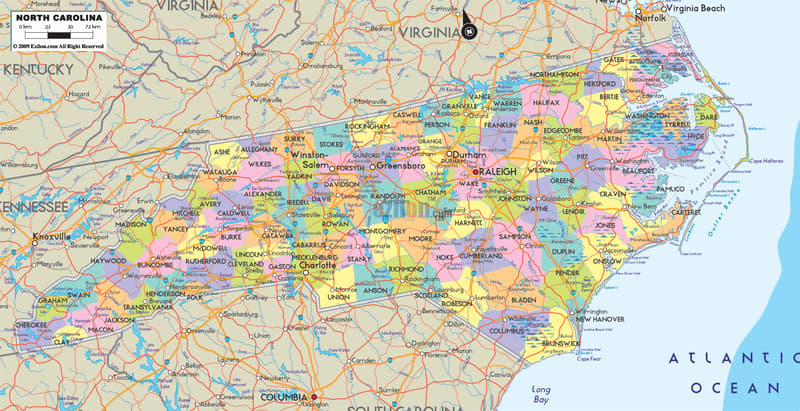
Description: Detailed large map of North Carolina State, USA showing cities, towns, county formations, roads highway, US highways and State routes.
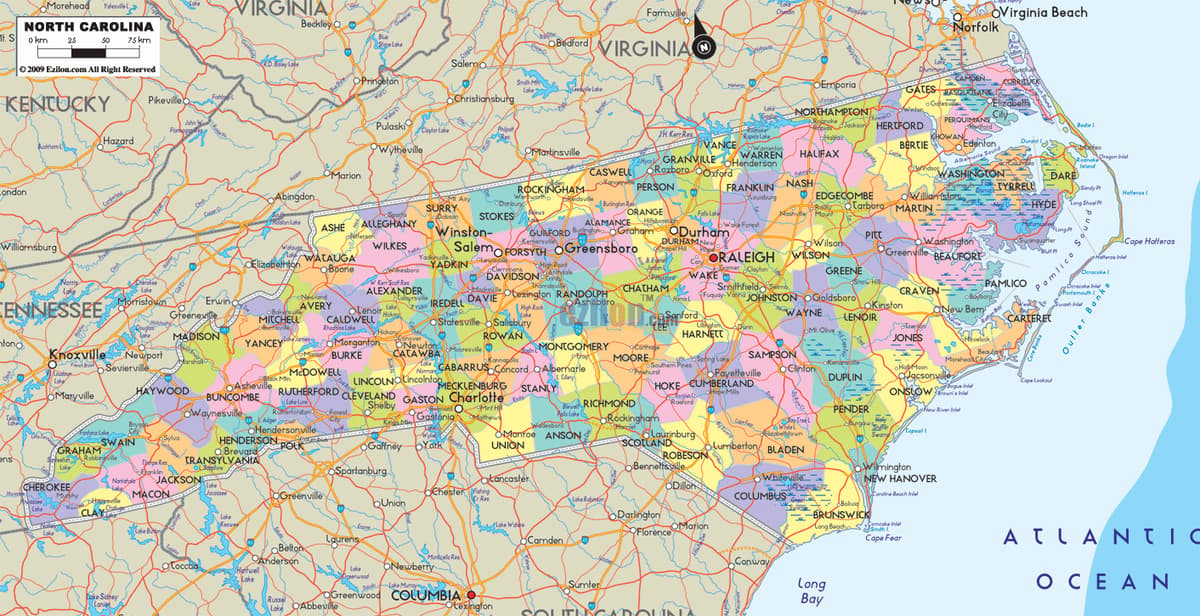
 Map of North Carolina (USA). North Carolina map with cities, counties, and towns. Use this detailed map to understand North Carolina's full county grid, every administrative capital (county seat), the major cities and towns, bordering states and waters, and a few highway cues for orientation only. It is the best map style for residents, travelers, and geography students who want clarity without road clutter. North Carolina packs all 100 counties, the seventh-highest county count of any state, into one map that runs from the Blue Ridge and Great Smoky Mountains in the west to the Outer Banks in the east, so color coding carries most of the weight here rather than a maze of route numbers. Each county sits in its own shaded block with the seat printed in bold right on top, and the thin road lines underneath exist only to help you keep your bearings, not to replace a real atlas. Start with the color blocks, find the county you're after, and the seat, neighboring counties, and nearest cities fall into place from there.
Borders and waters at a glance: Virginia runs the entire northern edge, Tennessee closes off the west through the Great Smoky and Blue Ridge ranges, Georgia touches the far southwest corner around Cherokee, Clay, and Macon counties, and South Carolina lines the long southern edge, while the Atlantic Ocean forms the entire eastern coastline past the barrier islands and sounds. Seven river systems, the Catawba, Yadkin-Pee Dee, Cape Fear, Neuse, Tar-Pamlico, Roanoke, and Chowan, act as the main orientation lines running from the Piedmont down to the coast. Picture the state moving in three bands: the Blue Ridge and Great Smoky Mountains in the west, the rolling Piedmont plateau through the middle, and the flat Coastal Plain, sounds, and barrier islands out toward the Outer Banks in the east. Whether you're mapping this out for schoolwork or planning a road trip, the same colored county grid has you covered.
Road-light orientation: Virginia forms the entire north border; the west edge leans on Tennessee through the Great Smoky and Blue Ridge ranges; the southwest corner touches Georgia for a short stretch around Cherokee, Clay, and Macon counties; the long south edge meets South Carolina; and the east side opens onto the Atlantic Ocean past barrier islands and sounds. All 100 counties are shown, and the Catawba, Yadkin-Pee Dee, Cape Fear, Neuse, Tar-Pamlico, Roanoke, and Chowan rivers act as the main orientation lines running from the Piedmont to the coast. Light corridor cues for I-95, I-40, I-85, I-77, and I-26 help place the state's major metro anchors the cartography marks clearly: Charlotte in Mecklenburg County, Raleigh in Wake County, Greensboro in Guilford County, and Asheville in Buncombe County.
Start at the Georgia and Tennessee corners. Cherokee County lists Murphy as the county seat, close to Hiwassee Lake and the meeting point of three states. Clay County shows Hayesville on the Hiwassee headwaters, and Graham County shows Robbinsville near Fontana Lake and the Cheoah and Santeetlah valleys on the edge of the Great Smoky Mountains. Macon County lists Franklin along the Little Tennessee River, with Highlands and Otto marked at higher elevation. East of there, Jackson County shows Sylva, with the university town of Cullowhee and the resort community of Cashiers also labeled. Swain County shows Bryson City at the Tuckasegee-Nantahala confluence, the western gateway into Great Smoky Mountains National Park. Haywood County lists Waynesville, with Canton on the Pigeon River, and Transylvania County lists Brevard, known as the Land of Waterfalls, near Pisgah National Forest.
Buncombe County is the mountain region's principal metro, with Asheville labeled on the French Broad River and the suburbs of Weaverville and Black Mountain shown nearby. North of Asheville, Madison County lists Marshall, following the river toward Hot Springs. South of the city, Henderson County shows Hendersonville, with Flat Rock on the Blue Ridge escarpment, and Polk County lists Columbus near Tryon, close to the South Carolina line. To the northeast, Yancey County shows Burnsville in Mount Mitchell country, home to the highest peak east of the Mississippi, and Mitchell County lists Bakersville near Spruce Pine along the Appalachian spine. Avery County shows Newland, with Banner Elk and the ski valleys, while Watauga County lists Boone, the college town anchoring the Blue Ridge Parkway corridor. Ashe County lists Jefferson, with West Jefferson also marked at the state's northern tip, and Alleghany County shows Sparta, completing the Blue Ridge crest at the Virginia line.
East of the mountains, the shading opens into rolling foothill counties. Rutherford County lists Rutherfordton, paired with the town of Forest City in the old textile and furniture belt, and McDowell County shows Marion, with Old Fort marking where the escarpment drops toward the Piedmont. Burke County lists Morganton, near Lake James and Valdese, and Caldwell County shows Lenoir, with Granite Falls and Hudson beneath the Blue Ridge. Alexander County lists Taylorsville, bridging toward the Catawba Valley, and Catawba County shows Newton, next to the Hickory metro area with Conover and Maiden also labeled. To the north, Wilkes County lists Wilkesboro, with North Wilkesboro on the Yadkin River, and Surry County shows Dobson, with Mount Airy marked near the Virginia line. Yadkin County lists Yadkinville just south of the river, and Stokes County shows Danbury toward the Dan River bluffs. Davie County lists Mocksville, and Iredell County lists Statesville, connecting this foothill arc into the central Piedmont and holding the largest share of Lake Norman's shoreline.
Forsyth County anchors the map's Triad label with Winston-Salem as the seat, and Kernersville and Clemmons shown nearby. Guilford County lists Greensboro, with High Point marked to the southwest, keeping I-40 and I-85 subtle so the county blocks read first. Davidson County shows Lexington, the barbecue capital, with Thomasville on the county's edge, and Randolph County lists Asheboro, stretching south past the Uwharrie hills and Randleman Lake. Rockingham County shows Wentworth, with Reidsville and Eden along the Dan River, and Caswell County lists Yanceyville on the Virginia line. Alamance County shows Graham, with Burlington, Elon, and Mebane along the Haw River, and Person County lists Roxboro, forming a clean step toward the Triangle.
Mecklenburg County dominates the southern Piedmont with Charlotte as the seat, and labels for Mint Hill, Pineville, Huntersville, Davidson, and Cornelius ringing Lake Norman. West of the city, Gaston County lists Gastonia near Belmont along the Catawba, Lincoln County shows Lincolnton on the river's west bank, and Cleveland County lists Shelby, closing the western flank. To the north, Rowan County shows Salisbury on the Yadkin, with China Grove marked to the south, and Cabarrus County lists Concord, with Kannapolis on the county line. Union County shows Monroe, stretching to the South Carolina border, and Stanly County lists Albemarle, with Badin Lake and the Uwharrie uplands nearby. Farther southeast, Anson County shows Wadesboro and Richmond County lists Rockingham, tracing the Pee Dee fall line with Hamlet marked as a rail hub, while Montgomery County shows Troy near Lake Tillery and Uwharrie National Forest, and Moore County lists Carthage, home to the Southern Pines-Pinehurst golf crescent.
Wake County shows Raleigh as the state capital, with Cary, Apex, Garner, Knightdale, Wake Forest, Morrisville, and Holly Springs ringing a belt of lakes. Durham County lists Durham, next to the Research Triangle Park corridor, and Orange County shows Hillsborough, framing Chapel Hill and Carrboro on the university ridge. Chatham County lists Pittsboro, reaching to Jordan Lake and the Haw River basin, and Johnston County shows Smithfield, stretching down the Neuse River past Clayton, Selma, and Benson. To the northeast, Franklin County lists Louisburg, while Granville County shows Oxford and Vance County lists Henderson, both riding the Kerr Lake line toward Virginia, and Warren County shows Warrenton, bridging to the Roanoke Valley. Lee County lists Sanford, marking the fall line into the Sandhills.
Cumberland County is the Sandhills anchor, with Fayetteville on the Cape Fear River near Fort Bragg, and Hope Mills and Spring Lake labeled close by. Harnett County shows Lillington, linking the Triangle to the Sandhills along the upper Cape Fear, and Hoke County lists Raeford, just west of Cumberland. Scotland County shows Laurinburg along the Lumber River headwaters, and Robeson County lists Lumberton, one of the state's largest counties, following the Lumber River through Pembroke and St. Pauls. Bladen County shows Elizabethtown, including the Bladen Lakes and White Lake, with the road-light palette keeping the blue lakes crisp.
Brunswick County lists Bolivia, covering the Cape Fear's west bank and barrier towns like Oak Island and Holden Beach. New Hanover County shows Wilmington at the river mouth, with Carolina Beach and Wrightsville Beach on the islands, and Pender County lists Burgaw, extending north to Surf City and Topsail Island. Inland, Columbus County shows Whiteville, tying the lower Cape Fear counties back to the South Carolina line.
Onslow County lists Jacksonville, marking Camp Lejeune and the New River estuary, while inland Duplin County shows Kenansville, with Wallace and Warsaw labeled, and Jones County lists Trenton, a small, low-lying county on the Trent River. Carteret County shows Beaufort, stretching along Bogue Banks and Cape Lookout, with Morehead City and Atlantic Beach across the sounds. Craven County lists New Bern at the Neuse-Trent confluence, near Marine Corps Air Station Cherry Point in Havelock, and Pamlico County shows Bayboro, outlining Pamlico Sound marshes and creeks. To the west, Sampson County lists Clinton, one of the state's largest agricultural counties, connecting this coastal cluster back toward the Sandhills.
Pitt County highlights Greenville along the Tar-Pamlico basin, and Greene County shows Snow Hill, compact between Contentnea Creek and the Neuse headwaters. Lenoir County lists Kinston on a Neuse River bend, and Wayne County shows Goldsboro, with Mount Olive also labeled upstream. Wilson County and Nash County cluster around Wilson and Nashville, both near Rocky Mount, which straddles the Nash-Edgecombe line, and Edgecombe County lists Tarboro, marking the Tar River valley toward Princeville. Halifax County shows Halifax, lining the Roanoke River with Roanoke Rapids and Scotland Neck nearby. To the north, Northampton County lists Jackson, running the Virginia line above the Roanoke, and Hertford County shows Winton on the Chowan River, with Gates County listing Gatesville tucked between them near the Virginia border. Bertie County lists Windsor, hugging the Cashie and Roanoke mouths, and Martin County shows Williamston along the Roanoke floodplain. Beaufort County lists Washington on the Pamlico River, with Belhaven and Bath marked along the estuary.
Chowan County fronts Albemarle Sound with colonial Edenton as the seat at the Chowan River mouth, and Perquimans County shows Hertford, bending around the Perquimans River. Pasquotank County lists Elizabeth City, facing Currituck Sound, while Camden County shows Camden, a narrow ribbon between rivers and canals, and Currituck County lists Currituck, stretching along Currituck Sound to the Virginia line and the barrier island villages. Dare County shows Manteo, containing the Outer Banks towns and Cape Hatteras, with the road-light style keeping the islands distinct. Hyde County lists Swan Quarter, mostly marsh with Ocracoke ferry access, and Tyrrell County shows Columbia inland along the Scuppernong River. Washington County lists Plymouth, occupying the Roanoke delta at Albemarle Sound.
A county map answers different questions than a driving map does. Residents want to know which county a town falls under for property, schools, and courts. Visitors need a statewide sense of where places sit relative to borders, rivers, and the coast. Students and teachers trace the state's settlement pattern along a grid of seats and courthouses reaching back to the 1668 Albemarle precincts. This map meets all three needs by listing every county name and seat distinctly, treating larger cities as context rather than the main event, and leaning on just enough road network to tie the story together. Look at the map and you can jump from Asheville to Hickory to Charlotte without ever reading an exit number. You can see that Boone sits in Watauga County on the Blue Ridge Parkway corridor, that Wilmington sits in New Hanover County at the mouth of the Cape Fear, that Greenville sits in Pitt County along the Tar-Pamlico, and that Manteo sits in Dare County out on the Outer Banks, all in a few seconds of scanning.
Seven river systems do most of the orientation work on this page. The Catawba River drains the southern Piedmont past Charlotte and its chain of lakes. The Yadkin-Pee Dee system cuts across the central Piedmont past Wilkesboro, Salisbury, and Albemarle before crossing into South Carolina. The Cape Fear River is the state's only major river that both begins and empties entirely within North Carolina, running past Fayetteville and Wilmington to the Atlantic. The Neuse River threads Raleigh, Smithfield, Kinston, and New Bern toward Pamlico Sound. The Tar-Pamlico system runs through Rocky Mount, Tarboro, and Washington. The Roanoke River crosses the northeast from the Virginia line through Halifax and Plymouth, and the Chowan River gathers the northeastern precinct counties before reaching Albemarle Sound. Keep these seven in mind and any county on the map is easy to place.
The road layer is intentionally minimal. I-95 runs the Coastal Plain north-south through Lumberton, Fayetteville, Wilson, Rocky Mount, and Roanoke Rapids. I-40 is the only interstate to cross the entire state, running from the Tennessee line through Asheville, the Triad, Durham, Raleigh, and on to Wilmington. I-85 cuts diagonally from the South Carolina line through Charlotte, Greensboro, and Durham toward Virginia. I-77 runs north-south through Statesville and Charlotte toward South Carolina, and I-26 connects Asheville south to the South Carolina line. None of these are meant for turn-by-turn navigation, only as county-placement cues.
Every one of North Carolina's 100 counties and its seat, in alphabetical order: Alamance County (Graham), Alexander County (Taylorsville), Alleghany County (Sparta), Anson County (Wadesboro), Ashe County (Jefferson), Avery County (Newland), Beaufort County (Washington), Bertie County (Windsor), Bladen County (Elizabethtown), Brunswick County (Bolivia), Buncombe County (Asheville), Burke County (Morganton), Cabarrus County (Concord), Caldwell County (Lenoir), Camden County (Camden), Carteret County (Beaufort), Caswell County (Yanceyville), Catawba County (Newton), Chatham County (Pittsboro), Cherokee County (Murphy), Chowan County (Edenton), Clay County (Hayesville), Cleveland County (Shelby), Columbus County (Whiteville), Craven County (New Bern), Cumberland County (Fayetteville), Currituck County (Currituck), Dare County (Manteo), Davidson County (Lexington), Davie County (Mocksville), Duplin County (Kenansville), Durham County (Durham), Edgecombe County (Tarboro), Forsyth County (Winston-Salem), Franklin County (Louisburg), Gaston County (Gastonia), Gates County (Gatesville), Graham County (Robbinsville), Granville County (Oxford), Greene County (Snow Hill), Guilford County (Greensboro), Halifax County (Halifax), Harnett County (Lillington), Haywood County (Waynesville), Henderson County (Hendersonville), Hertford County (Winton), Hoke County (Raeford), Hyde County (Swan Quarter), Iredell County (Statesville), Jackson County (Sylva), Johnston County (Smithfield), Jones County (Trenton), Lee County (Sanford), Lenoir County (Kinston), Lincoln County (Lincolnton), Macon County (Franklin), Madison County (Marshall), Martin County (Williamston), McDowell County (Marion), Mecklenburg County (Charlotte), Mitchell County (Bakersville), Montgomery County (Troy), Moore County (Carthage), Nash County (Nashville), New Hanover County (Wilmington), Northampton County (Jackson), Onslow County (Jacksonville), Orange County (Hillsborough), Pamlico County (Bayboro), Pasquotank County (Elizabeth City), Pender County (Burgaw), Perquimans County (Hertford), Person County (Roxboro), Pitt County (Greenville), Polk County (Columbus), Randolph County (Asheboro), Richmond County (Rockingham), Robeson County (Lumberton), Rockingham County (Wentworth), Rowan County (Salisbury), Rutherford County (Rutherfordton), Sampson County (Clinton), Scotland County (Laurinburg), Stanly County (Albemarle), Stokes County (Danbury), Surry County (Dobson), Swain County (Bryson City), Transylvania County (Brevard), Tyrrell County (Columbia), Union County (Monroe), Vance County (Henderson), Wake County (Raleigh), Warren County (Warrenton), Washington County (Plymouth), Watauga County (Boone), Wayne County (Goldsboro), Wilkes County (Wilkesboro), Wilson County (Wilson), Yadkin County (Yadkinville), and Yancey County (Burnsville).
North Carolina borders Virginia across its entire northern edge, Tennessee along the western mountains, Georgia for a short stretch at the Cherokee-Clay-Macon corner, and South Carolina along the long southern edge, while the Atlantic Ocean forms the eastern coastline. The state holds 100 counties, the seventh-highest count of any state. Dare County is the largest by land area at about 1,542 square miles, much of it sound water around the Outer Banks, while Clay County is the smallest at about 221 square miles. Wake County, home to Raleigh, is the most populous with roughly 1,232,000 residents, and Tyrrell County is the least populous with roughly 3,500 residents. Chowan, Currituck, Pasquotank, and Perquimans counties share the title of oldest, all four organized as precincts of the old Albemarle County in 1668. North Carolina covers about 53,819 square miles in total, including roughly 48,618 square miles of land. The capital, Raleigh, sits in Wake County near the Fall Line, and the state's major metros run from Charlotte and the southern Piedmont through the Triad and Triangle to Wilmington on the coast. Landscape-wise, the state moves from the Blue Ridge and Great Smoky Mountains in the west, across the rolling Piedmont plateau, down to the flat Coastal Plain, sounds, and barrier islands in the east.
North Carolina's ten largest cities by current population are Charlotte (about 960,600, Mecklenburg County), Raleigh (about 508,300, Wake County), Greensboro (about 310,300, Guilford County), Durham (about 306,900, Durham County), Winston-Salem (about 257,400, Forsyth County), Fayetteville (about 209,100, Cumberland County), Cary (about 184,600, Wake County), Wilmington (about 127,600, New Hanover County), High Point (about 119,600, Guilford County), and Concord (about 114,300, Cabarrus County). Charlotte anchors banking and finance, home to Bank of America's headquarters and a major Wells Fargo hub, alongside a growing logistics and energy sector. The Triangle, spanning Wake, Durham, and Orange counties, centers the Research Triangle Park innovation corridor between Duke University, the University of North Carolina at Chapel Hill, and North Carolina State University, drawing pharmaceutical, biotech, and software employers. The Triad counties of Forsyth, Guilford, and Davidson carry the state's furniture and textile manufacturing legacy alongside logistics tied to Piedmont Triad International Airport. Agriculture remains a major force statewide: North Carolina leads the nation in tobacco and sweet potato production and ranks among the top hog and poultry producing states, concentrated in Coastal Plain counties such as Duplin, Sampson, and Wayne. The Port of Wilmington in New Hanover County, along with Camp Lejeune in Onslow County and MCAS Cherry Point in Craven County, anchors the state's coastal economy alongside a large tourism industry drawing visitors to the Outer Banks and the Blue Ridge Mountains.
North Carolina's cultural identity runs from the mountains to the sea. The Blue Ridge Parkway and the peaks around Asheville and Boone anchor a mountain craft and music tradition, with Buncombe County's Asheville long known for its arts scene and the Biltmore Estate. Eastern North Carolina claims its own barbecue tradition centered on whole-hog, vinegar-based sauce, distinct from the tomato-based Lexington style associated with the Triad's Davidson County. Textile and furniture history runs deep through Gaston, Catawba, Davidson, and Randolph counties, where mill towns once powered the state's manufacturing identity. The Research Triangle counties of Wake, Durham, and Orange combine major universities with a growing tech and biotech economy, while coastal Dare County preserves the Wright Brothers National Memorial at Kill Devil Hills and the Roanoke Island site of the Lost Colony. Historic river towns like Edenton in Chowan County and New Bern in Craven County, North Carolina's first colonial capital, carry colonial-era architecture and history. The Outer Banks in Dare, Currituck, Hyde, and Carteret counties draw visitors for beaches, lighthouses, and maritime history, while the mountain counties around Cherokee and Swain preserve Eastern Band Cherokee heritage near the Qualla Boundary.
On this map, Mount Mitchell (Blue Ridge, Yancey County) and the Catawba, Cape Fear, and Neuse rivers double as landmarks for finding counties quickly. For elevation, terrain, watersheds, and land-cover detail, see our Physical Map of North Carolina.
North Carolina has a humid subtropical climate statewide, with milder, cooler conditions and more snow in the western mountains than in the warmer Piedmont and coastal plain. For a full seasonal and biome breakdown, see our Physical Map of North Carolina.
North-south travel runs mainly on I-95 (the Coastal Plain from Roanoke Rapids to the South Carolina line) and I-77 (Statesville to Charlotte). East-west travel runs on I-40, the only interstate crossing the entire state, from the Tennessee line through Asheville, the Triad, Durham, and Raleigh to Wilmington, with I-85 cutting diagonally through Charlotte, Greensboro, and Durham, and I-26 connecting Asheville to South Carolina. Keep in mind that ZIP codes do not follow county lines in North Carolina, so a single ZIP code can span two counties. Always confirm the county name directly from the map or index rather than assuming it from a ZIP prefix.
Use this as a quick index. Every line lists the county with its county seat (and a familiar city or landmark when the map labels one). Short cues mention river, border, or gentle corridor context only.
Cherokee – Murphy; far southwest corner against Georgia and Tennessee.
Clay – Hayesville; small county on the Hiwassee headwaters.
Graham – Robbinsville; Fontana Lake and the Cheoah valley.
Haywood – Waynesville; Canton on the Pigeon River.
Jackson – Sylva; university town of Cullowhee and Cashiers.
Macon – Franklin; Little Tennessee River, with Highlands nearby.
Swain – Bryson City; gateway to Great Smoky Mountains National Park.
Transylvania – Brevard; Land of Waterfalls near Pisgah National Forest.
Alleghany – Sparta; Blue Ridge crest at the Virginia line.
Ashe – Jefferson; West Jefferson at the state's northern tip.
Avery – Newland; Banner Elk and the ski valleys.
Buncombe – Asheville; mountain region's principal metro on the French Broad.
Henderson – Hendersonville; Flat Rock on the Blue Ridge escarpment.
Madison – Marshall; river road north toward Hot Springs.
Mitchell – Bakersville; Spruce Pine along the Appalachian spine.
Polk – Columbus; near Tryon at the South Carolina line.
Watauga – Boone; college town on the Blue Ridge Parkway.
Yancey – Burnsville; Mount Mitchell country, highest peak in the East.
Alexander – Taylorsville; bridges toward the Catawba Valley.
Burke – Morganton; Lake James and Valdese nearby.
Caldwell – Lenoir; Granite Falls and Hudson beneath the Blue Ridge.
Catawba – Newton; next to the Hickory metro area.
Davie – Mocksville; connects the foothills to the central Piedmont.
Iredell – Statesville; largest share of Lake Norman's shoreline.
McDowell – Marion; Old Fort where the escarpment meets the Piedmont.
Rutherford – Rutherfordton; paired with Forest City in the textile belt.
Stokes – Danbury; toward the Dan River bluffs.
Surry – Dobson; Mount Airy near the Virginia line.
Wilkes – Wilkesboro; North Wilkesboro on the Yadkin River.
Yadkin – Yadkinville; just south of the Yadkin River.
Alamance – Graham; Burlington, Elon, and Mebane along the Haw River.
Caswell – Yanceyville; rides the Virginia line.
Davidson – Lexington; barbecue capital, with Thomasville on the county edge.
Forsyth – Winston-Salem; Triad anchor with Kernersville and Clemmons nearby.
Guilford – Greensboro; High Point marked to the southwest.
Person – Roxboro; a clean step toward the Triangle.
Randolph – Asheboro; Uwharrie hills and Randleman Lake.
Rockingham – Wentworth; Reidsville and Eden along the Dan River.
Anson – Wadesboro; on the Pee Dee fall line.
Cabarrus – Concord; Kannapolis on the county line.
Cleveland – Shelby; closes the Metrolina region's western flank.
Gaston – Gastonia; near Belmont along the Catawba River.
Lincoln – Lincolnton; rides the Catawba's west bank.
Mecklenburg – Charlotte; southern Piedmont anchor around Lake Norman.
Montgomery – Troy; Lake Tillery and Uwharrie National Forest.
Moore – Carthage; Southern Pines-Pinehurst golf crescent.
Richmond – Rockingham; Hamlet marked as a rail hub.
Rowan – Salisbury; on the Yadkin, with China Grove to the south.
Stanly – Albemarle; Badin Lake and the Uwharrie uplands.
Union – Monroe; stretches to the South Carolina border.
Chatham – Pittsboro; reaches to Jordan Lake and the Haw River.
Durham – Durham; next to the Research Triangle Park corridor.
Franklin – Louisburg; northeast of the Triangle core.
Granville – Oxford; rides the Kerr Lake line toward Virginia.
Johnston – Smithfield; down the Neuse past Clayton and Selma.
Lee – Sanford; marks the fall line into the Sandhills.
Orange – Hillsborough; frames Chapel Hill and Carrboro.
Vance – Henderson; also on the Kerr Lake line.
Wake – Raleigh; the state capital, with Cary and Apex nearby.
Warren – Warrenton; bridges to the Roanoke Valley.
Bladen – Elizabethtown; Bladen Lakes and White Lake.
Cumberland – Fayetteville; Cape Fear River near Fort Bragg.
Harnett – Lillington; links the Triangle to the Sandhills.
Hoke – Raeford; just west of Cumberland County.
Robeson – Lumberton; follows the Lumber River through Pembroke.
Scotland – Laurinburg; on the Lumber River headwaters.
Brunswick – Bolivia; Cape Fear's west bank, Oak Island and Holden Beach.
Columbus – Whiteville; ties the coast back to the South Carolina line.
New Hanover – Wilmington; at the Cape Fear River mouth.
Pender – Burgaw; north to Surf City and Topsail Island.
Carteret – Beaufort; Bogue Banks and Cape Lookout.
Craven – New Bern; at the Neuse-Trent confluence.
Duplin – Kenansville; Wallace and Warsaw labeled nearby.
Jones – Trenton; small, low-lying county on the Trent River.
Onslow – Jacksonville; Camp Lejeune and the New River estuary.
Pamlico – Bayboro; Pamlico Sound marshes and creeks.
Sampson – Clinton; one of the state's largest farm counties.
Beaufort – Washington; on the Pamlico River, with Belhaven and Bath.
Bertie – Windsor; hugs the Cashie and Roanoke mouths.
Edgecombe – Tarboro; Tar River valley toward Princeville.
Gates – Gatesville; tucked near the Virginia border.
Greene – Snow Hill; between Contentnea Creek and the Neuse headwaters.
Halifax – Halifax; Roanoke River, with Roanoke Rapids nearby.
Hertford – Winton; on the Chowan River.
Lenoir – Kinston; on a Neuse River bend.
Martin – Williamston; along the Roanoke floodplain.
Nash – Nashville; also clustered near Rocky Mount.
Northampton – Jackson; runs the Virginia line above the Roanoke.
Pitt – Greenville; along the Tar-Pamlico basin.
Wayne – Goldsboro; Mount Olive also labeled upstream.
Wilson – Wilson; near Rocky Mount on the Nash-Edgecombe line.
Camden – Camden; narrow ribbon between rivers and canals.
Chowan – Edenton; colonial seat at the Chowan River mouth.
Currituck – Currituck; Currituck Sound to the Virginia line.
Dare – Manteo; Outer Banks towns and Cape Hatteras.
Hyde – Swan Quarter; mostly marsh, with Ocracoke ferry access.
Pasquotank – Elizabeth City; faces Currituck Sound.
Perquimans – Hertford; bends around the Perquimans River.
Tyrrell – Columbia; inland along the Scuppernong River.
Washington – Plymouth; Roanoke delta at Albemarle Sound.
Note: This directory is arranged to mirror how the labels cluster on our map, so you can scan county blocks and confirm seat names quickly in the road-light layout.
North Carolina has 100 counties and the map shows every one with a colored block and county seat.
County boundaries, county seats and neighboring states, with only light road references for orientation.
Raleigh in Wake County.
Mecklenburg County.
Wake County, the state capital and North Carolina's most populous county.
Guilford County.
Durham sits in Durham County, just northwest of Wake County, forming the Research Triangle with Orange County.
Forsyth County.
Buncombe County.
New Hanover County.
Cumberland County.
Pitt County.
Watauga County.
Orange County.
Craven County.
Onslow County.
From west to east: Ashe, Alleghany, Surry, Stokes, Rockingham, Caswell, Person, Granville, Vance, Warren, Northampton, Hertford, Gates and Currituck.
From west to east: Cherokee, Polk, Rutherford, Cleveland, Gaston, Union, Anson, Richmond, Scotland, Robeson, Columbus and Brunswick.
From south to north: Cherokee, Graham, Swain, Haywood, Madison, Yancey, Mitchell, Avery, Watauga and Ashe.
Cherokee, Clay and Macon at the far southwestern tip.
Thin lines for I-95, I-40, I-85, I-77 and I-26, used only to confirm direction, not for turn-by-turn navigation.
It threads the western mountain counties, including Watauga, Avery, Yancey, Buncombe and Haywood.
Dare County, with parts of Currituck, Hyde and Carteret along the barrier islands.
On the barrier islands of Dare County.
It sits mainly in Durham County, near the Durham-Wake county line.
Yancey County, on the Buncombe County line.
Cumberland, Bladen, Pender, New Hanover and Brunswick.
Camp Lejeune sits in Onslow County; MCAS Cherry Point is in Craven County near Havelock.
No. Printing or copying maps from this site is not permitted.
Dare County, at about 1,542 square miles, much of it sound water around the Outer Banks.
Clay County, at about 221 square miles.
Wake County, home to Raleigh, with roughly 1,232,000 residents.
Tyrrell County, with roughly 3,500 residents.
Charlotte, in Mecklenburg County, with roughly 960,000 residents.
Chowan, Currituck, Pasquotank and Perquimans, all organized as precincts of the old Albemarle County in 1668.
No. ZIP codes cross county lines, so use the county boundaries and seats shown here instead.

Physical Map of North Carolina
Physical map and map image of North Carolina.

Regional Directory of Canada
Information and guide about Canada and website listing.

Regional Directory of United States of America
Information and guide about United States of America and websites with American topics.

Regional Directory of Europe
Information and guide about Europe and websites with European topics.

Regional Directory of Australia
Information and guide about Australia and websites with Australian topics.