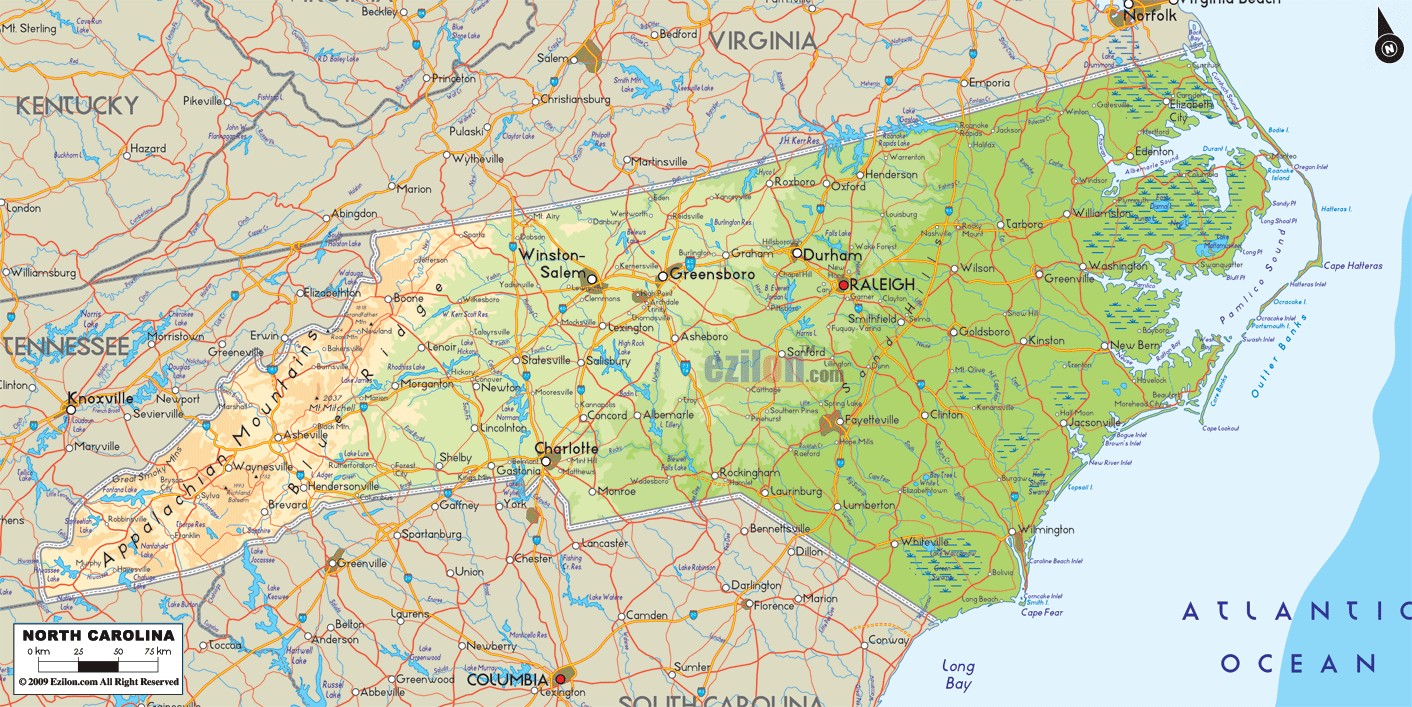
Description: The Physical map of North Carolina State, USA showing major geographical features such as rivers, lakes, topography and land formations.

Detailed Physical map of North Carolina with elevations and other topographic features such as mountains, rivers and lakes. For county boundaries, cities, and roads, see our County and Road Map of North Carolina. North Carolina borders Virginia, Tennessee, Georgia and South Carolina. The physical map shows a long east-west sweep of terrain that starts in the Blue Ridge Mountains and Great Smoky Mountains and drops step by step through the Piedmont to the low coastal plain and the thin line of the Outer Banks.
The geographical map of North Carolina shows how its ridges, river valleys, rolling hills, swamps, and barrier islands all affect where people live, where roads run, and how tourists move through the state. Designed as a silent assistant to all residents, travellers, and geography students who wish to see the land beneath the names.
The map extends from the western Tennessee line to the eastern Atlantic shoreline in a rectangular shape, tilted slightly to the northeast. The perimeter of the west abuts the Great Smoky Mountains National Park and high ridges toward the towns of Murphy, Andrews, and Bryson City.
The main cities across the Central Belt are Asheville, Charlotte, Greensboro, Winston-Salem, Raleigh, and Durham from the Piedmont. On the eastern side, the landscape fans out into the broad coastal plain, which contains Fayetteville, Greenville, New Bern, Jacksonville (a military town), Wilmington, and smaller cities among the rivers, estuaries, and sounds.
If you follow our physical map of North Carolina from left to right, you begin in the rugged highlands of the Blue Ridge Mountains and Great Smoky Mountains along the Tennessee border. Relief shading here is tight and dark, showing steep slopes and deep valleys.
Peaks rise above 6,000 feet near the state line, making this one of the highest areas in the eastern United States. Towns such as Murphy, Franklin, Sylva, Waynesville, and Boone lie in sheltered valleys or perched on ridges where roads can thread through.
The detailed map highlights long, narrow ridges that run roughly northeast to southwest. The Appalachian chain on these ridges shapes the rivers and roads. The Little Tennessee River and other streams flow through narrow fingers of land towards Tennessee; the French Broad River winds around Asheville. Pupils of Geography will study the folded and faulted mountains shown on this part of the map that influence drainage and settlement.
As we go east across North Carolina on the map, the high peaks give way to more rounded hills. The relief shading is less pronounced, and valleys open into wider basins. Hickory, Lenoir, Morganton, and Statesville are in this zone. Here, the land is still elevated compared with the coastal plain, but much easier to farm and build on than the high mountains.
Rivers such as the Catawba, Yadkin, and New River are visible as blue lines angling southeast out of the mountains. The dams have created reservoirs and lakes along the rivers, which appear on the map as blue patches. Lake Norman, near Charlotte, for instance, looks like a massive lake in a broad valley. High Rock Lake and other impoundments turn the rivers in the Piedmont. The lake pattern can explain many recreation areas and shoreline communities in a region.
As you reach the central third of the map, the relief becomes a pattern of rolling hills and low ridges. This is the Piedmont, a broad upland that stretches from Virginia to Alabama. North Carolina's Piedmont has a string of major cities, including Charlotte, Greensboro, Winston-Salem, High Point, Durham, and Raleigh. The urban corridor runs roughly southwest to northeast. It runs along the line of contact between hard crystalline rocks of the uplands and soft rocks of the coastal plain.
The map shows several rivers through the Piedmont. Yadkin Pee Dee Catawba Neuse Eno Haw Rivers. Over time, these streams carved broad valleys rather than deep gorges. This has resulted in a familiar topography of fields, woodland, and settlements. Many characterize this area for its rolling hills and smooth landscape. Despite the relief shading showing variation, there is no question of height differences.
For residents and travelers, this part of North Carolina's physical map is the most densely marked with roads and towns. Interstates and major highways appear as st ong lines connecting Charlotte to Raleigh and beyond, reflecting how the Piedmont became the state's economic core. Geography students can see how the gentle terrain and location between the mountains and the coast make this an ideal area for farming, manufacturing, and modern tech corridors.
Farther east, the rivers start dropping towards the sea faster, the map shows. The Fall Line is a narrow zone where the Piedmont meets the Inner Coastal Plain. Nearby towns include Fayetteville, Rocky Mount, Golds oro, and Wilson. According to the physical map, rivers flow through softer sediments and gain more meanders and wetlands.
These major rivers in the coastal plain region are the Neuse, Tar, Roanoke, and Cape Fear. As their floodplains grow larger, many small streams join the two banks. The relief shading here is very gentle, meaning the height decreases smoothly to sea level beyond the beach. The inner coastal plain is essential farmland, and the detailed map shows a lattice of roads serving small communities and market centers.
The far eastern section of the map shows the outer coastal plain. Low, broad lowlands are swampy in places. Sounds, estuaries, and barrier islands have carved shoreline. Tidal rivers and bays are home to cities such as Washington, Greenville, and New Bern. The map highlights large water bodies, such as Albemarle Sound, Amelico Sound, and Bogue Sound, that lie behind the thin, wave-shaped barrier islands of the Outer Banks.
Cape Hatteras, Cape Lookout, and Cape Fear are the most notable bends along the barrier islands. These capes serve as essential reference points for maritime navigation and storm tracking. To us, they look like narrow land projections bounded by the Atlantic Ocean on one side and sounds on the other. Thin lines indicate bridges and causeways connecting the barrier islands to the mainland.
Wetlands and swamp forests occupy lower areas of the Neuse and Cape Fear Rivers. The muted greens and blues of the map, which show these marshes, help explain the abundance of wildlife refuges and estuarine systems in coastal North Carolina. For travelers planning to visit beaches or seaside towns, this part of the best map of North Carolina is essential, since it clarifies which areas are on barrier islands, which are on the mainland, and how driving routes wrap around rivers and sounds.
One advantage of a detailed map like this is the way it makes river systems easy to trace. Numerous short, steep rivers travel west into Tennessee or cut through narrow gaps in the Blue Ridge to flow east. The rivers Catawba, Yadkin, and others carve out longer, smoother courses while the Piedmont is dotted with reservoirs. The Neuse, Tar, Roanoke, and Cape Fear Rivers are longer, slower, and have more open estuaries in the lower coastal plain.
People from geography will see from a physical map of North Carolina how drainage divides follow high ridges and how watersheds organize the state. Most of North Carolina's central and eastern areas flow into the Atlantic through the Neuse and Cape Fear systems. The Roanoke and Chowan River Basins drain most of the northeast, and just to the south, rivers come together in South Carolina.
Because our geographical map of North Carolina combines terrain, cities, and transportation, it serves as more than a picture. Residents can use it to see how their hometown sits in relation to mountains, hills, and he sea. A person living in Raleigh can see how close the coastal plain begins to the east and how the Piedmont extends to the west. Some of the land in Wilmington can look inland to the Cape Fear River basin and outward to the chain of barrier islands.
For a fabulous road trip, travelers can take the route from Asheville through the Blue Ridge Mountains, then across the Piedmont, ending on the Atlantic coast. Relief shading helps future riders "see" the climbs on the mountains and the flatness as they reach the coast. Visitors can enjoy river valleys, state parks, and lakes and sounds. The detailed map also adds context to national parks, national forests, and wildlife refuges, and shows how the protected areas relate to neighbouring regions.
Both teachers and students can use this teaching map of North Carolina in class to teach and learn about erosion, river meanders, floodplains, fall zones of the Piedmont, ocean processes, etc. If learners compare highlands, uplands, and lowlands, they can form a mental model of how the state's landscapes came to be (i.e., formation through tectonic uplift, weathering, and change in sea level).
It shows mountains, Piedmont hills, rivers, coastal plain, and barrier islands across North Carolina, along with major cities and main travel routes.
Elevation appears through shaded relief and color changes so high Appalachian ridges look darker and more textured while the coastal plain appears lighter and flatter.
They appear along the western border with Tennessee, where closely spaced shading marks steep ridges near towns such as Boone, Bryson City, and Murphy.
The map gradually shifts from dark, tight shading in the highlands to smoother, rolling relief around cities like Hickory and Statesville, marking the foothills zone.
The Catawba, Yadkin Pee Dee, Neuse, Tar, Roanoke, and Cape Fear Rivers are clearly marked, showing how they flow from uplands to the Atlantic coast.
Travelers can follow curving roads along mountain ridges, Piedmont rivers, and coastal sounds, using the relief shading to spot high viewpoints and flat coastal stretches.
It is ideal for school work because it clearly combines landforms, rivers, cities, and neighboring states, making it easy to explain North Carolina’s geography.
Charlotte appears in the southwestern Piedmont, shown on rolling uplands west of the Fall Line and south of the Catawba River reservoirs.
Yes, the coastal section of the map clearly outlines the thin barrier islands of the Outer Banks and labels beach towns that sit on those islands instead of the mainland.
Low wetlands appear in muted greens and blues along the lower Neuse and Cape Fear Rivers and around the sounds, showing broad swamp forests and marshes.
Asheville lies close to some of the highest peaks, with the Blue Ridge Parkway and Great Smoky Mountains National Park accessible within a short drive.
Albemarle Sound, Pamlico Sound, Core Sound, and Bogue Sound are the largest, acting as broad estuaries behind the Outer Banks and connecting to many tidal rivers.
Raleigh lies near the eastern edge of the Piedmont close to the Fall Line, with the lower coastal plain spreading out just to its east.
The Cape Fear River reaches Wilmington, while the Neuse River links to New Bern and the Pamlico region, helping to connect inland communities with the Atlantic.
Yes, because it shows the connections to Virginia, South Carolina, Tennessee, and Georgia, you can see how ridges, rivers, and coastal plains cross state boundaries.
The Piedmont has moderate elevation, good soils, and many rivers, which helped it develop manufacturing, research centers, and large cities along major transport routes.
They are barrier islands built from sand moved by waves and storms, which makes them low, shifting features that are easily reshaped by hurricanes and ocean currents.
These rivers provided transport corridors, fertile floodplains, and access to natural harbors, so many early towns, farms, and trading posts developed along their banks.
The parkway follows high ridges along the Appalachians, offering long views over valleys and linking national park areas with small mountain towns.
The region lies on a very low coastal plain where slow drainage and past sea level changes created both large farms and extensive peat rich wetlands.
Charlotte is close to Lake Norman and Lake Wylie, Greensboro and Burlington are near several Piedmont reservoirs, and Raleigh sits close to Jordan Lake and Falls Lake.
Hurricanes bring strong winds, storm surge, and heavy rain that can flood barrier islands, cut new inlets, and push water up river estuaries into low coastal towns.
The barrier islands block direct paths to the ocean, so rivers like the Roanoke and Tar empty into Albemarle and Pamlico Sounds before their waters reach open sea.
Hiking, camping, trout fishing, scenic driving, skiing in winter, and visiting waterfalls and parkway overlooks are all common in the high western counties.
Flooding is most common on the coastal plain where wide floodplains, slow moving rivers, and tropical storms combine, especially along the Neuse, Tar, and Cape Fear Rivers.
Fertile coastal and Piedmont soils support crops and livestock, while the central location, universities, and mild climate of the Piedmont have attracted research parks and tech companies.
No. The North Carolina physical map is provided for on screen viewing only, and printing, copying, or redistributing the map in any form is not allowed.

Counties and Road Map of North Carolina
Counties and Road map and map image of North Carolina.

Regional Directory of Canada
Information and guide about Canada and website listing.

Regional Directory of United States of America
Information and guide about United States of America and websites with American topics.

Regional Directory of Europe
Information and guide about Europe and websites with European topics.

Regional Directory of Australia
Information and guide about Australia and websites with Australian topics.