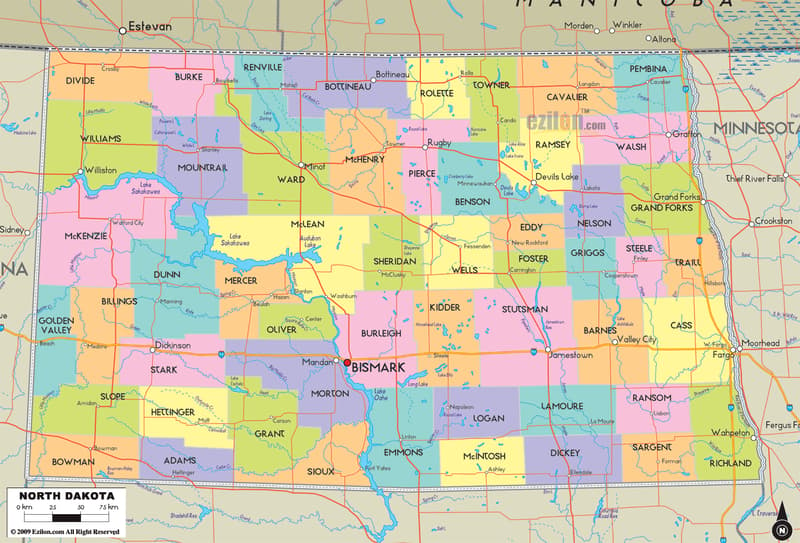
Description: Detailed large map of North Dakota State, USA showing cities, towns, county formations, roads highway, US highways and State routes.
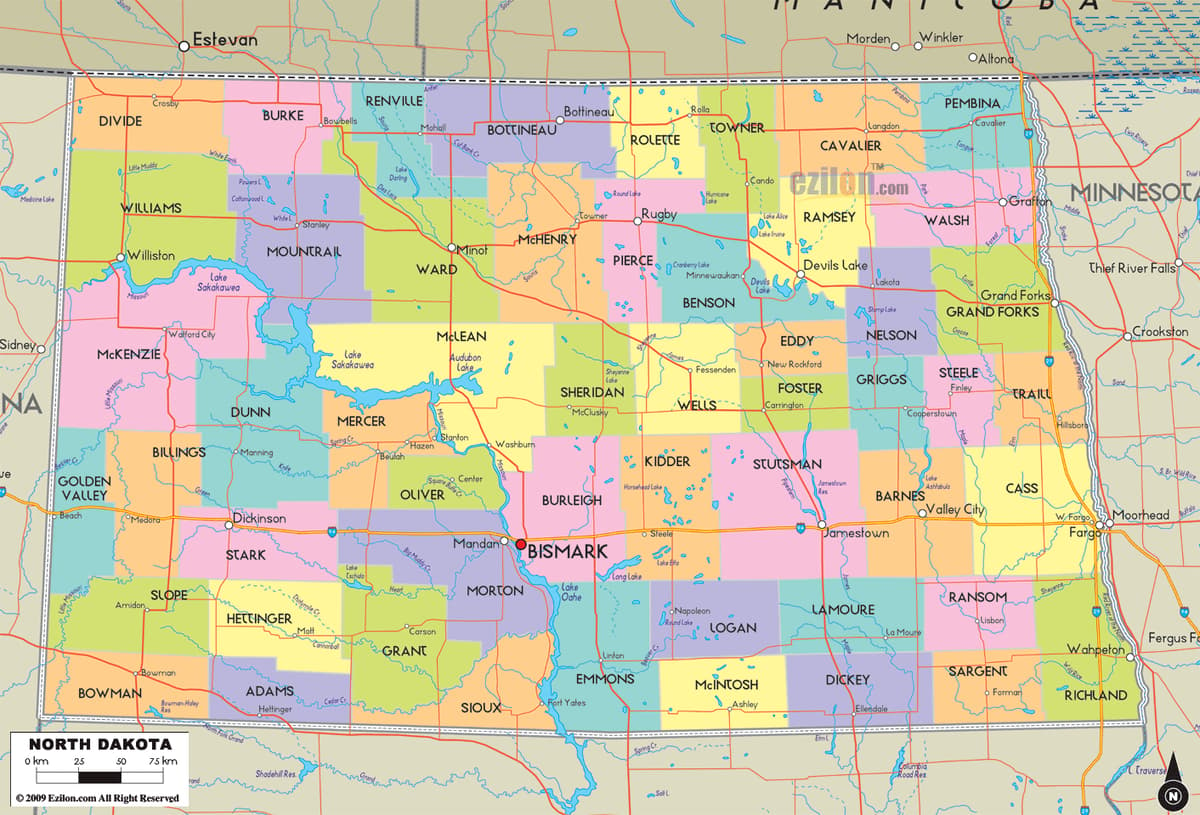
 Map of North Dakota (USA). North Dakota map with cities, counties, and towns. Use this detailed map to understand North Dakota's full county grid, every administrative capital (county seat), the major cities and towns, bordering states and waters, and a few highway cues for orientation only. It is the best map style for residents, travelers, and geography students who want clarity without road clutter. North Dakota covers roughly 70,700 square miles, and rather than crowd the page with a maze of highway lines, this map leans on the county grid to carry the detail. All 53 counties, each shaded its own color, show where a city sits, which government handles it, and how far it is to the next town over. Fargo, Bismarck, Grand Forks, Minot, and the smaller county seats are all labeled clearly enough to find in a few seconds, no matter which corner of the state you're trying to place.
Borders and waters at a glance: North Dakota's east edge follows the Red River of the North against Minnesota; the south edge borders South Dakota; the west edge borders Montana; and the entire northern edge is an international border with the Canadian provinces of Manitoba and Saskatchewan. Inside those borders, the Missouri, Red River of the North, James, Sheyenne, and Mouse (Souris) rivers act as the main orientation lines running through the interior, with Lake Sakakawea and Devils Lake as the two biggest bodies of water to watch for.
Road-light orientation: Just two interstates carry the whole state, and the map keeps them thin on purpose so the county colors and place names stay easy to read. I-94 runs east-west through Fargo, Jamestown, Bismarck-Mandan, and Dickinson. I-29 runs north-south along the Red River Valley from the South Dakota line through Fargo and Grand Forks to the Manitoba border. Notice that the state's biggest anchors, Fargo in Cass County, Bismarck in Burleigh County (the state capital), Grand Forks in Grand Forks County, and Minot in Ward County on the Mouse River, all sit right where these light corridor cues cross a county line. That is exactly why they work as landmarks.
Start in the far southwest corner. Bowman County lists Bowman as its seat right where North Dakota meets both Montana and South Dakota, with US-85 threading north toward Badlands country. East of it, Adams County posts the town of Hettinger as its seat on the open prairie steppe, and just north, Hettinger County itself is anchored by Mott, with New Leipzig nearby. Slope County, seat Amidon, is the least populous county on the map and sits near White Butte, the state's highest natural point. The postcard Badlands appear in Billings County, where Medora sits along the Little Missouri River at the gateway to Theodore Roosevelt National Park's South and North units. Golden Valley County, seat Beach, hugs the Montana line just north of Billings. Stark County, seat Dickinson, is the main service hub for the region, sitting directly on I-94.
Moving to the far northwest, Divide County, seat Crosby, occupies the corner where North Dakota touches both Montana and Saskatchewan. Burke County, seat Bowbells, sits just east, with the Portal crossing marking a major entry point from Canada. Williams County is the northwest hub, seat Williston, near where the Yellowstone River meets the Missouri just west of Lake Sakakawea. McKenzie County, seat Watford City, is the largest county on the map by area and stretches across the great bays of Lake Sakakawea and the Little Missouri badlands. Mountrail County, seat Stanley, runs southeast across oil country to New Town on the lake's north shore. Dunn County, seat Manning, sits south of the lake near the Killdeer Mountains. Mercer County, seat Stanton, wraps the wide mid-lake arms near Beulah and Hazen. Oliver County, seat Center, marks the geographic center of the state just west of the Missouri River. McLean County, seat Washburn, straddles the Garrison Dam and Riverdale area, with Garrison and Underwood also on the map. Morton County, seat Mandan, faces the capital across the river, and Burleigh County, seat Bismarck, is home to the state capital itself, with Wing and Driscoll dotting the prairie to the east.
South of Morton, Grant County, seat Carson, opens into ranchland dotted with towns like Elgin. Sioux County, seat Fort Yates, follows the Standing Rock stretch of the Missouri and is home to the Standing Rock Reservation. Emmons County, seat Linton, sits along the river's east bank near Hague, close to the South Dakota line. Moving east, Kidder County, seat Steele, sits directly on I-94 amid prairie pothole lakes near Tappen and Dawson. Logan County, seat Napoleon, and McIntosh County, seat Ashley, mark the state's historic German-Russian settlement belt, with McIntosh also home to Wishek. LaMoure County, seat LaMoure, sits on the James River just east. Sheridan County, seat McClusky, and Wells County, seat Fessenden, follow the James River basin, with Harvey at the north end of Wells. Foster County, seat Carrington, calls itself the "Central City" at the junction of US-281 and US-52. Eddy County, seat New Rockford, is the smallest county on the map by area and sits on the Sheyenne River. Stutsman County, seat Jamestown, and Barnes County, seat Valley City, serve as twin anchors along I-94 and the Sheyenne River. Griggs County, seat Cooperstown, rounds out the corridor along the upper Sheyenne.
North of the prairie corridor, Renville County, seat Mohall, sits on the Canadian border along the Mouse (Souris) River near the town of Glenburn. Ward County, seat Minot, is the region's hub, where the Souris loops past Burlington and Surrey. McHenry County, seat Towner, runs south from the Mouse loop with Velva on US-52. Bottineau County, seat Bottineau, climbs into the wooded Turtle Mountains, dotted with small lakes. Rolette County, seat Rolla, continues the higher wooded ridge, with Belcourt near the international line and home to the Turtle Mountain Reservation. Towner County, seat Cando, sits eastward on open prairie known as the "Duck Capital." Pierce County, seat Rugby, is labeled near the spot long marked as the geographic center of North America.
Ramsey County, seat Devils Lake, sits on the northern shore of the lake that shares its city's name. Benson County, seat Minnewaukan, wraps the lake's western coves and reaches prairie towns like Fort Totten and Maddock, home to the Spirit Lake Reservation. Nelson County, seat Lakota, sits southeast of the lake near Michigan City. Pembina County, the state's oldest county, anchors the far northeast corner, seat Cavalier, with the towns of Pembina and Neche on the river at the border. Cavalier County, seat Langdon, lies just west toward the Turtle Mountains. Walsh County, seat Grafton, sits along the Red River valley near Park River and Minto. Grand Forks County, seat Grand Forks, faces East Grand Forks, Minnesota across the Red River, with Emerado near Grand Forks Air Force Base. Traill County, seat Hillsboro, sits mid-valley near Mayville and Portland. Steele County, seat Finley, closes out the region on gentle glacial till plains.
Cass County, seat Fargo, is the state's most populous county and largest city, with West Fargo, Kindred, Horace, and Mapleton spread across the prairie where I-29 and I-94 intersect. South of Cass, Ransom County, seat Lisbon, sits on the Sheyenne River. Sargent County, seat Forman, runs along the border past Milnor and Gwinner. Richland County, seat Wahpeton, caps the southeast corner opposite Breckenridge, Minnesota, where the Bois de Sioux and Otter Tail rivers join to form the Red River. Dickey County, seat Ellendale, touches the South Dakota line near the western Maple River headwaters.
Five waterways do most of the orientation work on this page. The Missouri River arcs across the center, widening into Lake Sakakawea behind Garrison Dam before passing Bismarck-Mandan. The Red River of the North forms the entire eastern border with Minnesota. The James River and Sheyenne River loop through the central counties toward the Red River Valley. The Mouse (Souris) River curls through Ward, Renville, and McHenry counties near the Canadian border. Keep these five in mind and any county on the map is easy to place.
Every one of North Dakota's 53 counties and its seat, in alphabetical order: Adams County (Hettinger), Barnes County (Valley City), Benson County (Minnewaukan), Billings County (Medora), Bottineau County (Bottineau), Bowman County (Bowman), Burke County (Bowbells), Burleigh County (Bismarck), Cass County (Fargo), Cavalier County (Langdon), Dickey County (Ellendale), Divide County (Crosby), Dunn County (Manning), Eddy County (New Rockford), Emmons County (Linton), Foster County (Carrington), Golden Valley County (Beach), Grand Forks County (Grand Forks), Grant County (Carson), Griggs County (Cooperstown), Hettinger County (Mott), Kidder County (Steele), LaMoure County (LaMoure), Logan County (Napoleon), McHenry County (Towner), McIntosh County (Ashley), McKenzie County (Watford City), McLean County (Washburn), Mercer County (Stanton), Morton County (Mandan), Mountrail County (Stanley), Nelson County (Lakota), Oliver County (Center), Pembina County (Cavalier), Pierce County (Rugby), Ramsey County (Devils Lake), Ransom County (Lisbon), Renville County (Mohall), Richland County (Wahpeton), Rolette County (Rolla), Sargent County (Forman), Sheridan County (McClusky), Sioux County (Fort Yates), Slope County (Amidon), Stark County (Dickinson), Steele County (Finley), Stutsman County (Jamestown), Towner County (Cando), Traill County (Hillsboro), Walsh County (Grafton), Ward County (Minot), Wells County (Fessenden), and Williams County (Williston).
North Dakota borders Minnesota across the Red River of the North to the east, South Dakota to the south, Montana to the west, and the Canadian provinces of Manitoba and Saskatchewan along its entire northern edge. The state holds 53 counties. McKenzie County is the largest by land area at about 2,760 square miles, while Eddy County is the smallest at about 630 square miles. Cass County, home to Fargo, is the most populous county with roughly 200,945 residents, while Slope County is the least populous with roughly 706 residents. Pembina County is the oldest county, organized in 1867, well before most of the state's other counties followed in the 1870s and 1880s. North Dakota covers about 70,700 square miles in total, with about 69,000 square miles of land. The capital, Bismarck, sits in Burleigh County on the Missouri River, and the state's major population centers run from Fargo and Grand Forks in the Red River Valley through Bismarck-Mandan to Minot and Williston in the west. Landscape-wise, the state moves from the flat, fertile Red River Valley in the east across the rolling Drift Prairie and its prairie-pothole lakes, through the Missouri Plateau, and into the rugged Badlands along the Little Missouri River in the southwest.
Highways get rebuilt, renumbered, and rerouted more often than most people realize. County lines in North Dakota do not move that way. Pembina County was organized back in 1867, and most of the other 52 counties were locked in during the 1870s and 1880s, boundaries that have held steady ever since. That is the real reason this map of North Dakota counties leads with color-coded blocks instead of a dense highway grid: the county line is what decides which courthouse handles your paperwork, which school district your address falls into, and who sets your property tax rate, none of which a road atlas will ever tell you. Keeping the road layer light is not about leaving information out. It is about keeping the page readable, whether you are trying to find a county seat, figure out which side of a river a town sits on, or just get your bearings before a longer drive.
North Dakota's ten largest cities by current population are Fargo (about 138,574, Cass County), Bismarck (about 78,848, Burleigh County), Grand Forks (about 60,516, Grand Forks County), Minot (about 47,031, Ward County), West Fargo (about 41,619, Cass County), Williston (about 29,401, Williams County), Dickinson (about 25,830, Stark County), Mandan (about 25,214, Morton County), Jamestown (about 15,666, Stutsman County), and Wahpeton (about 8,171, Richland County). Fargo anchors the state's finance, retail, and technology sector and is home to North Dakota State University's research programs. Bismarck, the capital, centers state government and healthcare along the Missouri River. Grand Forks hosts a regional university and Grand Forks Air Force Base, while Minot's economy leans on Minot Air Force Base and the surrounding Mouse River farm trade. Williston and Watford City in McKenzie County sit at the heart of the Bakken oil patch, one of the country's major energy-producing regions. Agriculture remains central across the state, with wheat, soybeans, corn, canola, sunflowers, and sugar beets grown across the plains, and cattle ranching common in the western counties. With no coastline, North Dakota's water-based activity is limited, though the Missouri River and its reservoirs support recreation and hydropower rather than commercial shipping.
North Dakota's cultural identity is shaped by its plains geography and its settlement history. The Badlands around Medora in Billings County draw visitors to Theodore Roosevelt National Park, named for the president whose ranching years there influenced his later conservation policies. Much of the state's farm country carries strong Scandinavian and German-Russian immigrant heritage, visible in town names, church histories, and community festivals across counties like McIntosh, Barnes, and Bottineau. North Dakota is also home to several federally recognized tribal nations, including communities at Standing Rock in Sioux County, Turtle Mountain in Rolette County, Spirit Lake in Benson County, and the Fort Berthold area around Lake Sakakawea. Higher education is spread across the state's counties, with the University of North Dakota in Grand Forks, North Dakota State University in Fargo, Minot State University, Dickinson State University, and Valley City State University all anchoring their communities. The state's agricultural heritage remains visible every summer at county fairs and the North Dakota State Fair in Minot.
On this map, the Badlands (southwest, near Medora) and the Missouri, Red River of the North, and Sheyenne rivers double as landmarks for finding counties quickly. For elevation, terrain, watersheds, and land-cover detail, see our Physical Map of North Dakota.
North Dakota has a continental climate with cold, snowy winters and warm, often windy summers, with slightly drier conditions in the west than in the Red River Valley. For a full seasonal and biome breakdown, see our Physical Map of North Dakota.
East-west travel runs on I-94 (Fargo to Jamestown, Bismarck-Mandan, and Dickinson). North-south travel runs on I-29 (the South Dakota line through Fargo and Grand Forks to the Manitoba border). Keep in mind that ZIP codes do not follow county lines in North Dakota, so a single ZIP code can span two counties. Always confirm the county name directly from the map or index rather than assuming it from a ZIP prefix.
Use this as a quick index. Every line lists the county with its county seat and a short cue for river, border, or corridor context.
Adams – Hettinger; prairie steppe near the Cedar Creek breaks.
Bowman – Bowman; extreme southwest corner at Montana and South Dakota.
Hettinger – Mott; New Leipzig nearby.
Slope – Amidon; least populous county, near White Butte.
Billings – Medora; Little Missouri River, Theodore Roosevelt National Park.
Golden Valley – Beach; on the Montana line.
Stark – Dickinson; I-94 service hub.
Divide – Crosby; Montana and Saskatchewan corner.
Burke – Bowbells; Portal border crossing.
Williams – Williston; Missouri-Yellowstone confluence.
McKenzie – Watford City; largest county by area.
Mountrail – Stanley; New Town on the lake.
Dunn – Manning; near the Killdeer Mountains.
Mercer – Stanton; Beulah and Hazen.
Oliver – Center; geographic center of the state.
McLean – Washburn; Garrison Dam and Riverdale.
Morton – Mandan; opposite the capital.
Burleigh – Bismarck; the state capital.
Grant – Carson; ranchland near Elgin.
Sioux – Fort Yates; Standing Rock area.
Emmons – Linton; Hague, near South Dakota.
Kidder – Steele; I-94, prairie pothole lakes.
Logan – Napoleon; crossroads town.
McIntosh – Ashley; Wishek, German-Russian heritage.
LaMoure – LaMoure; on the James River.
Sheridan – McClusky; prairie wetlands.
Wells – Fessenden; Harvey, James River.
Foster – Carrington; "Central City," US-281/US-52 junction.
Eddy – New Rockford; smallest county by area, Sheyenne River.
Stutsman – Jamestown; James River, I-94.
Barnes – Valley City; Sheyenne River, "City of Bridges."
Griggs – Cooperstown; upper Sheyenne corridor.
Renville – Mohall; Canadian border, near Glenburn.
Ward – Minot; Souris (Mouse) River loop.
McHenry – Towner; Velva on US-52.
Bottineau – Bottineau; the Turtle Mountains.
Rolette – Rolla; Belcourt, Turtle Mountain Reservation.
Towner – Cando; the "Duck Capital."
Pierce – Rugby; geographic-center-of-North-America marker.
Ramsey – Devils Lake; the lake's north shore.
Benson – Minnewaukan; Fort Totten, Spirit Lake Reservation.
Nelson – Lakota; near Michigan City.
Pembina – Cavalier; the state's oldest county.
Cavalier – Langdon; near the Turtle Mountains.
Walsh – Grafton; Park River and Minto.
Grand Forks – Grand Forks; opposite East Grand Forks, Minnesota.
Traill – Hillsboro; near Mayville-Portland.
Steele – Finley; glacial till plains.
Cass – Fargo; most populous county, largest city.
Ransom – Lisbon; on the Sheyenne River.
Sargent – Forman; Milnor and Gwinner.
Richland – Wahpeton; Red River headwaters at the Minnesota line.
Dickey – Ellendale; on the South Dakota line.
This directory aligns with what you see on the page: every county, its seat, and a one-line locator that keeps the focus on counties rather than driving steps.
North Dakota has 53 counties and the map shows every one with a colored block and county seat.
County boundaries, county seats and neighboring states, with only light road references for orientation.
Bismarck in Burleigh County along the Missouri River.
Cass County, the state's most populous county.
Grand Forks County, on the Red River of the North.
Ward County, on the Mouse (Souris) River.
Williams County, in the northwest oil patch.
In Stark County along I-94.
Mandan is the seat of Morton County, on the west bank of the Missouri River opposite Bismarck.
Williams, McKenzie, Mountrail, Dunn, Mercer and McLean.
Ramsey County holds the lake's north shore; Benson County wraps its western coves.
From west to east: Divide, Burke, Renville, Bottineau, Rolette, Towner, Cavalier, Pembina.
From north to south: Pembina, Walsh, Grand Forks, Traill, Cass, Richland.
From north to south: Divide, Williams, McKenzie, Golden Valley, Billings, Slope, Bowman.
Bowman, Adams, Hettinger, Grant, Sioux, Emmons, McIntosh, Dickey, Sargent, Richland.
Missouri, Red River of the North, James, Sheyenne and Mouse (Souris).
In a road-light style, with only I-94 and I-29 shown as the state's two interstates.
Stutsman County, on the James River and I-94.
Barnes County, on the Sheyenne River.
Richland County, at the Minnesota border.
Billings County.
Sioux County, seat Fort Yates.
Bottineau County, with Rolette County continuing the ridge to the west.
Pierce County, near the historic geographic-center-of-North-America marker.
McKenzie County, at about 2,760 square miles.
Eddy County, at about 630 square miles.
Cass County, home to Fargo, with roughly 200,945 residents.
Slope County, with roughly 706 residents.
Fargo, in Cass County, with about 138,574 residents.
Pembina County, organized in 1867, well before most other counties followed in the 1870s and 1880s.
McKenzie County.
Foster County.
Eddy County.
Walsh County.
Cavalier County.
Locate the county seat first, follow rivers and lakes as guide rails, then use the thin highways only to confirm direction and distance.
No. Printing or copying maps from this site is not permitted.
No. ZIP codes cross county lines, so use the county boundaries and seats shown here instead.

Physical Map of North Dakota
Physical map and map image of North Dakota.

Regional Directory of Canada
Information and guide about Canada and website listing.

Regional Directory of United States of America
Information and guide about United States of America and websites with American topics.

Regional Directory of Europe
Information and guide about Europe and websites with European topics.

Regional Directory of Australia
Information and guide about Australia and websites with Australian topics.