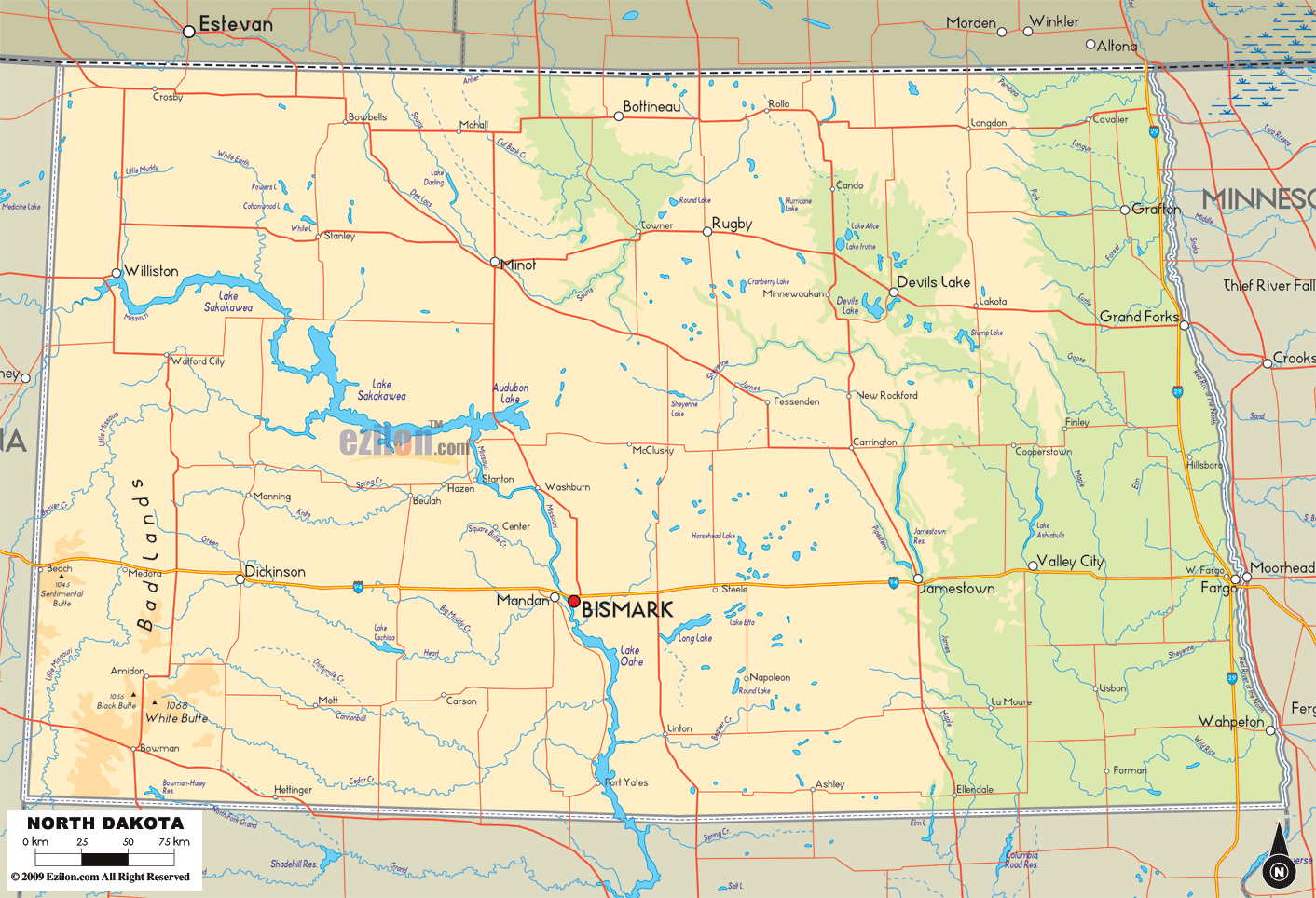
Description: The Physical map of North Dakota State, USA showing major geographical features such as rivers, lakes, mountains, topography and land formations.
Detailed Physical map of North Dakota with elevations and other topographic features such as mountains, rivers and lakes. For county boundaries, cities, and roads, see our County and Road Map of North Dakota. North Dakota borders Minnesota, South Dakota and Montana. When you look closely at this geographical map of North Dakota, you see gentle colors and relief shading that turn what seems like a flat landscape into a clearly structured pattern of plateaus, valleys, low hills, and broad depressions filled with water. This detailed map acts as a guide for residents, travelers, and geography students who want to understand how the land controls roads, farms, towns, and parks.
Our map stretches from the Montana border in the west to the Minnesota line in the east, and from Canada in the north to South Dakota in the south. Easily identifiable points include major cities in Williston, Minot, Bismarck, Jamestown, Grand Forks, Valley City, and Fargo. The Missouri River, Red River of the North, James River, and Sheyenne River are indicated by blue ribbons, while blue patches show lakes such as Lake Sakakawea, Lake Oahe, Devils Lake, and many prairie potholes. In the southwest corner, the word Badlands signals an area of broken, eroded terrain that contrasts with the otherwise level plains.
If we start reading the physical map of North Dakota from left to right, our eyes first land on the western counties around Williston, Watford City, Dickinson, and Beach. Relief shading here is slightly darker and rougher than in the east, confirming that this region forms part of the Missouri Plateau. The plateau slopes gently eastward, but along the Little Missouri River, the surface has been carved into the colorful Badlands.
On the map, the Badlands are labeled southwest of Dickinson near Medora, where Theodore Roosevelt National Park lies. Eroded hills and buttes appear as small clusters of textured shading, while the Little Missouri River snakes through them in a twisting blue line. South of this zone stands White Butte, the highest natural point in the state, which the map marks in the southwestern corner. These features show students how rock layers and river erosion work together to sculpt dramatic landscapes, even in a predominantly prairie state.
Highways follow relatively level ground along the plateau. A main east-west route passes through Dickinson and Bismarck, while other roads run north toward Williston and the Canadian border. Oil-producing towns and service centers in the Williston Basin appear as white circles, reminding travelers that energy development is a key part of western North Dakota.
Moving eastward on our geographical map of North Dakota, the shaded relief softens into rolling hills and ridges formed by glaciers. This central region is often called the Drift Prairie. Numerous small lakes, ponds, and sloughs dot the surface, as shown on the map as an irregular pattern of blue spots. These prairie potholes, formed by retreating ice sheets, hold water in shallow depressions and provide critical habitat for migratory birds.
The Missouri River is the dominant physical feature through the middle of the state. The river runs in from the north through Montana, broadens into Lake Sakakawea behind Garrison Dam, and flows southward towards Bismarck-Mandan and South Dakota. Lake Sakakawea is a long, branching reservoir with irregular shorelines and bays (as shown on the map). Towns such as Williston, Watford City, New Town, Parshall, Garrison, and Hazen appear around its margins, showing how communities cluster near water resources.
South of Bismarck and Mandan, the river expands again into the northern reach of Lake Oahe, which continues into South Dakota. The physical map clearly traces this waterway, making it easy to understand why so many recreation areas, boat ramps, and parks follow its course. For travelers, this detailed map shows how the main east-west highway crosses the Missouri near Bismarck and how bridges connect smaller towns on both banks.
The area east of the Missouri contains low hills and glacial moraines. Names like Washburn, Center, Beulah, Hazen, Hettlinger, Manning, Glen Ullin, and Mandan appear in an arc that marks the gentle crest of the drift prairie. Lakes such as Lake Tschida and other reservoirs are visible, reinforcing the idea that water storage plays a significant role in the state’s agriculture and hydropower.
Farther north, the map shows a belt of green and light shading marking the Turtle Mountains and other uplands along the Canadian border. Towns like Crosby, Bowbells, Mohall, Bottineau, and Rolla occupy these higher areas, which support forests and lakes unlike those of the open central plains.
To the east, the large, irregular blue patch of Devils Lake stands out. On a physical map of the region, Devils Lake has smaller water bodies and wetland features around it, suggesting a region with varying shorelines and shallow basins. Devils Lake, Lakota, Cando, and Minnewaukan are some nearby towns situated on higher ground. Geography students can use this part of the map to discuss how glacial basins without outlets respond to climate changes, since the lake’s level has historically risen and fallen.
The Red River Valley along the Minnesota border looks different from the rest of the state on our map. Here, the shading becomes very subtle, and the color changes to a broad green belt that signals low, fertile land. The Red River of the North runs from the south near Wahpeton and Breckenridge northward past Fargo, Grand Forks, and Pembina. Its tributaries, such as the Sheyenne River and Wild Rice River, enter from the west.
This part of the physical map of North Dakota clearly reveals an extremely flat landscape that once formed the floor of ancient Glacial Lake Agassiz. Because the valley is so level, the Red River tends to meander widely and flood easily. The map helps viewers understand why cities like Fargo and Grand Forks have built extensive levees and flood protection.
Intensive crop farming, including wheat, soybeans, sugar beets, and other row crops, characterises the Red River Valley. The plains west of the river are dotted with towns such as Valley City, Jamestown, Lisbon, La Moure, Cooperstown, Finley, Grafton, and Cavalier, linked by highways that follow broad divides between the basins of the James and Sheyenne rivers.
North Dakota is a water-rich state, according to a geographical map of the state. The Missouri River and its reservoirs dominate the western and central portion of the basin. The James River runs from the central southern border northward through towns like Ellendale, Ashley, Wishek, Napoleon, Medina, and Jamestown before turning into South Dakota. The Sheyenne River traces a longer, looping course from near McClusky southeast past Harvey, Carrington, Valley City, and Lisbon to join the Red River.
Smaller rivers such as the Mouse (Souris) River in the north around Minot and the Cannonball River in the southwest appear as thin blue lines. Hundreds of prairie pothole lakes fill the glaciated central region, creating a speckled pattern that explains why North Dakota is essential to duck and goose migrations.
The sizes of Lakes Sakakawea, Devils Lake, and Lake Oahe indicate they may affect regional climate and travel. The map suggests that roads either have to curve around or cross reservoirs at key points, such as bridges. Hikers, camping holidaymakers, and scenic drive travelers can use these features to target specific recreational spots.
Because this detailed map integrates terrain, water, and human settlements, it is a valuable tool for many users. Residents can see how their hometowns fit into larger regions. Someone living in Bismarck can quickly understand that the city lies on a terrace above the Missouri River, close to both prairie farmland to the east and oil country to the west. A resident of Fargo can see the straight course of the Red River along the state line and the broad flat fields that surround the city.
Travelers can use the map to plan routes that match their interests. A visitor might drive from Fargo across the plains to Jamestown and Bismarck, then follow the Missouri River north to Garrison and Williston, before crossing the Badlands near Medora and returning through the southern prairie towns. Relief shading helps them anticipate where the road might dip into valleys or climb gentle rises, while the distribution of lakes suggests where campgrounds and fishing sites might be located.
Teachers and students benefit from a physical map of North Dakota that is clear enough to show both significant patterns and local detail. Lessons on glaciation can be used in the prairie pothole region and Devils Lake. Discussions of river systems can compare the Missouri, Red, James, and Sheyenne basins. Units on economic geography can link oil fields, farms, wind farms, and cities to the underlying landforms.
It highlights broad plains, river valleys, lakes, low hills, and the Badlands along with major cities and transport routes.
Elevation is shown with shaded relief and color tints so higher plateaus and buttes look darker while river lowlands are lighter.
The Missouri, Red, James, and Sheyenne Rivers stand out as bold blue courses shaping the main valleys across the state.
Yes, the map traces highways beside rivers, lakes, and Badlands viewpoints, making it easy to link towns into a scenic route.
The Badlands in the southwest are marked with rugged shading and labels near Medora, Sentinel Butte, and the Little Missouri River.
Students can trace landform regions, watershed boundaries, and city locations to explain how North Dakota’s landscape influences people and farming.
Bismarck and Mandan sit on opposite banks of the Missouri River in the central southern part of the state.
Lake Sakakawea appears as a long reservoir on the Missouri with towns like Williston, Watford City, New Town, and Garrison along its shores.
No, the North Dakota map is only for on screen viewing and printing, copying, or redistributing it in any form is not allowed.
The eastern border shows a broad, flat green belt with the Red River and its tributaries, making the low floodplain easy to recognize.
Yes, county lines and town names are drawn clearly so you can see how communities are distributed across each region.
Zoom in to follow one region at a time, then pan slowly so labels, rivers, and relief shading stay sharp and easy to interpret.
Western North Dakota is dominated by rolling plains cut by the Missouri River and rugged Badlands carved into colorful cliffs.
Lake Sakakawea supports irrigation, hydropower, recreation, and wildlife habitat while storing Missouri River water.
The Red River Valley is an extremely flat former lake bed with rich soils that support large grain and sugar beet farms.
Long, cold winters bring snow, ice, and strong winds that can close roads, while summers are warm and often windy but usually dry.
Most oil producing fields lie in the Williston Basin of northwestern counties around Williston, Watford City, and Tioga.
Fargo serves as the main service and trade center for farms across the southeastern and eastern plains.
Devils Lake is known for changing water levels, good fishing, and its influence on nearby roads, wetlands, and communities.
Boating, fishing, camping, birdwatching, and visiting historic forts are all popular along the Missouri River corridor.
The Badlands attract visitors to Theodore Roosevelt National Park and surrounding viewpoints where people hike, camp, and view wildlife.
Farmers commonly grow wheat, barley, corn, soybeans, canola, and sunflowers along with hay and pasture grasses.
Strong prairie winds support many wind farms that add renewable power to the regional grid.
They are connected by a network of state highways following gentle divides and valleys between the Missouri and James River systems.
Grand Forks hosts a major university, air base, and regional services for farms and small towns along the Red River.
Communities may face river flooding, occasional severe thunderstorms with hail, and prairie wildfires during dry, windy periods.
Numerous wetlands, prairie potholes, and river corridors provide nesting and feeding areas along key migration routes.
Many prairie towns have grain elevators near rail lines, a compact main street, and residential blocks surrounded by open fields.
Many sit in closed depressions left by glaciers, so water can only leave through evaporation or seepage rather than flowing to the sea.
Visitors should keep fuel, water, warm clothing, and an emergency kit in the vehicle because distances are long and weather can change quickly.

Counties and Road Map of North Dakota
Counties and Road map and map image of North Dakota.

Regional Directory of Canada
Information and guide about Canada and website listing.

Regional Directory of United States of America
Information and guide about United States of America and websites with American topics.

Regional Directory of Europe
Information and guide about Europe and websites with European topics.

Regional Directory of Australia
Information and guide about Australia and websites with Australian topics.