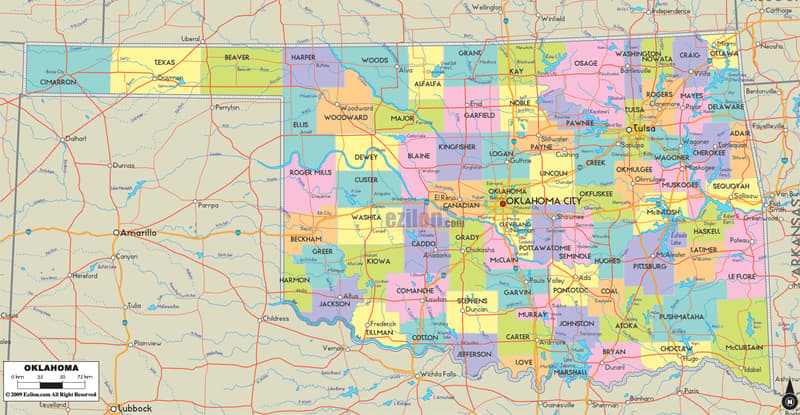
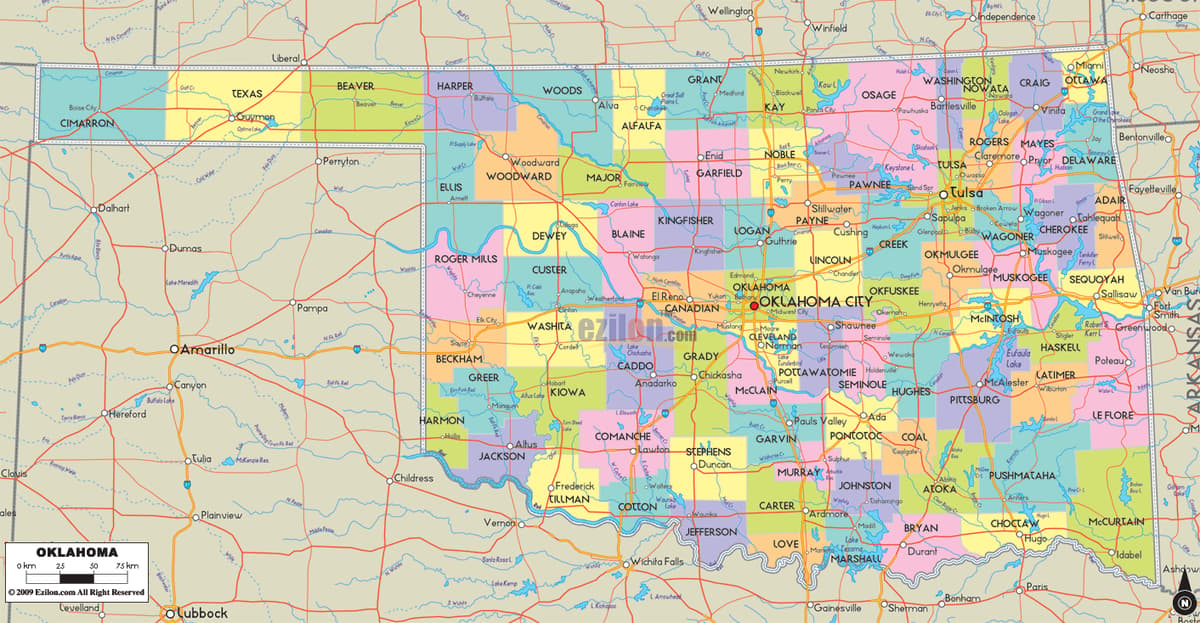
Description: Detailed large map of Oklahoma State, USA showing cities, towns, county formations, roads highway, US highways and State routes.
Map of Oklahoma (USA). Oklahoma map with cities, counties, and towns. Use this detailed map to understand Oklahoma's full county grid, every administrative capital (county seat), the major cities and towns, bordering states and waters, and a few highway cues for orientation only. It is the best map style for residents, travelers, and geography students who want clarity without road clutter. Oklahoma sits almost dead center in the country, and look at the map and the county grid tells the story right away: all 77 counties sit in distinct colored blocks, each labeled with its county seat in bold, running from the High Plains of the Panhandle in the far west through Green Country in the Northeast down to Little Dixie in the Southeast. The two big metro anchors are easy to spot: Oklahoma City in Oklahoma County near the center of the state, and Tulsa in Tulsa County to the Northeast.
Borders and waters at a glance: Kansas runs along the entire north edge and across the top of the Panhandle. A short stretch of Colorado and New Mexico meets the Panhandle's far western tip at Cimarron County. Texas wraps the entire south and west side of the state, and Arkansas lines the east. Follow that border up into the far Northeast corner and a single county, Ottawa, also touches Missouri. Inside those borders, the Arkansas, Canadian, Cimarron, and Red rivers do most of the interior orientation work, feeding lakes like Texoma, Eufaula, and Grand Lake that you'll see marked in blue as you scan the map.
Road-light orientation: Only a handful of interstates show up on the map, just enough to place a county without turning this into a driving map. I-35 runs north-south through the middle of the state, from the Kansas line near Blackwell through Oklahoma City to the Texas line near Thackerville. I-40 crosses east-west through Oklahoma City, connecting the Texas Panhandle approach near Erick to the Arkansas line near Roland. I-44 cuts diagonally from the Texas line through Lawton, Chickasha, Oklahoma City, and Tulsa up to the Missouri line in the far Northeast. None of these lines are meant for turn-by-turn navigation; they're here strictly to help you confirm which county you're looking at.
Start at the far northwest tip. Cimarron County lists Boise City as the county seat, the only county in the state touching both Colorado and New Mexico, with Black Mesa nearby marking the state's high point. East of it, Texas County shows Guymon, the Panhandle's population hub, and Beaver County shows Beaver where the strip narrows back toward the rest of the state. The map keeps this stretch road-light, just enough to hint at the route east toward Woodward.
Moving east from the Panhandle, Harper County lists Buffalo and Woods County lists Alva, both bridging toward the wheat country of the old Cherokee Outlet. Woodward County centers on Woodward, a clear regional hub near the upper Cimarron and Beaver river valleys. Ellis County shows Arnett, Alfalfa County shows Cherokee, Major County shows Fairview, and Dewey County shows Taloga, each a small seat spaced across open ranch and wheat country.
South of Woodward, the map steps into the Washita River basin. Roger Mills County lists Cheyenne, Custer County lists Arapaho, Beckham County lists Sayre, and Washita County lists New Cordell, all plotted with clean boundaries near old Route 66 country to the north. Further southwest, Greer County shows Mangum, Kiowa County shows Hobart, Jackson County shows Altus, and Harmon County shows Hollis at the Red River approach to Texas.
Back near the Kansas line, Grant County lists Medford and Kay County lists Newkirk, both classic Cherokee Outlet wheat counties. Garfield County shows Enid, a major regional hub anchoring northwest travel, while Noble County shows Perry and Pawnee County shows Pawnee, leading the eye east toward the tallgrass edge.
The heart of the map spotlights Oklahoma County, seat Oklahoma City, the state capital and the state's most populous county. Ringing it, Canadian County shows El Reno to the west, Cleveland County shows Norman to the south, Logan County shows Guthrie to the north, and Lincoln County shows Chandler to the east. Payne County lists Stillwater, home to Oklahoma State University, just north of Guthrie. Kingfisher County shows Kingfisher and Blaine County shows Watonga to the northwest, while Pottawatomie County shows Shawnee extending the metro's reach east. Light lines for I-35, I-40, and I-44 connect Oklahoma City to Norman, Edmond, and Moore without crowding the county palette.
West and south of the capital region, Caddo County lists Anadarko between the Oklahoma City sphere and Comanche County, seat Lawton, the southwest's defense-industry hub near Fort Sill. Grady County shows Chickasha and McClain County shows Purcell, forming the metro's southwest shoulder. Stephens County lists Duncan, Jefferson County lists Waurika, and Cotton County lists Walters, marching south to the Red River, while Tillman County closes the line at Frederick near the Texas crossing.
The southern midsection reads as a tight mosaic anchored by the Arbuckle uplift and Lake Texoma. Garvin County lists Pauls Valley, and Murray County lists Sulphur, next to the Chickasaw National Recreation Area. Pontotoc County shows Ada just east, while Johnston County shows Tishomingo and Marshall County shows Madill, both framing Lake Texoma's shoreline. Carter County lists Ardmore, a balance of industry and recreation, Love County lists Marietta against the Texas line, and Bryan County lists Durant at the Texoma shoreline's eastern end.
Northeast Oklahoma is dense with labels, but the design keeps every seat readable. Osage County, the state's largest county by area, lists Pawhuska across the tallgrass prairie north of Tulsa. Tulsa County is unmistakable with Tulsa as its seat, ringed by Washington County (Bartlesville), Nowata County (Nowata), and Rogers County (Claremore) to the north and northeast. Mayes County shows Pryor and Craig County shows Vinita spreading toward the Grand Lake shoreline, while Ottawa County (Miami) and Delaware County (Jay) hold the far northeast corner where Oklahoma meets both Kansas and Missouri. Wagoner County lists Wagoner and Creek County lists Sapulpa, sharing the metro's south and west flanks.
South and east of Tulsa, Okfuskee County lists Okemah and Seminole County lists Wewoka, carrying the central prairies eastward. Okmulgee County shows Okmulgee and McIntosh County shows Eufaula, both anchored near Lake Eufaula. Muskogee County lists Muskogee, a historic river city on the Arkansas, and Hughes County lists Holdenville, rounding out the corridor toward the wooded hills.
East of Muskogee, the hills tighten. Cherokee County lists Tahlequah, and Adair County lists Stilwell, both set in the Cookson Hills. Sequoyah County lists Sallisaw along the Arkansas River approach to the Arkansas state line.
The southeast corner is a patchwork of wooded hill counties. Atoka County lists Atoka and Coal County lists Coalgate, both north of the Red River plain. Pittsburg County lists McAlester, one of the larger southeast seats. Haskell County shows Stigler and Latimer County shows Wilburton, bridging west toward the San Bois and Ouachita foothills, while Le Flore County stretches up the Arkansas border with seat Poteau near the Poteau River valley. Southward, Pushmataha County lists Antlers, Choctaw County lists Hugo, and McCurtain County lists Idabel, each near reservoirs including Sardis Lake and Broken Bow Lake.
Four rivers do most of the orientation work on this page. The Arkansas River cuts through the northeast past Tulsa and Muskogee. The Canadian River, with its North Canadian fork, crosses the center past Oklahoma City. The Cimarron River threads the northwest through the wheat belt. The Red River traces the entire southern border past Ardmore, Durant, and Idabel. Keep these four in mind and any county on the map is easy to place.
The road layer is intentionally minimal. I-35 runs the Kansas line near Blackwell through Oklahoma City to the Texas line near Thackerville. I-40 runs the Texas Panhandle approach near Erick through Oklahoma City to the Arkansas line near Roland. I-44 runs from the Texas line through Lawton, Chickasha, Oklahoma City, and Tulsa to the Missouri line in the far northeast. None of these are meant for turn-by-turn navigation, only as county-placement cues.
Every one of Oklahoma's 77 counties and its seat, in alphabetical order: Adair County (Stilwell), Alfalfa County (Cherokee), Atoka County (Atoka), Beaver County (Beaver), Beckham County (Sayre), Blaine County (Watonga), Bryan County (Durant), Caddo County (Anadarko), Canadian County (El Reno), Carter County (Ardmore), Cherokee County (Tahlequah), Choctaw County (Hugo), Cimarron County (Boise City), Cleveland County (Norman), Coal County (Coalgate), Comanche County (Lawton), Cotton County (Walters), Craig County (Vinita), Creek County (Sapulpa), Custer County (Arapaho), Delaware County (Jay), Dewey County (Taloga), Ellis County (Arnett), Garfield County (Enid), Garvin County (Pauls Valley), Grady County (Chickasha), Grant County (Medford), Greer County (Mangum), Harmon County (Hollis), Harper County (Buffalo), Haskell County (Stigler), Hughes County (Holdenville), Jackson County (Altus), Jefferson County (Waurika), Johnston County (Tishomingo), Kay County (Newkirk), Kingfisher County (Kingfisher), Kiowa County (Hobart), Latimer County (Wilburton), Le Flore County (Poteau), Lincoln County (Chandler), Logan County (Guthrie), Love County (Marietta), Major County (Fairview), Marshall County (Madill), Mayes County (Pryor), McClain County (Purcell), McCurtain County (Idabel), McIntosh County (Eufaula), Murray County (Sulphur), Muskogee County (Muskogee), Noble County (Perry), Nowata County (Nowata), Okfuskee County (Okemah), Oklahoma County (Oklahoma City), Okmulgee County (Okmulgee), Osage County (Pawhuska), Ottawa County (Miami), Pawnee County (Pawnee), Payne County (Stillwater), Pittsburg County (McAlester), Pontotoc County (Ada), Pottawatomie County (Shawnee), Pushmataha County (Antlers), Roger Mills County (Cheyenne), Rogers County (Claremore), Seminole County (Wewoka), Sequoyah County (Sallisaw), Stephens County (Duncan), Texas County (Guymon), Tillman County (Frederick), Tulsa County (Tulsa), Wagoner County (Wagoner), Washington County (Bartlesville), Washita County (New Cordell), Woods County (Alva), and Woodward County (Woodward).
Oklahoma borders Kansas along the north and the top of the Panhandle, a short stretch of Colorado and New Mexico at the Panhandle's western tip, Texas along the south and west, Arkansas along the east, and touches Missouri at a single county corner in the far northeast. The state holds 77 counties. Osage County is the largest by land area at about 2,251 square miles, while Marshall County is the smallest at about 371 square miles. Oklahoma County, home to Oklahoma City, is the most populous at roughly 806,000 residents, while Cimarron County is the least populous at roughly 2,000 residents. Beaver, Canadian, Cleveland, Kingfisher, Logan, Oklahoma, and Payne counties share the title of oldest county, all seven organized together in 1890 when Oklahoma Territory was first created. Oklahoma covers about 69,899 square miles in total, with about 68,595 square miles of land. The capital, Oklahoma City, sits in Oklahoma County near the state's geographic center, and the state's major metros run from Oklahoma City and Norman through Tulsa to Lawton and Enid. Landscape-wise, the state moves from the High Plains of the Panhandle through rolling wheat country and the Cross Timbers, into lake-dotted Green Country in the northeast, and down through the Arbuckle and Ouachita uplifts in the south and southeast.
Oklahoma's ten largest cities by current population are Oklahoma City (about 702,767, Oklahoma County), Tulsa (about 411,894, Tulsa County), Norman (about 130,046, Cleveland County), Broken Arrow (about 119,194, Tulsa County), Edmond (about 98,103, Oklahoma County), Lawton (about 90,245, Comanche County), Moore (about 63,470, Cleveland County), Midwest City (about 58,086, Oklahoma County), Enid (about 50,577, Garfield County), and Stillwater (about 49,525, Payne County). Oklahoma City anchors the state's energy sector, home to major producers such as Devon Energy and Continental Resources, alongside Tinker Air Force Base, one of the region's largest employers. Tulsa carries its own energy heritage with companies like ONEOK and Williams Companies, plus an aviation maintenance base and the inland Port of Catoosa, which links the city to the Mississippi River and Gulf Coast by way of the McClellan-Kerr Arkansas River Navigation System. Agriculture still shapes the western half of the state: wheat and cattle dominate the plains, wind farms increasingly dot the Panhandle and northwest, and pecan and peanut farming carry weight in the south. With no coastline, Oklahoma's water commerce moves through this river-port system instead, led by Tulsa on the Arkansas.
Oklahoma's cultural identity draws on ranching, energy, and the historic road that once carried travelers straight through it. Route 66 crosses the state west to east through Beckham, Custer, Canadian, Oklahoma, Lincoln, Creek, Tulsa, Rogers, Craig, and Ottawa counties, and towns along the way still lean into that heritage with diners, murals, and roadside museums. Oklahoma City's National Cowboy and Western Heritage Museum anchors the state's cowboy and rodeo traditions, while stock shows and rodeos remain a fixture across the ranching counties of the west. The state is also home to numerous federally recognized tribal nations, a defining part of Oklahoma's heritage that shows up in county and town names across the map, from Cherokee and Choctaw to Seminole and Comanche. Higher education is spread across several counties: the University of Oklahoma in Norman (Cleveland County), Oklahoma State University in Stillwater (Payne County), and the University of Tulsa in Tulsa County. Energy and agriculture remain the throughline connecting the state's small county-seat towns to its two big metro anchors.
On this map, Black Mesa (High Plains, Cimarron County) and the Arkansas, Canadian, and Red rivers double as landmarks for finding counties quickly. For elevation, terrain, watersheds, and land-cover detail, see our Physical Map of Oklahoma.
Oklahoma has a continental climate with hot summers and cool winters, drier in the Panhandle and wetter in the southeast. For a full seasonal and biome breakdown, see our Physical Map of Oklahoma.
North-south travel runs mainly on I-35 (the Texas line near Thackerville through Oklahoma City to the Kansas line near Blackwell). East-west travel runs mainly on I-40 (the Texas Panhandle approach near Erick through Oklahoma City to the Arkansas line near Roland), with I-44 running diagonally from the Texas line through Lawton, Oklahoma City, and Tulsa to the Missouri line in the far northeast. Keep in mind that ZIP codes do not follow county lines in Oklahoma, so a single ZIP code can span two counties. Always confirm the county name directly from the map or index rather than assuming it from a ZIP prefix.
Use this as a quick index. Every line lists the county with its county seat and a short river, border, or corridor cue.
Cimarron – Boise City; touches Colorado and New Mexico, near Black Mesa.
Texas – Guymon; the Panhandle's population hub.
Beaver – Beaver; eastern end of the Panhandle strip.
Harper – Buffalo; near the Kansas line.
Woods – Alva; Cherokee Outlet wheat country.
Woodward – Woodward; regional hub on the upper Cimarron.
Ellis – Arnett, south of Woodward.
Alfalfa – Cherokee, near the Kansas line.
Major – Fairview, between Woods and Blaine.
Dewey – Taloga, in the western ranch country.
Roger Mills – Cheyenne, on the upper Washita.
Custer – Arapaho, near old Route 66.
Beckham – Sayre, close to the Texas Panhandle approach.
Washita – New Cordell, south of Custer.
Greer – Mangum, in the southwest corner.
Kiowa – Hobart, east of Greer.
Jackson – Altus, near the Red River.
Harmon – Hollis, at the Texas approach.
Grant – Medford, under the Kansas line.
Kay – Newkirk, wheat belt hub.
Garfield – Enid, major northwest anchor.
Noble – Perry, southeast of Enid.
Pawnee – Pawnee, leading toward the tallgrass edge.
Oklahoma – Oklahoma City; the state capital.
Canadian – El Reno, west of the capital.
Cleveland – Norman, south of the capital.
Logan – Guthrie, north of the capital.
Lincoln – Chandler, east of the capital.
Payne – Stillwater; home to Oklahoma State University.
Kingfisher – Kingfisher, northwest of the capital.
Blaine – Watonga, further northwest.
Pottawatomie – Shawnee, the metro's eastern edge.
Caddo – Anadarko, between the capital and Lawton.
Comanche – Lawton; near Fort Sill.
Grady – Chickasha, southwest of the capital.
McClain – Purcell, south of the capital.
Stephens – Duncan, on the way to the Red River.
Jefferson – Waurika, near the Texas line.
Cotton – Walters, south of Stephens.
Tillman – Frederick, at the Texas crossing.
Garvin – Pauls Valley, north of Murray.
Murray – Sulphur; Chickasaw National Recreation Area.
Pontotoc – Ada, east of Murray.
Johnston – Tishomingo, near Lake Texoma.
Marshall – Madill; the smallest county by area.
Carter – Ardmore, on I-35.
Love – Marietta, against the Texas line.
Bryan – Durant, at the Texoma shoreline.
Osage – Pawhuska; the largest county by area.
Tulsa – Tulsa; the state's second metro anchor.
Washington – Bartlesville, north of Tulsa.
Nowata – Nowata, near the Kansas line.
Rogers – Claremore, northeast of Tulsa.
Mayes – Pryor, toward Grand Lake.
Craig – Vinita, on the way to Grand Lake.
Ottawa – Miami; touches Kansas and Missouri.
Delaware – Jay, near the Grand Lake shoreline.
Wagoner – Wagoner, south of Tulsa.
Creek – Sapulpa, west of Tulsa.
Okfuskee – Okemah, on the central prairie.
Seminole – Wewoka, southeast of Okfuskee.
Okmulgee – Okmulgee, near Lake Eufaula.
McIntosh – Eufaula, on Lake Eufaula.
Muskogee – Muskogee; historic Arkansas River city.
Hughes – Holdenville, toward the wooded hills.
Cherokee – Tahlequah, in the Cookson Hills.
Adair – Stilwell, east of Cherokee.
Sequoyah – Sallisaw, on the Arkansas River approach to Arkansas.
Atoka – Atoka, north of the Red River plain.
Coal – Coalgate, west of Atoka.
Pittsburg – McAlester; one of the larger southeast seats.
Haskell – Stigler, toward the San Bois foothills.
Latimer – Wilburton, in the Ouachita foothills.
Le Flore – Poteau, along the Arkansas line.
Pushmataha – Antlers, in the forested hills.
Choctaw – Hugo, near the Red River.
McCurtain – Idabel; touches both Arkansas and Texas, near Broken Bow Lake.
This directory aligns with what you see on the page: every county, its seat, and a one-line locator that keeps the focus on counties rather than driving steps.
Oklahoma has 77 counties and the map shows every one with a colored block and county seat.
County boundaries, county seats and neighboring states, with only light road references for orientation.
Oklahoma City in Oklahoma County, near the center of the state.
Oklahoma County.
Tulsa County.
Cleveland County.
Cimarron, Texas, and Beaver counties, running west to east.
From west to east: Cimarron, Texas, Beaver, Harper, Woods, Alfalfa, Grant, Kay, Osage, Washington, Nowata, Craig, and Ottawa.
Only Ottawa County, in the far northeast corner.
From north to south: Delaware, Adair, Sequoyah, Le Flore, and McCurtain.
Only Cimarron County, at the tip of the Panhandle.
The Panhandle trio, Cimarron, Texas, and Beaver, plus Harmon, Jackson, Tillman, Cotton, Jefferson, Love, Marshall, Bryan, Choctaw, and McCurtain.
Only thin cues for corridors like I-35, I-40, and I-44 to help you place counties.
In Payne County. It is the county seat and home to Oklahoma State University.
Norman sits in Cleveland County just south of Oklahoma City.
Carter County.
In Garfield County, labeled at its center.
Washington County.
Muskogee County; seat Muskogee.
In Pittsburg County as the county seat.
Pontotoc County.
Stephens County.
Comanche County, seat Lawton, near Fort Sill.
Logan County.
In McCurtain County, near the forests and Broken Bow Lake.
Rogers County, northeast of Tulsa.
Caddo County.
Along the Marshall, Bryan, and Love county line on the Texas border.
Near the McIntosh, Pittsburg, and Haskell county corner in east-central Oklahoma.
Osage County, at about 2,251 square miles.
Marshall County, at about 371 square miles.
Oklahoma County, home to Oklahoma City, with roughly 806,000 residents.
Cimarron County, with roughly 2,000 residents.
Oklahoma City, in Oklahoma County, with about 702,767 residents.
Beaver, Canadian, Cleveland, Kingfisher, Logan, Oklahoma, and Payne counties, all organized in 1890 as the original Oklahoma Territory.
No. Printing or copying maps from this site is not permitted.
No. ZIP codes cross county lines, so use the county boundaries and seats shown here instead.

Physical Map of Oklahoma
Physical map and map image of Oklahoma.

Regional Directory of Canada
Information and guide about Canada and website listing.

Regional Directory of United States of America
Information and guide about United States of America and websites with American topics.

Regional Directory of Europe
Information and guide about Europe and websites with European topics.

Regional Directory of Australia
Information and guide about Australia and websites with Australian topics.