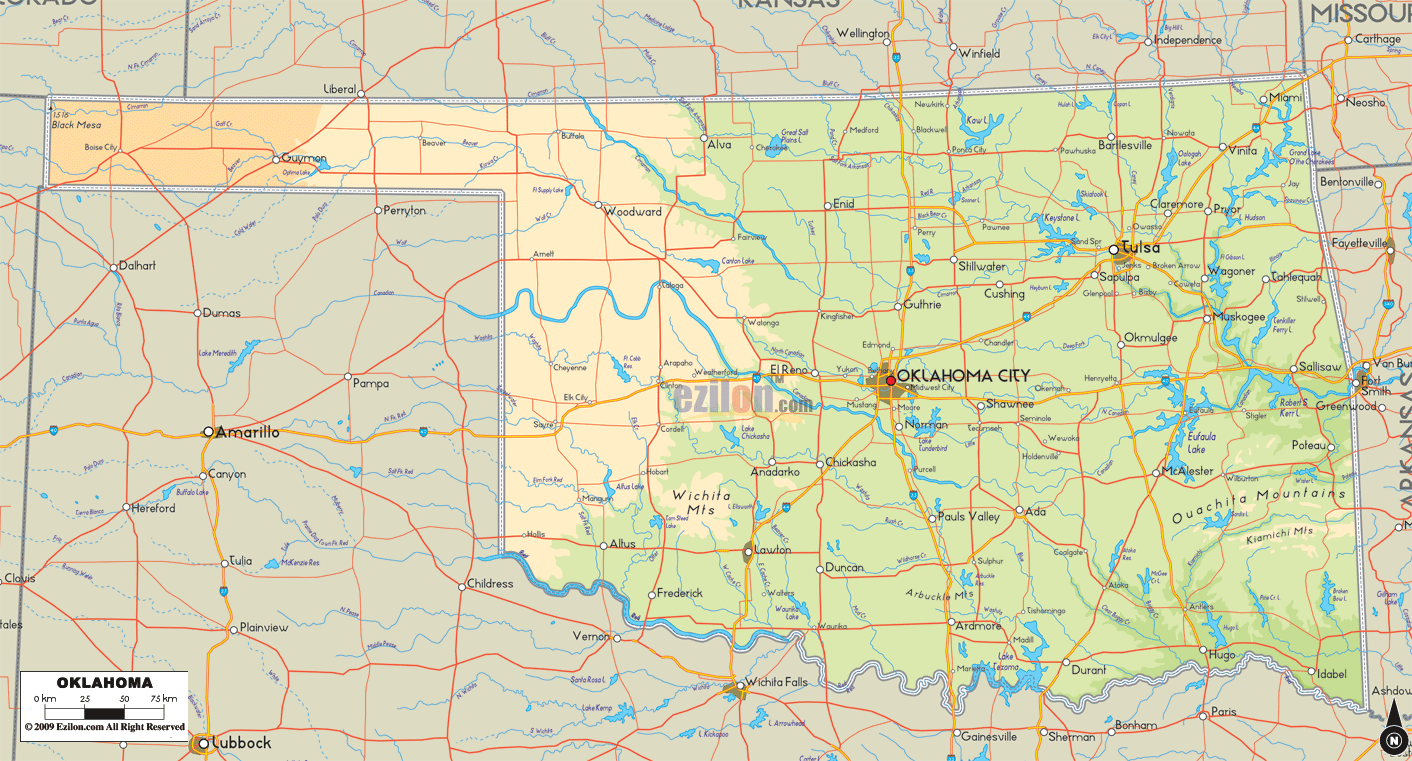
Description: The Physical map of Oklahoma State, USA showing major geographical features such as rivers, lakes, topography and land formations.

Detailed Physical map of Oklahoma with elevations and other topographic features such as mountains, rivers and lakes. Oklahoma borders Kansas, Missouri, Arkansas, Texas, New Mexico and Colorado. On a map of Oklahoma, we see a series of highways and interstates connecting Oklahoma City and Tulsa. However, the shaded relief, river patterns, and lake basins soon reveal how the landforms dictate the boundaries between the two towns. For county boundaries, cities, and roads, see our County and Road Map of Oklahoma.
Oklahoma occupies a roughly rectangular block that includes the narrow panhandle in the northwest and a broader main body stretching toward the forests of Arkansas and the hill country of Texas. On our detailed map, you can see bordering states clearly - Colorado and Kansas to the North, Missouri and Arkansas to the east, Texas lining both the south and the panhandle, and a corner of New Mexico to the far west. Inside this frame, the cartography shows three broad regions: high plains in the panhandle, central rolling prairies around Oklahoma City, and lake-dotted uplands and mountains in the east and south.
Far to the northwest, the physical map highlights the narrow strip of land known as the Oklahoma panhandle. Towns like Boise City, Guymon, and Beaver are located on light-colored terrain that suggests higher plains. Around the corner of Oklahoma, Colorado, and New Mexico is a meaningless, ugly little peak called Black Mesa, which happens to be Oklahoma's highest natural point. This region comprises the High Plains of the Great Plains, and the map shows very slight relief, with long, straight roads and few low-lying river valleys.
From a geography student's perspective, this part of the Oklahoma terrain map illustrates how an elevated plateau can appear flat yet rise hundreds of meters above the lower plains farther east. Streams such as the Cimarron River begin or cross here, cutting shallow channels that eventually deepen as they flow east toward the Arkansas River system.
Moving east of the panhandle into western counties like Woodward and Elk City, the map still shows broad plains, but the shading is a little more variable, and the river pattern is more complex. The Cimarron River, a blue ribbon twisting and turning across north central Oklahoma, broadly loops, while the North Canadian and Canadian Rivers enter central Oklahoma from Texas and New Mexico.
Towns such as Alva, Woodward, Watonga, and El Reno lie along these watercourses. The map makes it clear that even in a region often labeled as flat, river valleys create subtle corridors that attract settlements and highways. Travelers using this detailed map can see how major roads tend to parallel the Canadian River as it sweeps toward Oklahoma City.
Oklahoma City, the capital of Oklahoma, is also prominently shown in the centre of Oklahoma's map. It is shown as a thick hub of streets and markings. The surrounding area is gently tinted with a few low hills and shallow stream valleys. This central area is where the forested uplands of the east meet the western prairies of Canada, yet it is primarily open grassland and farmland.
The map shows a string of settlements along the bank of the North Canadian River. On the west, the cities that have been connected include El Reno, Yukon, Oklahoma City, and then Shawnee and Seminole on the east. The river winds south of downtown Oklahoma City, and Lake Overholser and Lake Hefner are part of the arrangement of water storage and river regulation in urban areas and recreational spaces.
About 30 miles north of Oklahoma City, the rise of towns like Guthrie, Stillwater, and Perry makes a transition from pure prairie country to the belt of oak and hickory woodland known as the Cross Timbers.
The physical map of this area shows a darker ground tone, with smaller tributaries that break up the plains. To the south, toward Pauls Valley, Ada, and Ardmore, the relief becomes more irregular, foreshadowing the low mountains and cuestas that rise farther south.
For residents and travelers, this central zone is essential because it houses much of the state's population and transport network. At the same time, it demonstrates how even gentle terrain can vary enough to support different ecosystems, from open wheat and cattle country to patchy forest.
The physical map shows Oklahoma as green, particularly in the eastern portion. Here, the Arkansas River system dominates the geography. The river begins its southwest course past Muskogee and continues northeast to Fort Smith, Arkansas. The map highlights the river's path, along which are situated Keystone Lake near Sand Springs and Robert S. Kerr Reservoir farther southeast. The dams have flooded valleys, making these lakes look like blue shapes.
In the northeast corner, Tulsa is a core metro area on the Arkansas River. A map of the area around Tulsa shows towns such as Broken Arrow, Sapulpa, Claremore, and Bartlesville joined by highways. Grand Lake o'o' the Cherokees is a large reservoir set in the hills of the far northeast. Many lakes and forested ridges characterize Oklahoma's eastern part. This is why it is heavily recreational, fishing, and tourism-oriented.
The Tribune lists the Verdigris, Neosho, and Illinois Rivers as tributaries of the Arkansas River. Towns such as Wagoner, Tahlequah, and Miami lie beside the rivers and alleys cross the rolling uplands.
The relief shading suggests the hills were not as high as the mountains located to the south. They are still lovely to drive and have diverse habitats.
For geography students, this eastern sector shows how a single extensive drainage system can produce multiple parallel valleys, each with its own string of communities. Travelers can use our detailed map to follow river corridors or circle from lake to lake while remaining aware of the larger Arkansas basin.
The southern border of the geographical map of Oklahoma is the Red River, which forms the border of Oklahoma and Texas. This river looks like a thick blue line running through the land, with S-shaped bends and curves and some reservoirs, including Lake Texoma, along the border. Cities like Durant, Hugo, and Idabel are by the river edge. From Texas, we can see Gainesville, Sherman, and Paris.
The Red River valley is a shade lower than Oklahoma or a shade warmer than Oklahoma, and it supports crops, cattle, and river-bottom forests. Our map depicts a valley that can be traced from the Arkansas border past Hugo and Durant and on to Vernon and Wichita Falls, Texas. The curve of the state line and the location of border towns can be attributed to the valley.
North of Lawton and Fort Sill, the map labels the Wichita Mountains as a compact patch of darker shading. These ancient granite peaks rise sharply from the plains and are home to a national wildlife refuge and recreational areas. Nearby towns such as Chickasha, Anadarko, and Altus sit on the surrounding plains, emphasizing how isolated the mountain block appears.
For map readers, the Wichita Mountains demonstrate that a relatively small yet rugged range can still have a significant influence on climate, vegetation, and tourism. Their presence breaks the monotony of the plains and offers opportunities for hiking, rock climbing, and wildlife viewing within a short drive of many communities.
The Ouachita and Kiamichi Mountains further complicate shading in southeastern Oklahoma. The counties of McAlester, Talihina, Layton, and Poteau are in valleys between the narrow east-west ridges. The Ouachita Mountains have folded rocks, like the sedimentary rocks of the Black Kettle area, whereas the Wichita Mountains do not.
In the area are lakes, including Eufaula Lake and Broken Bow Lake, which are surrounded by hills and form major recreation areas. Southeastern Oklahoma owes its character to tight relief, densely wooded areas, and abundant water bodies, similar to Arkansas's Ouachita and Ozark highlands, rather than the Great Plains where Oklahoma is located. Using the map, tourists can expect to see ridge-top highways, scenic drives, sweeping views, and lakeside campground cabins.
Teachers can use this Oklahoma geography map to explain several key themes of physical geography. The panhandle and western plains highlight the High Plains section of the Great Plains, characterized by its almost level surface and sparse drainage. Central Oklahoma lies within the transition zone of the Cross Timbers and rolling prairies, while the east and southeast lie within the Ouachita highlands, the Arkansas River basin, and the Red River valley.
Students can trace how rivers such as the Canadian, Cimarron, Arkansas, Verdigris, and Red organize the drainage pattern. When you follow these rivers off the edge of the map, you can talk about how Oklahoma's water makes it to the Mississippi River and the Gulf of Mexico. The mix of plains, mountains, and lakes also makes this physical map ideal for lessons on climate regions, natural vegetation, and land use.
This detailed map is a visual guide for residents and visitors, whether it's for a road trip, a weekend getaway, or outdoor sports. If you want huge open spaces, you should concentrate on the panhandle and western plains and take the highways through Guymon, Boise City, and Woodward. Those who like forests will love Keystone Lake. Visitors who prefer lakes may plan their routes around Eufaula Lake/Grand Lake/Lake Texoma.
Hikers and climbers will notice how the Wichita Mountains and Ouachita Mountains stand apart from the surrounding plains. The map makes it easy to identify access towns like Lawton, McAlester, Durant, and Idabel, then link them to park areas and trailheads marked near the mountains and lakes.
Check this out, it's a platter-style map given as an Oklahoma physical map, and it is a part of the map collection. It's available for you to view online. Don't print it, cop it, download it, or distribute it. Users are encouraged to study it directly on the site using the following link, rather than trying to capture it as a PDF. By observing these rules, the cartographic work is preserved so that later versions of the best map remain available.
It shows the Oklahoma panhandle, western plains, central rolling prairies, major rivers, lakes, and the Wichita and Ouachita Mountains along with cities and highways.
You can follow interstates and highways along river valleys, connect Oklahoma City, Tulsa, Lawton, and other towns, and choose scenic loops through mountains or lake regions.
The Arkansas River, Canadian River, North Canadian, Cimarron, Red River, Washita River, and Verdigris River are all clearly marked as key waterways.
Yes, light shading marks level plains while darker textured shading highlights the Wichita Mountains, Ouachita highlands, and hillier lake districts.
No, this Oklahoma map is for viewing on the website only, so printing, copying, downloading, or redistributing it is not allowed.
The map labels many small towns and key junctions, so it is very useful for regional orientation, though precise street navigation still needs a local map or GPS.
Oklahoma includes the High Plains panhandle, western prairie plains, central Cross Timbers transition zone, eastern lake and forest region, and the mountainous south and southeast.
The panhandle results from historical boundary agreements that left a strip of former public land attached to the Oklahoma Territory rather than to Texas or other states.
Most of Oklahoma has a continental climate with hot summers, cool winters, and strong seasonal contrasts, while the east receives more rainfall and the panhandle is drier.
The panhandle appears in the far northwest corner as a long horizontal strip between Colorado, Kansas, New Mexico, and Texas, with towns like Boise City and Guymon.
By comparing plains, river valleys, and mountain ranges, you can see why strong storms often track across open central and western areas while hills in the southeast alter local wind flow.
You can start at the Arkansas or Red River, trace each major tributary upstream, and note how towns, reservoirs, and highways cluster along these water corridors.
Both cities sit at crossroads of river valleys, rail lines, and highways in areas with reliable water supplies and central positions relative to the rest of the state.
They are an isolated block of ancient granite peaks that rise sharply from the plains, hosting a wildlife refuge, rugged scenery, and some of the state’s best hiking.
The Ouachita Mountains are long folded ridges covered in forest, aligned east west and connected to Arkansas, while the Wichita Mountains form a compact cluster of rounded granite hills.
Major recreation lakes include Eufaula Lake, Grand Lake o’ the Cherokees, Keystone Lake, Lake Texoma, Broken Bow Lake, and several others spread across eastern and southern counties.
The Red River forms most of the southern border with Texas, shapes the climate and agriculture of the valley, and feeds large reservoirs including Lake Texoma.
Teachers can connect battles, tribal territories, Dust Bowl stories, and modern energy development to specific regions on the map, helping students visualize where events occurred.
Western Oklahoma is drier, more strongly tied to ranching and broad grain farms, so towns are fewer and spaced farther apart than in the more densely settled east.
They can travel to the Ouachita and Kiamichi Mountains in the southeast, explore state parks around McAlester, Talihina, and Broken Bow, and follow ridge top highways for views.
Locks, dams, and reservoirs along the Arkansas River create a navigation system that links Tulsa and other communities to the Mississippi River and Gulf Coast ports.
High plains support pronghorn and prairie birds, central prairies hold bison and deer in preserves, while eastern forests and mountains host black bear, wild turkey, and many songbirds.
Although ice sheets did not fully cover the state, meltwater and wind blown sediments affected northern counties, leaving loess deposits, broad valleys, and fertile soils.
Maps help drivers spot alternate routes, identify river crossings that may flood, and locate nearby towns where they can seek shelter when storms develop.
McAlester, Antlers, Clayton, Broken Bow, and Idabel all provide lodging and services close to lakes, forests, and scenic drives.
The panhandle stands several hundred meters higher and feels cooler and drier, while central Oklahoma around Oklahoma City sits at lower elevation with more humid air.
Rainfall, soil type, and relief differ from the dry panhandle to the moist southeast, so ranching dominates the west, wheat and mixed farming dominate the center, and timber and livestock are common in the east.
A physical map explains landforms, while a road map shows detailed street networks, so using both lets travelers select routes that fit the terrain, from flat high plains to curving mountain highways.
They should check weather forecasts, carry water, plan routes that match their fitness level, and confirm access points since trails can cross rugged terrain far from towns.
The mix of plains ranching, Midwestern farming, and southern forest industries creates a blend of traditions, music, foods, and energy development that makes the state culturally diverse.

Counties and Road Map of Oklahoma
Counties and Road map and map image of Oklahoma.

Regional Directory of Canada
Information and guide about Canada and website listing.

Regional Directory of United States of America
Information and guide about United States of America and websites with American topics.

Regional Directory of Europe
Information and guide about Europe and websites with European topics.

Regional Directory of Australia
Information and guide about Australia and websites with Australian topics.