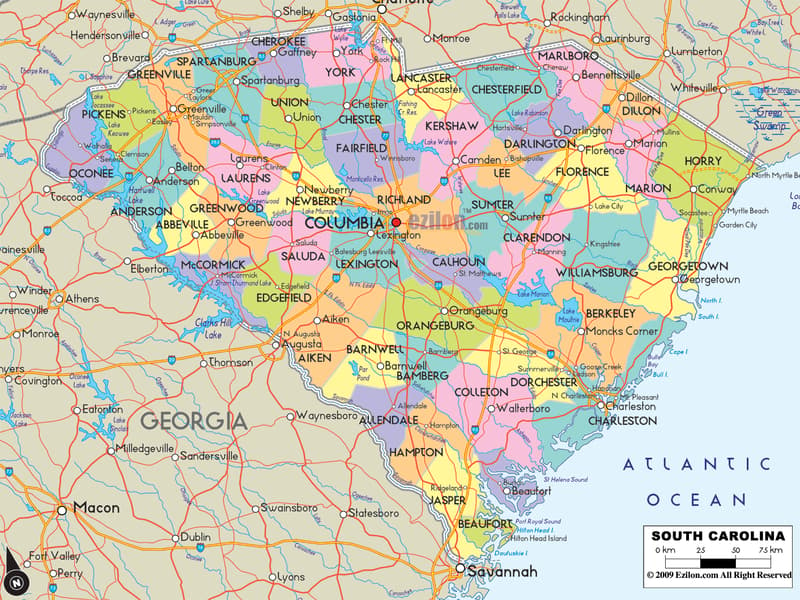
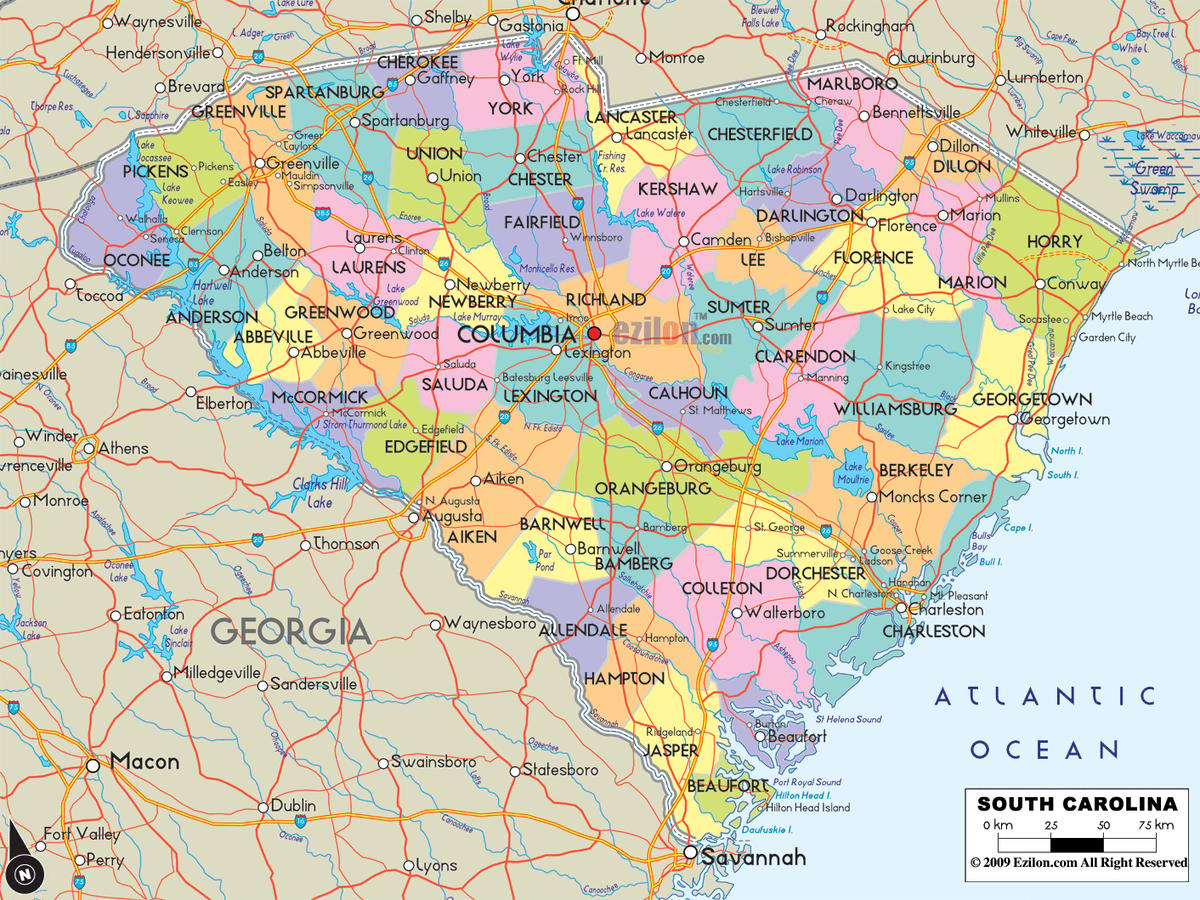
Description: Detailed large map of South Carolina State, USA showing cities, towns, county formations, roads highway, US highways and State routes.
 Map of South Carolina (USA). South Carolina map with cities, counties, and towns. Use this detailed map to understand South Carolina's full county grid, every administrative capital (county seat), the major cities and towns, bordering states and waters, and a few highway cues for orientation only. It is the best map style for residents, travelers, and geography students who want clarity without road clutter. Look at the map and the pattern is easy to read: all 46 counties sit in distinct colored blocks, each labeled with its county seat in bold, running from the Upstate around Greenville and Spartanburg, south through the Midlands and the capital at Columbia, east across the Pee Dee toward Florence, and down into the Lowcountry around Charleston and Beaufort. The map's big anchors are easy to spot too: Charleston in Charleston County, Columbia (the state capital) in Richland County, Greenville and Spartanburg along the Upstate's I-85 corridor, and Myrtle Beach in Horry County along the Grand Strand.
Borders and waters at a glance: North Carolina lines the entire northern edge of the map, running from the Blue Ridge corner near Oconee and Pickens counties east through Spartanburg, Cherokee, York, Lancaster, Chesterfield, Marlboro, Dillon, and Horry to the coast. Georgia borders the west and southwest across the Savannah River, running from Oconee down through Anderson, Abbeville, McCormick, Edgefield, Aiken, Barnwell, Allendale, Hampton, and Jasper to Beaufort. The Atlantic Ocean frames the east and southeast, where Horry, Georgetown, Charleston, Colleton, and Beaufort meet the sea. Follow this on the map and three rivers carry most of the orientation work: the Savannah, Santee, and Pee Dee, with the Waccamaw and Edisto also labeled along the coast.
Road-light orientation: Only a handful of interstates need your attention here. I-85 threads the Upstate through Anderson, Greenville, and Spartanburg. I-26 links Spartanburg to Columbia and on to Charleston. I-20 runs Augusta–Columbia–Florence. I-77 connects Charlotte to Columbia. I-95 runs north–south through the eastern counties near Florence and the Lowcountry. None of these are built for turn-by-turn navigation on this map; they're here only to help confirm which county you're looking at.
Start in the far northwest corner. Oconee County lists Walhalla as the county seat, tucked against the Blue Ridge and the Georgia and North Carolina lines, with Seneca and the shoreline of Lake Hartwell and Lake Keowee shown nearby. East of it, Pickens County shows Pickens as its seat, with Easley, Liberty, and Clemson, home to Clemson University, filling the foothills below Sassafras Mountain, the state's highest point. Anderson County anchors the southwest Upstate with its seat at Anderson, where the Savannah River forms the Georgia border and I-85 threads through toward Greenville.
Greenville County is one of the easiest blocks to spot, seat Greenville, spreading across the foothills with Greer, Simpsonville, Mauldin, and Travelers Rest clustered nearby and the North Carolina line touching its northern edge. East along I-85, Spartanburg County lists Spartanburg as its seat, with Duncan, Boiling Springs, and Landrum shown toward the state line. Cherokee County, seat Gaffney, sits just north with Blacksburg near the North Carolina border, bridging the Upstate to the Piedmont counties beyond.
South of Spartanburg and Cherokee, Union County keeps a rural pattern around its seat, Union, near the Broad River. Laurens County, seat Laurens, and Greenwood County, seat Greenwood, sit along the I-26 corridor linking Greenville to Columbia, with Lake Greenwood curving along the county line. Abbeville County, seat Abbeville, and McCormick County, seat McCormick, round out the Upstate's southwestern edge along the Savannah River and Clarks Hill Lake, both bordering Georgia.
York County, seat York, holds the state's largest city in this corner, Rock Hill, just south of Charlotte, with Fort Mill and Tega Cay filling the eastern arc where I-77 crosses into South Carolina. East of it, Lancaster County, seat Lancaster, follows the Catawba River toward the North Carolina line. Chester County, seat Chester, and Fairfield County, seat Winnsboro, sit just south, forming a quiet buffer between the Charlotte corridor and the capital region.
Richland County holds the state capital, Columbia, at the center of the map where I-26, I-20, and I-77 meet. Across the Congaree and Saluda rivers, Lexington County, seat Lexington, spreads from West Columbia to Irmo and Cayce, with Lake Murray's curved shoreline a clear cue. Northwest of Columbia, Newberry County, seat Newberry, and Saluda County, seat Saluda, fill out the inner Midlands.
Edgefield County, seat Edgefield, sits on the Georgia border above the Augusta metro. Aiken County, seat Aiken, is large and easy to spot to its east, with North Augusta on the Savannah River opposite Augusta, Georgia. Calhoun County, seat St. Matthews, is a small, compact block between Lexington, Richland, and Orangeburg. Orangeburg County, seat Orangeburg, is one of the largest counties on the map, joining the Midlands to the Lowcountry along the I-26 approach to Charleston.
Kershaw County, seat Camden, one of the state's oldest towns, sits northeast of Columbia along the Sandhills belt. Lee County, seat Bishopville, and Sumter County, seat Sumter, home to Shaw Air Force Base, fill the center of the Pee Dee. Clarendon County, seat Manning, wraps the north and west shores of Lake Marion, a major waterway between the Midlands and the Lowcountry.
Florence County, seat Florence, is the hub where I-95 meets I-20, with Lake City and Timmonsville on its edges. Just northwest, Darlington County, seat Darlington, shows Hartsville along the Lynches River.
Chesterfield County, seat Chesterfield, sits on the North Carolina line with Cheraw on the Great Pee Dee River. Marlboro County, seat Bennettsville, holds the northeast corner near Laurinburg, North Carolina. Dillon County, seat Dillon, and Marion County, seat Marion, sit along the I-95 corridor between Florence and Horry. Williamsburg County, seat Kingstree, rounds out the region to the southeast toward the Santee delta.
Horry County, seat Conway, is the northeastern coastal giant, home to Myrtle Beach, North Myrtle Beach, and the Waccamaw River, with the coast curving from Little River at the North Carolina line to Murrells Inlet at the Georgetown line. Georgetown County, seat Georgetown, is where the Waccamaw, Pee Dee, Black, and Sampit rivers meet at Winyah Bay, with Pawleys Island shown along the shore.
Berkeley County, seat Moncks Corner, sits north of Charleston along the Cooper River and Lake Moultrie. Charleston County, seat Charleston, is the largest county on the map by land area and a centerpiece of the coast, with Mount Pleasant, North Charleston, and barrier islands like Isle of Palms and Folly Beach shown around Charleston Harbor. Dorchester County, seat St. George, shows Summerville at the Berkeley and Charleston edges.
Colleton County, seat Walterboro, sits southwest of Charleston with Edisto Beach on the coast. Bamberg County, seat Bamberg, and Barnwell County, seat Barnwell, sit inland near the Savannah River. Allendale County, the state's least populous county, lists Allendale as its seat near the Georgia line. Hampton County, seat Hampton, and Jasper County, seat Ridgeland, lead toward the Savannah River and Georgia. Beaufort County, seat Beaufort, closes out the coast with Hilton Head Island, Bluffton, and Port Royal Sound.
Three rivers do most of the orientation work on this page. The Savannah River traces the entire western and southwestern border past Anderson, Aiken, and Beaufort counties. The Santee River, formed where the Congaree and Wateree meet, drains the Midlands through Lake Marion and Lake Moultrie toward the coast. The Pee Dee River threads the northeastern counties past Florence, Marion, and Georgetown before reaching Winyah Bay. Keep these three in mind and any county on the map is easy to place.
The road layer is intentionally minimal. I-85 runs through the Upstate past Anderson, Greenville, and Spartanburg. I-26 links Spartanburg to Columbia and on to Charleston. I-20 runs Augusta–Columbia–Florence. I-77 runs Charlotte–Columbia. I-95 runs north–south through the eastern counties near Florence and the Lowcountry. None of these are meant for turn-by-turn navigation, only as county-placement cues.
Every one of South Carolina's 46 counties and its seat, in alphabetical order: Abbeville County (Abbeville), Aiken County (Aiken), Allendale County (Allendale), Anderson County (Anderson), Bamberg County (Bamberg), Barnwell County (Barnwell), Beaufort County (Beaufort), Berkeley County (Moncks Corner), Calhoun County (St. Matthews), Charleston County (Charleston), Cherokee County (Gaffney), Chester County (Chester), Chesterfield County (Chesterfield), Clarendon County (Manning), Colleton County (Walterboro), Darlington County (Darlington), Dillon County (Dillon), Dorchester County (St. George), Edgefield County (Edgefield), Fairfield County (Winnsboro), Florence County (Florence), Georgetown County (Georgetown), Greenville County (Greenville), Greenwood County (Greenwood), Hampton County (Hampton), Horry County (Conway), Jasper County (Ridgeland), Kershaw County (Camden), Lancaster County (Lancaster), Laurens County (Laurens), Lee County (Bishopville), Lexington County (Lexington), Marion County (Marion), Marlboro County (Bennettsville), McCormick County (McCormick), Newberry County (Newberry), Oconee County (Walhalla), Orangeburg County (Orangeburg), Pickens County (Pickens), Richland County (Columbia), Saluda County (Saluda), Spartanburg County (Spartanburg), Sumter County (Sumter), Union County (Union), Williamsburg County (Kingstree), and York County (York).
South Carolina borders North Carolina to the north, Georgia to the west and southwest across the Savannah River, and the Atlantic Ocean to the east and southeast. The state holds 46 counties, the maximum allowed under state law. Charleston County is the largest by land area at about 1,358 square miles, while Calhoun County is the smallest at about 392 square miles. Greenville County is the most populous at roughly 583,000 residents, and Allendale County is the least populous at roughly 7,355. Beaufort, Charleston, Georgetown, and Orangeburg counties share the title of oldest, all four created in 1769 as colonial judicial districts. South Carolina covers about 32,020 square miles in total, with about 30,060 square miles of land. The capital, Columbia, sits in Richland County at the center of the state, and the state's major metros run from Charleston and the Lowcountry through Columbia to the Upstate's Greenville-Spartanburg-Anderson corridor and the Grand Strand around Myrtle Beach. Landscape-wise, the state moves from the Blue Ridge foothills in the far northwest through the rolling Piedmont, across the Sandhills belt at the center, and out into the flat coastal plain and marshy Lowcountry along the Atlantic.
On this map, Sassafras Mountain (Blue Ridge, Pickens County) and the Savannah, Santee, and Pee Dee rivers double as landmarks for finding counties quickly. For elevation, terrain, watersheds, and land-cover detail, see our Physical Map of South Carolina.
South Carolina's ten largest cities by current population are Charleston (about 161,300, Charleston County), Columbia (about 149,100, Richland County), North Charleston (about 132,000, Charleston County), Mount Pleasant (about 96,700, Charleston County), Rock Hill (about 76,200, York County), Greenville (about 76,200, Greenville County), Summerville (about 53,600, Dorchester County), Goose Creek (about 53,100, Berkeley County), Greer (about 52,700, Greenville County), and Sumter (about 43,000, Sumter County). Charleston anchors the state's port economy and aerospace manufacturing, home to Boeing's 787 assembly plant and one of the busiest container ports on the East Coast. The Upstate's Greenville-Spartanburg-Anderson corridor is a major automotive and manufacturing hub, anchored by BMW's largest plant worldwide near Greer in Spartanburg County, alongside Michelin and a deep base of textile-descended manufacturers. Columbia centers state government, the University of South Carolina, and Fort Jackson, the Army's largest basic training post. Tourism runs through the coast, from the Grand Strand around Myrtle Beach in Horry County to Charleston's historic district and Hilton Head Island in Beaufort County. Agriculture still shapes the interior, with South Carolina ranking among the nation's top peach producers alongside cotton, soybeans, and timber across the Midlands and Pee Dee.
South Carolina's cultural identity runs from the coast inland. Charleston's historic district and Gullah Geechee coastal heritage, rooted in the Sea Islands around Beaufort and Charleston counties, anchor the state's Lowcountry culture, alongside the beach-town draw of Myrtle Beach and the Grand Strand. Revolutionary War history runs through several counties: the Cowpens National Battlefield in Cherokee County, Kings Mountain near the York County line, and Camden's Revolutionary War sites in Kershaw County. The Upstate carries a strong textile heritage, with mill towns across Spartanburg and Greenville counties that once anchored the region's economy and still shape its downtowns. Higher education is spread across the state too, with Clemson University in Pickens County, the University of South Carolina in Columbia (Richland County), and The Citadel and College of Charleston both in Charleston County.
South Carolina has a humid subtropical climate with hot, humid summers and mild winters, cooler in the Blue Ridge foothills and more hurricane-prone along the Atlantic coast. For a full seasonal and biome breakdown, see our Physical Map of South Carolina.
North-south travel runs mainly on I-77 (Charlotte to Columbia) and I-95 (through the eastern counties near Florence and the Lowcountry). East-west travel runs on I-85 (through the Upstate), I-26 (Spartanburg to Columbia to Charleston), and I-20 (Augusta to Columbia to Florence). Keep in mind that ZIP codes do not follow county lines in South Carolina, so a single ZIP code can span two counties. Always confirm the county name directly from the map or index rather than assuming it from a ZIP prefix.
Use this as a quick index. Every line lists the county with its county seat (and a familiar city when the map labels one). Short cues mention river, border, or gentle corridor context only.
Oconee – Walhalla; Blue Ridge corner at the Georgia and North Carolina lines.
Pickens – Pickens; Clemson University and Sassafras Mountain.
Anderson – Anderson; Savannah River and the Georgia line.
Greenville – Greenville; largest Upstate metro along I-85.
Spartanburg – Spartanburg; east of Greenville on I-85.
Cherokee – Gaffney; North Carolina line north of Spartanburg.
Union – Union; Broad River, south of Spartanburg.
Laurens – Laurens; on the I-26 corridor to Columbia.
Greenwood – Greenwood; Lake Greenwood shoreline.
Abbeville – Abbeville; Savannah River, near the Georgia line.
McCormick – McCormick; Clarks Hill Lake at the Georgia border.
York – York; Rock Hill and Fort Mill near Charlotte.
Lancaster – Lancaster; Catawba River valley.
Chester – Chester; between York and Fairfield.
Fairfield – Winnsboro; just north of Columbia.
Richland – Columbia; the state capital.
Lexington – Lexington; Lake Murray shoreline.
Newberry – Newberry; northwest of Columbia.
Saluda – Saluda; small Midlands county on the fall line.
Edgefield – Edgefield; on the Georgia border above Augusta.
Aiken – Aiken; Savannah River opposite Augusta, Georgia.
Calhoun – St. Matthews; smallest South Carolina county by area.
Orangeburg – Orangeburg; joins the Midlands to the Lowcountry.
Kershaw – Camden; one of the state's oldest towns.
Lee – Bishopville; between Kershaw and Sumter.
Sumter – Sumter; Shaw Air Force Base nearby.
Clarendon – Manning; Lake Marion shoreline.
Florence – Florence; I-95 and I-20 junction.
Darlington – Darlington; Lynches River, northwest of Florence.
Chesterfield – Chesterfield; North Carolina line, Great Pee Dee River.
Marlboro – Bennettsville; northeast corner near the North Carolina line.
Dillon – Dillon; I-95 corridor near the North Carolina line.
Marion – Marion; between Florence and Horry.
Williamsburg – Kingstree; toward the Santee delta.
Horry – Conway; Myrtle Beach and the Grand Strand.
Georgetown – Georgetown; Winyah Bay river confluence.
Berkeley – Moncks Corner; Lake Moultrie, north of Charleston.
Charleston – Charleston; largest South Carolina county by area.
Dorchester – St. George; Summerville at the Charleston edge.
Colleton – Walterboro; Edisto Beach, southwest of Charleston.
Bamberg – Bamberg; between Barnwell and Orangeburg.
Barnwell – Barnwell; near the Savannah River and Georgia line.
Allendale – Allendale; least populous South Carolina county.
Hampton – Hampton; toward the Savannah River and Georgia.
Jasper – Ridgeland; last county before Georgia and Savannah.
Beaufort – Beaufort; Hilton Head Island and Port Royal Sound.
This directory aligns with what you see on the page: every county, its seat, and a one-line locator that keeps the focus on counties rather than driving steps.
South Carolina has 46 counties, the maximum allowed under state law, and the map shows every one with a colored block and county seat.
County boundaries, county seats and neighboring states, with only light road references for orientation.
Columbia in Richland County, near the center of the state where I-26, I-20 and I-77 meet.
Charleston County.
Richland County.
Greenville County, along I-85 in the Upstate.
Myrtle Beach sits on the Grand Strand coast in Horry County; the seat is Conway.
In Beaufort County, in the southern Lowcountry.
York County, on the North Carolina line.
Kershaw County, northeast of Columbia.
Sumter County, in the Pee Dee Sandhills belt.
Clarendon, Orangeburg, Berkeley and Dorchester counties.
Florence County, at the junction of I-95 and I-20, a transport hub for the Pee Dee.
Georgetown County, on the coast between Horry and Charleston.
Colleton County, between Charleston and Beaufort.
In Aiken County, near the Georgia line opposite Augusta.
Orangeburg County, in the Midlands.
Cherokee County, on the North Carolina line.
Spartanburg County, east of Greenville along I-85.
Berkeley County, north of Charleston.
Dorchester County.
Fairfield County, just north of Columbia.
From west to east: Oconee, Pickens, Greenville, Spartanburg, Cherokee, York, Lancaster, Chesterfield, Marlboro, Dillon and Horry.
From north to south along the Savannah River: Oconee, Anderson, Abbeville, McCormick, Edgefield, Aiken, Barnwell, Allendale, Hampton, Jasper and Beaufort.
I-85 in the Upstate, I-26 from Columbia to Charleston, I-20 from Augusta to Florence, I-77 from Charlotte to Columbia, and I-95 through the eastern counties.
Along the Horry County coast from Little River to Murrells Inlet, including Myrtle Beach.
Pickens County, near Lake Hartwell.
Richland County, in Columbia.
No. Printing or copying maps from this site is not permitted.
Charleston County, at about 1,358 square miles.
Calhoun County, at about 392 square miles.
Greenville County, with roughly 583,000 residents.
Allendale County, with roughly 7,355 residents.
Charleston, in Charleston County, with about 161,300 residents.
Beaufort, Charleston, Georgetown and Orangeburg counties, all created in 1769 as colonial judicial districts.
No. ZIP codes cross county lines, so use the county boundaries and seats shown here instead.

Physical Map of South Carolina
Physical map and map image of South Carolina.

Regional Directory of Canada
Information and guide about Canada and website listing.

Regional Directory of United States of America
Information and guide about United States of America and websites with American topics.

Regional Directory of Europe
Information and guide about Europe and websites with European topics.

Regional Directory of Australia
Information and guide about Australia and websites with Australian topics.