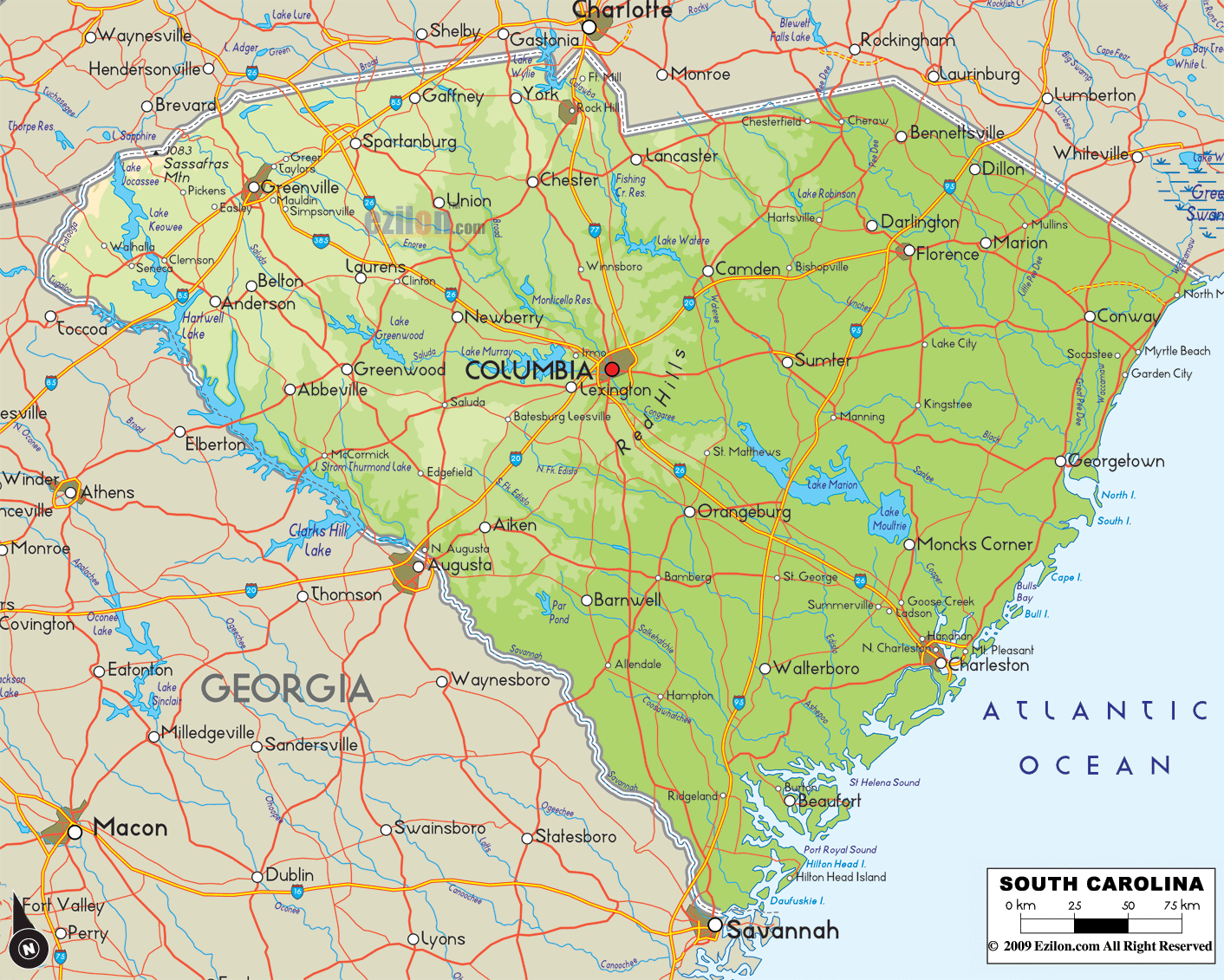
Description: Detailed physical map of South Carolina State, USA showing major geographical features such as rivers, lakes, coastline, topography and land formations.

Detailed Physical map of South Carolina with elevations and other topographic features such as mountains, rivers and lakes. South Carolina borders North Carolina and Georgia. At a glance, our detailed map shows three broad bands of terrain running southwest to northeast: rugged uplands around Greenville, rolling Piedmont and Sandhills across the Midlands, and a low coastal plain that becomes marshy Lowcountry near cities such as Charleston and Beaufort. For county boundaries, cities, and roads, see our County and Road Map of South Carolina.
To the north, North Carolina borders South Carolina; Georgia borders the west across the Savannah River; and the Atlantic Ocean makes up its eastern border. Readers can observe how the rivers flow from high ground near the foothills of the Appalachian Mountains towards the sea. Also, the state outline on the map shows where towns, farms, ports, and highways developed.
In the extreme northwest corner near the North Carolina border, the Blue Ridge area is shown in darker shading and tighter contour lines on the physical map, the southern end of the Appalachian system, where the land rises. Sassafras Mountain is South Carolina’s tallest peak, while several other summits are just across the state line. The region does not have such a high geographic density due to the steep slopes, forests, and narrow valleys. Scenic highways that climb to mountain viewpoints are also present.
Streams that begin in these highlands, including branches of the Chattooga, Saluda, and Broad rivers, appear as short blue lines that quickly gather volume as they flow Southeast into the Piedmont.
Moving Southeast from the Blue Ridge, the shading on the South Carolina map lightens into the Piedmont plateau. This rolling upland covers much of the Upstate, where cities such as Greenville, Spartanburg, Anderson, Rock Hill, and Greenwood are located. The map shows a network of rivers and artificial lakes, such as Lake Hartwell, Lake Keowee, and Lake Murray, that provide hydroelectric power, recreation, and water supply.
Highways like Interstate 85 and Interstate 26 cut diagonally across this region, connecting Greenville and Spartanburg with Charlotte, North Carolina, and the Midlands around Columbia. When readers follow these routes on the physical map of South Carolina, they can see how roads tend to follow broad valleys and avoid the roughest ridges, an essential clue to the state’s transport geography.
Across the central part of the state, the map labels the Sandhills, a narrow belt of ancient coastal dunes that now lies far inland. This strip runs from the Georgia line near Aiken northeastward past Columbia, Camden, and toward Florence. Slightly higher, sandy soils and longleaf pine forests give the Sandhills a different look from the surrounding farmland.
For students reading the South Carolina map, the Sandhills mark an old shoreline from a time when the sea level was higher. On the map, they help divide the higher Piedmont to the northwest from the flatter inner coastal plain to the Southeast.
The Midlands are also where several important rivers meet. The map shows the Saluda River and the Broad River flowing from the northwest toward Columbia, the state capital. At Columbia, they join to form the Congaree River, which then continues southeast until it merges with the Wateree River, creating part of the Santee River system.
Large reservoirs such as Lake Murray on the Saluda and Lake Marion and Lake Moultrie farther downstream appear as prominent blue shapes on the physical map of South Carolina. These lakes are central to recreation, fishing, and power generation. Because our map is detailed and clearly labeled, visitors can quickly see how campgrounds, towns, and highways cluster around these lake shores.
Southeast of the Sandhills, shading becomes very gentle as the land descends into the coastal plain. The inner coastal plain around Orangeburg and Sumter is slightly higher and better drained. In comparison, the outer coastal plain, closer to the sea, is lower, wetter, and crossed by broad, slow rivers such as the Edisto, Pee Dee, Waccamaw, and lower Santee.
On the physical map of South Carolina, these rivers twist across the lowlands toward the Atlantic, often surrounded by swampy forests and marshes. The pattern shows that agriculture used to depend on a combination of rice, indigo, and later cotton, aided by floodplains and tidal irrigation.
Along the coast, the map of South Carolina highlights the Lowcountry, a region of tidal creeks, salt marshes, and barrier islands. Cities such as Charleston, Beaufort, and Georgetown sit in sheltered inlets and bays: Charleston Harbor forms where the Ashley and Cooper rivers meet, a central feature on the coastline.
Barrier islands and Sea Islands, including Hilton Head Island, Edisto Island, Kiawah Island, and others, sit just offshore. The map illustrates how several narrow inlets and sounds, including Port Royal Sound, link the Atlantic Ocean to the inland waters. Those wanting to drive to the beach or for a scenic view can look at routes east along river corridors from I-95 to the islands and resort communities.
Farther north, the map marks Myrtle Beach, North Myrtle Beach, and surrounding Grand Strand resorts along the Atlantic shore near the North Carolina line. Here, the coastal plain meets long sandy beaches with only small river mouths, giving this part of South Carolina a look different from the deeply indented Lowcountry farther south.
Even though most of South Carolina has a humid subtropical climate, the physical map shows why conditions vary from place to place. The Blue Ridge at higher elevations near the western borders of Georgia and North Ca olina is cool and wet. In the Piedmont region, summers are very hot, and winters are relatively mild. This climate is well-suited to agriculture and industry. The coastal plain and Lowcountry have longer growing seasons. They also have higher humidity but experience more hurricanes and tropical storms from the Atlantic.
By relating climate zones to terrain on the map, readers can understand why crops, forests, wildlife habitats, and cities are distributed the way they are.
The map identifies the significant cities in South Carolina and their geographic relationship. The two towns are located at the foot of the mountains, near Interstate 85. Columbia is located at the fall line, where rivers leave the Piedmont and drop to the coastal plain, making it easy to transport. The Lowcountry harbour is where Charleston sits, while Myrtle Beach is on the Grand Strand beach.
Interstates 85, 26, 20, and 95 are well-marked, forming a triangle that is the Upstate, the Midlands, and the coast. Rail lines and secondary roads followed the rivers’ valleys and old trade routes. When visitors use our best map of South Carolina in combination with satellite navigation, they see not only where the highways run but also why they were built there.
The physical map of South Carolina shows various lakes, rivers, and forests, along with major parks and other protected areas. Much of the upland interior is Sumter National Forest, and Francis Marion National Forest in the northeast of Charleston. Home to one of the Southeast’s last remaining old-growth forests, Congaree National Park lies near Columbia, SC. Wetlands and barrier islands are protected by coastal refuges near Beaufort, Edisto, and Georgetown.
Recreation planners, paddlers, and hikers can use the geographical map of South Carolina to trace blueways, trails, and scenic drives that link these protected landscapes. The arrangement of features on the map makes it clear that South Carolina’s outdoor opportunities closely follow its rivers, lakes, and coast.
For teachers and students, our physical map of South Carolina is a visual summary of the state’s geography. It lets students locate the Blue Ridge highlands, identify the Piedmont plateau, trace the Sandhills belt, and contrast inner coastal plain farms with Lowcountry marshes. They can mark where Columbia, Charleston, Greenville, Spartanburg, Florence, Myrtle Beach, and other cities lie in relation to these regions.
By combining this map with classroom lessons, educators help pupils understand that terrain is not just background scenery but a key driver of history, economy, and daily life.
For the tourist, the barometric map is designed to show distances and relationships not revealed on the printed map. Someone who leaves Greenville and drives to Charleston passes through the Piedmont. Then he drives through the Sandhills. Then he arrives in the coastal plain. A visitor can see this when driving along the highway. A person who means to go on a beach vacation can contrast the boggy Lowcountry around Hilton Head and Beaufort with the simple strand of Myrtle Beach.
Because the map aligns major highways, rivers, and cities, it works as an orientation tool for anyone relocating to the state or exploring it for the first time.
This South Carolina map is provided for online viewing and reference only. People can zoom in, compare features with the state maps of other States, and see the natural layout of rivers, lakes, and regions, but they cannot print, copy, download, or redistribute images of the map. When you follow this rule, you protect cartographic work and guarantee quality geographic resources on the site.
It shows the Blue Ridge mountains in the northwest, the Piedmont and Sandhills across the center, and the broad coastal plain and Lowcountry along the Atlantic shore.
You can trace routes from Greenville through Columbia to Charleston or Myrtle Beach, seeing how highways cross each major region from the Blue Ridge to the Atlantic.
North Carolina lies to the north, Georgia lies to the west and southwest across the Savannah River, and the Atlantic Ocean forms the eastern boundary.
They sit in the Piedmont foothills just southeast of the Blue Ridge, close enough to reach mountain trails while still connected to major highways like Interstate 85.
The map highlights the Savannah, Saluda, Broad, Congaree, Santee, Edisto, Pee Dee and Waccamaw rivers, along with many smaller streams and branches.
Columbia stands at the fall line where the Saluda and Broad meet to form the Congaree, a central crossroads for river traffic, roads and railways.
Large reservoirs such as Lake Hartwell, Lake Keowee, Lake Murray, Lake Marion and Lake Moultrie are popular for boating, fishing and lakeside holidays.
The Sandhills are an inland belt of ancient coastal dunes with sandy soils and pine forests that run from Aiken and Columbia toward the Florence area.
The Lowcountry covers the outer coastal plain around Charleston, Beaufort and Hilton Head, where salt marshes, tidal creeks and Sea Islands dominate the landscape.
The Ashley and Cooper flow from inland lowlands into Charleston Harbor, where their combined estuary creates a deep, sheltered port on the Atlantic coast.
The map marks Myrtle Beach, North Myrtle Beach and nearby Grand Strand communities that line a long sandy shoreline in the northeastern part of the state.
Changes in elevation, soil and distance from the ocean produce forests in the uplands and marshes along the coast, a contrast that is easy to see on the physical map.
Maps reveal low lying barrier islands, tidal rivers and coastal inlets where strong storms can send water inland, helping residents and planners understand vulnerable areas.
The state has a humid subtropical climate with hot summers and mild winters, though mountain areas are cooler and coastal locations feel more maritime.
Congaree National Park lies southeast of Columbia along the Congaree River floodplain, preserving a large tract of old growth bottomland forest.
Interstates 85, 26, 20 and 95 are the main routes, linking the Upstate, Midlands and coastal areas and connecting the state to Georgia, North Carolina and the rest of the Southeast.
The drive is about three to four hours, and the route crosses the Piedmont hills, the Sandhills belt and the coastal plain before reaching Charleston Harbor.
They provide the highest elevations, source many rivers, offer scenic recreation and connect South Carolina physically to the larger Appalachian system.
Along rivers like the Santee, Edisto and Ashepoo in the Lowcountry, old rice fields, dikes and canals still mark former plantation landscapes.
It shows fertile river valleys and coastal plains where row crops and timber grow, along with upland areas better suited to pasture, orchards and mixed farming.
No, the map is provided only for online viewing and study and must not be printed, downloaded, copied or redistributed in any form.
They can locate the Blue Ridge, Piedmont, Sandhills and coastal plain, then mark cities such as Greenville, Columbia, Charleston and Myrtle Beach within each region.
Boating, fishing, camping, swimming and lakeside holidays are popular, supported by marinas, parks and resorts around the shorelines.
The Great Pee Dee and Waccamaw rivers, along with several smaller streams, drain the northeastern coastal plain toward Georgetown and the Atlantic.
Highway and rail corridors link coastal South Carolina with Savannah in Georgia, Wilmington in North Carolina and inland hubs such as Atlanta and Charlotte.
Installations such as Fort Jackson near Columbia, the Marine Corps bases near Beaufort and other facilities appear near major transport routes on the map.
Hilton Head Island is a large Sea Island south of Charleston with resort communities, golf courses and beaches reached by bridges from the mainland.
By comparing cities to terrain, rivers and coasts, newcomers can decide between mountain foothills, inland Midlands communities or humid coastal Lowcountry towns.
They are welcome to study the maps on the website, but printing, copying, screenshotting or redistributing the images is not allowed.
A clear physical map shows landforms, rivers and regions in one view, helping users understand the state’s geography in ways that turn by turn apps cannot match.

Counties and Road Map of South Carolina
Counties and Road map and map image of South Carolina.

Regional Directory of Canada
Information and guide about Canada and website listing.

Regional Directory of United States of America
Information and guide about United States of America and websites with American topics.

Regional Directory of Europe
Information and guide about Europe and websites with European topics.

Regional Directory of Australia
Information and guide about Australia and websites with Australian topics.