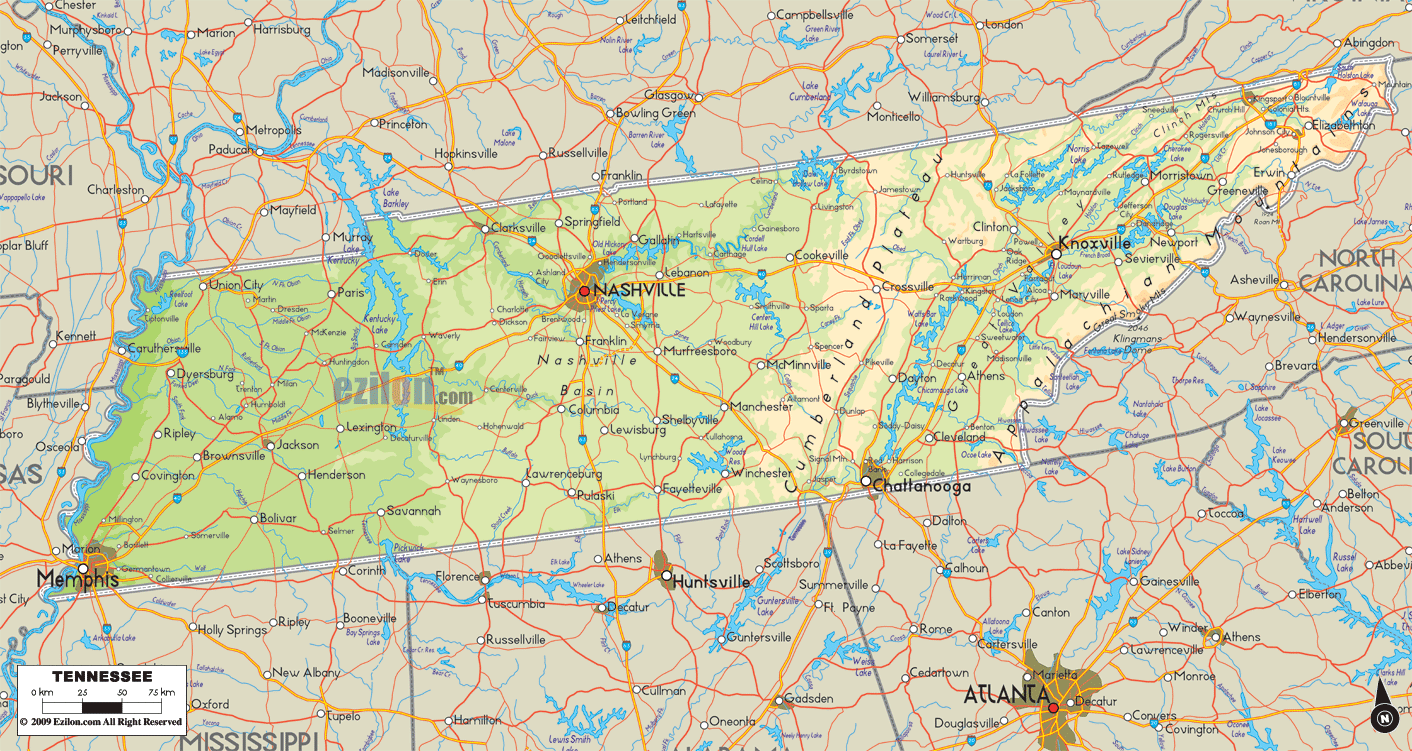
Description: Physical map of Tennessee State, USA showing major geographical features such as rivers, lakes, mountains, topography and land formations.

Detailed Physical map of Tennessee with elevations and other topographic features such as mountains, rivers and lakes. For county boundaries, cities, and roads, see our County and Road Map of Tennessee. Tennessee borders Kentucky, Virginia, North Carolina, Georgia, Alabama, Mississippi, Arkansas and Missouri. On our detailed map, you can read three clear bands of terrain. West Tennessee, along the Mississippi, is low and broad; Middle Tennessee is a mix of rolling plateaus and basins around Nashville; and East Tennessee rises into the folded ridges of the Great Smoky Mountains and the Cumberland Plateau.
Tennessee is located in the southeastern United States. Kentucky and Virginia are to the North of TN; TN borders North Carolina (to the east); Georgia, Alabama, and Mississippi are to the South of TN; Arkansas and Missouri are across the Mississippi River to the West of TN. This best map places Tennessee within that busy crossroads region, where rivers, highways, and mountain passes have long controlled travel routes.
On the left side of the map, you can see the broad blue line of the Mississippi River, which forms Tennessee’s western border. Cities such as Memphis, Covington, Ripley, and Dyersburg mark the human focus of this river corridor. The surrounding shading shows low-lying floodplains and gently rising loess bluffs, built from fine wind-blown silt.
The physical map of Tennessee clearly marks meandering river channels, oxbow lakes, and backwater areas. These features tell geography students that the terrain here is soft and easily shaped by water. For residents and travelers, the map helps explain why levees, flood control projects, and riverside parks are essential to life in West Tennessee.
Near the northwest corner, along the Kentucky border, lies Reelfoot Lake, a broad natural lake formed by land movement during historic earthquakes. It appears on our map as a light blue patch set slightly back from the main Mississippi channel. South of this, rivers like the Obion, Forked Deer, and Loosahatchie flow westward, their branching channels visible as thin blue threads running through the green farmland.
Highways and rail lines from Memphis to Jackson and Union City follow the firmest ground, staying just above the wettest bottom lands. The Tennessee map uses these patterns to show how transportation lines respond to flood risk and soil conditions.
At the center of the map, the city of Nashville stands out as a bright hub where many highways meet. Around it, subtle shading outlines the Nashville Basin, a low, fertile area ringed by higher ground known as the Highland Rim. Towns such as Franklin, Murfreesboro, Columbia, and Gallatin sit in or near this basin, making it one of the most populated parts of Tennessee.
The Cumberland River curves in a broad loop through Nashville, its valley forming a natural route for roads and rail links shown clearly on the map. Geography students can see how the river and basin together create a natural stage for Tennessee’s capital city, with easy access to the surrounding plateaus.
Beyond the Nashville Basin, the terrain rises onto the Highland Rim, a rolling upland where towns such as Clarksville, Springfield, and Cookeville appear. On the physical map of Tennessee, this area shows more texture, with scattered ridges and valleys.
Farther east, the terrain steps up again onto the Cumberland Plateau, an elevated tableland stretching from north to south. Cities like Crossville, Sparta, and Cookeville mark gateways to this higher country. Streams cut narrow gorges into the plateau, though only the larger rivers show on the map as thin blue lines. The plateau’s higher elevation and rougher relief explain why central east-west highways thread through specific gaps and valleys, which stand out as corridors on our detailed map.
In East Tennessee, cities such as Knoxville, Morristown, Greeneville, and Kingsport lie within the Ridge and Valley province. The map uses parallel ridges and elongated valleys to illustrate this pattern, running diagonally from southwest to northeast. Rivers like the Holston, Clinch, and French Broad weave between these ridges, eventually feeding the Tennessee River.
Roads on the geographical map of Tennessee follow the valleys more than the ridges. This structure shows why east-west travel can be complex, with highways bending and turning to follow natural passes rather than straight lines.
Along the eastern border, where Tennessee meets North Carolina, the relief becomes more dramatic. The Great Smoky Mountains and other Appalachian ranges rise as a heavy band of shading. Towns such as Sevierville, Gatlinburg, and Newport mark gateway communities to the Great Smoky Mountains National Park.
Peaks such as Clingmans Dome and Mount Le Conte are among the highest points in Tennessee, though only some are labeled on the map. Their positions along the state line show how the rugged topography defines the border. Streams that begin in these highlands rush down to join larger rivers like the Little Tennessee and Pigeon River, which you can follow as thin blue lines from the heights into the valleys.
A key feature on the physical map of Tennessee is the Tennessee River itself. It curves through the southeast near Chattanooga, then loops into Alabama, and later reenters the state in the west before meeting the Ohio River in Kentucky. Large reservoirs like Kentucky Lake, Lake Barkley, and Pickwick Lake stand out as broad blue shapes along this route.
These lakes, managed by the Tennessee Valley Authority (TVA), support power generation, flood control, and recreation. The Tennessee map helps travelers identify where marinas, state parks, and shoreline communities cluster along these water bodies.
Tennessee River. Other Major Rivers are clearly visible there. The Cumberland River borders Nashville, while the Duck River bisects central towns like Columbia and Shelbyville. Before they join the Tennessee River, near Knoxville, parts of east Tennessee are drained by the Clinch and Holston systems.
By tracing these rivers on the map, students can see how watersheds divide the state. For example, the Cumberland drains northward toward the Ohio River, while the Tennessee flows south and west before also reaching the Ohio. These patterns help explain why different parts of Tennessee experienced distinct historical trade routes and settlement paths.
Although Tennessee has a humid subtropical climate overall, the physical map shows why conditions differ from west to east. The area in Lowland West Tennessee close to Memphis is warm and moist, ideal for growing crops. The higher basins and rims of Middle Tennessee are cooler. In East Tennessee mountains and valleys, summers are cooler; higher elevations receive more snow.
When paired with climate data, our detailed map helps learners understand why certain crops appear in different regions and why some mountain communities experience more fog and rainfall.
West Tennessee’s bottom lands and terraces support cotton, soybeans, and corn. Around the basin of Nashville, there is more pasture, hay, and row crops in Middle Tennessee, while more forest is in the Highland Rim region. Most of East Tennessee’s steep slopes remain heavily wooded. Farming occurs primarily in valley bottoms.
Road networks and interstates of urbanized areas like Memphis, Nashville, Knoxville, and Chattanooga are closely located. This best map of Tennessee makes it easy to see how these cities sit at river bends, basin centers, or mountain passes that favor trade and travel.
Residents can use the physical map of Tennessee to link local experience with statewide patterns. A student in Jackson can follow Interstate 40 eastward and see how it climbs from the Mississippi floodplain to the Highland Rim and on toward the Smokies. A student in Knoxville can track the rivers that drain their region and then join the Tennessee River.
Teachers can create activities that help learners recognize West, Middle, and East Tennessee. Next, they can show the Mississippi, Cumberland, and Tennessee Rivers. Finally, they may match cities with regions.
Travelers can plan scenic loops by following the terrain cues. One classic route runs from Memphis along the river bluffs, then east through Jackson to Nashville, onward through Knoxville and into the Great Smoky Mountains, before looping south to Chattanooga and back across the plateaus. Our Tennessee map shows how that loop touches almost every primary landscape type in the state.
Because the map shows both highways and landforms, users can choose between the fastest interstate route and slower scenic byways that follow river valleys or crest ridges.
The Tennessee map on this site is intended for online viewing, study, and trip planning. It is essential to respect the no-printing-or-copying rule. Users should not download, print, or reuse the image in other media. Instead, the map should be viewed directly on the Ezilon webpage whenever it is needed.
It shows West Tennessee along the Mississippi River, Middle Tennessee with the Nashville Basin and Highland Rim, and East Tennessee with the Cumberland Plateau and Great Smoky Mountains.
By tracing Interstate 40 and nearby highways on the map you can see where the route crosses rivers, climbs plateaus and passes major cities such as Jackson and Nashville.
Kentucky and Virginia lie to the north, North Carolina to the east, Georgia, Alabama and Mississippi to the south, and Arkansas and Missouri across the Mississippi River to the west.
It forms the western border near Memphis, with flat floodplain and low bluffs that stand in contrast to the higher plateaus and mountains farther east.
It appears as a low central area around Nashville surrounded by higher land, with the Cumberland River looping through the city and many roads converging there.
The Highland Rim is a ring of higher rolling hills around the Nashville Basin and on the map it shows as textured upland with towns like Clarksville, Springfield and Tullahoma.
They run along the eastern border with North Carolina near towns such as Gatlinburg, Sevierville and Newport, forming the highest and most rugged area in Tennessee.
It provides major navigation, power and recreation and can be seen curving near Chattanooga, looping into Alabama and reentering western Tennessee as a broad reservoir system.
Kentucky Lake, Lake Barkley, Pickwick Lake, Norris Lake and several TVA reservoirs appear in blue, marking key recreation areas and water storage sites.
Higher areas on the Cumberland Plateau and Smokies are cooler and wetter, while lowlands in West Tennessee and the central basins are warmer with longer growing seasons.
Interstate 40 crosses west to east through Memphis, Nashville and Knoxville, Interstate 24 connects Nashville to Chattanooga, and Interstate 75 runs north south through Knoxville and Chattanooga.
Memphis lies in the west on the Mississippi River, Nashville is central in the basin, Knoxville is in the Ridge and Valley region, and Chattanooga sits near the Tennessee River gap in the southeast.
They can match contour lines and shaded relief to park locations to find ridges, waterfalls and river gorges on the Cumberland Plateau and in the Great Smoky Mountains.
These landforms channel roads and rail lines into certain gaps and valleys, which is why highways bend and follow river corridors rather than crossing every ridge directly.
The Cumberland flows north and west from Nashville to the Ohio River in Kentucky, while the Tennessee loops south and west before also joining the Ohio, giving two separate drainage paths.
Limestone bedrock in the Highland Rim and Nashville Basin dissolves easily, forming karst landscapes where sinkholes, caves and underground streams are common.
East Tennessee mountains and parts of the Cumberland Plateau show dense forest shading, while West and Middle Tennessee show more open farmland and scattered woods.
They can color or trace each region using rivers and mountain lines, then link major cities and land uses to those three traditional divisions.
High peaks, deep valleys, rich biodiversity and scenic drives draw visitors, and the map makes it easy to see gateways such as Gatlinburg and connecting roads like Newfound Gap.
Low sections of the Mississippi bottom lands near Memphis, river valleys of the Cumberland and Tennessee, and certain small stream valleys in Middle and East Tennessee can flood during heavy rain.
No, the map is provided for viewing, study and trip planning only and it must not be printed, downloaded, copied or reused anywhere else.
Higher elevations on the Smokies and plateau receive more snow and colder temperatures, while lowlands in Memphis and Nashville usually see milder winter conditions.
The University of Tennessee is in Knoxville in East Tennessee, Vanderbilt University is in Nashville in Middle Tennessee, and the University of Memphis lies in West Tennessee near the Mississippi River.
By looking for highways that follow river valleys, cross plateaus or trace mountain fronts, travelers can pick byways that show more of the landscape instead of only using straight interstates.
Sections of the Ocoee, Hiwassee, Nolichucky and Pigeon rivers in East Tennessee and parts of the Buffalo and Duck rivers in Middle Tennessee are well known recreation streams.
Most of that border follows the main crest of the Appalachians and the Smokies, so the line generally runs along high ridges visible in the map’s relief shading.
Valleys offer flatter land, deeper soils and easier transport corridors while steep ridges are harder to farm and build on, so they stay mostly forested.
They can assign students to trace rivers, label regions, mark tourist destinations and compare physical features with historical events such as migration routes and Civil War campaigns.
They may cite information gained from viewing the map but are not allowed to copy the image, host it elsewhere or print it due to the site’s no printing and no copying rules.
A modern map gives a broad view of landforms, rivers and regions that phone navigation cannot show clearly, so users gain better context for directions, distances and scenic choices.

Counties and Road Map of Tennessee
Counties and Road map and map image of Tennessee.

Regional Directory of Canada
Information and guide about Canada and website listing.

Regional Directory of United States of America
Information and guide about United States of America and websites with American topics.

Regional Directory of Europe
Information and guide about Europe and websites with European topics.

Regional Directory of Australia
Information and guide about Australia and websites with Australian topics.