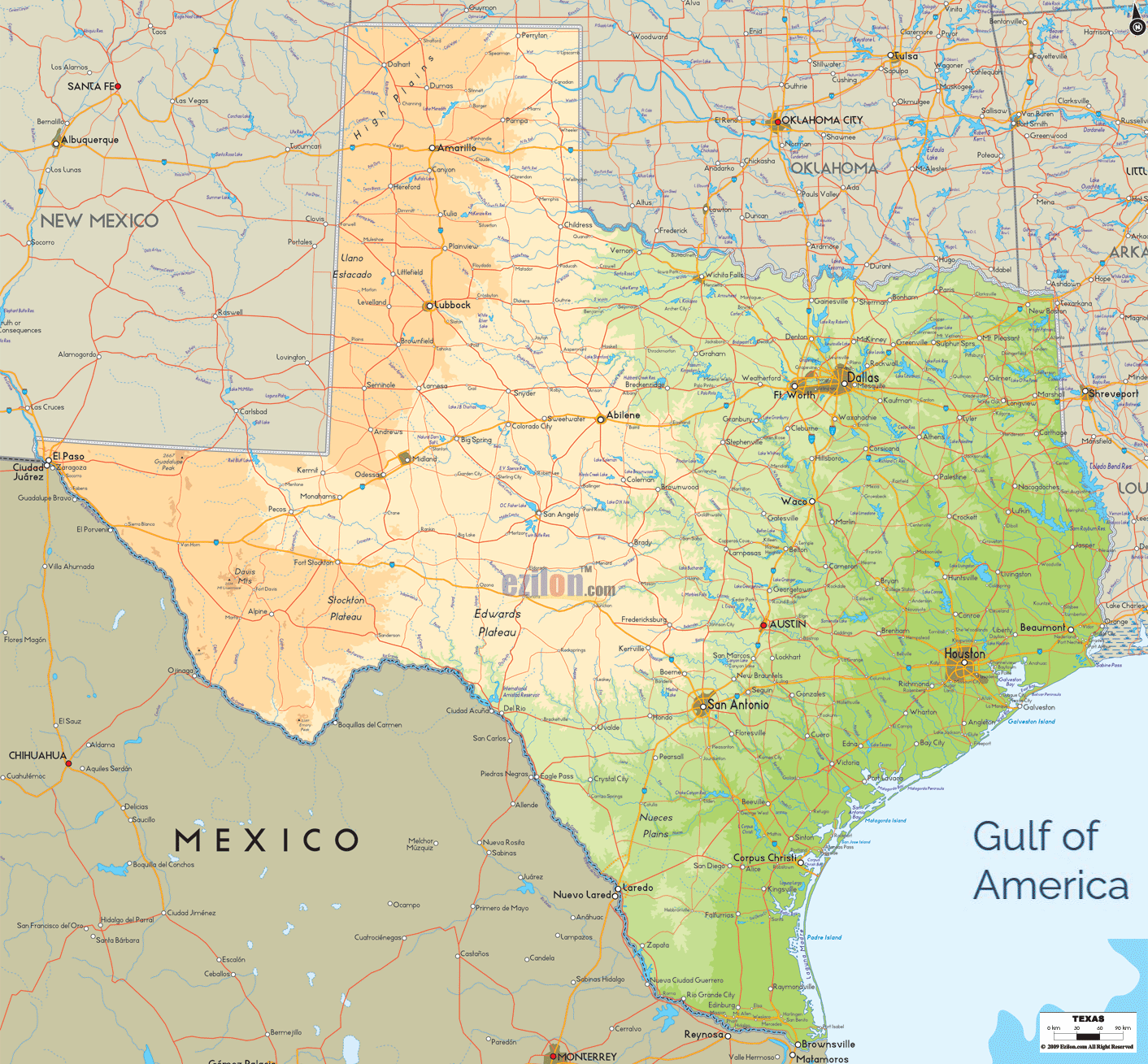
Description: The Physical map of Texas State, USA showing major geographical features such as rivers, lakes, topography and land formations.

Detailed Physical map of Texas with elevations and other topographic features such as mountains, rivers and lakes. For county boundaries, cities, and roads, see our County and Road Map of Texas. Texas borders New Mexico, Oklahoma, Arkansas and Louisiana. On our detailed map you can see how the land rises in the far west around El Paso, drops in a long slope across the Great Plains and Hill Country, then flattens again into the low coastal plain that faces the Gulf of America. Major cities like Dallas, Houston, San Antonio, Austin and El Paso are placed within these landscapes so that you can read how terrain and rivers shape settlement.
Bordering New Mexico to the west, Oklahoma to the north, Arkansas to the northeast, Louisiana to the east and Mexico to the southwest, Texas occupies a central position between the American South, Midwest and Southwest. The map frame lets you see this context, with interstate highways and rail corridors linking Texas to surrounding states and to the Mexican cities beyond the Rio Grande.
In the upper left of the map the rectangular Texas Panhandle stands out. Towns such as Amarillo, Pampa and Childress dot a landscape shaded in light tan, which indicates the high, flat surface of the Great Plains. East of the New Mexico line you can see the name Llano Estacado, a broad plateau of level, windswept terrain. Few major rivers cut this region, which explains why roads tend to run in straight lines and why center pivot irrigation is so important to farming up here.
The Canadian River crosses the northern Panhandle in a shallow valley, and smaller streams like the Red River forks appear as thin blue lines that break the otherwise smooth surface. For geography students, our map makes the contrast between the flat Llano Estacado and the more dissected plains to the east very clear.
Southwest Texas, around El Paso, Fort Stockton and Marfa, forms the Trans Pecos region. On the physical map of Texas this area shows stronger relief shading, with scattered mountain ranges and basins that belong to the Chihuahuan Desert. Features such as the Stockton Plateau and Edwards Plateau are labeled, revealing a high, dry land cut by canyons and arroyos.
The Rio Grande forms the long international border with Mexico, snaking past places like Ciudad Juarez, Presidio, Del Rio and Laredo. In the Big Bend arc the river carves deep canyons through rugged terrain, a fact hinted at by the concentrated contour shading along that curve. Travelers can follow this border on the map to understand how remote and sparsely populated much of West Texas is.
Moving eastward from the desert, the map shows the Edwards Plateau and the famous Texas Hill Country, roughly between San Angelo, San Antonio and Austin. Here the terrain is shown as a mix of green and tan, with countless short blue stream segments, which reflects a dissected limestone plateau full of hills, valleys and springs.
Rivers like the Llano, Pedernales, Guadalupe and Colorado River of Texas cross this region from west to east. Around Austin and San Antonio the Hill Country edges meet the lower coastal plain in a line known as the Balcones Escarpment, visible on our map as a shift in shading and drainage style. This is one of the most scenic parts of Texas, known for clear rivers, ranch land and small towns like Fredericksburg and Kerrville.
North of the Hill Country the map highlights the Rolling Plains and North Central Texas, leading toward Dallas and Fort Worth. The color remains mostly light green with gentle variations, indicating open prairie that has been widely converted to farms and rangeland. The Brazos River and its branches, including the Clear Fork and Double Mountain Fork, cross these plains, while the Red River runs along the border with Oklahoma to the north.
The Dallas Fort Worth Metroplex appears as a dense tangle of roads and city symbols, clearly contrasting with the more regular rural grid around it. The geographical map of Texas makes it easy to see how the metro area sits at the contact between the eastern forests and western prairies, connected by interstate links in all directions.
The right side of the map is dominated by the green tones of East Texas, a region of forests, lakes and slow rivers. Cities like Tyler, Longview, Lufkin and Nacogdoches occupy the Piney Woods, where the land is gently rolling and heavily vegetated. Rivers such as the Sabine, Neches, Angelina and Trinity flow southeast toward the Gulf, their floodplains visible as narrow belts of deeper green.
Our detailed map of Texas also shows man made lakes like Toledo Bend Reservoir on the Sabine River and Sam Rayburn Reservoir on the Angelina River. These large blue patches highlight important recreation areas and water supplies for the region.
Following the map south and east you reach the wide Gulf Coastal Plain. Here the land slopes gently toward the Gulf of America with broad bays, tidal marshes and sandy barrier islands. Cities such as Houston, Galveston, Beaumont, Corpus Christi, Brownsville and Port Isabel line the coast or sit slightly inland along major bays and ship channels.
Rivers like the Brazos, Colorado, Guadalupe, San Antonio, Nueces and Rio Grande reach the sea in estuaries that are clearly marked on the geographical map of Texas. For travelers, this coast offers long beach drives, birding routes and ports that connect Texas to global trade.
The Rio Grande is the best known river on the physical map of Texas. Running along the southwest border, it collects runoff from dry mountains and plateaus. Because much of its basin is arid, the river depends heavily on seasonal flow and upstream water management. Reservoirs such as Amistad and Falcon (labelled farther downstream) store water for irrigation and city use.
Northwest Texas, including parts of the Llano Estacado, drains into the Canadian River and upper Red River, which eventually join the Mississippi via Oklahoma and Arkansas. These rivers show as long, looping blue lines across otherwise dry plains, making them easy to trace for watershed studies.
Central and eastern Texas is dominated by rivers that flow independently to the Gulf. The Colorado River of Texas passes near San Angelo, Austin and La Grange before reaching Matagorda Bay. The Brazos River runs from the Panhandle through Waco and Bryan toward the coast between Houston and Corpus Christi. The Trinity River and its forks drain the Dallas area and discharge near Galveston Bay. The Guadalupe, San Antonio, Nueces and Sabine rivers each drain specific belts of terrain.
Our map lets geography students compare these watersheds side by side. By following the blue lines from their headwaters in the high plains or Hill Country to their mouths on the coast, they can see how river length and elevation change influence flow speed, erosion and flood risk.
Texas spans several climate zones, and the physical map helps explain why. The western high plains and Trans Pecos area are semi arid, with limited surface water and large ranches. Central Texas has a mix of dry and humid conditions, especially around the Hill Country where elevation is moderate. East Texas and the Gulf Coastal Plain are humid and receive abundant rainfall.
When paired with climate data, our geographical map of Texas can help users understand why forests are dense in the east, why crops such as cotton, sorghum and wheat dominate the plains, and why irrigation is essential around Lubbock and the Panhandle.
The map also hints at Texas energy resources. Areas around Midland and Odessa lie in the Permian Basin, a major oil and gas producing region. While wells are not individually marked, the dense road network and location within the dry plateau remind users of this industrial landscape.
Large protected areas appear in west and south Texas, including the remote mountains near Big Bend and wildlife refuges along the coast. Forested zones in East Texas support timber and paper industries, while agricultural valleys along the Brazos and Colorado rivers produce cotton, grains and vegetables.
Travelers can use the physical map of Texas to design routes that match their interests. For desert scenery, they can follow the Rio Grande from El Paso to Big Bend, using the map to locate small towns, crossings and canyon areas. For a Hill Country loop, they might trace highways between Austin, San Antonio, Kerrville and Fredericksburg, seeking stretches that cross rivers and ridges.
Coastal visitors can move from Galveston down through Freeport, Corpus Christi and South Padre Island, guided by the coastline and bays shown on the map. The blend of terrain shading and road detail makes it easy to choose scenic alternatives to the main interstates.
Students and teachers can work with the physical and geographical map of Texas to explore regions, watersheds and landforms in a single view. Classroom projects might include tracing the path of the Colorado River, comparing elevation between Amarillo and Brownsville, or labeling the Hill Country, Llano Estacado and Piney Woods.
Researchers who need a quick visual overview of the state’s physical geography can use the map as a reference while respecting the no printing and no copying rule. The image is available for online viewing and study but must not be downloaded, reproduced or redistributed in any format.
It highlights West Texas high plains and deserts, Central Texas Hill Country and plateaus, and East Texas with its forests and broad Gulf Coastal Plain.
By tracing highways across the Trans Pecos, Hill Country and coastal plain you can see elevation changes, river crossings and city stops between El Paso, San Antonio, Austin and Houston.
Texas borders New Mexico to the west, Oklahoma to the north, Arkansas to the northeast, Louisiana to the east, Mexico to the southwest and the Gulf of America along its southeast coast.
The Rio Grande forms the long international boundary with Mexico, curving from El Paso through the Big Bend region and then southeast toward Brownsville and the Gulf.
The Panhandle appears as a high, rectangular region in the north with towns such as Amarillo, while the Llano Estacado is marked as a flat plateau along the New Mexico border with few major rivers.
The Hill Country lies in Central Texas around Austin, San Antonio, Kerrville and Fredericksburg, where the map shows dissected plateaus, short rivers and many low hills.
The Edwards Plateau is a high limestone region west of Austin and San Antonio, shown with mixed tan and green shading and crossed by rivers like the Llano, Guadalupe and Colorado.
Big Bend appears along the great curve of the Rio Grande in southwest Texas, south of Marathon and Alpine, where the river cuts deep canyons through rugged mountains and desert basins.
The Gulf Coastal Plain is shown as low, green terrain along the southeast edge of the state with bays, estuaries and cities such as Houston, Corpus Christi and Brownsville.
The Piney Woods cover East Texas near cities like Tyler, Lufkin and Nacogdoches and are indicated by dense green shading and many short, slow moving rivers.
Look for large blue patches such as Toledo Bend Reservoir, Sam Rayburn Reservoir, Lake Livingston, Lake Texoma and Falcon Lake scattered across East, Central and South Texas.
Dry high plains and deserts in the west shift into semi humid plateaus and then into very humid forests and coastal lowlands in the east, matching the shading and river density on the map.
The Brazos and Colorado flow from the plains and Hill Country toward the Gulf, carving valleys that support farms, towns and reservoirs that are clearly traced on the geographical map of Texas.
Dallas and Fort Worth sit in North Central Texas on rolling plains between the East Texas forests and drier western prairies, where several highways and the Trinity River cross.
You can follow the coastline from Galveston to Corpus Christi and Brownsville, using the map to locate bays, islands, river mouths and coastal cities for overnight stops.
Austin and San Antonio lie along the eastern edge of the Hill Country near the Balcones Escarpment, where the elevated plateaus drop toward the coastal plain.
West Texas deserts appear in tan shading with isolated mountains, sparse rivers and long stretches between towns such as El Paso, Fort Stockton and Presidio.
Interstate 10 crosses from El Paso through San Antonio and Houston, Interstate 20 links El Paso, Midland and Dallas, Interstate 35 runs from the Rio Grande through San Antonio, Austin and Dallas, and Interstate 45 connects Houston with Dallas.
Because they flow across low, humid coastal plains with gentle slopes, so rivers like the Trinity, Neches and Sabine develop wide meanders and broad floodplains.
No, the Ezilon Texas map is for online viewing and reference only and must not be printed, downloaded, copied or reused in other documents or websites.
Students can use the map to label regions, trace rivers, mark cities and compare mountains, plains and coasts while keeping all work based on an accurate physical reference.
A detailed map gives a big picture view of mountains, plains, rivers and regions that GPS screens do not show clearly, so travelers can better understand scenery and route choices.
Areas around Big Bend, the Guadalupe Mountains, Palo Duro Canyon and several Gulf Coast refuges are marked near their towns and roads, helping visitors locate park entrances and nearby services.
While it does not plot storms directly, the map highlights North Central plains and Panhandle areas where open terrain and clashing air masses often bring spring and early summer storms.
Greens usually mark lower, wetter forests and plains, tans mark higher or drier plateaus and deserts, and darker shading indicates steeper slopes and mountain areas.
Large sections are gently rolling or flat, especially the High Plains and coastal plain, but the map also shows rugged mountains, deep canyons and hill country that break up the flatness.
By tracing river courses southward along the Mexican border for the Rio Grande and eastward along the Oklahoma line for the Red River you can see how each drainage system follows different terrain belts.
Houston sits on the low Gulf Coastal Plain near the Trinity and San Jacinto rivers and several bayous, just inland from the Gulf and east of the Brazos River valley.
They may view and reference geographic information from the map but must respect the no printing and no copying policy and should link back to the Ezilon page instead of reusing the image.
A modern map gives a broad view of landforms, rivers and regions that phone navigation cannot show clearly, so users gain better context for directions, distances and scenic choices.

Counties and Road Map of Texas
Counties and Road map and map image of Texas.

Regional Directory of Canada
Information and guide about Canada and website listing.

Regional Directory of United States of America
Information and guide about United States of America and websites with American topics.

Regional Directory of Europe
Information and guide about Europe and websites with European topics.

Regional Directory of Australia
Information and guide about Australia and websites with Australian topics.