

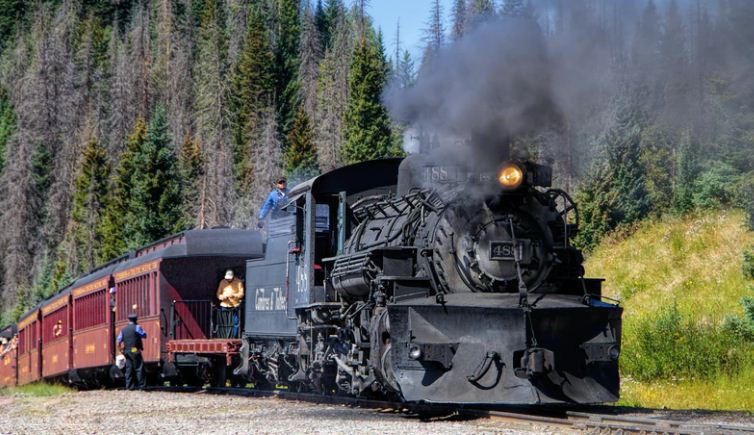
Rail fans who study the history of a famous US steam locomotive usually end up talking about one giant: the Union Pacific Big Boy. Because of their size and power and the role they played in moving heavy freight over the Rocky Mountains, the Big Boy locomotives became legends. Their story extends from the Second World War to modern-day heritage that draws significant crowds.
How Did the Big Boy Become an American Icon?
The backstory of a famous steam locomotive in the United States often involves a problem. In the 1940s, Union Pacific wanted a locomotive that could haul long, heavy freight between Utah and Wyoming and power over the steep grades of the Wasatch Mountains. Previously designed steam engines did not have the adequate speed and power to do it all. So, trains needed multiple locomotives and helper engines.
Engineers designed the Big Boy to be a single, powerful machine to pull massive trains up steep grades and still move them quickly over the flat stretches. As one of the largest and most powerful series of steam locomotives ever built, the result exemplified American railroad muscle.
The Union Pacific Big Boy originated.
The detailed history of a famous US steam locomotive, such as the Big Boy, begins in the shops of the American Locomotive Company (ALCO). During the years 1941 to 1944, ALCO manufactured 25 4-8-8-4 Big Boy locomotives. The weird wheel layout has a leading four-wheel truck, two sets of eight driving wheels, and a trailing four-wheel truck to support the massive firebox.
A locomotive’s performance was key for Union Pacific.
- Transport a minimum of 3,600 tons up long mountain ramps.
-
After the steepest climbs, maintain a good speed.
-
Use one large, efficient machine instead of smaller ones.
Engineers tested the new design on the line between Ogden and Evanston, Utah, and discovered that a Big Boy could handle about 4,200 tons on the ruling grade while averaging 18–20 mph uphill. A Big Boy at full power could consume about eleven tons of coal and 12,000 gallons of water per hour to produce about 6,290 drawbar horsepower.
Supersized Performance.
The raw numbers that brought the United States famous steam locomotive Big Boy to the forefront must be mentioned in any essay. A Big Boy and its tender, fully loaded, were about 133 feet long and weighed 1.2 million pounds. According to Encyclopedia Britannica, Big Boy is one of the largest and most powerful steam locomotive series ever built.
These locomotives were built for service on the line between Ogden, Utah, and Green River, Wyoming, where major grades and heavy trains required substantial power. The crews found the engines to be ‘sure-footed’ and more user-friendly than some of the earlier articulated types. The Union Pacific gradually increased their rated tonnage as experience grew. Big Boys could pull 120-car freight trains at speeds approaching forty miles per hour in mountain territory, doing the work of three smaller engines.
Involvement of freight in wartime and postwar.
The story of an iconic US steam locomotive cannot be separated from World War II. The United States was ramping up wartime production, and the Big Boys were entering service, requiring the rapid movement of enormous amounts of freight. They moved heavy trains loaded with equipment, agricultural goods, and other goods across the interior West, helping keep the flow of goods to ports and factories.
Following the war, Big Boys remained a major freight power on UP’s main line. A majority of them spent their careers working back and forth between Cheyenne, Wyoming, and Ogden, Utah, especially over Sherman Hill and the Wasatch Range. Although steam engines were powerful, manufacturing them was more expensive than manufacturing diesel engines. By the late 1950s, Big Boys were being phased out of service, and regular service ended in the early 1960s.
The Giant’s Retirement And Conservation.
A comprehensive account of a famous US steam locomotive includes the events that followed its retirement. Although all twenty-five Big Boys were manufactured, none of them were scrapped during their operating life. Union Pacific chose to donate several of the class locomotives to museums and cities rather than send them all to the breakers when they retired.
Currently, eight Big Boys survive at static locations.
-
Wyoming’s Cheyenne
-
Denver, CO.
-
Midland City.
-
Missouri, St. Louis
-
Scranton, Pennsylvania, and cities beyond.
Most of these behemoths serve as silent monuments to the high point of American steam engineering, but one Big Boy ultimately received a second life on the road.
You won’t believe how amazing the restoration of Big Boy 4014 was.
In recent years, many history fans have focused on a famous US steam locomotive, the Union Pacific Big Boy No. 4014. The locomotive played an important role; built in 1941, it ran more than one million miles. Up until 1961, the 4014 ran successfully before being retired in December 1961 and then transferred to Pomona, California, as a donation from Union Pacific. The Big Boy (Union Pacific) was on display at the museum in Pomona, California, and remained there for decades.
In 2013, Union Pacific reached an agreement to reacquire 4014 and return it to Cheyenne, Wyoming, for complete restoration. The steam team for the railroad took on a multi-year project that involved completely dismantling the locomotive, repairing or rebuilding major components, and converting it from coal firing to oil.
By early 2019, workers connected the boiler and running gear, completed several tests on the boiler, and finished many other small jobs. In May 2019, Big Boy 4014 was returned to service for the 150th anniversary of the completion of the Transcontinental Railroad. That return made it the only operating Big Boy and among the most prominent living pieces of American rail legacy.
Big Boy 4014 as a Mobile Museum
A famous steam locomotive in the US is now running regularly on mainline tours. Big Boy 4014 is part of the Union Pacific heritage fleet and operates special trips on the system. Many railfans and families gather at trackside and station platforms to see the 4-8-8-4 in operation, often called the world’s largest operating steam locomotive.
Public exhibitions show.
-
The way steam-age engineering carried heavy freight.
-
A 600-ton engine in action that generates a loud sound.
-
Importance of the conservation and craftsmanship of restoring historic structures
Video documentaries and railfan footage have carried Big Boy’s story much further than the usual train crowd.
Why Big Boy Still Matters Today.
The big-picture chronicle of a Big Boy, a well-known American steam engine, touches on industries, communities, and culture. The Big Boys represented an attempt to lower costs by using larger, more powerful single units for heavy freight, an idea that survived into the diesel era. Before diesel-electric power took over, these remarkable vehicles represented the pinnacle of American steam designs.
Both the restored 4014 and the preserved Big Boys show how railroads and museums can work together to protect them while still serving as educational tools. Many visitors who see a Big Boy in person get a visceral sense of how railroads built the modern United States by moving goods over great distances.
In Conclusion, a History of a famous US steam locomotive.
The history of a famous US steam locomotive (Union Pacific Big Boy) that ties together design genius, wartime effort, and modern preservation. With high-speed runs over the Wasatch Mountains, slow moves into museums, and a dramatic return to steam.
Big Boy’s story tells the rise, fall, and return of American mainline steam power. So long as 4014 steams and the preserved engines stand in museums, people will learn how these giants helped shape freight rail and broader US history.
