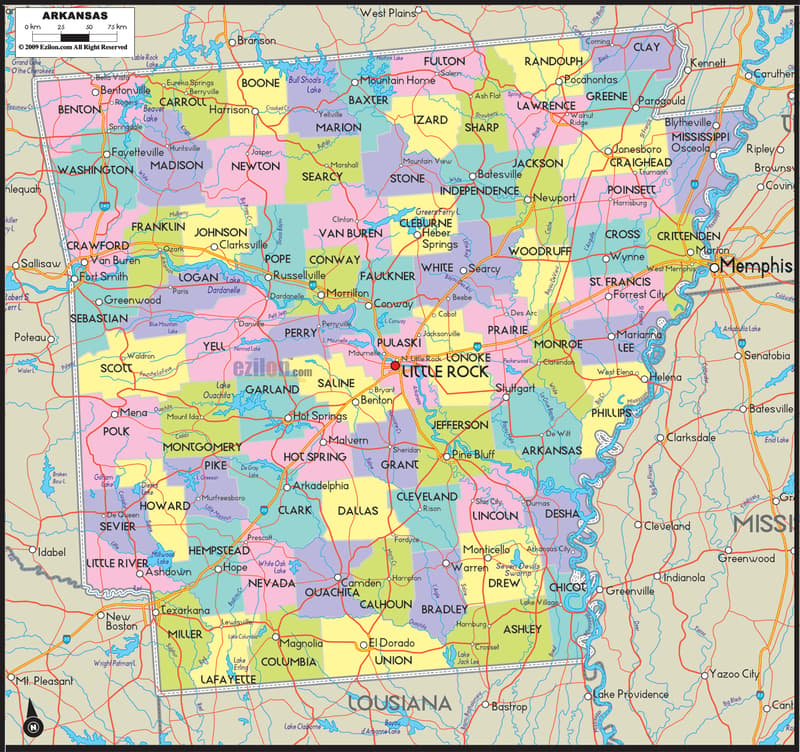
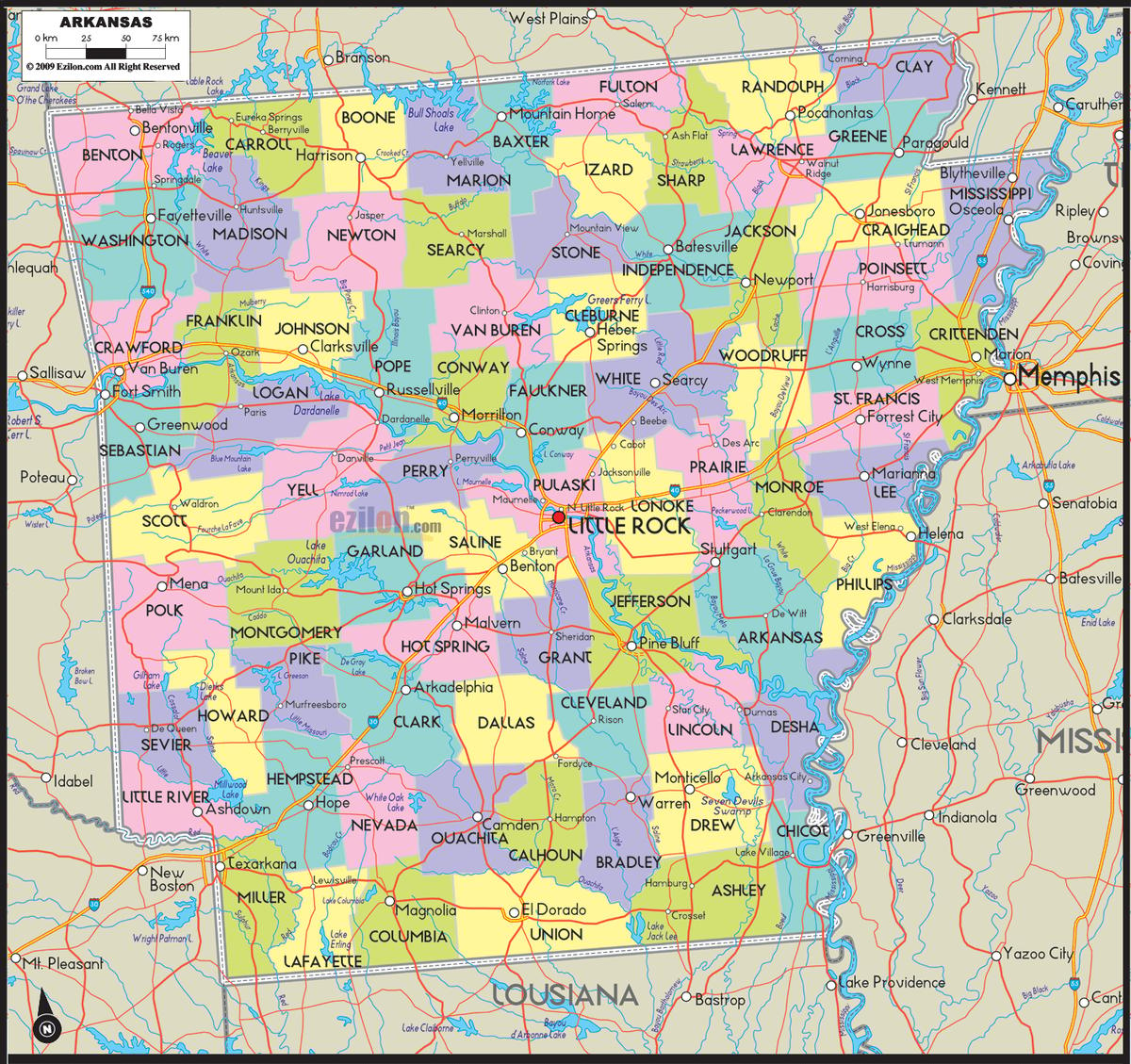
Description: Detailed large map of Arkansas showing cities, counties, towns, county seats, state boundaries and a light interstate reference layer.

Map of Arkansas (USA). Arkansas map with cities, counties, and towns. Use this detailed map to understand Arkansas’s full county grid, every administrative capital (county seat), the major cities and towns, bordering states and waters, and a few highway cues for orientation only. This is the best choice for residents, travelers, and geography students looking for relief without road clutter.
Arkansas is comprised of 75 counties packed into just over 53,000 square miles, more counties than most states of its size have, so the map leans on color rather than a tangle of route numbers to keep all that readable.
Missouri serves as the state’s northern border, then runs east to the eastern side of the state. If you cross the Mississippi River and look east, you are looking at Tennessee, almost to Mississippi and Crittenden counties. The state of Mississippi itself continues along that same river line south past Lee, Phillips, Desha, and Chicot counties. Louisiana blocks the bottom near Miller, Lafayette, Columbia, Union, Ashley, and Chicot counties while Texas and Oklahoma run the full length of the west side. Inside those borders lie four memorable rivers: the Arkansas, the White, the Mississippi, and the Ouachita. They carry out the majority of the task of chopping this state into parts you can realistically envision.
There are only five highways on this map, and they are there by design. Across the north-central corridor east to west is I-40. Angling southwest toward Texarkana is I-30. Serving the fast-growing northwest corner is I-49. Running the eastern Delta edge is I-55. Peeling off into Jonesboro is its short spur I-555. Learn those five lines, and you can put almost any town on this page without it needing the full road atlas beside it.
Arkansas borders Missouri to the north, Tennessee and Mississippi to the east across the Mississippi River, Louisiana to the south, and Texas and Oklahoma to the west. This Arkansas map, showing counties and cities, shows all 75 counties. Union County is the largest by land area at about 1,039 square miles, while Lafayette County is the smallest at about 526 square miles. Pulaski County is the most populous, with roughly 401,209 residents, and Calhoun County is the least populous, with roughly 4,690 residents. Arkansas County, established in December 1813, is the oldest county in the state, formed before Arkansas itself became a separate territory.
The state covers about 53,179 square miles in total, with about 52,035 square miles of land. The capital is Little Rock, located in Pulaski County at the bend of the Arkansas River. This Map of Arkansas major cities picture extends from the Northwest Arkansas corridor of Fayetteville, Springdale, Rogers, and Bentonville through Fort Smith and the capital to Jonesboro in the northeast.
The state begins in the Ozark Plateau and the Ouachita Mountains in the western and northern regions. Further to the center lies the Arkansas River Valley, and at the east and southeast are the flat, low Delta lowlands of the Mississippi Alluvial Plain.
This Map of Arkansas counties lists every one of the state’s 75 counties alongside its seat, in alphabetical order: Arkansas–DeWitt and Stuttgart; Ashley–Hamburg; Baxter–Mountain Home; Benton–Bentonville; Boone–Harrison; Bradley–Warren; Calhoun–Hampton; Carroll–Berryville and Eureka Springs; Chicot–Lake Village; Clark–Arkadelphia; Clay–Piggott and Corning; Cleburne–Heber Springs; Cleveland–Rison; Columbia–Magnolia; Conway–Morrilton; Craighead–Jonesboro and Lake City; Crawford–Van Buren; Crittenden–Marion; Cross–Wynne; Dallas–Fordyce; Desha–Arkansas City; Drew–Monticello; Faulkner–Conway; Franklin–Ozark and Charleston; Fulton–Salem; Garland–Hot Springs; Grant–Sheridan; Greene–Paragould; Hempstead–Hope; Hot Spring–Malvern; Howard–Nashville; Independence–Batesville; Izard–Melbourne; Jackson–Newport; Jefferson–Pine Bluff; Johnson–Clarksville; Lafayette–Lewisville; Lawrence–Walnut Ridge; Lee–Marianna; Lincoln–Star City; Little River–Ashdown; Logan–Booneville and Paris; Lonoke–Lonoke; Madison–Huntsville; Marion–Yellville; Miller–Texarkana; Mississippi–Blytheville and Osceola; Monroe–Clarendon; Montgomery–Mount Ida; Nevada–Prescott; Newton–Jasper; Ouachita–Camden; Perry–Perryville; Phillips–Helena-West Helena; Pike–Murfreesboro; Poinsett–Harrisburg; Polk–Mena; Pope–Russellville; Prairie–Des Arc and DeValls Bluff; Pulaski–Little Rock; Randolph–Pocahontas; Saline–Benton; Scott–Waldron; Searcy–Marshall; Sebastian–Fort Smith and Greenwood; Sevier–De Queen; Sharp–Ash Flat; St. Francis–Forrest City; Stone–Mountain View; Union–El Dorado; Van Buren–Clinton; Washington–Fayetteville; White–Searcy; Woodruff–Augusta; Yell–Dardanelle and Danville.
Look at the top left corner of the map, and you will see the state’s busiest growth story packed into two counties. Benton County, seat Bentonville, is where Walmart keeps its headquarters, and the suburbs around it, Rogers and Siloam Springs among them, have been sprinting to keep up. Right below it, Washington County, seat Fayetteville, is home to the University of Arkansas and actually shares the Springdale city label with Benton County across the line between them, which is why the two counties read almost as one metro area on the map. Fayetteville, Springdale, Rogers, and Bentonville corridor is one of the fastest-growing in the nation. Climb east and the map changes character fast: Madison County, seat Huntsville, and Carroll County, seats Berryville and Eureka Springs, trade the flat suburban grid for steep Ozark valleys and curving roads. US-71, US-62, US-412, and the I-49 corridor tie the whole area together like a thread.
Follow the Missouri line east from there and Boone County, seat Harrison, opens into Marion County, seat Yellville, and Baxter County, seat Mountain Home, where two of the map’s biggest blue shapes, Bull Shoals Lake and Norfork Lake, take over the landscape. Fulton County, seat Salem, Izard County, seat Melbourne, and Stone County, seat Mountain View, round out this northern lake belt, and Mountain View in particular is worth knowing for its Ozark Folk Center and its mountain music tradition. Drop south of the lakes and you will notice the roads thin out noticeably around Searcy County, seat Marshall, and Newton County, seat Jasper, which is really just the map reflecting how steep and winding the Buffalo National River country gets through both of them. Van Buren County, seat Clinton, lies just below, bridging the Ozark uplands above it and the Arkansas River Valley farther south.
Trace the White River on the map and it carries you through Independence County, seat Batesville, then on to Jackson County, seat Newport. Further northeast, Lawrence County, seat Walnut Ridge, Sharp County, seat Ash Flat, and Randolph County, seat Pocahontas, sit right where the Ozark uplands flatten out toward the Delta. Tucked into the far northeast corner, Clay County actually carries two seats, Piggott and Corning, while Greene County, seat Paragould, and Craighead County, seats Jonesboro and Lake City, mark the biggest population concentration in the whole region. Jonesboro, Arkansas’s fifth-largest city, anchors that corner, and you can reach it on the map via US-63, US-49, or the I-555 spur off I-55.
Slide over to the river’s edge and Mississippi County is the first thing you will notice, it carries two seats, Blytheville and Osceola, both sitting close against the water. Just south, Crittenden County, seat Marion, holds West Memphis, directly across the river from Memphis, Tennessee, right where I-40 and I-55 both cross the state line. Move inland and Poinsett County, seat Harrisburg, and Cross County, seat Wynne, sit between the St. Francis and Cache rivers, while St. Francis County itself, seat Forrest City, lands on I-40 about halfway between Little Rock and Memphis.
Right at the Oklahoma line, Fort Smith anchors Sebastian County, seats Fort Smith and Greenwood, sitting directly across the river from Van Buren, the seat of Crawford County. I-40 crosses the state line at exactly this point, with US-64 running parallel along the river’s north bank. Follow the valley east, and Franklin County, seat Ozark, Charleston, and Scott County, seat Waldron, stretch toward the Ouachita foothills. Johnson County, seat Clarksville, and Pope County, seat Russellville, face each other across Lake Dardanelle, the broad reservoir on the Arkansas River where Russellville and Dardanelle sit on opposite banks. Logan County carries two seats of its own, Booneville and Paris, and Yell County carries Dardanelle and Danville, reaching south toward Mount Magazine, the highest point anywhere in the state.
Continuing on Interstate 40 east, you will pass Morrilton, the county seat of Conway County, and Perryville, the county seat of Perry County, as you enter Pulaski County, Little Rock and North Little Rock. Little Rock and North Little Rock lie on opposite river banks just around the bend of the Arkansas River. This is the busiest intersection on the whole map: I-30, I-40, I-430, I-440, and I-530 all meet here, along with US-65, US-67, and US-167.
Just north of the capital, Faulkner County’s seat, Conway, is the home of Arkansas’s eighth-largest city. Saline County, seat Benton, and Grant County, seat Sheridan, occupy the southwest, while Lonoke County, seat Lonoke, and White County, seat Searcy, stretch east toward the Delta, ringing the capital on the map. To the north of the metro area is Cleburne County, with its seat in Heber Springs, which is home to Greers Ferry Lake, an increasingly popular boating and fishing lake fed by the Little Red River.
A mere head southwest of the capital and Garland County seat, Hot Springs, Lake Hamilton and Lake Ouachita frame Hot Springs National Park with its old-time bath houses still amusing visitors all year long. The seat location of Hot Spring County is Malvern on Interstate 30 from Little Rock. As we venture further into the mountains, we notice that Montgomery County, whose seat is Mount Ida, Polk County, whose seat is Mena, and Pike County, whose seat is Murfreesboro, near the Crater of Diamonds, are progressively more absent on the map. This is quite normal and is not surprising. Similarly, farther north and east, we have Clark County, whose seat is Arkadelphia, and the Ouachita River, which meets I-30.
Howard County, seat Nashville, and Sevier County, seat De Queen, lead you down into Little River County, seat Ashdown, where the Red River marks the approach to Texas. Hempstead County, seat Hope, and Nevada County, seat Prescott, sit along I-30, and Lafayette County, seat Lewisville, the smallest county on the map by land area, touches both Texas and Louisiana. Right at the southwest corner, Miller County anchors Texarkana, exactly where I-30 crosses into Texas.
In the far southern part of the state, Columbia County, with its county seat in Magnolia, and Union County, with its county seat in El Dorado, the largest county on the map by land area, anchor the oil and timber economy. Ouachita County, with its seat, Camden, and tiny Calhoun County, with its seat, Hampton, the least populous county in the state, sit inland along the Ouachita River.
Dallas County’s seat is Fordyce. Bradley County’s seat is Warren, which is known for its pink tomatoes. Cleveland County’s seat is Rison. These counties make up the forested belt just north of El Dorado.
Jefferson County, seat Pine Bluff, southeast of the capital, lies on the lower Arkansas River; access is via I-530. Lincoln County, with Star City as its seat, and Drew County, with Monticello as its seat, lead down to Ashley County, with Hamburg as its seat, which is a most important timber and paper-mill county, and Chicot County, with Lake Village as its seat, which curls around an oxbow of the Mississippi River at Lake Chicot.
Desha County, which has Arkansas City as its seat and Dumas and McGehee as its largest towns, is downstream from there. Lee County, whose seat is Marianna, and Phillips County, whose seat is Helena-West Helena, share the river’s blues heritage. The King Biscuit Blues Festival, held every October, takes place in Helena.
Prairie County has two seats: Des Arc and DeValls Bluff, which straddle the White River floodplain on the map. Arkansas County, the oldest county in the state, has two seats of its own: DeWitt and Stuttgart, which calls itself the rice- and duck-hunting capital of Arkansas. Monroe County, seat Clarendon, and Woodruff County, seat Augusta, round out the Grand Prairie, a stretch of rice fields, duck blinds, and slow bayous where the Cache and White rivers do most of the navigating for you.
Almost all of this map’s orientation weight rests on four features. The Arkansas River flows west to east, passing most directly through Fort Smith, Little Rock, and Pine Bluff. The White River flows from the Ozarks and continues through the Delta region. The entire eastern border is formed by the Mississippi River. The southern mountains drain into Louisiana via the Ouachita River. Learn those four, keep the Ozark and Ouachita highlands in mind to the west and north and the Delta lowlands to the east and southeast, and almost any county on this map becomes easy to place.
A standard road map would complicate Arkansas with thousands of miles of state highway and county road detail that most people never really need. This color map has a completely different look. It represents all 75 counties in solid blocks of color. Every county seat is marked clearly.
The interstate system and some major US routes have been left in as a light reference only. When viewed like this, the map answers the questions that people actually look for: which county a city is in, where one county ends and the next begins, which county touches a given border or river, faster than a cluttered turn-by-turn road map could manage. If you want real driving directions, a GPS app remains the better tool for the job. If you want to understand the structure of Arkansas county by county, this is a clearer view.
Arkansas’s ten largest cities on the map, by current population, are Little Rock (about 202,591, Pulaski County), Fayetteville (about 93,949, Washington County), Fort Smith (about 89,142, Sebastian County), Springdale (about 84,161, Washington and Benton counties), Jonesboro (about 78,576, Craighead County), Rogers (about 69,908, Benton County), North Little Rock (about 64,591, Pulaski County), Conway (about 64,134, Faulkner County), Bentonville (about 54,164, Benton County), and Pine Bluff (about 41,253, Jefferson County).
Bentonville is where Walmart, the world’s largest retailer, is headquartered, and the Benton-Washington county corridor around it has grown into a real logistics and technology hub. Home to Tyson Foods, poultry processing in Springdale runs through Washington, Benton, and Sebastian counties.
Little Rock is a key financial and state health care center on the map, and Jonesboro, Craighead County, is a commercial center for the rice and soybean farmland of northeast Arkansas. The Grand Prairie counties of Arkansas, Prairie, and Lonoke lead the nation in rice production. Timber still drives the economy in the southern counties of Union, Ashley, Bradley and Ouachita.
Trace the cultural map of Arkansas and it runs from the Ozark Folk Center in Stone County all the way to the blues heritage of Helena in Phillips County, home every October to the King Biscuit Blues Festival. Hot Springs, in Garland County, built its whole identity around the bathhouses of Hot Springs National Park and these days also hosts a well-known documentary film festival. In the capital, Little Rock’s River Market District and the William J. Clinton Presidential Library have been pulling in visitors since the early 2000s. Higher education is spread across the map too: the University of Arkansas sits in Fayetteville (Washington County), Arkansas State University in Jonesboro (Craighead County), and both the University of Central Arkansas and Hendrix College in Conway (Faulkner County). Up in Northwest Arkansas, the Crystal Bridges Museum of American Art, built with Walmart family funding in Bentonville, has become a major draw for Benton County.
On this map, the Ozark and Ouachita highlands to the west and north and the Delta lowlands to the east and southeast double as quick landmarks for finding a county, with the Arkansas, White, and Mississippi rivers acting as your navigation lines. For elevation, terrain, watersheds, and land-cover detail, see our Physical Map of Arkansas.
The entire state of Arkansas does experience a humid subtropical climate. However, the temperatures are noticeably milder in the Ozarks and Ouachita highlands than they are in the delta lowlands. Refer to Physical Map of Arkansas for complete seasonal detail.
Driving from north to south is mostly done on I-49 in the northwestern part of the state and on US-65 through the center of the state. In contrast, I-40 serves as the major interstate route from east to west through the north-central part of the state while I-30 serves as the major route to the southwest toward Texarkana. The I-555 spur and I-55 serve the Delta and Jonesboro northeast. It is something that is important to know that the ZIP codes in Arkansas do not follow the county lines. If you’re unsure of the county name, use the map or the index instead of guessing the ZIP prefix.
Arkansas has 75 counties, and the map shows every one with a colored block and its county seat labeled.
Little Rock is the state capital, located in Pulaski County at the bend of the Arkansas River.
Pulaski County holds both Little Rock and North Little Rock, Arkansas’s largest metro area.
Washington County, in the heart of Northwest Arkansas.
Sebastian County, on the Oklahoma border along the Arkansas River.
Springdale sits mainly in Washington County, while Rogers and Bentonville are in Benton County.
Craighead County, the commercial hub of northeast Arkansas.
Garland County, home to Hot Springs National Park and Lake Hamilton.
Miller County, right on the Texas state line.
Jefferson County, along the lower Arkansas River southeast of Little Rock.
Faulkner County, just north of the Little Rock metro area.
Baxter County, near Bull Shoals Lake and Norfork Lake in the Ozarks.
Union County, Arkansas’s largest county by land area, in the south Arkansas Timberlands.
Crittenden County, across the Mississippi River from Memphis, Tennessee.
Benton, Carroll, Boone, Marion, Baxter, Fulton, Randolph, and Clay counties line the Missouri border.
Benton, Washington, Crawford, Sebastian, Scott, Polk, Howard, Sevier, and Little River counties.
Miller, Little River, and Sevier counties sit along the Texas line near the Red River.
Miller, Lafayette, Columbia, Union, Ashley, and Chicot counties.
Mississippi County and Crittenden County, near Memphis.
Crittenden, Lee, Phillips, Desha, and Chicot counties along the lower river.
I-40, I-30, I-49, I-55, and I-555 are shown as light reference lines, not turn-by-turn routes.
Union County, at about 1,039 square miles in the south Arkansas Timberlands.
Lafayette County, at about 526 square miles in the southwest corner.
Pulaski County, with about 401,209 residents, home to Little Rock.
Calhoun County, with about 4,690 residents, in south-central Arkansas.
Little Rock, in Pulaski County, with about 202,591 residents.
Arkansas County, established in December 1813, the first county formed in the territory.
No. ZIP codes cross county lines, so use the county boundaries and seats shown here instead.
No. Printing or copying maps from this site is not permitted.
Benton, Washington, Madison, and Carroll counties, anchored by Bentonville, Rogers, Springdale, and Fayetteville.
Through Newton and Searcy counties, between Harrison and Marshall.
Bull Shoals, Norfork, Greers Ferry, Lake Dardanelle, Lake Ouachita, Lake Hamilton, and Lake Chicot.

Physical Map of Arkansas
Physical map and map image of Arkansas.

Regional Directory of Canada
Information and guide about Canada and website listing.

Regional Directory of United States of America
Information and guide about United States of America and websites with American topics.

Regional Directory of Europe
Information and guide about Europe and websites with European topics.

Regional Directory of Australia
Information and guide about Australia and websites with Australian topics.