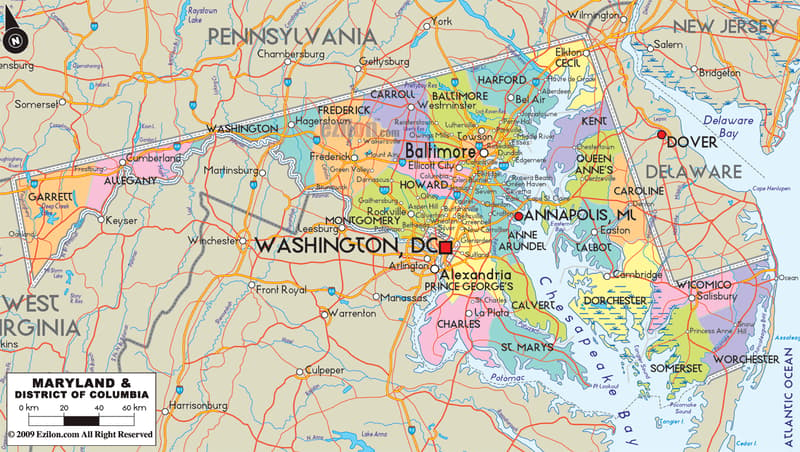
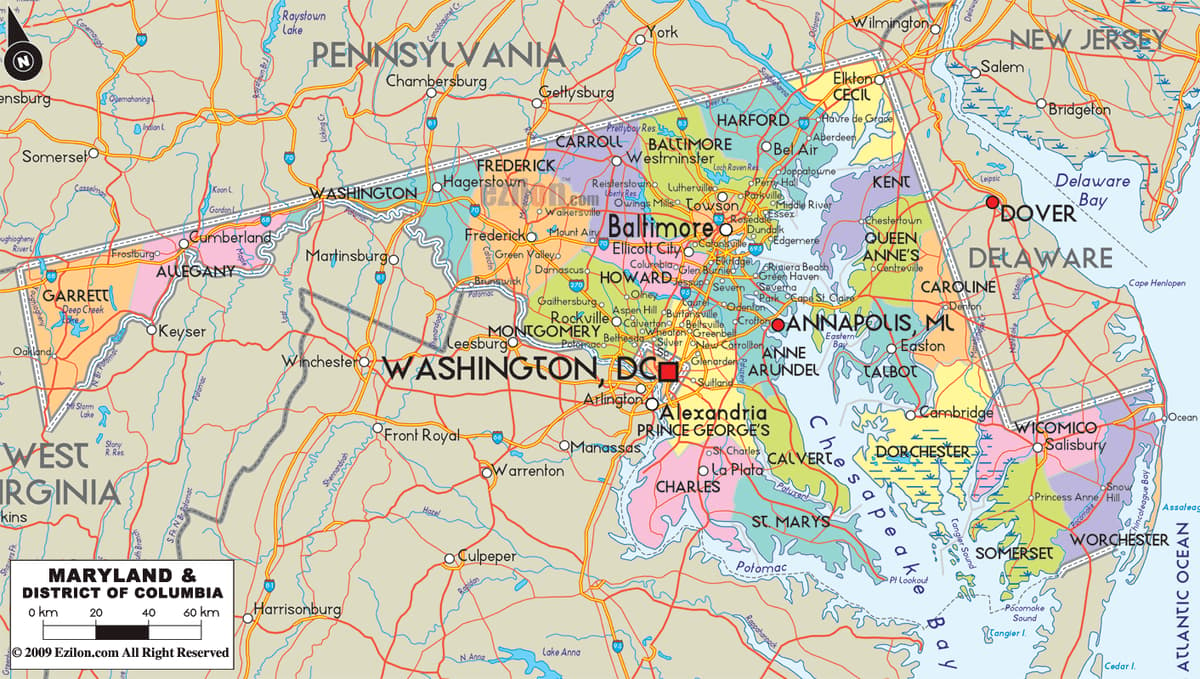
Description: Detailed large map of Maryland State, USA showing cities, towns, county formations, roads highway, US highways and State routes.
 Map of Maryland (USA). Maryland map with cities, counties, and towns. Use this detailed map to understand Maryland's full county grid, every administrative capital (county seat), the major cities and towns, bordering states and waters, and a few highway cues for orientation only. It is the best map style for residents, travelers, and geography students who want clarity without road clutter. This map of Maryland with cities and towns is built county-first, so every one of the 23 counties, plus the independent Baltimore City, is shaded on the map and labeled with its seat before anything else.
Borders and waters at a glance: Look at the map and Pennsylvania runs the entire north edge along the Mason-Dixon Line, Delaware closes off the northeast corner of the Eastern Shore, Virginia and West Virginia trace the long, winding Potomac River border to the south and west, and Washington, D.C. sits tucked in like its own enclave, wrapped by Montgomery and Prince George's counties, Maryland's DC suburbs. The Chesapeake Bay splits the state neatly down the middle into a Western Shore and an Eastern Shore, and all 23 counties plus the independent Baltimore City fall on one side or the other.
Road-light orientation: The Potomac, Susquehanna, Patuxent, and Patapsco rivers act as the main orientation lines running through the interior of the map. Light corridor cues for I-95, I-70, I-68, I-83, I-97, I-270, and I-495 help place the state's big anchors: Baltimore, an independent city on the Patapsco; the Washington, D.C. suburbs in Montgomery and Prince George's counties; and Annapolis, the state capital, on the Severn in Anne Arundel County. None of these lines are meant for turn-by-turn navigation, follow this on the map only as county-placement cues.
Start at the far southwestern tip of Western Maryland. Garrett County lists Oakland as its seat, and this is the highest, coolest corner of the state, home to Deep Creek Lake and the ski slopes around McHenry and Accident. Light I-68 threads east from here toward Allegany County, seat Cumberland, where the Potomac cuts through a water gap and Frostburg sits up on the ridge. The panhandle narrows further at Washington County, seat Hagerstown, right where light I-70 meets I-81; Hancock marks the skinniest stretch of Maryland, with Boonsboro and Sharpsburg just south near the Antietam Creek valley. These three counties border both Pennsylvania to the north and West Virginia to the south along the Potomac.
East of the mountains, the land rolls into the Piedmont. Frederick County, the largest county in the state by area, lists Frederick as its seat, where light US-15 crosses I-70; Thurmont, Middletown, and Brunswick ring the county, with Catoctin Mountain rising just to the west. Carroll County, seat Westminster, sits just east, a farm county of rolling ridges with Sykesville, Eldersburg, and Manchester marked along its edges.
South of Frederick, the map turns to the D.C. suburbs. Montgomery County, seat Rockville, carries a long string of familiar names: Bethesda, Silver Spring, Gaithersburg, Germantown, and Takoma Park, with light I-270 and I-495 curling toward Washington. East of it, Prince George's County, seat Upper Marlboro, wraps the eastern half of the Beltway and holds College Park, Greenbelt, Bowie, and Hyattsville. Between the two big Beltway counties and Baltimore sits Howard County, seat Ellicott City, home to the planned community of Columbia along light US-29. On the water, Anne Arundel County lists Annapolis, the state capital, as its seat, with Glen Burnie, Severna Park, and Odenton spread along the Severn and the Bay, and light I-97 connecting it north to Baltimore.
At the center of the map, Baltimore County, seat Towson, forms a horseshoe around the independent Baltimore City, which is not part of any county and has its own city government. The county side shows Catonsville, Owings Mills, Reisterstown, Pikesville, Dundalk, and Essex. The city side centers on the Inner Harbor and the port, with light I-95 and the I-695 Beltway ring giving bearings without crowding the harbor shoreline.
Northeast of Baltimore, Harford County, seat Bel Air, meets the Susquehanna River at its mouth, with Aberdeen and Havre de Grace marking the shoreline along light I-95. Across the river, Cecil County, seat Elkton, closes out the state's northeast corner, with Perryville and North East lining the upper Bay on the approach to the Chesapeake and Delaware Canal.
Cross the Chesapeake Bay Bridge on light US-50/301 and you are on the Eastern Shore. Kent County, seat Chestertown, sits at the top of the peninsula on the Chester River, with Rock Hall nearby. Queen Anne's County, seat Centreville, anchors the western landing of the Bay Bridge at Kent Island. Inland, Caroline County, seat Denton, is a quiet farm county between the Choptank and the Delaware line, with Ridgely and Federalsburg marked. South along light US-50, Talbot County, seat Easton, reaches into the Bay with the harbor towns of St. Michaels and Oxford.
Heading toward the southeast, marshy Dorchester County, seat Cambridge, spreads out along the Choptank with the vast Blackwater wetlands nearby. East of it, Wicomico County, seat Salisbury, is the Lower Shore's regional hub where light US-50 and US-13 cross. South of Salisbury, Somerset County, seat Princess Anne, reaches into Tangier Sound toward Crisfield. On the ocean side, in the far southeastern corner, Worcester County, seat Snow Hill, holds the resort city of Ocean City and the protected dunes of Assateague Island, with light US-50 tracing the last stretch to the coast.
South of the Beltway crescent, Charles County, seat La Plata, faces Virginia across the Potomac, with Waldorf marked along light US-301. East of the Patuxent, Calvert County, seat Prince Frederick, is a long, narrow peninsula with Solomons and Chesapeake Beach at its tips. At the point where the Potomac meets the Bay sits St. Mary's County, Maryland's oldest county, seat Leonardtown, with Lexington Park and historic St. Mary's City nearby.
A county map answers different questions than a driving map does. Residents want to know which county a town falls under, for schools, courts, or property records. Visitors mostly need a sense of where a place sits relative to the Bay, the borders, and the bigger cities. Because every county block is colored on this map and every seat is printed in a consistent symbol, the eye can answer those everyday questions fast. Which county is Columbia in? Howard. Where does Ocean City sit? Worcester, on the Atlantic. Which county holds the Naval Academy? Anne Arundel, at Annapolis. What is the seat of the state's largest county by area? Frederick, in Frederick County. Where is Cumberland relative to Hagerstown? West across Allegany from Washington County along light I-68. That is the value of a detailed map like this one for residents, commuters, and visitors alike: counties first, with just enough of a road network to anchor direction.
A handful of water features do most of the orientation work on this page. Follow the Chesapeake Bay down the middle of the map and you can see it split the state into Western Shore and Eastern Shore halves. The Potomac River forms the long southern and western boundary past Cumberland, Washington, D.C., and St. Mary's County. The Susquehanna River enters the Bay near Havre de Grace in the northeast. The Patapsco River shapes Baltimore's harbor in central Maryland, and the Patuxent River separates the Western Shore's inner counties from Calvert. Keep these five in mind and any county on the map is easy to place.
The road layer is intentionally minimal. I-95 runs the Pennsylvania line–Baltimore–Washington, D.C. corridor. I-70 runs Baltimore–Frederick–Hagerstown, ending at I-68. I-68 continues Hagerstown–Cumberland toward the West Virginia line. I-83 links Baltimore north to the Pennsylvania line, and I-97 connects Baltimore south to Annapolis. I-270 and I-495 serve the Capital Beltway crescent, and light US-50/301 carries the Bay Bridge crossing east to Ocean City. None of these are meant for turn-by-turn navigation, only as county-placement cues.
Every one of Maryland's 23 counties and its seat, plus the independent Baltimore City, in alphabetical order: Allegany County (Cumberland), Anne Arundel County (Annapolis), Baltimore City (an independent city with no county seat of its own), Baltimore County (Towson), Calvert County (Prince Frederick), Caroline County (Denton), Carroll County (Westminster), Cecil County (Elkton), Charles County (La Plata), Dorchester County (Cambridge), Frederick County (Frederick), Garrett County (Oakland), Harford County (Bel Air), Howard County (Ellicott City), Kent County (Chestertown), Montgomery County (Rockville), Prince George's County (Upper Marlboro), Queen Anne's County (Centreville), St. Mary's County (Leonardtown), Somerset County (Princess Anne), Talbot County (Easton), Washington County (Hagerstown), Wicomico County (Salisbury), and Worcester County (Snow Hill).
Maryland borders Pennsylvania along the Mason-Dixon Line to the north, Delaware at the northeast corner of the Eastern Shore, Virginia and West Virginia across the Potomac River to the south and west, and wraps around Washington, D.C. in the middle of its Beltway crescent. The state holds 23 counties plus the independent Baltimore City, which functions like a county for most purposes but answers to no county government. Frederick County is the largest by land area at about 660 square miles, while Howard County is the smallest county at about 251 square miles (Baltimore City is smaller still, at roughly 81 square miles, but it is a city, not a county). Montgomery County is the most populous, with roughly 1,074,582 residents, while Kent County is the least populous, with roughly 19,565. St. Mary's County, founded in 1637, is the oldest county in the state, the birthplace of the original Maryland colony. Maryland covers about 12,406 square miles in total, with about 9,707 square miles of land. The capital, Annapolis, sits in Anne Arundel County on the Severn River, and the state's major metros run from Baltimore through the Washington, D.C. suburbs of Montgomery and Prince George's counties. Landscape-wise, the state moves from forested mountains in Garrett and Allegany counties, through the rolling Piedmont around Frederick and Baltimore, down to the flat, tidal Coastal Plain on both shores of the Chesapeake Bay.
Maryland's ten largest cities by current population are Baltimore (about 560,812, an independent city), Columbia (about 107,315, Howard County), Frederick (about 95,108, Frederick County), Germantown (about 91,473, Montgomery County), Waldorf (about 85,954, Charles County), Silver Spring (about 84,593, Montgomery County), Ellicott City (about 75,561, Howard County), Glen Burnie (about 73,957, Anne Arundel County), Gaithersburg (about 71,290, Montgomery County), and Rockville (about 68,957, Montgomery County). Federal government and defense work anchor a large share of the state's economy: the National Security Agency at Fort Meade in Anne Arundel County, Aberdeen Proving Ground in Harford County, Joint Base Andrews in Prince George's County, and Naval Air Station Patuxent River in St. Mary's County. Montgomery County's I-270 corridor, running through Rockville and Gaithersburg, is one of the country's dense biotech clusters, anchored by the National Institutes of Health and the FDA. The Port of Baltimore remains one of the busiest on the East Coast for autos and bulk cargo, a role tied directly to the Patapsco's deep harbor. On the Eastern Shore, poultry farming and processing, centered around Salisbury in Wicomico County, is a major economic engine, alongside grain and vegetable farms across the flat Coastal Plain counties.
Maryland's identity runs straight through the Chesapeake Bay. The blue crab is practically the state's mascot, and watermen towns from Crisfield to Rock Hall still center on crab houses, oyster boats, and the seasonal rhythm of the water. Baltimore carries its own distinct culture: Fells Point and the Inner Harbor mix maritime history with a music and arts scene that produced John Waters films and the fast, percussive sound of Baltimore club music, alongside institutions like the Baltimore Museum of Art and the Preakness Stakes at Pimlico each spring. Annapolis, the colonial-era capital, is built around the U.S. Naval Academy and a compact historic district of brick rowhouses and church spires that predate the Revolution. Washington County carries a heavier, quieter history at Antietam National Battlefield near Sharpsburg, site of the Civil War's single bloodiest day. Higher education is spread widely across the counties, too, with Johns Hopkins University and the University of Maryland, Baltimore in Baltimore City, the University of Maryland's flagship campus in College Park (Prince George's County), the Naval Academy in Annapolis, Towson University in Baltimore County, and Salisbury University on the Eastern Shore.
On this map, Backbone Mountain (Garrett County) and the Potomac, Susquehanna, and Patapsco rivers double as landmarks for finding counties quickly. For elevation, terrain, watersheds, and land-cover detail, see our Physical Map of Maryland.
Maryland has a humid subtropical climate across most of the state, turning cooler and snowier in the mountains of Garrett and Allegany counties. For a full seasonal and biome breakdown, see our Physical Map of Maryland.
North-south travel runs mainly on I-95 (the Pennsylvania line through Baltimore to Washington, D.C.), I-495 (the Capital Beltway), I-270 (Bethesda to Frederick), I-83 (Baltimore to the Pennsylvania line), and I-97 (Baltimore to Annapolis). East-west travel runs on I-70 (Baltimore to Frederick to Hagerstown), continuing as I-68 (Hagerstown to Cumberland toward West Virginia), with US-50/301 carrying traffic from Washington, D.C. across the Bay Bridge to the Eastern Shore and Ocean City. Keep in mind that ZIP codes do not follow county lines in Maryland, so a single ZIP code can span two counties. Always confirm the county name directly from the map or index rather than assuming it from a ZIP prefix.
Use this as a quick index. Every line lists the county with its county seat (and a familiar city when the map labels one). Short cues mention river, border, or gentle corridor context only.
Garrett – Oakland; Deep Creek Lake and the state's highest ground. Borders Pennsylvania and West Virginia.
Allegany – Cumberland; Potomac water gap and Frostburg on the ridge. Borders Pennsylvania and West Virginia.
Washington – Hagerstown; the narrow Hancock panhandle and Antietam. Borders Pennsylvania and West Virginia.
Frederick – Frederick; the state's largest county by area, on light I-70 and US-15. Borders Pennsylvania and Virginia.
Carroll – Westminster; rolling farm ridges toward the Patapsco headwaters. Borders Pennsylvania.
Montgomery – Rockville; Bethesda, Silver Spring, and the I-270 biotech corridor. Borders Washington, D.C. and Virginia.
Prince George's – Upper Marlboro; College Park, Bowie, and Joint Base Andrews. Borders Washington, D.C. and Virginia.
Howard – Ellicott City; the planned community of Columbia at the center.
Anne Arundel – Annapolis; the state capital and the Naval Academy on the Severn.
Baltimore County – Towson; a suburban ring around Baltimore City on the I-695 Beltway.
Baltimore City – independent city, not part of any county; the Inner Harbor and Port of Baltimore.
Harford – Bel Air; Aberdeen and Havre de Grace at the Susquehanna's mouth. Borders Pennsylvania.
Cecil – Elkton; the state's northeast corner and the C&D Canal approach. Borders Pennsylvania and Delaware.
Kent – Chestertown; the state's least populous county, on the Chester River. Borders Delaware.
Queen Anne's – Centreville; Kent Island anchors the Bay Bridge landing. Borders Delaware.
Caroline – Denton; an inland farm county along the Choptank. Borders Delaware.
Talbot – Easton; St. Michaels and Oxford on Eastern Bay.
Dorchester – Cambridge; marsh country and the Blackwater refuge. Borders Delaware.
Wicomico – Salisbury; the Lower Shore's regional hub on US-50 and US-13. Borders Delaware.
Somerset – Princess Anne; Crisfield and the reach into Tangier Sound.
Worcester – Snow Hill; Ocean City and Assateague Island on the Atlantic. Borders Delaware.
Charles – La Plata; Waldorf along US-301, facing Virginia across the Potomac. Borders Virginia.
Calvert – Prince Frederick; a long, narrow peninsula between the Bay and the Patuxent.
St. Mary's – Leonardtown; Maryland's oldest county, between the Potomac and the Patuxent. Borders Virginia.
This directory aligns with what you see on the page: every county, its seat, and a one-line locator that keeps the focus on counties rather than driving steps.
Maryland has 23 counties plus the independent Baltimore City, shown together as 24 labeled areas with seats.
Annapolis, the state capital, sits in Anne Arundel County on the Severn River.
None. Baltimore is an independent city, separate from Baltimore County since 1851.
Howard County, where Columbia is a planned, unincorporated community.
Frederick County, where it is also the county seat.
From west to east: Garrett, Allegany, Washington, Frederick, Carroll, Baltimore County, Harford, and Cecil.
Cecil, Kent, Queen Anne's, Caroline, Dorchester, Wicomico, and Worcester.
Frederick, Montgomery, Prince George's, Charles, and St. Mary's, all along the Potomac River.
Garrett, Allegany, and Washington in Western Maryland.
Montgomery and Prince George's.
Light lines for I-95, I-70, I-495, I-695, I-270, I-83, I-97, I-68, and US-50/301, placed only for county-level bearings.
On the Severn River in Anne Arundel County, home to the state capital and the U.S. Naval Academy.
Worcester County, on the Atlantic barrier strand just north of Assateague Island.
Worcester County.
Garrett County.
Washington County, near Sharpsburg.
Baltimore County, where Towson is the county seat.
Wicomico County, where Salisbury is the county seat.
Dorchester County, where Cambridge is the county seat.
Washington County, where Hagerstown is the county seat.
Prince George's County.
Montgomery County.
Crossing the Bay between Anne Arundel County and Queen Anne's County.
Charles County.
Kent County, where it is the county seat.
St. Mary's County, Maryland's oldest county.
Cecil County.
Allegany County, where Cumberland is the county seat.
No. Printing or copying maps from this site is not permitted.
Frederick County, at about 660 square miles.
Howard County, at about 251 square miles among the 23 counties. Baltimore City is smaller still but is an independent city, not a county.
Montgomery County, with roughly 1,074,582 residents.
Kent County, with roughly 19,565 residents.
Baltimore, an independent city, with roughly 560,812 residents.
St. Mary's County, established in 1637.
No. ZIP codes cross county lines, so use the county boundaries and seats shown here instead.

Physical Map of Maryland
Physical map and map image of Maryland.

Regional Directory of Canada
Information and guide about Canada and website listing.

Regional Directory of United States of America
Information and guide about United States of America and websites with American topics.

Regional Directory of Europe
Information and guide about Europe and websites with European topics.

Regional Directory of Australia
Information and guide about Australia and websites with Australian topics.