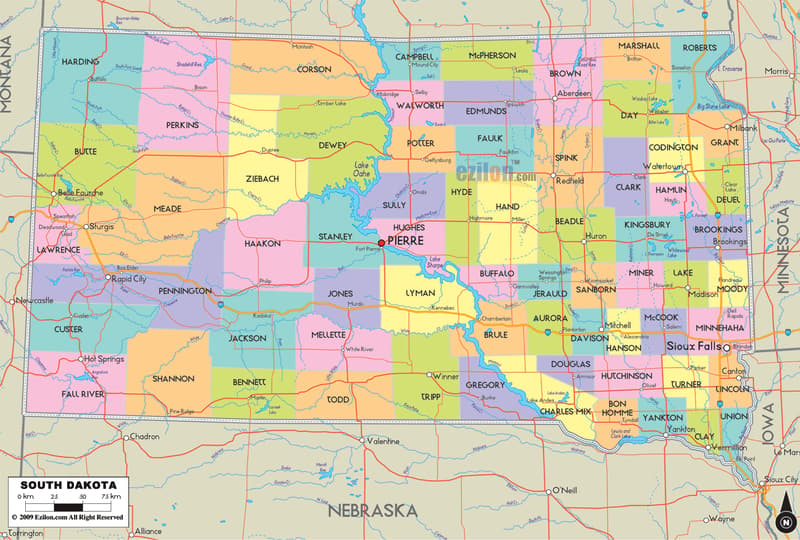
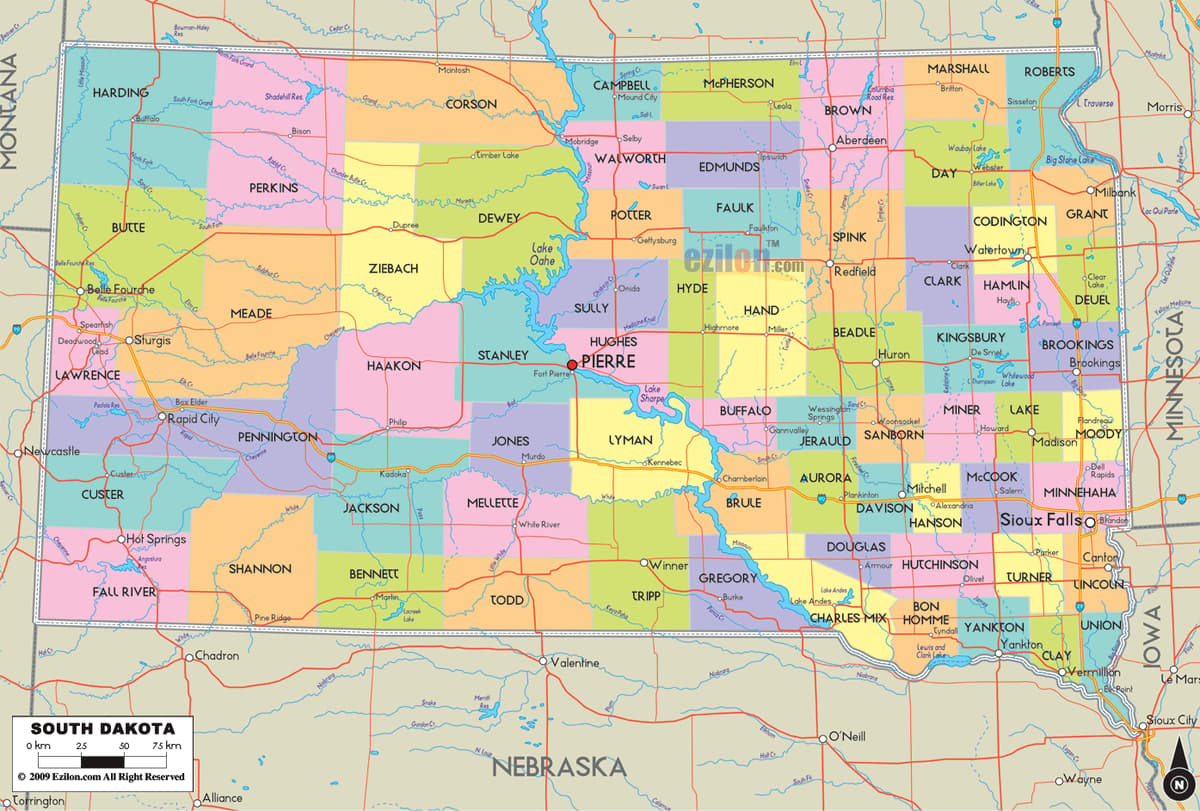
Description: Detailed large map of South Dakota State, USA showing cities, towns, county formations, roads highway, US highways and State routes.
Borders and waters at a glance: North Dakota runs the entire north edge of the state, Minnesota and Iowa sit to the east across the Big Sioux River, Nebraska lines the south across the Missouri River, and Wyoming closes out the west, along with a short stretch of Montana in the far northwest corner. Look at the map and the Missouri, Big Sioux, Cheyenne, and James rivers do most of the orientation work, threading through the interior and giving all 66 counties something natural to line up against.
Road-light orientation: The road layer stays deliberately thin here. Follow just three corridors – I-90, I-29, and US-83 – and you can place the big anchors the map marks clearly: Sioux Falls in Minnehaha County, Rapid City in Pennington County, Aberdeen in Brown County, and the state capital, Pierre, in Hughes County on the Missouri River.
Start at the far northwest corner. Harding County lists Buffalo as the seat, open ranch country reaching toward Camp Crook near the Montana line beyond the map's frame, this is the only South Dakota county that touches Montana. East of it, Perkins County shows Bison as the seat with Lemmon on the state line and Prairie City nearby. Corson County, seat McIntosh, follows the Standing Rock Reservation and the Missouri's upper arm past McLaughlin. Campbell County lists Mound City as the seat, a small river county near Herreid. McPherson County shows Leola as the seat with Eureka and Wetonka close by. Brown County, seat Aberdeen, is the major hub of the northeast interior, with Groton, Warner, and Hecla nearby and the James River crossing north to south. Marshall County lists Britton as the seat along the North Dakota line near Lake City. Roberts County, seat Sisseton, sits in the extreme northeast corner on the Minnesota and North Dakota lines, marked by Big Stone Lake, Lake Traverse, and the Coteau lake country.
Moving into West River country, Butte County lists Belle Fourche as the seat where several rivers meet, with Newell nearby and the county touching both Wyoming and Montana. Lawrence County, seat Deadwood, is the historic hills county with Lead and Spearfish clustered along the northern Black Hills canyons against the Wyoming line. Meade County, seat Sturgis, is huge in area, stretching from Black Hills foothills near Ellsworth Air Force Base east into open prairie toward Faith. Pennington County lists Rapid City as the seat, a large west-central county spanning the city itself, the Badlands margins, and Mount Rushmore's approaches, with Wall, Box Elder, and Hill City dotting the map. Custer County, seat Custer, is a Black Hills core county south of Pennington with Custer State Park and Keystone. Fall River County lists Hot Springs as the seat at the southwest corner on the Nebraska line, with Edgemont nearby. Oglala Lakota County (shown on older maps as Shannon County) has no county seat of its own; administrative services are handled from Hot Springs, and the county sits between Bennett and Fall River covering the Pine Ridge communities. Jackson County, seat Kadoka, runs from Badlands benches near Interior east into the White River valley. Bennett County lists Martin as the seat, a rectangle on the Nebraska line between Jackson and Todd counties.
Todd County has no county seat of its own; its administrative offices are in Winner, over in Tripp County, and the map shows Mission and Rosebud as its main communities. Mellette County, seat White River, sits north of Todd with Wood and the broad White River valley crossing toward Jones and Lyman counties. Tripp County lists Winner as the seat, a bold label along the central southern tier with Colome toward Gregory County. Gregory County, seat Burke, has Missouri River bluffs and a jagged east edge near Bonesteel and Herrick. Charles Mix County lists Lake Andes as the seat, west of Yankton with Wagner, Pickstown near Fort Randall Dam, and the long reach of Lake Francis Case. Bon Homme County, seat Tyndall, sits north of the Missouri on the Nebraska line with Springfield and Tabor. Yankton County lists Yankton as the seat at the James River's mouth where it meets the Missouri, an early territorial capital with bridges into Nebraska. Clay County, seat Vermillion, is home to the University of South Dakota, with the Missouri's sharp bend forming the south border. Union County lists Elk Point as the seat at the state's southeastern tip, where the Missouri and Big Sioux rivers converge near Dakota Dunes and the Iowa line.
Stanley County lists Fort Pierre as the seat on the west bank opposite the capital, between Lake Oahe and Lake Sharpe. Hughes County, seat Pierre, sits in the center of the state below the Oahe dam with Blunt to the east, and Pierre is South Dakota's state capital. Sully County lists Onida as the seat north of Pierre between the Oahe shoreline and wheat country, along the road to Gettysburg. Potter County, seat Gettysburg, sits north of Sully with Hoven and Lebanon inland. Walworth County lists Selby as the seat and includes Mobridge at the river bridge where Corson meets Campbell and Dewey counties. Dewey County, seat Timber Lake, runs along the Cheyenne River Reservation on the west bank of the Missouri. Ziebach County lists Dupree as the seat, one of the most rural counties in the state, west of Dewey and north of Haakon. Haakon County, seat Philip, straddles the Cheyenne River west of Jones. Jones County lists Murdo as the seat, a small central rectangle along I-90 between Lyman and Stanley. Lyman County, seat Kennebec, has Missouri River shores with Oacoma opposite Chamberlain and Presho inland. Buffalo County lists Gann Valley as the seat, one of the least populated counties, on the east bank of the river between Hughes and Brule. Brule County, seat Chamberlain, is a major river crossing tied to Kimball by the bluffs of Lake Francis Case. Aurora County lists Plankinton as the seat, east of Brule with Stickney and farm grid roads toward Davison. Davison County, seat Mitchell, is a bold regional center north of Hanson and Charles Mix. Hanson County lists Alexandria as the seat, a compact square bridging Mitchell and Salem in McCook County. Douglas County, seat Armour, sits south of Aurora and Davison near Bridgewater. Hutchinson County lists Olivet as the seat, touching Yankton and Bon Homme, with Parkston, Menno, and Tripp County towns nearby.
Edmunds County lists Ipswich as the seat, west of Brown County with Bowdle and Roscoe. Faulk County, seat Faulkton, sits south of Edmunds with Orient and prairie pothole lakes. Spink County lists Redfield as the seat between Huron and Aberdeen, with Frankfort and Doland. Clark County, seat Clark, is a lakes region county west of Codington and Hamlin. Day County lists Webster as the seat, dotted with lakes like Waubay and Bitter Lake, bordering Marshall and Roberts. Codington County, seat Watertown, is a major northeast hub on the Big Sioux River with Florence and Henry nearby. Hamlin County lists Hayti as the seat between Codington and Deuel, with Estelline near the county edge. Deuel County, seat Clear Lake, touches Minnesota at Gary and Lake Cochrane. Grant County lists Milbank as the seat on the Minnesota line north of Deuel, near Big Stone Lake.
Beadle County lists Huron as the seat, an easy label at the James River crossing, with Wessington shown to the northwest. Hand County, seat Miller, sits south of Faulk with a neat grid of townships like Ree Heights. Hyde County lists Highmore as the seat on open prairie between the James and Missouri valleys. Sanborn County, seat Woonsocket, is south of Beadle with Letcher and lakes toward Jerauld. Jerauld County lists Wessington Springs as the seat, small and scenic west of Sanborn, north of Aurora. Miner County, seat Howard, sits east of Sanborn and west of Lake County, a compact square on the valley floor. McCook County lists Salem as the seat, directly west of Minnehaha, connecting the James valley to the Sioux Falls metro.
Brookings County lists Brookings as the seat, a university town anchoring the I-29 corridor with Volga, Aurora, and Elkton nearby. Kingsbury County, seat De Smet, has prairie lakes and homestead country west of Brookings with Arlington and Lake Preston. Lake County lists Madison as the seat, between Kingsbury, Miner, and Moody, on lakes just north of Sioux Falls. Moody County, seat Flandreau, sits on the Minnesota line north of Minnehaha with Egan and Colman. Minnehaha County lists Sioux Falls as the seat, the state's largest city, sitting along I-29 and the Big Sioux River with Brandon, Hartford, Dell Rapids, and Tea clustered around it. Lincoln County, seat Canton, lies directly south of Minnehaha and includes the fast-growing suburbs of Harrisburg and Lennox, with the Big Sioux shaping the Iowa border. Turner County lists Parker as the seat, west of Lincoln with Marion and Centerville leading toward Hutchinson and Clay counties.
Four waterways do most of the orientation work on this page. The Missouri River cuts north to south through the center, backing up into Lake Oahe above Pierre and Lake Sharpe below it before continuing past Chamberlain and Yankton. The Big Sioux River traces the Minnesota and Iowa edges through Watertown, Brookings, Flandreau, and Sioux Falls. The Cheyenne River carves a broad valley across the middle of West River country, and the James River runs north to south through the eastern interior past Aberdeen, Huron, and Yankton. Keep these four in mind and any county on the map is easy to place.
The road layer is intentionally minimal. I-90 runs east-west across the entire state near Spearfish, Rapid City, Wall, Murdo, Mitchell, and Sioux Falls. I-29 runs north-south along the Minnesota and Iowa line through Watertown, Brookings, and Sioux Falls. US-83 threads down the middle of the state through Pierre and Mission. None of these are meant for turn-by-turn navigation, only as county-placement cues.
Every one of South Dakota's 66 counties and its seat, in alphabetical order: Aurora County (Plankinton), Beadle County (Huron), Bennett County (Martin), Bon Homme County (Tyndall), Brookings County (Brookings), Brown County (Aberdeen), Brule County (Chamberlain), Buffalo County (Gann Valley), Butte County (Belle Fourche), Campbell County (Mound City), Charles Mix County (Lake Andes), Clark County (Clark), Clay County (Vermillion), Codington County (Watertown), Corson County (McIntosh), Custer County (Custer), Davison County (Mitchell), Day County (Webster), Deuel County (Clear Lake), Dewey County (Timber Lake), Douglas County (Armour), Edmunds County (Ipswich), Fall River County (Hot Springs), Faulk County (Faulkton), Grant County (Milbank), Gregory County (Burke), Haakon County (Philip), Hamlin County (Hayti), Hand County (Miller), Hanson County (Alexandria), Harding County (Buffalo), Hughes County (Pierre), Hutchinson County (Olivet), Hyde County (Highmore), Jackson County (Kadoka), Jerauld County (Wessington Springs), Jones County (Murdo), Kingsbury County (De Smet), Lake County (Madison), Lawrence County (Deadwood), Lincoln County (Canton), Lyman County (Kennebec), Marshall County (Britton), McCook County (Salem), McPherson County (Leola), Meade County (Sturgis), Mellette County (White River), Miner County (Howard), Minnehaha County (Sioux Falls), Moody County (Flandreau), Oglala Lakota County (administered from Hot Springs), Pennington County (Rapid City), Perkins County (Bison), Potter County (Gettysburg), Roberts County (Sisseton), Sanborn County (Woonsocket), Spink County (Redfield), Stanley County (Fort Pierre), Sully County (Onida), Todd County (administered from Winner), Tripp County (Winner), Turner County (Parker), Union County (Elk Point), Walworth County (Selby), Yankton County (Yankton), and Ziebach County (Dupree).
South Dakota borders North Dakota along its entire north edge, Minnesota and Iowa to the east across the Big Sioux River, Nebraska to the south across the Missouri River, and Wyoming with a short stretch of Montana to the west. The state holds 66 counties. Meade County is the largest by land area at about 3,471 square miles, while Clay County is the smallest at about 412 square miles. Minnehaha County, home to Sioux Falls, is the most populous at roughly 208,600 residents, while Jones County is the least populous with roughly 900 residents. Bon Homme, Brookings, Charles Mix, Clay, Hutchinson, Union, and Yankton counties share the title of oldest county, all organized in 1862 during the Dakota Territory era. South Dakota covers about 77,116 square miles in total, with roughly 75,811 square miles of land. The capital, Pierre, sits in Hughes County on the Missouri River, and the state's major population centers run from Sioux Falls and Brookings in the east through Mitchell and Pierre in the middle to Rapid City and the Black Hills towns in the west. Landscape-wise, the state splits cleanly along the Missouri River, with rolling farmland and glacial lakes to the east, and drier ranch country, the Badlands, and the Black Hills uplift to the west.
South Dakota's ten largest cities by current population are Sioux Falls (about 209,000, Minnehaha County), Rapid City (about 79,900, Pennington County), Aberdeen (about 27,900, Brown County), Brookings (about 24,500, Brookings County), Watertown (about 23,500, Codington County), Yankton (about 15,700, Yankton County), Mitchell (about 15,700, Davison County), Huron (about 14,300, Beadle County), Pierre (about 14,100, Hughes County), and Spearfish (about 12,200, Lawrence County). Sioux Falls anchors banking and healthcare, home to major card-services and financial operations along with Sanford Health and Avera Health systems, and it has been one of the fastest-growing metro areas in the Midwest for years. Rapid City serves as the gateway to the Black Hills and Mount Rushmore, with Ellsworth Air Force Base in neighboring Meade County adding a steady federal presence. Brookings is built around South Dakota State University and agricultural research, while agriculture itself still runs through the state's identity everywhere east of the Missouri, with corn, soybeans, wheat, and cattle dominating the land use. West River counties lean toward cattle ranching and tourism tied to the Black Hills, Badlands National Park, and the annual Sturgis motorcycle rally in Meade County. With no coastline, the state's commerce moves by rail, interstate, and the Missouri River's reservoir system rather than by seaport.
South Dakota's cultural identity centers on the Black Hills and the wide-open plains that surround them. Mount Rushmore National Memorial near Keystone in Custer County draws visitors from across the country, and the granite peaks and pine forests around it anchor a tourism economy that also includes Custer State Park, Badlands National Park near Wall and Interior, and the old mining town of Deadwood in Lawrence County. Agricultural heritage runs deep across the eastern counties, celebrated each year at county fairs and the Corn Palace in Mitchell, a landmark decorated annually with crop art. The state is home to several federally recognized tribal nations, a defining part of South Dakota's heritage and present-day community life across the western and south-central counties. Higher education is spread across the map too, with the University of South Dakota in Vermillion (Clay County), South Dakota State University in Brookings, Black Hills State University in Spearfish (Lawrence County), and the South Dakota School of Mines and Technology in Rapid City.
On this map, Black Elk Peak (Black Hills, Pennington County) and the Missouri, Big Sioux, and Cheyenne rivers double as landmarks for finding counties quickly. For elevation, terrain, watersheds, and land-cover detail, see our Physical Map of South Dakota.
South Dakota has a continental climate with cold winters and warm summers, drier and windier in the west than in the more humid eastern plains. For a full seasonal and biome breakdown, see our Physical Map of South Dakota.
East-west travel runs almost entirely on I-90, which crosses the full width of the state from Spearfish and Rapid City through Wall, Murdo, and Mitchell to Sioux Falls. North-south travel on the east side runs on I-29, linking Sioux Falls, Brookings, and Watertown up to the Minnesota and North Dakota lines, while US-83 serves as the lighter central spine through Pierre and Mission. Keep in mind that ZIP codes do not follow county lines in South Dakota, so a single ZIP code can span two counties. Always confirm the county name directly from the map or index rather than assuming it from a ZIP prefix.
Use this as a quick index. Every line lists the county with its county seat (or administrative center where the county has none). Short cues mention river, border, or gentle corridor context only.
Harding – Buffalo; only South Dakota county touching Montana.
Perkins – Bison, on the North Dakota line.
Corson – McIntosh; Standing Rock Reservation.
Campbell – Mound City, on the Missouri's upper arm.
McPherson – Leola, on the North Dakota line.
Brown – Aberdeen; northeast interior hub.
Marshall – Britton, near the lake chains.
Roberts – Sisseton; Big Stone Lake and the Coteau.
Butte – Belle Fourche, at the edge of the Black Hills.
Lawrence – Deadwood; Lead and Spearfish nearby.
Meade – Sturgis; Ellsworth Air Force Base.
Pennington – Rapid City; Badlands and Mount Rushmore approaches.
Custer – Custer; Custer State Park.
Fall River – Hot Springs, at the southwest corner.
Oglala Lakota – administered from Hot Springs; Pine Ridge communities.
Jackson – Kadoka; Badlands benches near Interior.
Bennett – Martin, on the Nebraska line.
Todd – administered from Winner; Mission and Rosebud.
Mellette – White River, north of Todd.
Tripp – Winner, on the Nebraska line.
Gregory – Burke; Missouri River bluffs.
Charles Mix – Lake Andes; Fort Randall Dam nearby.
Bon Homme – Tyndall, on the Nebraska line.
Yankton – Yankton; James and Missouri confluence.
Clay – Vermillion; University of South Dakota.
Union – Elk Point; tri-state Missouri and Big Sioux confluence.
Stanley – Fort Pierre, opposite the capital.
Hughes – Pierre; South Dakota's capital.
Sully – Onida, north of Pierre.
Potter – Gettysburg, on the Oahe arm.
Walworth – Selby; Mobridge river bridge.
Dewey – Timber Lake; Cheyenne River Reservation.
Ziebach – Dupree; one of the most rural counties.
Haakon – Philip, on the Cheyenne River.
Jones – Murdo, on the I-90 corridor.
Lyman – Kennebec; Oacoma opposite Chamberlain.
Buffalo – Gann Valley; one of the least populated counties.
Brule – Chamberlain; major Missouri River crossing.
Aurora – Plankinton, east of Brule.
Davison – Mitchell; regional center.
Hanson – Alexandria, between Mitchell and Salem.
Douglas – Armour, south of Aurora and Davison.
Hutchinson – Olivet; touches Yankton and Bon Homme.
Edmunds – Ipswich, west of Brown.
Faulk – Faulkton; prairie pothole lakes.
Spink – Redfield, between Huron and Aberdeen.
Clark – Clark; lakes region county.
Day – Webster; Waubay and Bitter Lake.
Codington – Watertown; Big Sioux River hub.
Hamlin – Hayti, between Codington and Deuel.
Deuel – Clear Lake, on the Minnesota line.
Grant – Milbank; near Big Stone Lake.
Beadle – Huron; James River crossing.
Hand – Miller, south of Faulk.
Hyde – Highmore; James-Missouri divide.
Sanborn – Woonsocket, south of Beadle.
Jerauld – Wessington Springs, west of Sanborn.
Miner – Howard, west of Lake County.
McCook – Salem; leads to the Sioux Falls metro.
Brookings – Brookings; South Dakota State University.
Kingsbury – De Smet; prairie lakes country.
Lake – Madison, north of Sioux Falls.
Moody – Flandreau, on the Minnesota line.
Minnehaha – Sioux Falls; the state's largest city.
Lincoln – Canton; fast-growing suburbs south of Sioux Falls.
Turner – Parker, west of Lincoln.
This directory aligns with what you see on the map: every county, its seat, and a one-line locator that keeps the focus on counties rather than driving steps.
Sixty-six, each shaded with a labeled county seat.
Pierre, in Hughes County, on the Missouri River below Lake Oahe.
Minnehaha County.
Pennington County.
Brown County.
Harding, Perkins, Corson, Campbell, McPherson, Brown, Marshall and Roberts.
Roberts, Grant, Deuel, Brookings, Moody, Minnehaha and Lincoln.
Union, Lincoln and Minnehaha along the Big Sioux River.
Fall River, Oglala Lakota, Bennett, Todd, Tripp, Gregory, Charles Mix, Bon Homme, Yankton, Clay and Union.
Butte, Meade, Pennington, Custer and Fall River.
Harding County, at the state's northwest corner.
I-90 east-west across the state, I-29 north-south along Minnesota and Iowa, and US-83 down the middle. Counties remain the focus.
In Lawrence County in the northern Black Hills.
In Meade County near Ellsworth Air Force Base.
In Custer County, seat of the same name, near Custer State Park.
In Fall River County at the state's southwest corner.
In Brule County at the Missouri River crossing.
In Clay County, home to the University of South Dakota.
In Codington County on the Big Sioux River.
In Brookings County on the I-29 corridor.
In Davison County.
In Beadle County at the James River crossing.
Pierre sits in Hughes County on the east bank; Fort Pierre is across the river in Stanley County.
The county has no county seat of its own; administrative services are handled in Hot Springs, Fall River County.
Stanley, Hughes, Sully, Potter, Walworth, Lyman, Buffalo, Brule and Jones.
Roberts, Codington, Hamlin, Deuel, Brookings, Moody, Minnehaha, Lincoln and Union.
North of Pierre along the Missouri, bordered by Sully, Potter, Walworth and Corson counties.
South of Pierre past Fort Pierre, Lyman and Brule counties.
No. Printing or copying maps from this site is not permitted.
Meade County, at about 3,471 square miles.
Clay County, at about 412 square miles.
Minnehaha County, home to Sioux Falls, with roughly 208,600 residents.
Jones County, with roughly 900 residents.
Sioux Falls, in Minnehaha County, with about 209,000 residents.
Bon Homme, Brookings, Charles Mix, Clay, Hutchinson, Union and Yankton counties share the title, all organized in 1862 during the Dakota Territory era.
No. ZIP codes cross county lines, so use the county boundaries and seats shown here instead.
Look for the county name in bold shading, then the county seat label inside the boundary.
Use the Missouri River as the dividing line, then read seats from Rapid City and Sturgis in the west to Sioux Falls, Brookings and Watertown in the east.

Physical Map of South Dakota
Physical map and map image of South Dakota.

Regional Directory of Canada
Information and guide about Canada and website listing.

Regional Directory of United States of America
Information and guide about United States of America and websites with American topics.

Regional Directory of Europe
Information and guide about Europe and websites with European topics.

Regional Directory of Australia
Information and guide about Australia and websites with Australian topics.